
The relentless advancement of industrial technology continuously demands higher performance from mechanical transmission systems. Requirements for greater precision, higher load capacity, longer service life, and more compact designs have exposed the limitations of traditional mechanisms like ball screws. In this context, the planetary roller screw (PRS) mechanism has emerged as a superior solution for converting rotary motion to linear motion (or vice-versa) with exceptional efficiency and robustness. Among its various configurations, the Bearing-Type Planetary Roller Screw represents a specialized and highly performant derivative. This article delves into the working principle, kinematic relationships, and dynamic contact force analysis of this specific mechanism, providing a comprehensive foundation for its design and optimization.
At its core, a planetary roller screw mechanism operates on a fascinating synergy between threaded engagement and epicyclic (planetary) gearing. It typically consists of three main components: a central threaded screw, a set of threaded rollers distributed around the screw, and an internally threaded nut that encloses the rollers. The rollers mesh simultaneously with the screw and the nut. As the screw rotates, it drives the rollers, which in turn walk along the nut’s threads. Crucially, a gear ring (often integral to the nut or a separate component) prevents the rollers from rotating about their own axes relative to the nut, forcing them to revolve around the screw axis like planets around a sun. This compound motion results in the linear displacement of the nut relative to the screw.
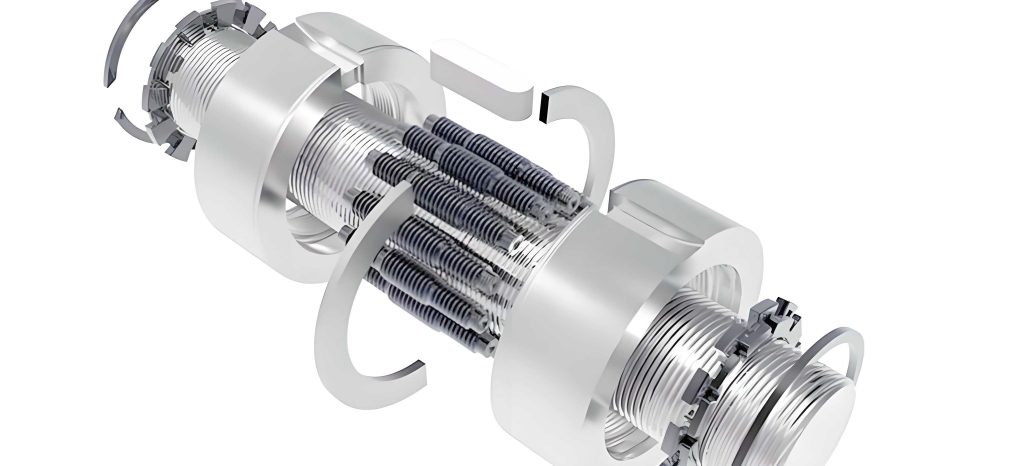
The advantages of the standard planetary roller screw over a ball screw are profound. The line contact (as opposed to point contact in ball screws) between the threads significantly increases the contact area. This leads to a much higher load capacity, greater stiffness, and improved fatigue life. Furthermore, the multi-roller design inherently distributes the load, enhancing reliability and allowing for more compact assemblies for a given force output. These characteristics make planetary roller screw mechanisms indispensable in high-demand applications such as aerospace actuation (e.g., flight control surfaces, landing gear), robotics, injection molding machines, and heavy industrial automation.
Variants of Planetary Roller Screw Mechanisms
The basic principle of the planetary roller screw gives rise to several architectural variants, each tailored for specific performance needs. Understanding these variants is key to appreciating the unique position of the bearing-type design.
| Variant Type | Key Structural Feature | Primary Advantage | Typical Challenge |
|---|---|---|---|
| Standard (Inverted) | Rollers have threads; Nut has a gear ring. | Well-balanced performance, common design. | Precision manufacturing of small roller threads. |
| Recirculating | Rollers are axially long and recirculate within the nut like in a ball screw. | Virtually unlimited travel length. | Complex nut internal geometry and guidance system. |
| Differential / Two-Stage | Uses two sets of rollers with different leads to achieve very fine motion. | Extremely high resolution and reduction ratio. | Increased complexity and potential for error accumulation. |
| Bearing-Type | Rollers and nut feature ring grooves (not threads); Uses integral bearing races. | Very high axial load capacity, low friction, high rigidity. | Design complexity in integrating bearing functions. |
The Bearing-Type Planetary Roller Screw (BPRS) distinguishes itself by modifying the engagement geometry. In this design, the threads on both the rollers and the nut are replaced with precision ring grooves. The screw remains threaded. The roller’s ring groove often has a spherical profile, which helps maintain alignment. Most significantly, the “nut” assembly is not a single part but a sophisticated sub-assembly that incorporates thrust roller bearings. This integration is the source of its exceptional performance in high-load, high-stiffness applications, as it directly manages the substantial axial forces and minimizes parasitic friction.
Structural Composition and Working Principle of the Bearing-Type PRS
The Bearing-Type Planetary Roller Screw is a masterpiece of integrated mechanical design. Its components and their functions are as follows:
- Screw: A multi-start threaded shaft with a standard triangular thread profile (e.g., 60°). It is the primary input/output element for rotary motion.
- Rollers: Multiple cylindrical elements placed around the screw. Their outer surface contains a series of ring grooves (spherical profile) instead of helical threads. They act as the “planets.”
- Bearing Ring (Functional Nut): This is the core of the “nut” assembly. It is an annular ring with internal ring grooves that mesh with the grooves on the rollers. It directly receives the axial load from the rollers.
- Thrust Cylindrical Roller Bearings: Located at one or both axial ends of the bearing ring. The bearing ring rotates within these bearings. Their primary function is to support the enormous axial thrust load from the bearing ring and convert sliding friction into much lower rolling friction.
- Threaded Carrier (Retainer): A ring with internal threads that engages with the screw. Its primary function is to maintain the circumferential position and phasing of the rollers, ensuring they are evenly spaced and preventing them from skewing. It effectively replaces the function of the gear ring in a standard planetary roller screw.
- Housing & End Caps: The structural enclosure that holds the thrust bearings, the bearing ring, and aligns the entire assembly.
The force transmission path is elegantly direct: Screw → Rollers (via thread-groove contact) → Bearing Ring (via groove-groove contact) → Thrust Roller Bearings → End Caps/Housing. The threaded carrier reacts against the screw to provide the necessary kinematic constraint for the rollers’ planetary motion.
Kinematic Analysis and Motion Relationships
Establishing the precise kinematic relationships is fundamental for designing and analyzing the Bearing-Type Planetary Roller Screw. We define the following parameters:
- $d_s$, $d_r$, $d_n$: Pitch diameters of the screw, roller, and nut (bearing ring groove pitch circle), respectively.
- $p_s$, $p_r$: Lead of the screw and roller. For the BPRS, $p_r = 0$ because the roller has ring grooves, not a helix.
- $n$: Number of starts (threads) on the screw.
- $d_c$: Pitch diameter for the roller’s revolution (carrier diameter).
- $\omega_s$, $\omega_r$, $\omega_c$: Angular velocity of the screw, the roller about its own axis (spin), and the roller assembly about the screw axis (revolution, i.e., carrier speed), respectively.
- $v_n$: Linear velocity of the nut assembly (housing/end cap).
The kinematics can be derived by considering the mechanism as an epicyclic gear train. The threaded carrier, moving with angular velocity $\omega_c$, acts as the arm (carrier) of the planetary system. The screw (sun gear) and the bearing ring (ring gear, which we initially assume is prevented from rotating) are the central gears.
The transmission ratio between the screw (s) and roller (r) relative to the carrier (c) is:
$$ i_{sr}^c = \frac{\omega_s – \omega_c}{\omega_r – \omega_c} = -\frac{d_r}{d_s} $$
The negative sign indicates opposite directions of rotation for the screw and roller relative to the carrier when they are external gears.
Rearranging to solve for the roller spin speed:
$$ \omega_r = \left[ \left( \frac{d_s}{d_r} + 1 \right) \omega_c – \frac{d_s}{d_r} \omega_s \right] $$
The relationship between the screw speed and carrier speed can be found from the geometry of the threaded carrier engaging the screw. Considering the velocity at the pitch point, we can derive:
$$ \omega_c = \frac{d_s}{2 d_c} \omega_s $$
Finally, the axial displacement of the nut is derived from the relative motion between the components. The fundamental kinematic equation for axial travel $L$ in a general planetary roller screw is:
$$ L = \left( \frac{\omega_r}{2\pi} p_r \pm \frac{\omega_c}{2\pi} n p_s \pm \frac{\omega_s}{2\pi} n p_s \right) t $$
where $t$ is time, and the $\pm$ signs depend on the hand of helices and direction of rotation. For the BPRS, since $p_r = 0$ and the nut (housing) is prevented from rotating ($\omega_n=0$), the equation simplifies. The axial velocity $v_n$ of the nut assembly becomes:
$$ v_n = \pm \frac{\omega_s}{2\pi} n p_s \mp \frac{\omega_c}{2\pi} n p_s $$
Substituting the expression for $\omega_c$:
$$ v_n = \frac{n p_s}{2\pi} \left( \omega_s – \frac{d_s}{2 d_c} \omega_s \right) = \frac{n p_s \omega_s}{2\pi} \left(1 – \frac{d_s}{2 d_c}\right) $$
This formula provides the theoretical conversion between rotary input ($\omega_s$) and linear output ($v_n$).
Static Force Analysis and Contact Forces
Understanding the internal load distribution is critical for assessing the life, stiffness, and efficiency of the Bearing-Type Planetary Roller Screw. Under an external axial load $F_a$ applied to the nut housing, this load is shared among the $N$ rollers. Each roller experiences contact forces at two key interfaces: the screw-roller interface and the roller-bearing ring interface.
The contact force at each interface can be resolved into components. At the screw-roller contact point (which has a thread helix angle $\lambda$ and thread profile half-angle $\tau$), the normal force $F_{ns}$ has three components:
- Axial component $F_{as}$ (contributes to carrying the load).
- Radial component $F_{rs} = F_{as} \tan \tau$.
- Tangential (circumferential) component $F_{ts} = F_{as} \tan \lambda$.
Thus, the normal contact force magnitude is:
$$ F_{ns} = F_{as} \sqrt{1 + \tan^2 \lambda + \tan^2 \tau} $$
At the roller-bearing ring contact (groove-groove, with no effective helix angle but a profile angle $\tau$), the normal force $F_{nr}$ has:
- Axial component $F_{ar}$.
- Radial component $F_{rr} = F_{ar} \tan \tau$.
Thus:
$$ F_{nr} = F_{ar} \sqrt{1 + \tan^2 \tau} $$
For static equilibrium of a single roller in the axial direction, assuming the threaded carrier does not carry axial load, the axial components from both contacts must balance for that roller’s share of the load. However, the total external axial load $F_a$ is balanced by the sum of the axial components $F_{ar}$ from all rollers acting on the bearing ring:
$$ \sum_{i=1}^{N} F_{ar}^{(i)} = F_a $$
If the load is perfectly distributed, $F_{ar} = F_a / N$ for each roller. The screw-side axial component $F_{as}$ per roller will be similar but not necessarily identical due to the influence of the threaded carrier’s constraint and friction. The relationship between $F_{ar}$ and $F_{as}$ for a roller is influenced by the friction and the forces at the roller-carrier contact points.
Dynamic Simulation and Contact Force Behavior
While theoretical analysis provides essential formulas, dynamic simulation using multi-body dynamics (MBD) software offers deep insight into the transient behavior, load sharing unevenness, and the impact of operational parameters. A dynamic model of a Bearing-Type Planetary Roller Screw can be constructed with the following steps:
- Model Definition: Import 3D CAD geometry of all components. Define material properties (e.g., bearing steel for density, stiffness).
- Joint Creation: Apply kinematic joints: Revolute joint for the screw base; Cylindrical joint for the threaded carrier (allowing rotation and translation); Revolute joints between rollers and carrier; Fixed joints for housing parts; and appropriate joints for bearing elements (e.g., revolute for rollers within bearings).
- Contact Force Application: Define contact forces between critical pairs using a compliant contact model (e.g., Impact function in ADAMS):
- Screw thread ↔ Roller groove
- Roller groove ↔ Bearing Ring groove
- Threaded Carrier thread ↔ Screw thread
- Bearing rollers ↔ Bearing races
The contact force model often uses a spring-damper formulation: $$ F_{contact} = \max(0, K(q_0 – q)^e – C \cdot \dot{q} \cdot STEP(q, q_0-d, 1, q_0, 0)) $$ where $K$ is stiffness, $q$ is penetration, $e$ is force exponent, $C$ is damping, and $d$ defines the penetration for full damping.
- Friction Modeling: Apply Coulomb friction at contact points with static ($\mu_s$) and dynamic ($\mu_d$) coefficients.
- Drives and Loads: Apply a rotational motion drive to the screw. Apply an external axial force (load) to the nut housing.
A simulation with a constant screw speed will yield time-history data for velocities, displacements, and contact forces. Comparing the simulated average nut speed $v_n’$ with the theoretical $v_n$ validates the model. A typical result might show a very close agreement, with a minor error (e.g., 0.1-2%) due to simplifications in the theoretical model (like ignoring bearing ring rotation).
The simulation powerfully reveals how contact forces evolve with external load. The following trends are consistently observed for the Bearing-Type Planetary Roller Screw:
- Load Dependence: The magnitudes of the contact forces at both the screw-roller ($F_{ns}$) and roller-bearing ring ($F_{nr}$) interfaces increase linearly with the applied external axial load $F_a$.
- Force Asymmetry: For a given external load, the contact force on the roller-bearing ring (nut side) side is consistently larger than the contact force on the screw-roller side. This is a critical characteristic of the BPRS design.
- Carrier Load: The force between the threaded carrier and the screw is not negligible. It increases with the external load and plays a crucial role in the force balance on the rollers. This carrier force is the reason for the asymmetry mentioned above; it relieves some of the load on the screw-roller contact.
The following table summarizes typical simulation outcomes for contact forces under varying loads, assuming a perfectly distributed load model is approximated but not fully achieved due to system dynamics and imperfections.
| External Axial Load $F_a$ (kN) | Avg. Roller-Bearing Ring Force $F_{nr}$ (N) | Avg. Screw-Roller Force $F_{ns}$ (N) | Avg. Carrier-Screw Force (N) | Observation |
|---|---|---|---|---|
| 40 | ~3,330 | ~3,280 | ~330 | $F_{nr} > F_{ns}$; Carrier force is ~5% of roller load. |
| 70 | ~5,820 | ~5,530 | ~1,715 | Difference between $F_{nr}$ and $F_{ns}$ increases. |
| 100 | ~8,330 | ~7,760 | ~3,610 | Carrier force becomes significant (~22% of screw-roller force). |
Design Considerations and Performance Optimization
The analysis of motion and contact forces directly informs the design optimization of the Bearing-Type Planetary Roller Screw. Key considerations include:
- Lead and Ratio Selection: The kinematic equation $v_n = \frac{n p_s \omega_s}{2\pi} (1 – \frac{d_s}{2 d_c})$ defines the transmission ratio. Designers can adjust $n$, $p_s$, and the diameter ratio to achieve the desired linear speed for a given motor RPM.
- Load Distribution: Uneven load sharing among rollers is a primary cause of reduced life and stiffness. Factors influencing this include:
- Manufacturing errors in pitch, lead, and profile.
- Elastic deformations of the screw, housing, and bearings.
- Alignment errors during assembly.
Finite Element Analysis (FEA) and advanced dynamic models are used to predict and minimize load unevenness.
- Stiffness Maximization: The axial stiffness is a function of the contact stiffness at the two interfaces and the bearing stiffness. The BPRS has high inherent stiffness due to the line contacts and the integral thrust bearings. Optimizing the groove profile (spherical radius) and preloading the thrust bearings are common methods to enhance stiffness.
- Efficiency: Efficiency is affected by friction at the thread/groove contacts and rolling friction in the thrust bearings. Using high-quality lubrication, smooth surface finishes, and optimized groove profiles minimizes losses. The use of thrust roller bearings in the BPRS specifically targets a major source of loss in standard PRS designs, where the nut may experience significant sliding friction.
- Thermal Management: Under high-speed or continuous high-load operation, heat generation from friction can lead to thermal expansion, altering preload and accuracy. Thermal analysis and effective cooling strategies are essential for precision applications.
Conclusion
The Bearing-Type Planetary Roller Screw mechanism represents a pinnacle of power-dense, high-performance linear actuation. Its unique architecture, which replaces nut threads with ring grooves and integrates thrust roller bearings, directly addresses the needs of the most demanding applications requiring extreme axial load capacity, high rigidity, and robust efficiency. Through kinematic analysis, we can precisely define the relationship between rotary input and linear output. Through static and dynamic force analysis—greatly enhanced by modern simulation tools—we gain critical insight into the internal load distribution, revealing the characteristic asymmetry where the nut-side contact carries a higher load, partially relieved by the force on the threaded carrier.
Mastering these principles of motion and contact dynamics is not merely an academic exercise; it is the foundation for effectively designing, selecting, and applying these remarkable mechanisms. As industries continue to push the boundaries of performance in aerospace, robotics, and advanced manufacturing, the Bearing-Type Planetary Roller Screw will undoubtedly play an increasingly vital role, driven by a deep and quantitative understanding of its fundamental behavior.