
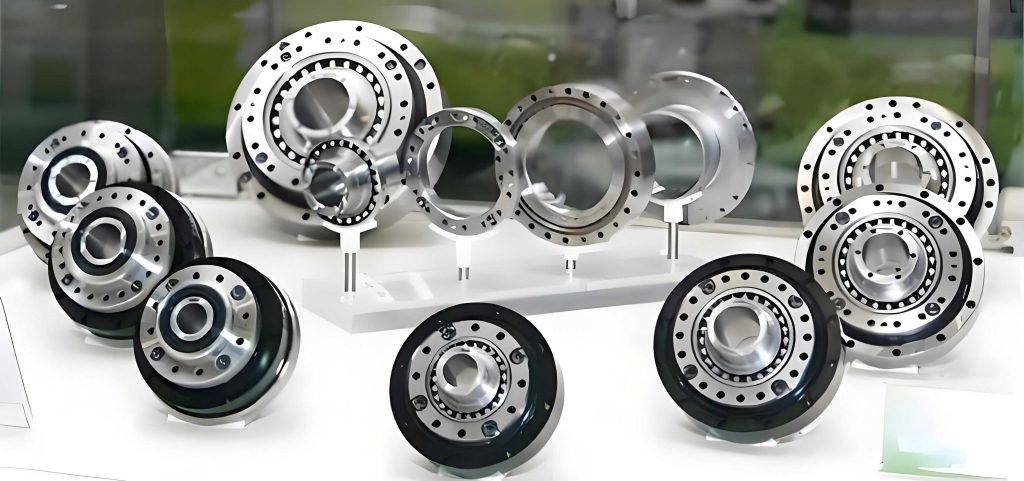
The rotary vector reducer, often abbreviated as RV reducer, represents a pinnacle of compact, high-performance power transmission technology. Its exceptional combination of high reduction ratios, substantial torsional stiffness, minimal backlash, and compact form factor has cemented its role as the preferred actuator for precision applications, most notably in the joints of industrial robots. The underlying kinematic principle governing its operation is that of a planetary closed differential system. This analysis delves into the fundamental motion characteristics of the rotary vector reducer, elucidating its evolution from simpler mechanisms, establishing its equivalent kinematic model, and deriving the critical formulas for its power flow distribution. A thorough understanding of this planetary closed differential nature is indispensable for the successful forward design and optimization of these sophisticated reducers.
Fundamental Concepts: Planetary Differential vs. Planetary Closed Differential
To comprehend the unique operation of a rotary vector reducer, one must first distinguish between two related but distinct concepts: the planetary differential mechanism and the planetary closed differential mechanism. Both are variants of planetary gear systems, but their functional purposes and degrees of freedom differ significantly.
Planetary Differential Mechanisms
A planetary differential mechanism is characterized by having two or more degrees of freedom. Its primary function is to split a single input motion into two or more output motions, or conversely, to combine multiple input motions into a single output. The classic automotive differential is the most ubiquitous example. In such a system, the output speeds of the two wheels are not fixed by the input speed alone; they are determined by the external loads (e.g., traction conditions), allowing the wheels to rotate at different speeds while turning. Another typical example is a basic NGW-type planetary gearset with two inputs or two outputs. The defining feature is that for a given input, the outputs are not kinematically constrained relative to each other; the system possesses an internal degree of freedom that accommodates speed differences.
Planetary Closed Differential Mechanisms
In contrast, a planetary closed differential mechanism possesses only one degree of freedom. It is a single-input, single-output system. However, internally, the input power and motion are intentionally split and transmitted along two or more distinct parallel paths within the mechanism before being recombined at the output. This architecture is often employed in high-power, high-torque applications like wind turbine gearboxes (e.g., designs from manufacturers like Bosch Rexroth or legacy MAAG designs) to divide load among multiple gear trains, enhancing power density and reliability. The key distinction is that all internal paths are kinematically constrained; there is no independent degree of freedom, and the speed ratios between all elements are fixed.
The difference in degrees of freedom is the critical discriminator. This can be formally assessed using the Gruebler’s equation for planar mechanisms:
$$ F = 3n – 2P_L – P_H $$
where \( F \) is the degree of freedom, \( n \) is the number of moving links, \( P_L \) is the number of lower pairs (revolute or prismatic joints), and \( P_H \) is the number of higher pairs (gear meshes, cam contacts).
| Mechanism Type | Example | Moving Links (n) | Lower Pairs (PL) | Higher Pairs (PH) | Degrees of Freedom (F) |
|---|---|---|---|---|---|
| Planetary Differential | Automotive Differential | 5 | 5 | 3 | 2 |
| Planetary Differential | Basic NGW Differential | 4 | 4 | 2 | 2 |
| Planetary Closed Differential | Complex Wind Turbine Gearbox | 8 | 8 | 7 | 1 |
| Planetary Closed Differential | Another Wind Turbine Design | 6 | 6 | 5 | 1 |
| Planetary Closed Differential | Rotary Vector Reducer | 4 | 4 | 3 | 1 |
As the table conclusively shows, the rotary vector reducer, with a calculated degree of freedom \( F = 1 \), belongs unequivocally to the category of planetary closed differential mechanisms. Its motion is not for splitting outputs based on load, but for internally dividing and recombining power flow through fixed kinematic paths to achieve high reduction and load sharing.
Evolutionary Pathway: From Cycloidal Drive to the Rotary Vector Reducer
The genesis of the rotary vector reducer lies in the cycloidal drive, specifically the single-stage, single-tooth-difference cycloidal pin-wheel speed reducer. Understanding this evolution is key to modeling the rotary vector reducer.
The Single-Tooth-Difference Cycloidal Drive
This reducer consists of four primary functional components: an eccentric input shaft (crank), one or two cycloidal discs (planets), a stationary ring of cylindrical pins (pinwheel, acting as the ring gear), and an output mechanism (typically a set of pins or holes in the output flange that engage with holes in the cycloidal discs). The fundamental kinematic relationship is defined by a single-tooth difference between the cycloidal disc and the stationary pin ring: \( z_p – z_c = 1 \), where \( z_p \) is the number of pins and \( z_c \) is the number of lobes on the cycloidal disc. For one full revolution of the input eccentric, the cycloidal disc undergoes a slow reverse rotation equivalent to one lobe (or one tooth) relative to the pin ring.
Kinematic Equivalence and the “Negative Sun Gear” Concept
The cycloidal stage can be interpreted as a planetary gear set. In this等效 model:
- The Cycloidal Disc is equivalent to a Planet Gear.
- The Pin Ring is equivalent to a fixed Internal Ring Gear.
- The Output Flange/Carrier is equivalent to the Planet Carrier.
- The Input Eccentric Crank is equivalent to the Sun Gear.
The unique motion relationship—one crank revolution causing a one-lobe shift—is analogous to a sun gear driving a planet gear where the sun gear has a negative tooth count. Specifically, the input crank can be considered a sun gear with \( z_s = -1 \). This conceptual leap allows the application of standard planetary gear ratio formulas. For an NGW planetary set with a fixed ring gear, input on the sun, and output on the carrier, the speed ratio \( i \) is:
$$ i_{planet} = \frac{n_s}{n_c} = 1 + \frac{z_r}{z_s} $$
Applying this to the等效 cycloidal stage, with \( z_s = -1 \) and \( z_r = z_p \):
$$ i_{cyclo} = 1 + \frac{z_p}{-1} = 1 – z_p = -(z_p – 1) = -z_c $$
The negative sign indicates that the cycloidal disc rotates in the opposite direction to the input crank when observed from a non-rotating reference frame. This等效 calculation produces the correct, well-known reduction ratio of the simple cycloidal drive, validating the “negative sun gear” concept as a powerful analytical tool for the rotary vector reducer.
Architectural Advancement to the Rotary Vector Reducer
The standard cycloidal drive has limitations, particularly regarding the load capacity and life of the eccentric bearing. The rotary vector reducer ingeniously overcomes this by modifying the architecture:
- Planetization of the Crank: The single input crank is replaced by two or three crank pins, which are no longer the primary input shaft. Instead, they are attached to planet gears.
- Addition of a First-Stage Planetary Gear Train: A central sun gear drives multiple planet gears. Each planet gear is mounted on a crank pin, which now serves as its shaft. Thus, the crank pins (the等效 negative sun gears of the cycloidal stage) are no longer fixed in space; they both rotate on their own axes (planet rotation) and revolve around the central sun gear (planet carrier revolution).
- Closed Differential Formation: The system becomes a two-stage, closed-loop mechanism. The first stage is a standard parallel-shaft or planetary reduction (sun to planets). The second stage is the cycloidal reduction (planetized crank to cycloid disc to output). The outputs of both stages are coupled to the final output carrier.
This transformation is the crux of the rotary vector reducer’s design. It transforms a simple one-degree-of-freedom reducer into a one-degree-of-freedom planetary closed differential system, distributing load across multiple cranks and providing an additional, tunable reduction stage.
Kinematic and Power Flow Analysis of the Rotary Vector Reducer
Equivalent Mechanism and Speed Ratio Derivation
The motion of a rotary vector reducer can be decomposed into two parallel kinematic paths that converge at the output carrier (denoted as \( H \)). Let \( n_1 \) be the input speed to the sun gear, \( n_H \) be the output speed of the carrier, and \( n_4 = 0 \) be the speed of the fixed pin ring.
- Path 1 (Direct through Planets): A portion of the input motion is transmitted directly from the planet gears through their cranks to the output carrier. This is the motion of the planet carrier itself.
- Path 2 (Through Cycloidal Reduction): Another portion of the input motion is transmitted from the planet gears to the cycloidal discs via the crank eccentricity, undergoes the high-ratio cycloidal reduction, and then drives the output carrier.
Using the velocity superposition principle for planetary systems and the等效模型, the relationship between the speeds of the first-stage planet gear (which is also the crank/等效 sun of the second stage) and the central elements can be established. The fundamental relative motion equation for the cycloidal stage, considering the planetized crank, is:
$$ \frac{n_{crank} – n_H}{n_4 – n_H} = \frac{z_4}{z_{crank}} $$
Where \( n_{crank} \) is the absolute speed of the crank/等效 sun, \( z_4 = z_p \), and \( z_{crank} = -1 \). The speed of the crank \( n_{crank} \) is determined by the first-stage planetary reduction. For a first-stage with sun gear \( z_1 \), planet gear \( z_2 \), and a fixed ring (or with the planet carrier connected to the output \( H \)), the relationship is \( n_{crank} = – \frac{z_1}{z_2} n_1 \) (assuming simple gear meshes). Substituting and solving for the total ratio \( i_{RV} = n_1 / n_H \) with \( n_4 = 0 \) yields:
$$ i_{RV} = \frac{n_1}{n_H} = \frac{z_2}{z_1} \times z_4 + 1 $$
This is the fundamental speed reduction formula for a standard rotary vector reducer. It elegantly combines the first-stage ratio \( (z_2/z_1) \) with the cycloidal stage’s pin count \( z_4 \), plus 1.
Power Flow Distribution and Derivation
The planetary closed differential nature of the rotary vector reducer means the input power \( P_{in} \) is split along the two internal paths described earlier. Let \( P_1 \) be the power transmitted via Path 1 (direct) and \( P_2 \) be the power transmitted via Path 2 (cycloidal). A critical principle for planetary closed differentials is that the total reduction ratio is the sum of the reduction ratios contributed by each independent power flow path, assuming the other path is locked. Furthermore, the proportion of total power flowing through a given path is equal to the ratio of that path’s stand-alone speed ratio to the total speed ratio.
We can define the stand-alone ratios:
- \( i_1 \): The ratio from input to output if Path 2 (cycloidal transmission) were locked. This is simply the speed ratio of the first stage from sun to the planet carrier (the cranks). For a simple planetary first stage with the planet carrier as output, \( i_1 = 1 + \frac{z_2}{z_1} \). In many RV designs, the first stage is a parallel spur gear reduction from sun to planets, where the planet carrier is the output of that stage, making \( i_1 = \frac{z_2}{z_1} + 1 \).
- \( i_2 \): The ratio from input to output if Path 1 (direct carrier drive) were locked, forcing all power through the cycloidal stage. This is the product of the first-stage ratio and the cycloidal stage ratio: \( i_2 = \frac{z_2}{z_1} \times z_c \). Since \( z_c = z_4 – 1 \), we have \( i_2 = \frac{z_2}{z_1} \times (z_4 – 1) \).
The total ratio is the sum: \( i_{RV} = i_1 + i_2 \). Substituting the expressions:
$$ i_{RV} = \left( \frac{z_2}{z_1} + 1 \right) + \left( \frac{z_2}{z_1} \times (z_4 – 1) \right) = \frac{z_2}{z_1} \times z_4 + 1 $$
This confirms the consistency of the power flow approach with the direct kinematic derivation. The power distribution ratios \( Q_1 \) and \( Q_2 \) are then:
$$ Q_1 = \frac{P_1}{P_{in}} = \frac{i_1}{i_{RV}} = \frac{ \frac{z_2}{z_1} + 1 }{ \frac{z_2}{z_1} \times z_4 + 1 } $$
$$ Q_2 = \frac{P_2}{P_{in}} = \frac{i_2}{i_{RV}} = \frac{ \frac{z_2}{z_1} \times (z_4 – 1) }{ \frac{z_2}{z_1} \times z_4 + 1 } $$
And naturally, \( Q_1 + Q_2 = 1 \).
Verification via Mechanical Equilibrium
The power distribution formulas can be verified by analyzing the static force equilibrium within the first stage. Consider the sun gear and a single planet gear. The input torque \( T_{in} \) applies a tangential force \( F_t \) at the sun-planet mesh pitch circle with radius \( r_1 \). This same force \( F_t \) acts at the planet gear’s center, which is connected to the crank. This force \( F_t \) is ultimately responsible for applying a drive torque to the output carrier \( H \) via the crank pin.
The torque contributed to the carrier by this direct force from one planet is \( T_{direct} = F_t \times R \), where \( R \) is the radius of the planet center circle (\( R = r_1 + r_2 \), with \( r_2 \) being the planet pitch radius). The total direct torque from all planets is proportional to this. The power flowing through this direct path \( P_1 \) is \( T_{direct} \cdot \omega_H \), where \( \omega_H \) is the output angular velocity. The total input power is \( P_{in} = T_{in} \cdot \omega_1 = (F_t \cdot r_1) \cdot \omega_1 \).
Therefore, the direct power fraction is:
$$ \frac{P_1}{P_{in}} = \frac{F_t \cdot R \cdot \omega_H}{F_t \cdot r_1 \cdot \omega_1} = \frac{R}{r_1} \cdot \frac{1}{i_{RV}} $$
Since the gear ratio \( \frac{z_2}{z_1} = \frac{r_2}{r_1} \), we have \( \frac{R}{r_1} = \frac{r_1 + r_2}{r_1} = 1 + \frac{z_2}{z_1} \). Substituting this and the expression for \( i_{RV} \):
$$ \frac{P_1}{P_{in}} = \frac{1 + \frac{z_2}{z_1}}{ \frac{z_2}{z_1} \cdot z_4 + 1 } $$
This result is identical to \( Q_1 \) derived from the kinematic power flow principle, providing a rigorous mechanical validation. This analysis reveals a crucial insight: in a rotary vector reducer, the cycloidal discs do not transmit the full input power. A significant portion ( \( Q_1 \) ) bypasses the cycloidal reduction entirely and is transmitted directly to the output via the planet carrier action. This load-sharing characteristic contributes to the high efficiency and compact size of the rotary vector reducer, as the highly stressed cycloidal contacts are relieved of transmitting the total power.
Implications for Forward Design of Rotary Vector Reducers
The planetary closed differential model and the derived power flow equations provide a powerful theoretical framework for the forward design and analysis of rotary vector reducers. Key implications include:
- Ratio Synthesis: Designers can strategically select the first-stage gear teeth \( z_1 \) and \( z_2 \) and the pin count \( z_4 \) to achieve a desired total reduction ratio \( i_{RV} \) using \( i_{RV} = \frac{z_2}{z_1} \cdot z_4 + 1 \). The ratio is highly sensitive to \( z_4 \), allowing for large reductions in a compact space.
- Load and Stress Analysis: The power distribution ratios \( Q_1 \) and \( Q_2 \) are essential for accurate load calculation on components. The torque acting on the cycloidal disc is not based on the full input torque but on \( Q_2 \cdot T_{in} \cdot i_2 \). Similarly, forces on the first-stage gears and crank bearings are determined by the split power flows. This enables precise sizing and life prediction.
- Efficiency Optimization: Overall efficiency is a weighted sum of the efficiency of each power path. Since Path 1 (direct) typically has very high efficiency (bearing losses), and Path 2 (cycloidal) has slightly lower efficiency due to sliding-rolling contacts, the overall efficiency can be higher than that of a pure cycloidal drive transmitting the same power. The model allows for efficiency estimation and optimization by balancing the power split.
- Stiffness and Backlash: The parallel load paths contribute to the renowned high torsional stiffness of the rotary vector reducer. The analysis of how manufacturing tolerances and elastic deflections in each path affect the overall backlash and stiffness can be guided by this differential model.
- Understanding Unique Motion: The concept of the planetized crank (the negative sun gear in planetary motion) clarifies the complex compound rotation within the reducer, aiding in dynamic analysis and the diagnosis of vibration or wear patterns.
In conclusion, the rotary vector reducer is not merely a gearbox but a sophisticated embodiment of planetary closed differential kinematics. Its design brilliance lies in transforming a standard cycloidal drive into a two-stage system where the input crank becomes a planet-gear-like element, creating two internal, constrained power transmission paths. The derivations of its total speed ratio \( i_{RV} = \frac{z_2}{z_1} \cdot z_4 + 1 \) and the associated power distribution ratios \( Q_1 \) and \( Q_2 \) are fundamental outcomes of this analysis. These principles demystify the internal workings of the rotary vector reducer, moving beyond empirical design towards a model-based, forward engineering approach. This theoretical foundation is critical for advancing the design, optimization, and reliable manufacturing of these essential components for precision robotics and automation, breaking dependence on reverse engineering and enabling genuine innovation in the field of high-performance speed reduction.