
The operational longevity, efficiency, and reliability of precision gear systems are profoundly influenced by the lubrication regime established between meshing teeth. For strain wave gear drives, also known as harmonic drives, this is a particularly critical and complex subject. The unique operating principle of the strain wave gear, involving the controlled elastic deformation of a flexible spline (the “Flexspline”) against a rigid circular spline (the “Circular Spline”) via a wave generator, creates a challenging tribological environment. The engagement is characterized by multi-tooth contact over a significant arc, low relative sliding velocities at many contact points, and a pronounced oscillating “squeeze” motion as teeth engage and disengage. This paper conducts a comprehensive analysis of the lubrication state within the tooth mesh of a strain wave gear. A mathematical model for calculating the lubricant film is derived, considering both shear and squeeze effects. Through parametric finite element analysis of geometric, kinematic, and dynamic parameters, we compute the minimum film thickness for lubricants of varying kinematic viscosity. Based on the resulting film thickness and specific film ratio (λ) curves, we propose and discuss practical engineering measures aimed at improving lubrication and substantially reducing tooth surface wear in strain wave gear applications.
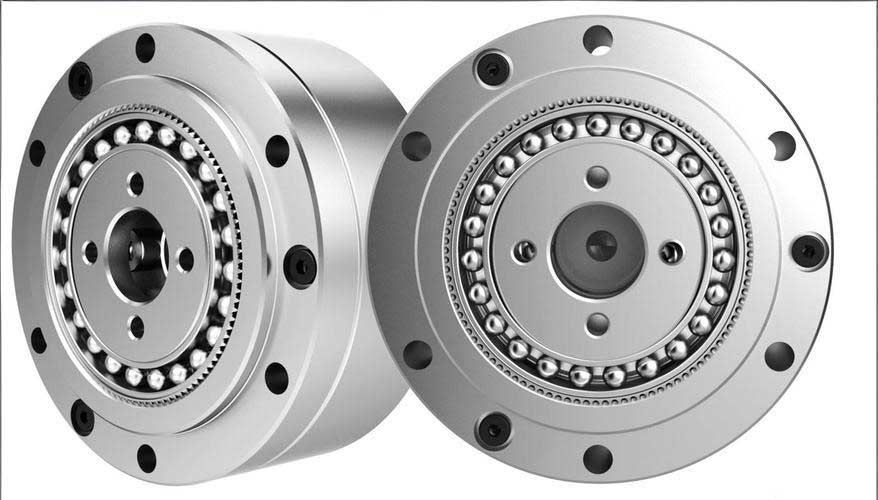
The fundamental challenge in lubricating a strain wave gear stems from its kinematics. Unlike conventional gears with primarily rolling and sliding, the meshing in a strain wave gear involves a significant component of radial approach and separation—the squeeze motion. At the point of initial contact near the major axis of the wave generator, the relative sliding velocity is nearly zero, negating the possibility of generating a hydrodynamic shear (wedge) film. Conversely, in regions where the tooth surfaces are nearly parallel, the necessary convergent wedge for hydrodynamic action is absent. Therefore, classical elastohydrodynamic lubrication (EHL) models for spur or helical gears require significant adaptation. A more accurate model for the strain wave gear must account for the superposition of pressures generated by any available sliding motion and the dominant squeeze-film motion caused by the radial velocity component as teeth mesh and unmesh. The primary hypothesis is that under typical operating speeds, the lubrication in a strain wave gear is governed predominantly by squeeze-film effects rather than by hydrodynamic wedge formation.
To model this, we consider a single tooth pair within the load-carrying zone. The geometry can be approximated as two non-parallel surfaces in close proximity, forming a converging wedge in the direction of sliding and a time-varying gap in the direction of squeeze. The lubricant is assumed to be isoviscous and incompressible for this initial analysis. The Reynolds equation for this combined scenario is solved using the principle of superposition for pressure. The minimum film thickness due to the shear (wedge) action, \( h_{ijq}^{min} \), at a meshing point can be expressed as:
$$ h_{ijq}^{min} = \frac{\eta \cdot v_{rti} L C_{wi} \mu_i}{F_{ni} B_i} $$
Where:
\( \eta \) = Dynamic viscosity of the lubricant (Pa·s)
\( v_{rti} \) = Relative sliding velocity of the tooth surfaces at the i-th tooth pair (m/s)
\( L \) = Tooth width (m)
\( B_i \) = Depth of engagement for the i-th tooth pair (m)
\( C_{wi} \) = Load coefficient for the wedge film, given by \( C_{wi} = \frac{6}{(a_i – 1)^2} \left[ \ln a_i – \frac{2(a_i – 1)}{a_i + 1} \right] \), with \( a_i \) being the gap ratio of the oil wedge.
\( \mu_i \) = Side-leakage coefficient accounting for finite tooth width, \( \mu_i = \frac{5}{4(1 + B_i^2)} \).
\( F_{ni} \) = Normal load on the i-th tooth pair (N)
Simultaneously, the minimum film thickness generated by the squeeze motion, \( h_{ijy}^{min} \), particularly at the region near the tooth tip of the Flexspline, is derived from the squeeze-film equation for a rectangular area with side leakage:
$$ h_{ijy}^{min} = -\frac{3 \beta \eta B_i^3}{F_{ni}} \left( v_{rsi} – \frac{B_i \tan \alpha_i}{2} \right) $$
Where:
\( v_{rsi} \) = Relative squeeze (approach) velocity (m/s)
\( \beta \) = Side flow factor (dimensionless)
\( \alpha_i \) = Pressure angle (or wedge angle) of the contact
The negative sign indicates that the squeeze film is diminishing with time as the surfaces approach. The total instantaneous local film thickness is a complex combination of these two components, though in many zones of the strain wave gear mesh, one component will dominate or be the sole contributor.
To analyze the lubrication state, we perform calculations based on a representative strain wave gear model, the D120 type. The key operational and geometric parameters are summarized in the table below:
| Parameter | Symbol | Value | Unit |
|---|---|---|---|
| Module | m | 0.5 | mm |
| Reference Pressure Angle | α | 20 | ° |
| Gear Ratio | i | 120 | – |
| Circular Spline Teeth | z_c | 242 | – |
| Flexspline Teeth | z_f | 240 | – |
| Wave Generator Speed | n_w | 1500 | rpm |
| Transmitted Torque | T | 500 | N·m |
| Tooth Width | L | Assumed 10 | mm |
The load distribution \( F_{ni} \), relative velocities \( v_{rti} \) and \( v_{rsi} \), and geometric factors \( B_i \) and \( a_i \) across the arc of engagement are obtained through a dedicated finite element analysis of the meshing process for this specific strain wave gear geometry. These computed parameters serve as the input for the film thickness equations. The analysis is performed for industrial gear oils with different kinematic viscosities (\( \nu \)) at the operating temperature, remembering that dynamic viscosity \( \eta = \nu \cdot \rho \), where \( \rho \) is the density.
Analysis of Minimum Shear (Wedge) Film Thickness
Calculations using Equation (1) reveal significant insights. At the major axis position (engagement start), the relative sliding velocity \( v_{rti} \) is zero, resulting in a shear film thickness of zero. Furthermore, within an angular zone from approximately 36° to 42° from the major axis, the gap ratio \( a_i \) approaches unity, indicating nearly parallel surfaces. This geometry is incapable of generating a pressure wedge, and consequently, the calculated shear film thickness in this region is also negligible. For the remaining engagement zones, with oils of kinematic viscosity \( \nu = 50 \) and \( 70 \, mm^2/s \), the computed shear film thickness values are extraordinarily small, on the order of \( 10^{-2} \, \mu m \) or less. This is far below the typical composite surface roughness of gear teeth. Therefore, it is concluded that a conventional hydrodynamic wedge film does not establish a load-bearing fluid film in a strain wave gear under these operating conditions. The primary lubrication mechanism must be sought elsewhere.
Analysis of Squeeze Film Thickness and the Specific Film Ratio
The results from the squeeze film equation (2) tell a different story. The plot below shows the variation of the minimum squeeze film thickness \( h_{ijy}^{min} \) across the engagement arc for four different lubricants.
[Note: The following textual description replaces the original Figure 1] The squeeze film thickness curves show a characteristic profile, starting from a maximum value at the initial engagement point (major axis) and decreasing as the meshing proceeds. The key observation is the direct, strong correlation between lubricant viscosity and film thickness. Curve 1 (ν = 70 mm²/s) shows the highest film values, up to approximately 4 μm at its peak. Curve 2 (ν = 50 mm²/s) is lower, followed by Curve 3 (ν = 30 mm²/s), and finally Curve 4 (ν = 10 mm²/s) shows the thinnest films, barely exceeding 1 μm. This confirms that the squeeze-film effect is the dominant and viable mechanism for generating a fluid film in a strain wave gear.
However, the absolute film thickness is only one part of the lubrication state diagnosis. The critical parameter determining the severity of surface interaction is the Specific Film Ratio (λ), also known as the Lambda ratio. It is defined as the ratio of the minimum lubricant film thickness to the composite surface roughness:
$$ \lambda_i = \frac{h_{i}^{min}}{\sqrt{R_{q1}^2 + R_{q2}^2}} $$
Where \( R_{q1} \) and \( R_{q2} \) are the root-mean-square (RMS) roughness of the Flexspline and Circular Spline tooth surfaces, respectively. For a machined surface, the RMS roughness \( R_q \) is related to the more common arithmetic average roughness \( R_a \) by \( R_q \approx 1.25 R_a \). Assuming gear teeth finished by shaping or skiving with a typical \( R_a = 1.25 \, \mu m \), the composite roughness \( \sqrt{R_{q1}^2 + R_{q2}^2} \) is approximately 1.77 μm. The calculated λ values across the mesh are plotted conceptually below for the four lubricants.
[Note: The following textual description replaces the original Figure 2] The specific film ratio (λ) curves mirror the film thickness trends. For the low-viscosity oil (ν = 10 mm²/s, Curve 4), the maximum λ value is less than 1 across the entire load zone. This defines a boundary lubrication regime, where asperity contact is frequent and significant wear is expected. As viscosity increases to 30 and 50 mm²/s (Curves 3 and 2), the peak λ values rise into the range of 1 to 3. This indicates a mixed lubrication regime, where the load is shared between the fluid film and contacting asperities. Wear rates in this regime are lower than in boundary lubrication but are still present. Finally, for the highest viscosity oil analyzed (ν = 70 mm²/s, Curve 1), the λ values mostly remain between 1 and 3, suggesting the strain wave gear operates predominantly in a mixed lubrication state, a significant improvement over boundary lubrication.
This theoretical finding aligns with empirical evidence. Field tests on strain wave gears using an energy-efficient oil with ν ≈ 10 mm²/s (and anti-wear additives) reported reduced operating temperature and improved efficiency. However, they also exhibited pronounced tooth surface wear. This practical observation strongly validates the model’s prediction of a boundary lubrication state for low-viscosity oils in this application.
Measures to Improve Lubrication and Reduce Wear in Strain Wave Gears
Based on the foregoing analysis, several targeted measures can be implemented to shift the lubrication regime of a strain wave gear from boundary/mixed towards full-film conditions, thereby minimizing wear.
1. Optimization of Lubricant Viscosity
The most direct influence on film thickness in a strain wave gear is the lubricant’s dynamic viscosity. As demonstrated, increasing the kinematic viscosity from 10 to 70 mm²/s transformed the state from boundary to mixed lubrication. To achieve a full-film (elastohydrodynamic) regime with λ > 3 across the entire mesh, calculations suggest a lubricant with a kinematic viscosity on the order of 140-150 mm²/s at operating temperature is required. This corresponds to ISO VG 150 grade industrial or extreme pressure (EP) gear oils.
The selection, however, involves a critical trade-off. Higher viscosity increases film thickness and protective capacity but also increases viscous shear losses (churning and drag), leading to lower mechanical efficiency and higher operating temperatures. The elevated temperature, in turn, reduces the lubricant’s viscosity—a self-regulating but potentially counterproductive cycle. Therefore, the optimal viscosity grade must be determined by balancing the wear protection requirements against efficiency targets and thermal management capabilities for the specific strain wave gear design and duty cycle. For high-precision, long-life applications, accepting a slight efficiency penalty for vastly improved reliability through the use of a higher viscosity oil is often justified.
2. Formulation of Advanced Boundary Lubrication Films
In applications where low viscosity oils are mandatory (e.g., for extreme low-temperature operation or ultra-high efficiency demands), and the system is destined to operate in the boundary lubrication regime, the focus must shift from bulk film formation to surface chemistry. The goal is to enhance the strength and durability of the boundary films that separate asperities. This is achieved through lubricant additives:
- Oiliness Agents/Friction Modifiers: These are long-chain polar molecules (e.g., fatty acids, esters) that adsorb strongly onto metal surfaces, forming a durable, low-shear-strength monolayer. They are particularly effective in low-speed, moderate-load conditions typical of many strain wave gear applications, reducing the coefficient of friction and preventing adhesive wear (scuffing).
- Anti-Wear (AW) and Extreme Pressure (EP) Additives: For more severe conditions, AW additives (e.g., Zinc Dialkyldithiophosphate – ZDDP) react with the metal surface under moderate heat from asperity contacts to form a protective, sacrificial tribofilm. EP additives (containing Sulfur, Phosphorus, or Chlorine) react at higher local temperatures generated under heavy load, forming chemically bonded films that prevent welding and severe scoring. The choice and concentration of these additive packages require careful formulation and testing specific to the materials (often steel-on-steel) used in strain wave gears.
3. Strategic Tooth Profile Modification (Tip Relief)
The squeeze-film analysis reveals a fundamental geometric limitation. The film thickness calculation assumes a nearly parallel gap, but the actual tooth engagement forms a wedge. In a squeezing wedge, the lubricant at the narrow end (near the tooth tip) experiences the greatest resistance to outflow, causing this region to dictate the overall pressure build-up and film collapse. This can lead to initial contact and high stress at the tip/edge, hindering the formation of a uniform squeeze film.
A proposed solution is the intentional modification (relief) of the Flexspline tooth tip profile. The objective is not to change the active flank geometry but to remove a small amount of material from the tip region to create a more uniform clearance along the path of engagement, facilitating a more effective and uniform squeeze film. The principle is illustrated below.
[Note: The following textual description replaces the original Figure 3] The modification involves relieving the tooth tip profile so that the film thickness from the pitch point to the tip is more uniform, approximating the calculated ideal squeeze film thickness \( \bar{h} \) at the mid-depth of engagement. The amount of relief \( \Delta x \) at a distance \( x \) from the tooth tip can be determined linearly: \( \Delta x = \bar{h} – (h_{min} + x \tan \alpha) \), where \( \alpha \) is the local wedge angle and \( h_{min} \) is the film thickness at the tip before modification. This controlled relief eliminates the sharp edge contact that impedes lubricant entrapment, allowing the squeeze film to develop more effectively across the entire contact zone. When combined with an appropriately high-viscosity lubricant, tip profile modification can synergistically promote thicker and more robust film formation, leading to a marked reduction in wear. It is crucial to note that such modifications will alter the load distribution; therefore, their design must be integrated with a comprehensive loaded tooth contact analysis (LTCA) for the strain wave gear.
Summary and Extended Considerations
The lubrication of strain wave gear drives is a domain where squeeze-film dynamics prevail over traditional hydrodynamic wedge effects. The analytical model presented, combining shear and squeeze film formulations, provides a framework for understanding the lubrication state. The key takeaways are:
- The lubrication regime in a typical strain wave gear under moderate speed is borderline between boundary and mixed lubrication when using standard industrial gear oils.
- The specific film ratio (λ) is a crucial metric for predicting wear performance, and it is highly sensitive to lubricant viscosity.
- A multi-pronged approach is necessary for optimization:
Measure Primary Effect Key Consideration Increase Viscosity Directly increases squeeze film thickness, raising λ. Trade-off with increased power loss and temperature. Use Advanced Additives Strengthens boundary films, reduces friction & wear when λ < 1. Requires compatibility testing with gear materials. Implement Tip Relief Optimizes geometry for squeeze film formation, reduces edge stress. Must be carefully designed to avoid negative impact on load capacity and transmission error.
Future work in this field should focus on developing more sophisticated thermohydrodynamic models that account for the non-Newtonian behavior of lubricants under high pressure, the elastic deformation of the Flexspline teeth (micro-EHL effects), and the transient thermal effects within the contact. Furthermore, experimental validation using techniques like ultrasonic film thickness measurement or detailed post-operation wear mapping is essential to refine the models and the proposed improvement measures. Ultimately, a deep understanding of the unique lubrication mechanics in the strain wave gear is fundamental to unlocking its full potential in terms of precision, durability, and efficiency in advanced mechanical systems.