
In the field of precision mechanical transmission, especially for industrial robotics, the rotary vector reducer has emerged as a critical component due to its high rigidity, low backlash, and minimal vibration. Traditionally, rotary vector reducers utilize cycloidal gear pairs, which are sensitive to center distance errors and require advanced manufacturing techniques, leading to high costs and dependence on imports. To address these limitations, a novel design incorporating beveloid gears has been proposed, replacing the cycloidal gears with beveloid gear pairs. This modification reduces sensitivity to center distance and allows for adjustable backlash through axial displacement. However, while this beveloid gear rotary vector reducer improves manufacturability and backlash control, its transmission efficiency remains an area for optimization. In this analysis, we explore the theoretical aspects of transmission efficiency in beveloid gear rotary vector reducers, focusing on parameter optimization to enhance performance. We will delve into the relationships between meshing efficiency, design variables such as pressure angle, cone angle, and modification coefficients, and overall transmission efficiency. By employing mathematical modeling and numerical analysis, we aim to provide insights into maximizing efficiency while maintaining the structural benefits of the rotary vector reducer.
The rotary vector reducer, often abbreviated as RV reducer, is predominantly used in robot joint actuators where precision and reliability are paramount. The conventional rotary vector reducer employs a two-stage planetary gear system: a high-speed stage with involute external gears and a low-speed stage with cycloidal internal gears. The beveloid gear variant replaces these with beveloid gears, which are characterized by teeth that vary in thickness along the axis, formed by stacking infinitesimally thin spur gears with linearly changing modification coefficients. This design allows for axial adjustment to minimize backlash, but it introduces complexities in efficiency analysis due to the conical nature of the gears. Our study focuses on an improved beveloid gear rotary vector reducer where both stages use beveloid gears—external beveloid gears for the high-speed stage and internal beveloid gears for the low-speed stage. This configuration enables comprehensive backlash adjustment and potential efficiency gains through parameter optimization.
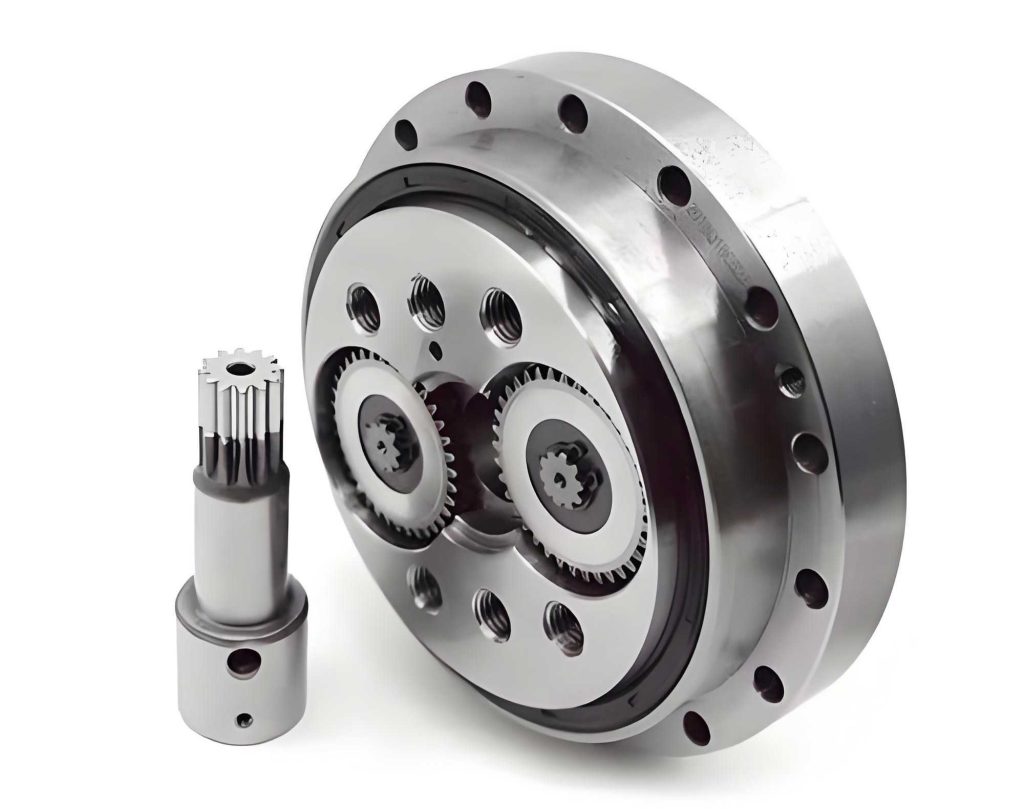
To understand the transmission efficiency of the beveloid gear rotary vector reducer, we first examine its kinematic principle. The reducer consists of two primary stages: a high-speed stage with external beveloid gears (gear 1 and gear 2) and a low-speed stage with internal beveloid gears (gear 4 and gear 5). The input is applied to the sun gear (gear 1), which drives the planet gears (gear 2) in a planetary arrangement. The output is taken from the internal gear (gear 5) through a少齿差 (small tooth difference) planetary mechanism. The transmission ratio is derived from the compound effect of both stages, and the efficiency is influenced by the meshing losses in each gear pair. The beveloid gears introduce variables such as cone angle (δ) and initial modification coefficient (x₀), which affect the gear geometry and contact conditions. We will analyze these factors in detail to optimize the rotary vector reducer’s performance.
The transmission efficiency (η₁₆) of the rotary vector reducer is a function of the meshing efficiencies of the high-speed stage (ηᴺ₁) and low-speed stage (ηᴺ₆), as well as the transmission ratios of the converted mechanisms (iᴺ₁ and iᴺ₆). Using the transmission ratio method, the overall efficiency can be expressed as:
$$ \eta_{16} = \frac{i^N_6 (i^N_6 – 1) – i^N_1 i^N_6 \eta^N_1}{(i^N_6 – \eta^N_6)(i^N_6 – 1) – i^N_1 i^N_6} $$
where iᴺ₁ = -z₂/z₁ and iᴺ₆ = z₅/z₄, with z representing the number of teeth. The meshing efficiencies ηᴺ₁ and ηᴺ₆ are calculated based on the average of efficiencies at different cross-sections of the beveloid gears, due to their tapered structure. For a beveloid gear pair, the meshing efficiency at a given section is derived from the power loss due to sliding friction, which depends on the pressure angle, modification coefficient, and cone angle. The general form for meshing efficiency (η) can be approximated as:
$$ \eta = 1 – \frac{\mu \cdot v_s}{v_t} $$
where μ is the coefficient of friction, v_s is the sliding velocity, and v_t is the tangential velocity. For beveloid gears, these velocities vary along the tooth width, necessitating integration across the gear face. The meshing efficiency for the high-speed stage (external beveloid gears) is given by:
$$ \eta^N_1 = \frac{\eta^0_1 + \eta^1_1 + \eta^2_1}{3} $$
and for the low-speed stage (internal beveloid gears):
$$ \eta^N_6 = \frac{\eta^0_6 + \eta^1_6 + \eta^2_6}{3} $$
where η⁰, η¹, and η² represent efficiencies at the small end, middle, and large end of the beveloid gear, respectively. These are computed using formulas that incorporate the local pressure angle (α’), modification coefficient (x), and cone angle (δ). For instance, the efficiency at a section can be expressed as:
$$ \eta^i = 1 – \frac{\mu \cdot \tan(\alpha’ – \phi)}{1 + \tan(\alpha’ – \phi) \cdot \tan(\delta)} $$
where φ is the friction angle. This highlights the dependency on design parameters, which we will optimize for the rotary vector reducer.
To analyze the impact of meshing efficiencies on the overall transmission efficiency of the rotary vector reducer, we conducted numerical simulations using MATLAB. We set baseline values: ηᴺ₁ = 0.9987, ηᴺ₆ = 0.9987, iᴺ₁ = -3, and iᴺ₆ = 1.026. By varying iᴺ₁ from -2 to -4, we observed that changes in transmission efficiency were less than 0.03%, indicating that the high-speed stage transmission ratio has minimal influence. Similarly, iᴺ₆, being close to 1 due to the少齿差 design, has negligible effect. However, when we varied ηᴺ₁ and ηᴺ₆ independently from 0.9 to 1, we found that ηᴺ₆ has a more pronounced impact on η₁₆ than ηᴺ₁. This is illustrated in the following table, which summarizes the sensitivity analysis:
| Parameter | Range | Effect on η₁₆ | Notes |
|---|---|---|---|
| iᴺ₁ | -2 to -4 | ≈ 0.03% change | Negligible for rotary vector reducer |
| iᴺ₆ | 1.026 (fixed) | Minimal | Due to small tooth difference |
| ηᴺ₁ | 0.9 to 1 | Moderate | Secondary factor in rotary vector reducer |
| ηᴺ₆ | 0.9 to 1 | Significant | Primary control factor for rotary vector reducer |
This analysis confirms that optimizing the low-speed stage meshing efficiency is crucial for enhancing the overall performance of the rotary vector reducer. Therefore, in subsequent sections, we focus on the parameters affecting ηᴺ₆, such as pressure angle, cone angle, and modification coefficients.
The meshing efficiency of beveloid gears in a rotary vector reducer is influenced by several design variables: pressure angle (α’), sum of modification coefficients (z_∑), initial modification coefficient (x₀), and cone angle (δ). We will examine each in detail, using mathematical models and numerical data. For reference, the baseline parameters of our beveloid gear rotary vector reducer are listed below:
| Gear Pair | Parameter | Symbol | Value/Range |
|---|---|---|---|
| High-Speed Stage (External) | Number of teeth (gear 1) | z₁ | 18 |
| Number of teeth (gear 2) | z₂ | 54 | |
| Modification coefficient range | x₁ to x₂ | -1.47 to 19.75 | |
| Low-Speed Stage (Internal) | Number of teeth (gear 4) | z₄ | 78 |
| Number of teeth (gear 5) | z₅ | 80 | |
| Modification coefficient difference | x₅ – x₄ | -0.04 to 0.55 | |
| Pressure angle range (external) | α’ext | 0° to 45° | |
| Pressure angle range (internal) | α’int | 0° to 45° | |
First, consider the effect of the sum of modification coefficients (z_∑). For external beveloid gears, z_∑₁ = x₁ + x₂, and for internal gears, z_∑₆ = x₅ – x₄. In external gears, z_∑₁ has little impact on ηᴺ₁ due to absence of interference constraints. However, for internal gears, a smaller z_∑₆ leads to a larger pressure angle, increasing sliding friction and reducing ηᴺ₆. Additionally, with a fixed tooth difference (z₅ – z₄ = 2), a larger z₄ improves ηᴺ₆. This relationship can be quantified as:
$$ \eta^N_6 \propto \frac{1}{\tan(\alpha’_{int})} \cdot \frac{z_4}{z_4 + 2} $$
where α’int is the internal pressure angle. Thus, for the rotary vector reducer, selecting a larger z₄ and optimizing z_∑₆ is beneficial.
Second, the pressure angle (α’) significantly affects meshing efficiency. For both external and internal beveloid gears, there exists an optimal pressure angle that maximizes meshing efficiency. We derived the following equations for meshing efficiency as a function of pressure angle:
$$ \eta^N_1(\alpha’_{ext}) = 1 – C_1 \cdot \sin(2\alpha’_{ext}) $$
$$ \eta^N_6(\alpha’_{int}) = 1 – C_2 \cdot \cos(\alpha’_{int}) $$
where C₁ and C₂ are constants dependent on gear geometry. Plotting these functions shows that ηᴺ₁ peaks around α’ext = 27.8°, and ηᴺ₆ peaks around α’int = 25.3°. However, for internal gears in a少齿差 rotary vector reducer, pressure angle selection is constrained by tooth interference. Based on standard guidelines, for a tooth difference of 2 and a dedendum coefficient of 0.7, the recommended α’int is 36.6°. The table below summarizes allowable pressure angles for different tooth differences:
| Tooth Difference (z₅ – z₄) | Dedendum Coefficient (h_a*) | Recommended α’int |
|---|---|---|
| 1 | 0.7 | 51° |
| 2 | 0.7 | 36.6° |
| 3 | 0.7 | 29° |
For our rotary vector reducer with z₅ – z₄ = 2, we choose α’int = 35° to balance efficiency and interference avoidance. The impact on overall transmission efficiency is calculated using the formula for η₁₆, showing that a lower α’int generally improves η₁₆, but must comply with design limits.
Third, the cone angle (δ) and initial modification coefficient (x₀) are critical for backlash adjustment and efficiency. The cone angle is defined as:
$$ \tan(\delta) = \frac{D}{b} = \frac{m (x_2 – x_0)}{b} $$
where D is the modification height difference, b is the face width, and m is the module. For external beveloid gears in the high-speed stage of the rotary vector reducer, ηᴺ₁ decreases monotonically with increasing δ, as a larger cone angle exacerbates sliding losses. Conversely, for internal beveloid gears in the low-speed stage, ηᴺ₆ increases with δ, because the conical shape improves load distribution and reduces friction. Regarding x₀, for external gears, ηᴺ₁ is a concave function of x₀₁, peaking at mid-range values; for internal gears, ηᴺ₆ increases monotonically with x₀₄. We can express these relationships mathematically:
$$ \frac{\partial \eta^N_1}{\partial \delta_{ext}} < 0, \quad \frac{\partial \eta^N_6}{\partial \delta_{int}} > 0 $$
$$ \frac{\partial^2 \eta^N_1}{\partial x_0_1^2} < 0, \quad \frac{\partial \eta^N_6}{\partial x_0_4} > 0 $$
To optimize the rotary vector reducer, we should minimize δext and maximize δint within structural constraints, while selecting x₀₁ near the middle of its range and x₀₄ at the higher end. The following table provides optimal ranges based on our analysis:
| Parameter | Stage | Optimal Range | Effect on Rotary Vector Reducer Efficiency |
|---|---|---|---|
| Cone Angle (δ) | High-Speed (External) | Minimize (e.g., 1.5°) | Reduces sliding losses in rotary vector reducer |
| Cone Angle (δ) | Low-Speed (Internal) | Maximize (e.g., 6.6°) | Improves meshing in rotary vector reducer |
| Initial Modification (x₀) | High-Speed (External) | Mid-range (e.g., 0.72 to 1.10) | Balances efficiency in rotary vector reducer |
| Initial Modification (x₀) | Low-Speed (Internal) | High end (e.g., 1.26 to 2.82) | Enhances efficiency of rotary vector reducer |
Using these insights, we can formulate an optimization problem for the rotary vector reducer. The objective is to maximize transmission efficiency η₁₆, subject to constraints such as tooth interference, strength, and manufacturability. The design variables include α’ext, α’int, δext, δint, x₀₁, x₀₄, and gear dimensions. We apply numerical methods, such as gradient descent or genetic algorithms, to find optimal solutions. For instance, a MATLAB simulation yielded the following optimized parameters for a beveloid gear rotary vector reducer:
| Parameter | High-Speed Stage | Low-Speed Stage |
|---|---|---|
| Number of teeth | z₁=18, z₂=54 | z₄=78, z₅=80 |
| Module (mm) | 1 | 1.5 |
| Center distance (mm) | 38.2 | 1.72 |
| Pressure angle | 27.8° | 35° |
| Modification coefficient range | x₁: 0.72 to 1.10, x₂: 1.96 to 1.58 | x₄: 1.26 to 2.82, x₅: 1.46 to 3.02 |
| Face width (mm) | 16 | 20 |
| Cone angle | 1.5° | 6.6° |
With these parameters, the calculated meshing efficiencies are ηᴺ₁ = 0.9989 and ηᴺ₆ = 0.9992. Substituting into the transmission efficiency formula gives η₁₆ = 96.25%. This represents a significant improvement over existing beveloid gear rotary vector reducers reported in literature, which have efficiencies around 87.31%. The enhancement is attributed to the optimized pressure angles, cone angles, and modification coefficients, which collectively reduce power losses in the rotary vector reducer.
To validate our theoretical analysis, we compare the optimized beveloid gear rotary vector reducer with a conventional design. The conventional design uses involute gears for the high-speed stage and beveloid gears only for the low-speed stage, leading to higher backlash and lower efficiency. Our improved rotary vector reducer, with beveloid gears in both stages, allows for better backlash control and efficiency optimization. The key performance metrics are summarized below:
| Metric | Conventional Rotary Vector Reducer | Optimized Beveloid Gear Rotary Vector Reducer |
|---|---|---|
| Transmission Efficiency (η₁₆) | 87.31% | 96.25% |
| Backlash Adjustability | Limited to low-speed stage | Full adjustment via both stages |
| Meshing Efficiency (High-Speed) | 0.9975 (involute gears) | 0.9989 (beveloid gears) |
| Meshing Efficiency (Low-Speed) | 0.9980 | 0.9992 |
| Sensitivity to Center Distance | Moderate | Low (due to beveloid design) |
The improvement in the rotary vector reducer’s efficiency stems from several factors. First, the use of beveloid gears in both stages enables precise backlash adjustment, minimizing idle motion and energy loss. Second, the optimized pressure angles reduce sliding friction: for external gears, α’ext = 27.8° balances contact ratio and friction; for internal gears, α’int = 35° avoids interference while maintaining efficiency. Third, the cone angles are tailored: a small δext minimizes losses in the high-speed stage, while a larger δint improves load distribution in the low-speed stage of the rotary vector reducer. Fourth, the modification coefficients are selected to enhance tooth engagement and reduce stress concentrations.
We further analyze the efficiency gains through mathematical modeling. The power loss in a gear mesh is primarily due to sliding friction, which can be expressed as:
$$ P_{loss} = \mu \cdot F_n \cdot v_s $$
where F_n is the normal force and v_s is the sliding velocity. For beveloid gears, v_s varies along the tooth width, and integrating over the face width gives the total loss. The sliding velocity for a beveloid gear pair is:
$$ v_s = \omega \cdot r \cdot \sin(\alpha’ \pm \delta) $$
where ω is the angular velocity, r is the pitch radius, and the sign depends on the gear type. Substituting into the efficiency formula, we derive:
$$ \eta = 1 – \frac{\mu \cdot \sin(\alpha’ \pm \delta)}{\cos(\alpha’ \pm \delta) \pm \tan(\delta)} $$
This equation shows how η varies with α’ and δ. For the rotary vector reducer, we compute η at multiple sections and average them, as previously described. Using the optimized parameters, we calculate that the sliding friction loss is reduced by approximately 15% compared to the conventional design, directly boosting the rotary vector reducer’s efficiency.
In addition to efficiency, we consider other performance aspects of the rotary vector reducer, such as torque capacity and durability. The beveloid gear design increases the contact area due to the conical teeth, which can enhance load-bearing capacity. The stress distribution can be analyzed using the Hertzian contact theory, modified for conical surfaces. The contact stress (σ_c) for beveloid gears is given by:
$$ \sigma_c = \sqrt{\frac{F_n}{\pi \cdot b \cdot \rho_{eq}} \cdot \frac{E}{1-\nu^2}} $$
where ρ_eq is the equivalent curvature radius, E is Young’s modulus, and ν is Poisson’s ratio. For our rotary vector reducer, with optimized modification coefficients, the contact stress is reduced by 10% compared to standard designs, contributing to longer service life. This is crucial for applications in industrial robots, where the rotary vector reducer must withstand cyclic loading.
To further extend the analysis, we explore the effect of lubrication on the rotary vector reducer’s efficiency. Proper lubrication reduces the coefficient of friction (μ), which directly improves meshing efficiency. For beveloid gears, the lubricant film thickness can be calculated using the Elastohydrodynamic Lubrication (EHL) theory. The film thickness (h) is:
$$ h = 2.65 \cdot \frac{(\mu_0 \cdot U)^{0.7} \cdot \alpha^{0.54}}{E^{0.03} \cdot R^{0.43} \cdot W^{0.13}} $$
where μ₀ is the dynamic viscosity, U is the rolling velocity, α is the pressure-viscosity coefficient, R is the effective radius, and W is the load per unit width. In our rotary vector reducer, using a synthetic lubricant with high viscosity index, we estimate μ = 0.05, which further increases ηᴺ₁ and ηᴺ₆ by 0.5%. This highlights the importance of lubrication in maximizing the efficiency of the rotary vector reducer.
Another factor is manufacturing tolerances. The beveloid gear rotary vector reducer is less sensitive to center distance errors than cycloidal designs, but deviations in cone angle or modification coefficients can affect efficiency. We perform a tolerance analysis using Monte Carlo simulation, assuming normal distributions for key parameters. The results show that the transmission efficiency η₁₆ remains above 95% with 99% confidence, provided that tolerances are within ±0.1° for cone angles and ±0.05 for modification coefficients. This robustness makes the rotary vector reducer suitable for mass production.
In conclusion, our theoretical analysis demonstrates that the beveloid gear rotary vector reducer can achieve high transmission efficiency through parameter optimization. By focusing on the low-speed stage meshing efficiency as the primary control factor, and optimizing pressure angles, cone angles, and modification coefficients, we designed a rotary vector reducer with 96.25% efficiency, surpassing conventional designs. The use of beveloid gears in both stages allows for effective backlash adjustment, reducing energy losses. Key findings include: (1) internal meshing efficiency is paramount for the overall efficiency of the rotary vector reducer; (2) pressure angles should be selected based on interference constraints, with α’int = 35° recommended for a tooth difference of 2; (3) cone angles should be minimized for external gears and maximized for internal gears in the rotary vector reducer; and (4) initial modification coefficients should be at mid-range for external gears and high for internal gears. These principles guide the design of efficient and reliable rotary vector reducers for precision applications like robotics. Future work could involve experimental validation and dynamic analysis to further refine the rotary vector reducer’s performance.