
A high-level symposium held in Beijing has placed cooperation between Beijing’s innovation resources and Henan’s application scenarios at the center of China’s fast-moving embodied intelligence and humanoid robot landscape. The 2026 Henan-Beijing Embodied Intelligence Industry Symposium, held on October 14, 2026, brought together government officials, industry leaders, university representatives, research institutes, and key enterprises from the Beijing-Tianjin region to discuss how humanoid robot and embodied intelligence technologies can move from laboratories and pilot programs into large-scale real-world use.
The event was hosted by the Henan Provincial Department of Industry and Information Technology. It was described as Henan’s first future-industry-themed symposium held in Beijing and as the province’s third proactive “go out” future-industry matchmaking event in 2026, following earlier activities in Shanghai and Guangzhou. The meeting was not a conventional promotional event. It focused on concrete cooperation among humanoid robot developers, embodied intelligence enterprises, supply chain companies, capital platforms, and application-side partners. Participants exchanged views on Henan’s support policies, industrial-chain supporting capacity, and scenario lists, and they explored precise docking between Beijing-Tianjin innovation capabilities and Henan’s manufacturing and application base.
Among the participants were responsible officials from the Henan Provincial Department of Industry and Information Technology, the Henan Provincial Government Office in Beijing, the Zhengzhou Airport Economy Zone Management Committee, Henan Investment Group, and the Zhengzhou Municipal Bureau of Industry and Information Technology. They met face to face with representatives of key embodied intelligence enterprises, universities, and research institutions from the Beijing-Tianjin region. The discussion covered how humanoid robot companies can access Henan’s manufacturing system, logistics networks, commercial retail channels, tourism resources, and public-service scenarios, and how Henan can support the growth of humanoid robot and embodied intelligence enterprises through policy, capital, data infrastructure, and industrial carriers.
1. A Symposium Designed to Match Humanoid Robot Innovation with Real Application Scenarios
The symposium reflected a growing recognition that embodied intelligence, including humanoid robot systems, is entering a critical period of breakthrough. The technology is no longer only a subject of laboratory research. It is increasingly being tested in manufacturing, logistics, retail, healthcare, tourism, household services, and other environments where perception, decision-making, mobility, and manipulation must work together. For humanoid robot developers, the central challenge is not only to improve algorithms, actuators, sensors, and dexterous hands, but also to gain access to real scenarios, real data, and real operational conditions.
Henan’s industrial structure and market scale make it an important partner in that process. The province has a complete range of manufacturing categories, abundant application scenarios, a broad market, and an active open economy. These conditions provide a strong foundation for the development and deployment of embodied intelligence and humanoid robot technologies. Beijing, meanwhile, has dense innovation resources, a concentration of high-end talent, and many leading enterprises. It has significant advantages in research, model development, core components, and early-stage technological breakthroughs. The complementarity between the two sides was a central theme of the symposium.
Yan Chen, Party Secretary and Director of the Henan Provincial Department of Industry and Information Technology, said in his remarks at the symposium that the embodied intelligence industry is at a critical stage of accumulating strength and seeking breakthroughs. He noted that Henan has complete manufacturing categories, rich scenarios, a broad market, and an open and active environment, giving the province a good foundation for developing embodied intelligence. Beijing, he added, has dense innovation resources, high-end talent, and many leading enterprises, giving it clear advantages in leading industrial development. He emphasized that the two regions have strong industrial complementarity and large room for cooperation, and that they are fully capable of producing more substantive results in the embodied intelligence field.
The phrase “Beijing has innovation, Henan has scenarios” was repeated several times during the event. For humanoid robot companies, that phrase captures a practical division of labor. Beijing can provide cutting-edge research, embodied large models, talent, and early-stage enterprise clusters. Henan can provide factories, warehouses, retail spaces, tourism sites, hospitals, training grounds, and a large pool of users and workers. When these strengths are connected, humanoid robot development can move more quickly from prototype demonstration to repeatable commercial deployment.
2. Henan Presents Policies, Supply Chains, and Scenario Lists for Humanoid Robot Development
At the symposium, Henan officials and platform representatives presented the province’s support policies, industrial-chain supporting capacity, and scenario lists to Beijing-Tianjin enterprises, universities, and research institutions. The aim was precise docking rather than broad promotion. Humanoid robot enterprises need to know where they can test their systems, who can supply components, how they can access production capacity, and what kind of capital and policy support is available for long-term development. Henan used the symposium to address those questions directly.
The presence of the Zhengzhou Airport Economy Zone Management Committee, Henan Investment Group, and the Zhengzhou Municipal Bureau of Industry and Information Technology signaled that the cooperation framework extends beyond a single government department. It involves industrial parks, investment platforms, local manufacturing systems, and application-side resources. For humanoid robot companies, this multi-level participation is important because the commercialization of humanoid robot technology requires coordination across hardware, software, data, training, testing, production, and customer access.
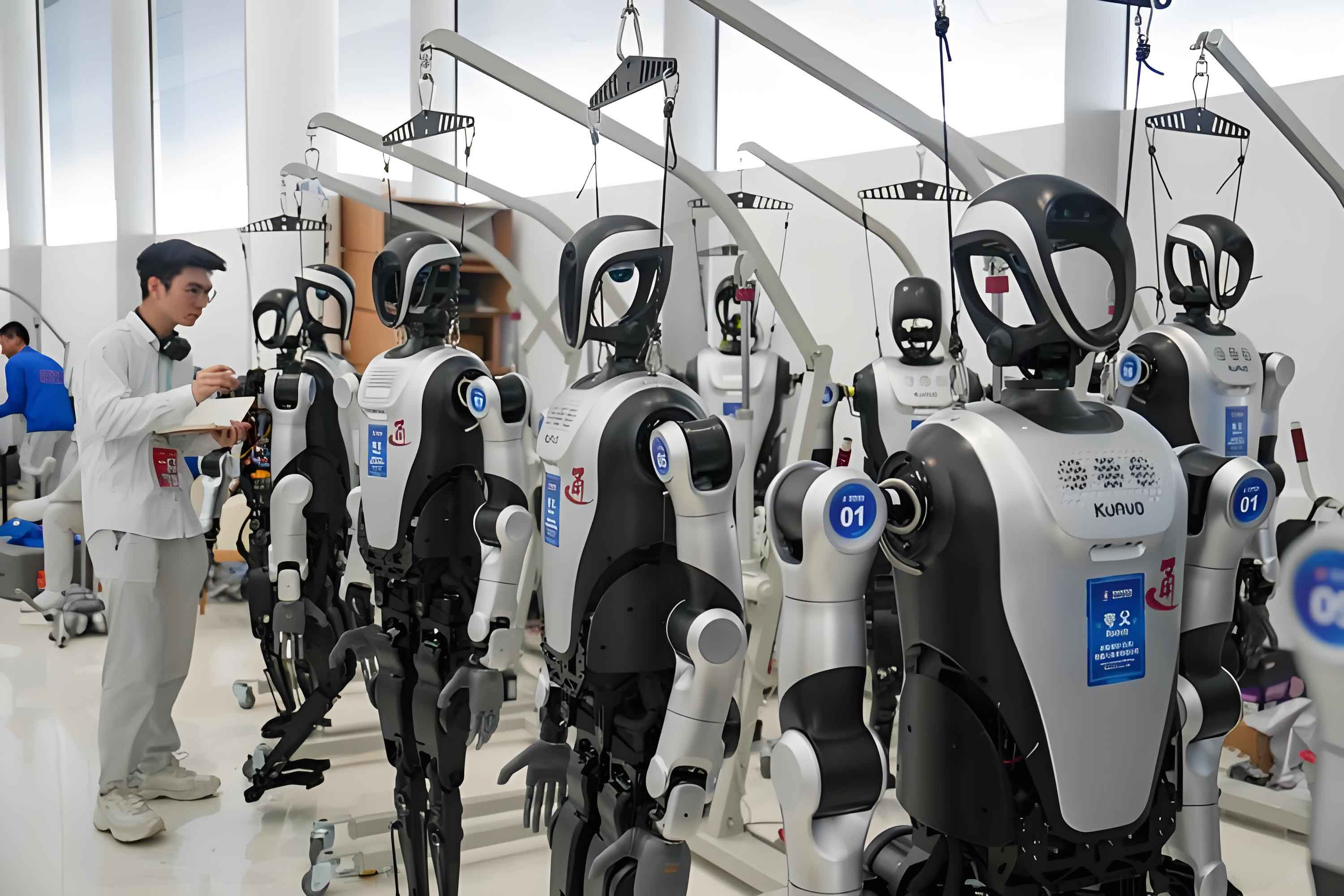
The scenario list was especially significant for humanoid robot developers. A humanoid robot system must operate in unstructured or semi-structured environments, which means it needs training data from real operations. A factory floor, a logistics center, a retail store, a hotel, a restaurant, or a hospital can provide different kinds of challenges. These environments are not simply demonstration venues. They are sources of operational data, failure cases, human-robot interaction experience, and workflow integration knowledge. For humanoid robot companies, access to such scenarios can shorten iteration cycles and improve product reliability.
Henan’s manufacturing base can support humanoid robot development in several ways. Precision manufacturing, sensors, motors, and other supply chain capabilities are relevant to dexterous hands, joints, actuators, and complete machine production. Logistics networks can support the movement of components and finished humanoid robot units. Commercial retail and tourism can provide service scenarios where humanoid robot systems can be tested in tasks such as simple meal preparation, room cleaning, reception, guidance, and other service functions. The symposium therefore presented Henan not only as a market but also as an industrial and testing partner for humanoid robot enterprises.
3. Beijing Innovation Resources and Henan Application Scenarios Form a Complementary Pair
The cooperation potential between Beijing and Henan is rooted in their different but complementary industrial profiles. Beijing is home to many universities, research institutes, technology companies, and high-level talent. It has strong capabilities in artificial intelligence, embodied large models, robotics software, and core algorithm development. These capabilities are essential for advancing humanoid robot intelligence. However, humanoid robot development also requires hardware iteration, real-scene data, supply chain coordination, and large-scale application testing. Those requirements make regions with diversified manufacturing and rich application scenarios important partners.
Henan’s advantages lie in its industrial diversity and its ability to provide real operational environments. The province has manufacturing categories that span many sectors, and its logistics and commercial networks are extensive. For humanoid robot enterprises, this means access to potential customers, partners, and testbeds across multiple industries. A humanoid robot that works well in one factory may need significant adaptation before it can work in a warehouse, a hotel, or a hospital. Each scenario has different requirements for safety, precision, speed, human interaction, and cost. Henan’s broad scenario base can help humanoid robot companies evaluate their systems under varied conditions.
The symposium’s focus on precise docking shows that both sides are seeking practical outcomes. Beijing-Tianjin enterprises can bring technology, talent, and innovation-driven product development. Henan can bring scenarios, supply chain resources, capital platforms, and industrial carriers. When these resources are combined, humanoid robot projects can be tested, improved, and scaled with greater efficiency. The event therefore served as a platform for matching the innovation side of humanoid robot development with the application side of humanoid robot deployment.
The discussions also highlighted the importance of data. Humanoid robot intelligence depends on large-scale, high-quality data from real operations. In a laboratory, a humanoid robot may perform well under controlled conditions. In a real factory or service environment, it must handle variability, unexpected events, human behavior, and changing workflows. Real-scene data collection and dataset construction are therefore critical. Henan’s willingness to open real operational scenarios can support the construction of humanoid robot datasets and the training of embodied models. This is one of the reasons why the phrase “Beijing has innovation, Henan has scenarios” resonated so strongly at the symposium.
4. JD Technology Proposes Real-World Scenarios and Data Collection for Humanoid Robot Development
At the symposium, the person responsible for the embodied intelligence segment at JD Technology was the first enterprise representative to outline a cooperation vision. The company expressed hope that Henan would open real operational scenarios in advantageous fields such as intelligent manufacturing, transportation and logistics, and commercial retail. Such scenarios would support real-scene training and dataset construction for embodied intelligence and humanoid robot systems. The company also proposed jointly building a large-scale data collection system with the Zhongyuan Heterogeneous Humanoid Robot Training Ground.
This proposal is closely connected to the needs of humanoid robot development. Humanoid robots require data from manipulation, navigation, human-robot interaction, and task execution. In logistics and retail environments, humanoid robot systems can encounter tasks such as picking, sorting, shelf replenishment, customer guidance, and inventory-related operations. In intelligent manufacturing, humanoid robot systems may be tested in material handling, quality inspection support, machine tending, and other operations. These scenarios generate data that can be used to train embodied models and improve the robustness of humanoid robot systems.
JD Technology’s representative stated that the company would make scenarios real, data real, and services real in order to promote technology implementation. That commitment aligns with the symposium’s emphasis on substantive cooperation. For humanoid robot enterprises, real-scene data is not a secondary resource. It is a core input for improving perception, planning, control, and manipulation. A large-scale data collection system linked to the Zhongyuan Heterogeneous Humanoid Robot Training Ground could provide a structured environment for collecting, labeling, and using data from multiple scenarios. It could also support the training and verification of humanoid robot models before deployment.
The proposal also shows how a platform enterprise can connect multiple parties. JD Technology’s business footprint includes intelligent manufacturing support, transportation and logistics, and commercial retail. These areas can serve as entry points for humanoid robot testing and application. If Henan’s real scenarios are opened in a coordinated way, humanoid robot companies can work with platform enterprises, local manufacturers, logistics operators, and retail partners to design repeatable tasks and collect operational data. This kind of cooperation can help humanoid robot development move from isolated pilots to broader ecosystem-level testing.
5. Enterprises Seek Scalable Scenarios, Data Centers, and Regional Application Centers for Humanoid Robots
More than 10 embodied intelligence enterprise representatives spoke at the symposium, introducing their development status and cooperation needs. Among them were Poke Robot, Deta Yuanchuang, Liuxing Space, Yaoxing Technology, Beijing Tushi Technology, Qiwu Technology, and Zhongke Guiji. Their participation showed the breadth of interest in Henan’s humanoid robot and embodied intelligence opportunities, from dexterous hands and embodied models to service scenarios and regional application centers.
Chen Boguo, President of Zhongke Guiji (Nanjing) Robotics Co., Ltd., stated that the company needs Henan’s large-scale scenarios for replication and deployment. He noted that the company already has industry-level dexterous hands, embodied large models, and mass production delivery capabilities. The company hopes to join with leading enterprises in Henan’s manufacturing and logistics sectors to build replicable benchmark applications for humanoid robot systems. It also hopes to establish a data collection center or regional application center in Henan and to collaborate with precision manufacturing, sensor, and motor supply chain enterprises. In addition, the company is exploring the landing of dexterous hand and complete machine production lines.
This combination of needs is representative of the humanoid robot industry. Dexterous hands are a critical hardware component for humanoid robot manipulation. Embodied large models are central to humanoid robot intelligence. Mass production delivery capability is necessary for commercial scale. However, none of these capabilities can be fully validated without real application scenarios and supply chain support. Henan’s manufacturing and logistics sectors can provide both. A data collection center or regional application center in Henan could support humanoid robot training, testing, and localization. Collaboration with precision manufacturing, sensor, and motor suppliers could strengthen the hardware ecosystem for humanoid robot production.
Yang Ruda, Chief Operating Officer of Poke Robot, said that the company plans to land service-sector scenarios next year. The company can rely on Henan’s rich tourism resources and apply humanoid robot systems first in scenarios such as simple meal preparation and room cleaning. It also plans to use a new crowdsourced data collection model that enters ordinary households. This model could not only create local employment opportunities but also continuously feed research and development investment. For humanoid robot development, household and service scenarios are among the most challenging because they involve human interaction, safety, variability, and user expectations. Starting with relatively structured service tasks such as simple meal preparation and room cleaning can provide useful data and operational experience for humanoid robot systems.
The crowdsourced data collection model is particularly relevant to humanoid robot training. Humanoid robots need data from homes, restaurants, hotels, and other everyday environments. However, collecting such data at scale is difficult. A crowdsourced approach can involve ordinary users and workers in data collection, creating a distributed network of real-world data sources. If implemented carefully, this model can support humanoid robot model training while creating local employment. It can also help humanoid robot companies understand how ordinary users interact with robots and what tasks are most valuable in real service settings.
The interest expressed by multiple enterprises shows that Henan’s scenario resources are not limited to one sector. Humanoid robot companies are looking at manufacturing, logistics, retail, tourism, household services, and other areas. Each sector can provide different types of data and validation opportunities. A humanoid robot that is trained in a factory may need further training before it can work in a hotel. A humanoid robot that performs well in a structured logistics center may face new challenges in a household environment. Henan’s broad economy can therefore serve as a multi-scenario testing ground for humanoid robot development.
6. Capital and Industry Seek Two-Way Binding Around Humanoid Robot Growth
During the exchange, some enterprises expressed hope that Henan state-owned capital could participate in their new rounds of financing. They proposed a strategic cooperation model based on “orders plus scenarios plus production capacity landing,” aiming to achieve two-way binding between capital and industry. This request reflects the capital-intensive nature of humanoid robot development. Humanoid robot companies need sustained investment in research and development, hardware iteration, data collection, testing, and production capacity. At the same time, investors need clear pathways to industrial landing and commercial returns.
The “orders plus scenarios plus production capacity landing” model is designed to connect these needs. Orders can provide market traction for humanoid robot products. Scenarios can provide testing and validation environments. Production capacity landing can bring manufacturing investment and local employment. When combined with capital participation, these elements can create a more stable cooperation framework between a humanoid robot enterprise and a regional industrial ecosystem. For Henan, this model can help attract high-potential humanoid robot companies while ensuring that their operations, supply chains, and application projects are connected to the local economy.
The symposium therefore went beyond a simple policy presentation. It explored how capital can be used to support the entire humanoid robot value chain, from technology development to scenario validation and production. This approach is consistent with the broader shift from one-way promotion to two-way engagement. Henan is not only inviting companies to invest; it is also positioning itself as a long-term partner that can provide scenarios, capital, industrial carriers, and full-lifecycle services. For humanoid robot enterprises, this kind of partnership can reduce the risks associated with market entry and scale-up.
7. Henan Investment Group Offers Full-Cycle Services for Humanoid Robot Projects
The enterprises’ financing needs aligned with the full-cycle “accompanying” service model already built by Henan Investment Group. The group has initiated and established industry funds, special funds, and merger and acquisition funds related to Huirong Artificial Intelligence and embodied intelligence. It has invested in more than 20 projects covering computing power, models, applications, embodied intelligence, and other segments. This investment portfolio gives the group a broad view of the humanoid robot and embodied intelligence ecosystem, from foundational computing power and models to applications and hardware.
Henan Investment Group is also leading the construction of the country’s third heterogeneous humanoid robot training ground. The training ground has achieved a full closed loop of data collection, algorithm training, and scenario verification. It has attracted many embodied intelligence enterprises to participate in ecosystem co-building. For humanoid robot development, this kind of training ground is a critical infrastructure. It allows humanoid robot companies to collect data in controlled and semi-controlled environments, train embodied models, and verify performance before moving to real application scenarios. The closed-loop operation of data collection, algorithm training, and scenario verification can help shorten the development cycle of humanoid robot systems.
The training ground also supports cooperation among multiple stakeholders. Humanoid robot enterprises can use the facility to test their systems. Component suppliers can collaborate on hardware integration. Application-side partners can provide scenario requirements. Investors can evaluate technical progress and commercial potential. Research institutions can contribute algorithms and talent. This ecosystem approach is important because humanoid robot development is too complex for any single company to handle alone. It requires coordination across hardware, software, data, testing, and application domains.
Henan Investment Group’s role as an “accompanying” partner reflects a longer-term view of humanoid robot industry development. The group is not only providing financing but also supporting the construction of infrastructure, the formation of industrial clusters, and the connection between technology providers and application scenarios. For humanoid robot companies, this can be valuable because the path from prototype to mass production is long and capital-intensive. A full-cycle service model can provide support at different stages, from early research and development to pilot testing, production capacity expansion, and market deployment.
8. Henan’s Future Industry Outreach Expands from the Yangtze River Delta to the Greater Bay Area and the Beijing-Tianjin Region
The Beijing symposium was part of a broader effort by Henan to promote future-industry cooperation in 2026. In April, Henan held the Henan-Shanghai Future Industry Entrepreneurs Symposium in Shanghai. In September, it held the Henan-Guangdong Future Industry Cooperation and Exchange Matchmaking Event in Guangzhou. The October event in Beijing was the third proactive “go out” future-industry matchmaking activity of the year. From the Yangtze River Delta to the Greater Bay Area and then to the Beijing-Tianjin region, Henan has been extending invitations to high-quality enterprises, projects, and teams, encouraging them to pay attention to Henan and invest in Henan.
This sequence of activities shows a structured approach to future-industry investment promotion. Different regions have different strengths. Shanghai and the Yangtze River Delta are important centers for advanced manufacturing, artificial intelligence, and international business. The Greater Bay Area is known for electronics, hardware innovation, and commercialization. The Beijing-Tianjin region has dense research resources, universities, and technology enterprises. By engaging with each region, Henan can connect with different parts of the humanoid robot and embodied intelligence value chain. Beijing-Tianjin enterprises can bring frontier research and talent. Yangtze River Delta and Greater Bay Area enterprises can bring manufacturing, supply chain, and commercialization experience.
For humanoid robot development, this multi-region outreach is significant. Humanoid robot systems require a combination of artificial intelligence, mechanical engineering, electronics, sensors, actuators, control systems, and application knowledge. No single region or company has all the necessary capabilities. By building connections across regions, Henan can create a broader innovation and supply chain network for humanoid robot enterprises. The Beijing symposium was therefore not an isolated event but part of a larger strategy to position Henan as an open highland for embodied intelligence and humanoid robot industrialization.
9. Leading Humanoid Robot Companies and Local Manufacturers Build a Growing Industrial Presence in Henan
Henan’s efforts are already attracting domestic leading embodied intelligence enterprises. According to the information presented at the symposium, Zhuoyide has built a humanoid robot production line in Henan. UBTECH has created the country’s first robot embedded industry town. Zhongqing Robot’s production base phase I has been put into production. AgiBot’s central China embodied intelligence industrial base is under construction. These projects show that humanoid robot and embodied intelligence companies are beginning to establish a physical presence in Henan, not only through sales or pilot projects but also through production lines, industrial towns, and industrial bases.
Local manufacturers are also contributing to the humanoid robot ecosystem. CITIC Heavy Industries and Xiangyu Medical are among the local enterprises that have launched a batch of practical humanoid robot products in fields such as special operations and medical rehabilitation. These products show that humanoid robot technology can be adapted to specific industry needs. Special operations may require robust mobility, remote operation, and resistance to harsh environments. Medical rehabilitation may require safe human-robot interaction, precise control, and clinical validation. The involvement of local manufacturers can strengthen the humanoid robot supply chain and application ecosystem in Henan.
The presence of leading enterprises and local manufacturers creates opportunities for further cooperation. Humanoid robot companies can work with local manufacturers on components, complete machines, and application-specific products. They can use Henan’s production capacity and supply chain to scale up. They can also access local application scenarios in manufacturing, logistics, healthcare, and other sectors. For Henan, the growth of the humanoid robot industry can support industrial upgrading, employment, and technological capability. For humanoid robot enterprises, Henan can serve as a base for production, testing, and market expansion.
| Cooperation area | What was presented or proposed at the symposium | Relevance to humanoid robot development |
|---|---|---|
| Policy and industrial-chain matching | Henan presented support policies, industrial-chain supporting capacity, and scenario lists to Beijing-Tianjin enterprises, universities, and research institutions. | Provides humanoid robot companies with a clear framework for deployment, supply chain coordination, and local partnership. |
| Real-world application scenarios | Henan’s advantages in intelligent manufacturing, transportation and logistics, commercial retail, tourism, and service sectors were highlighted. | Offers humanoid robot systems real-scene training, testing, and validation opportunities across multiple industries. |
| Data collection and training infrastructure | JD Technology proposed jointly building a large-scale data collection system with the Zhongyuan Heterogeneous Humanoid Robot Training Ground. | Supports humanoid robot dataset construction, embodied model training, and real-scene verification. |
| Replicable benchmark applications | Enterprises expressed interest in manufacturing, logistics, simple meal preparation, room cleaning, and other service scenarios. | Helps humanoid robot companies build repeatable use cases and move from pilot projects to commercial deployment. |
| Capital and industry linkage | Some enterprises sought Henan state-owned capital participation in new financing rounds through an “orders plus scenarios plus production capacity landing” model. | Connects humanoid robot financing with market demand, scenario validation, and local production capacity. |
| Full-cycle investment services | Henan Investment Group has established related funds and invested in more than 20 projects covering computing power, models, applications, and embodied intelligence. | Provides long-term capital and ecosystem support for humanoid robot companies at different development stages. |
| Training ground and closed-loop verification | Henan Investment Group is leading construction of the country’s third heterogeneous humanoid robot training ground with a data collection, algorithm training, and scenario verification loop. | Strengthens humanoid robot testing infrastructure and supports ecosystem co-building among enterprises and research institutions. |
| Existing industrial presence | Zhuoyide, UBTECH, Zhongqing Robot, AgiBot, CITIC Heavy Industries, and Xiangyu Medical were cited for production lines, industrial bases, industrial towns, and practical humanoid robot products. | Demonstrates a growing humanoid robot industrial base in Henan and creates opportunities for supply chain and application cooperation. |
10. From Promotion to Two-Way Engagement: Henan Positions Itself as an Investor and Long-Term Partner
The symposium illustrated a shift from one-way promotion to two-way engagement. In the past, regional investment promotion often focused on policy presentations and invitations. The Henan-Beijing event, by contrast, focused on matching specific enterprise needs with specific regional resources. Humanoid robot companies spoke about their technology, products, and cooperation requirements. Henan representatives presented policies, supply chains, scenarios, capital platforms, and industrial carriers. The discussion was structured around how to make cooperation real and how to support humanoid robot projects through the full lifecycle.
This approach reflects Henan’s effort to use the role of an “investor” and its full-lifecycle service capacity to graft the most promising future seeds onto the industrial soil of the Central Plains. For humanoid robot enterprises, the attraction is not only market size but also the availability of scenarios, capital, production capacity, and long-term partnership. For Henan, the goal is to build an open highland for the embodied intelligence industry and to attract high-quality humanoid robot enterprises, projects, and teams. The symposium in Beijing was therefore both a matchmaking event and a signal that Henan intends to compete for humanoid robot and embodied intelligence opportunities through concrete industrial cooperation.
The potential outcomes of such cooperation could extend across the humanoid robot value chain. At the technology level, Beijing-Tianjin enterprises can bring embodied models, algorithms, dexterous hand technology, and talent. At the manufacturing level, Henan can provide precision manufacturing, sensors, motors, production lines, and industrial parks. At the application level, Henan can provide factories, logistics centers, retail stores, hotels, tourism sites, hospitals, and households. At the capital level, Henan Investment Group and related funds can support financing, mergers and acquisitions, and project incubation. At the data level, the Zhongyuan Heterogeneous Humanoid Robot Training Ground and real-scene cooperation can support dataset construction and model training. When these elements are connected, humanoid robot development can become more integrated and commercially sustainable.
The event also underlined the importance of open cooperation in the humanoid robot industry. Humanoid robot systems are complex, and their development requires contributions from many disciplines and sectors. No single region can provide all the necessary resources. Beijing’s innovation density, Henan’s scenario richness, and the manufacturing and commercialization capabilities of other regions can complement one another. By engaging with Shanghai, Guangzhou, and Beijing in 2026, Henan has shown that it is building a multi-regional cooperation network for future industries. The humanoid robot sector can benefit from this network because it needs both frontier innovation and large-scale application.
For enterprises, the key question is how to move from intention to implementation. The symposium provided a starting point by bringing together the main stakeholders. The next step is to translate the discussions into concrete projects. This may involve joint data collection systems for humanoid robot training, benchmark application projects in manufacturing and logistics, service robot pilots in tourism and household scenarios, dexterous hand and complete machine production line cooperation, and financing arrangements linked to orders, scenarios, and production capacity. Each of these areas can contribute to the growth of the humanoid robot ecosystem in Henan and the broader Beijing-Tianjin-Henan cooperation framework.
The humanoid robot industry is still at an early stage of large-scale commercialization, but the direction is clear. Advances in embodied intelligence, dexterous manipulation, mobility, and human-robot interaction are expanding the range of possible applications. Regions that can provide real scenarios, reliable supply chains, patient capital, and long-term policy support will be better positioned to attract humanoid robot enterprises. Henan’s combination of manufacturing diversity, market scale, scenario resources, capital platforms, and training infrastructure gives it a distinctive role in this process. Beijing’s innovation resources and enterprise clusters provide the technological energy that can drive humanoid robot development forward.
The 2026 Henan-Beijing Embodied Intelligence Industry Symposium therefore represented more than a single meeting. It showed how a region can engage with the humanoid robot industry through a structured combination of policy, scenarios, capital, supply chain, and industrial carriers. It also showed how humanoid robot enterprises can use regional cooperation to access the resources they need for product iteration and commercialization. The message from the event was clear: Beijing has innovation, Henan has scenarios, and the two sides see strong potential for humanoid robot and embodied intelligence cooperation. As follow-up projects take shape, that potential can be converted into production lines, data systems, benchmark applications, and a more open industrial ecosystem for humanoid robot development.