
The global demand for lemons is consistently rising, necessitating more efficient and sustainable harvesting methods. Traditional manual harvesting is labor-intensive and costly, creating a significant impetus for the development of automated agricultural systems. The core component of such a robotic harvester is its end-effector—the device responsible for the delicate tasks of grasping, detaching, and handling the fruit. A primary challenge in designing an end-effector for lemon harvesting is to prevent damage to the fruit’s delicate skin, which directly impacts market value. This article details the innovative design, theoretical analysis, and simulation of a novel bio-inspired end-effector specifically developed for the automatic harvesting of lemons. Our design philosophy integrates functional decomposition, bio-inspired design principles, and systematic simulation to create an end-effector that performs reliable, low-damage picking operations.
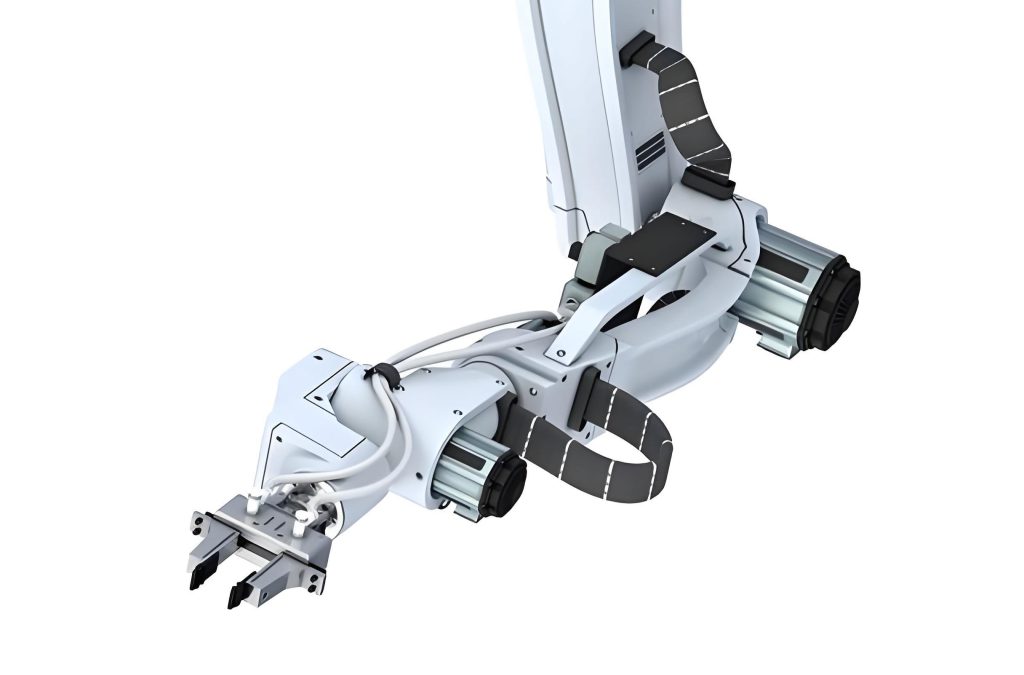
The overall function of the harvesting end-effector is decomposed into three primary sub-functions: clamping, cutting, and posture adjustment. The clamping mechanism must securely hold the lemon without causing bruising or puncture. The cutting mechanism must cleanly sever the pedicel (fruit stem). Finally, the posture adjustment mechanism must orient the cutting plane to ensure a perpendicular cut relative to the pedicel’s growth angle, facilitating a clean separation. The integration of these three functions into a single, coordinated end-effector forms the basis of our robotic solution.
Design of the Key Mechanisms
1. Clamping Mechanism: A Fin-Inspired, Underactuated Gripper
The clamping mechanism of the end-effector is designed for gentle yet secure grasping. It employs an underactuated three-fingered configuration, where a single servo motor drives all three fingers simultaneously. This simplifies control and reduces the number of required actuators. The fingers are arranged in a translational motion structure, guided by cylindrical sliders within grooves on a base plate.
The core innovation lies in the design of the fingertip pads. Inspired by the biomechanics of a fish’s caudal fin rays, which exhibit compliant bending and energy dissipation under load, we developed a D-shaped, flexible bio-inspired pad. When the end-effector grips the lemon, these compliant pads conform to the irregular surface wrinkles of the fruit, distributing contact pressure evenly and significantly reducing the risk of skin damage compared to a rigid gripper. The geometry ensures stable three-point contact.
Force Analysis for Stable Grasping: For a stable three-fingered grip where all fingers apply equal force \( F \), the angles between them must be 120° to achieve static force equilibrium. The minimum clamping force \( F_{min} \) required to prevent the lemon from slipping can be derived from the balance between friction and gravity:
$$ \sum F_y = 0 \Rightarrow 3F \sin(30^\circ) \mu \ge k G $$
$$ F_{min} = \frac{k G}{3 \mu \sin(30^\circ)} = \frac{k G}{1.5 \mu} $$
where \( G \) is the weight of the lemon, \( \mu \) is the coefficient of friction between the pad and the lemon skin, and \( k \) is a safety factor. The mechanism’s central aperture has a diameter of 80 mm, allowing it to accommodate lemons with diameters ranging from 40 to 80 mm.
| Component | Parameter | Value / Description |
|---|---|---|
| Finger Guide | Slider Radius | 2 mm |
| Guide Groove Length | 20 mm | |
| Finger Travel Range | 0 – 20 mm | |
| Clamping Aperture | Diameter | 80 mm |
| Gripping Range | Fruit Diameter | 40 – 80 mm |
2. Cutting Mechanism: A Beetle-Inspired, Rotary Cutter
The cutting mechanism of the end-effector is responsible for severing the pedicel. We adopted a rotary cutting scheme where three blades mounted on a rotating platform perform a scissoring action. A key design decision was selecting a single-bevel blade over a double-bevel blade. A force analysis demonstrates that for achieving the same cutting effect, a double-bevel blade requires a greater cutting force.
Let \( F_1 \) be the component of the reaction force normal to the blade face, \( \theta \) be the friction angle, and \( \alpha \) be the included angle of a double-bevel blade edge. The required driving force \( F_2 \) for the double-bevel blade and \( F_5 \) for the single-bevel blade (with edge angle \( \alpha \)) can be simplified and compared. The difference \( \Delta F \) is found to be positive for practical angles, confirming the advantage of the single-bevel design for our end-effector:
$$ \Delta F = F_2 – F_5 = \frac{2F_1 \sin(\alpha/2 + \theta)[\cos \theta – \cos(\alpha/2 + \theta)]}{\cos^2 \theta} > 0 $$
for \( 0 \le \alpha/2 \le \pi/4 \) and \( 0 \le \theta \le \pi/2 \).
Further inspired by the efficient, vibration-dampening tooth structure of a longhorn beetle’s mandibles, we designed a bio-inspired tooth profile for the blade’s cutting edge. This profile aims to enhance cutting stability, optimize stress distribution during the cut, and minimize harmful vibrations transmitted to the fruit.
Gear Transmission System: A planetary gear system ensures synchronized rotation of all three blades. A central servo motor drives a primary pinion gear. This pinion engages with an internal ring gear, which in turn drives three smaller planetary gears, each connected to a blade. This design provides a compact and reliable transmission for the cutting action of the end-effector.
Torque Transmission Analysis: The relationship between the input torque \( M_1 \) from the motor and the output torque \( M_2 \) at each blade shaft is determined by the gear train’s transmission ratio and efficiency \( \eta \):
$$ M_2 = \eta \cdot \frac{z_2 \cdot z_4}{z_1 \cdot z_3} \cdot M_1 $$
where \( z_1, z_2, z_3, z_4 \) are the tooth counts of the primary pinion, internal ring gear (outer), internal ring gear (inner), and planetary gear, respectively. With our selected gear parameters and an assumed efficiency of 95%, the relationship simplifies to \( M_2 \approx 0.943 M_1 \).
| Gear | Symbol | Teeth (z) | Module (mm) |
|---|---|---|---|
| Primary Pinion | \( z_1 \) | 19 | 0.8 |
| Internal Ring (Outer) | \( z_2 \) | 152 | 0.8 |
| Internal Ring (Inner) | \( z_3 \) | 137 | 0.8 |
| Planetary Gear | \( z_4 \) | 17 | 0.8 |
3. Posture Adjustment Mechanism: A 3-DOF Parallel Platform
To ensure the cutting plane of the end-effector is always perpendicular to the pedicel, a posture adjustment mechanism is integrated between the clamping unit and the cutting unit. This mechanism is based on a 3-DOF (Degrees of Freedom) parallel platform architecture. It consists of a moving platform (which holds the cutting mechanism) and a fixed platform (connected to the clamping mechanism), linked by three identical supporting limbs.
Each limb contains a spherical joint at the moving platform, a revolute joint at the fixed platform, and a prismatic joint (linear actuator) in between, configured as an offset slider-crank mechanism. This arrangement allows the moving platform to tilt about the x and y axes and move linearly along the z-axis, providing the necessary orientation adjustments for the end-effector’s cutter head. Kinematic analysis and simulation confirm that the mechanism operates without interference even at its extreme motion limits, ensuring reliable performance during the harvesting cycle.
Simulation and Analysis
To validate the design concepts and performance of the proposed bio-inspired end-effector, comprehensive finite element and kinematic simulations were conducted.
1. Finite Element Analysis of the Clamping Process
A simulation was performed to analyze the stress distribution in the bio-inspired flexible pad during clamping. The materials were modeled with the properties listed below.
| Material | Density (kg/m³) | Elastic Modulus (MPa) | Poisson’s Ratio |
|---|---|---|---|
| Flexible Pad (Rubber) | 900 | 8 | 0.49 |
| Lemon Fruit | 1060 | 50 | 0.30 |
The results showed that the D-shaped, fin-inspired structure effectively dissipated contact energy. The maximum von Mises stress in the pad was 0.708 MPa, which is significantly lower than the yield strength of typical rubber materials (~10 MPa). This confirms that the clamping mechanism of the end-effector applies a safe, non-damaging pressure to the lemon fruit.
2. Finite Element Analysis of the Cutting Process
The cutting performance of the bio-inspired blade was compared against a conventional straight blade. The simulation evaluated two key metrics: the maximum stress on the pedicel and the vibration amplitude of the pedicel at the instant of severance. Lower vibration amplitude is critical to prevent damage at the fruit’s calyx.
| Material | Density (kg/m³) | Elastic Modulus (MPa) | Poisson’s Ratio |
|---|---|---|---|
| Blade (High-Speed Steel) | 8160 | 210,000 | 0.30 |
| Lemon Pedicel | 700 | 200 | 0.30 |
The simulation yielded compelling results:
- Conventional Blade: Max. Pedicel Stress = 11.034 MPa; Vibration Amplitude = 18.315 mm.
- Bio-inspired Blade: Max. Pedicel Stress = 11.518 MPa; Vibration Amplitude = 3.9965 mm.
While both blades induced similar levels of stress in the pedicel, the bio-inspired blade reduced the vibration amplitude by approximately 78%. This dramatic reduction demonstrates the superior cutting stability and low-impact characteristic of the beetle-inspired tooth design, which is a crucial advantage for the end-effector’s goal of high-quality, low-damage harvesting.
3. Kinematic Simulation of the Posture Adjustment Mechanism
The dynamic performance of the posture adjustment mechanism within the end-effector was analyzed using multi-body dynamics software. A simulation was set up where one of the three linear actuators (slider-crank mechanisms) extended to its maximum stroke over 1.5 seconds. The linear velocity and acceleration of the corresponding slider were measured.
The results showed a smooth velocity profile for the slider, with no abrupt changes. The acceleration curve remained very low, with a peak below 0.1 m/s². A minor, transient oscillation in acceleration was observed around 0.9 seconds, attributable to the coordinated motion coupling between the three supporting limbs of the parallel platform. This oscillation had no detrimental effect on the smooth velocity profile. The overall smooth motion confirms the kinematic feasibility and dynamic stability of the posture adjustment system for the intended application in the harvesting end-effector.
Conclusion
This article presented the design and simulation analysis of a novel bio-inspired end-effector for robotic lemon harvesting. By decomposing the harvesting task into clamping, cutting, and posture adjustment functions, and applying principles from biomechanics (fish fins and beetle mandibles), we developed an integrated solution. The key features of this end-effector include an underactuated, fin-inspired flexible gripper for low-damage clamping; a synchronized rotary cutter with a beetle-inspired tooth profile for stable, low-vibration cutting; and a 3-DOF parallel platform for precise orientation of the cutting plane.
Finite element simulations validated the mechanical safety of the clamping interface and demonstrated the significant advantage of the bio-inspired blade in suppressing pedicel vibration by 78% compared to a conventional design. Kinematic simulations confirmed the smooth and stable operation of the posture adjustment mechanism. The collective results verify the feasibility of the proposed end-effector design. This work provides a reference for the application of biomimetic and systematic design methodologies in agricultural robotics, contributing to the development of advanced,精细化harvesting end-effectors for delicate fruits. Future work will focus on the detailed structural analysis of the full assembly, lightweight optimization, and the construction and field testing of a physical prototype to further validate the performance of this bio-inspired end-effector.