
In the aviation industry, the detection of cracks in aircraft structures is a critical task that spans the entire lifecycle of the vehicle. Fatigue cracks, which account for 50% to 90% of structural failures, pose a significant risk due to their hidden and sudden nature. If left undetected, these cracks can lead to catastrophic events, compromising safety during service, ground strength tests, and fatigue experiments. Traditional inspection methods, such as visual checks and ultrasonic testing, often fall short in narrow and inaccessible spaces like aircraft box sections or inlet ducts. These areas are either too confined for human entry or require specialized personnel, leading to inefficiencies and potential hazards. To address this challenge, we have developed a novel approach that leverages bionic robot technology for crack detection in narrow spaces. This article presents our comprehensive research on a bionic robot platform capable of navigating constrained environments, integrated with advanced image processing and deep learning algorithms for crack identification. By combining robotics and artificial intelligence, we aim to enable rapid, accurate, and autonomous inspections, thereby enhancing aircraft maintenance and safety protocols.
The core of our system revolves around a bionic robot designed to mimic biological locomotion, allowing it to traverse complex terrains within narrow spaces. The bionic robot is equipped with adaptive mechanisms, sensors, and control systems that enable stable movement and obstacle avoidance. We have conducted extensive studies on the robot’s kinematics, gait planning, and environmental perception, ensuring it can operate effectively in confined areas such as aircraft wing boxes. Simultaneously, we have developed a crack recognition algorithm based on Mask R-CNN (Region-Based Convolutional Neural Network), which processes images captured by the bionic robot to detect and measure cracks with high precision. Our methodology involves image preprocessing techniques, data augmentation, and model optimization to improve robustness and accuracy. In this article, we detail the design and implementation of the bionic robot platform, the crack detection algorithm, and experimental validation in a simulated aircraft box section. We also discuss future directions for enhancing the system’s capabilities and applications in industrial settings.
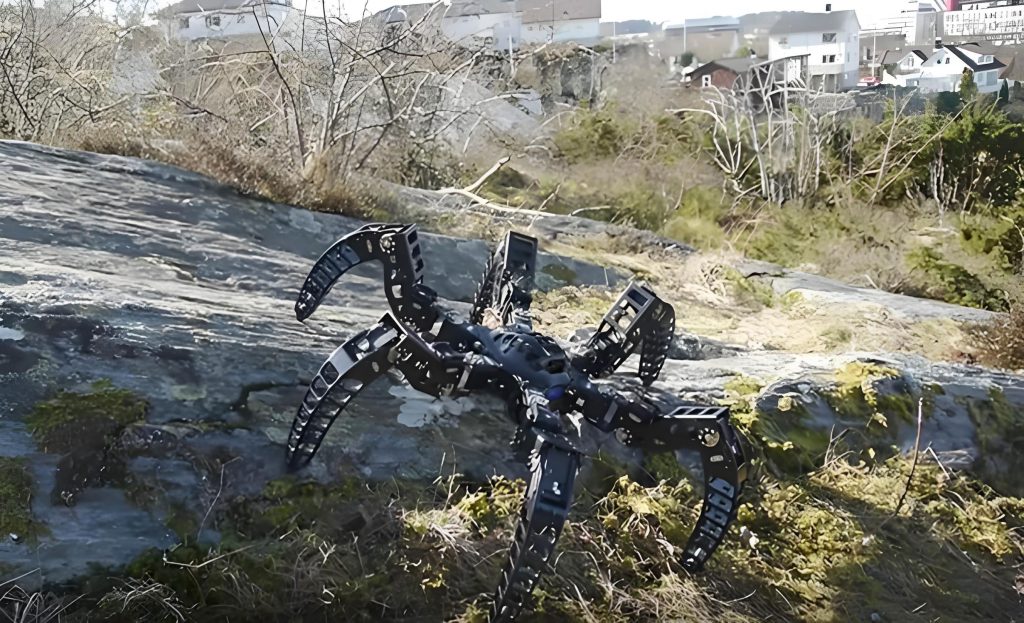
The overall scheme for narrow space crack detection involves two main components: the bionic robot platform and the image-based crack recognition system. The bionic robot is tasked with entering narrow spaces, following predefined paths, and capturing high-quality images of potential crack sites. We selected a typical aircraft central wing box as the test environment due to its confined structure and relevance to real-world scenarios. The robot’s route planning includes linear motion, obstacle crossing, and定点停顿 (fixed-point pauses) for image acquisition. To achieve this, we designed the bionic robot with a compact form factor, flexible footpads, and multiple degrees of freedom. The control system incorporates sensors for environmental awareness, such as laser rangefinders and tactile sensors, enabling autonomous navigation. On the algorithmic side, we focus on processing the images to identify cracks using deep learning. The workflow begins with image preprocessing to reduce noise and enhance features, followed by the application of a Mask R-CNN model for instance segmentation and crack measurement. We have also implemented a user interface for result visualization. This integrated approach ensures that the bionic robot can not only access hard-to-reach areas but also provide actionable data on crack dimensions and locations.
To quantify the system’s parameters, we present key aspects in Table 1, which summarizes the bionic robot specifications and crack detection algorithm metrics. This table highlights the interdisciplinary nature of our research, combining robotics and computer vision.
| Component | Parameter | Value or Description |
|---|---|---|
| Bionic Robot | Degrees of Freedom | 12 active joints |
| Footpad Material | Flexible silicone rubber | |
| Key Sensors | Laser (VL53L0x), IMU (JY901L), tactile (LDT0-028K) | |
| Motion Modes | Linear walk, obstacle crossing, pause for imaging | |
| Crack Detection Algorithm | Model Architecture | Mask R-CNN with ResNet backbone |
| Image Preprocessing | Filtering, grayscale conversion, edge detection | |
| Training Data | Augmented dataset with 5000+ annotated images | |
| System Performance | Crack Detection Rate | 100% in test samples |
| Length Measurement Error | Average 1.39 mm, maximum 3.73 mm |
The design and development of the bionic robot platform were informed by biological principles, particularly the locomotion of creatures like geckos that excel in narrow spaces. Our bionic robot features a quadrupedal structure with 12 active degrees of freedom, allowing for versatile movement patterns. The kinematic model of the robot is derived using the Denavit-Hartenberg (D-H) convention, which defines coordinate frames for each joint. For a single leg, the forward kinematics equation is given by the transformation matrix product:
$$ T = A_1 \cdot A_2 \cdot A_3 \cdot A_4 $$
where $A_i$ represents the homogeneous transformation matrix for joint $i$. The inverse kinematics, essential for control, is solved through geometric and algebraic methods to determine joint angles for desired foot positions. The bionic robot’s footpads are made of a custom high-temperature vulcanized silicone rubber, providing adhesion and shock absorption. This material enhances the robot’s stability on uneven surfaces, a critical factor in narrow environments. The sensor suite includes laser distance sensors for obstacle detection, an inertial measurement unit (IMU) for posture control, and tactile sensors for contact feedback. These components enable the bionic robot to perceive its surroundings and adjust its gait accordingly. We implemented a dynamic balancing algorithm that uses sensor data to maintain stability during motion. The gait planning involves generating sequences of leg movements for different terrains, such as walking or climbing over obstacles. The bionic robot’s ability to pause at specific points is crucial for image acquisition, ensuring that cracks are captured from optimal angles and distances.
In terms of control, we developed a hierarchical system where high-level path planning is combined with low-level motor commands. The bionic robot follows a predefined route within the narrow space, but it can also adapt to unexpected obstacles using real-time sensor data. The motion control equations are based on proportional-integral-derivative (PID) controllers for joint actuators, with feedback from encoders and force sensors. For example, the torque $\tau$ for a joint is computed as:
$$ \tau = K_p e(t) + K_i \int e(t) dt + K_d \frac{de(t)}{dt} $$
where $e(t)$ is the error between desired and actual positions, and $K_p$, $K_i$, $K_d$ are tuning gains. This ensures precise movement of the bionic robot even in constrained spaces. Additionally, we incorporated a behavior strategy module that decides when to switch between gaits based on environmental cues. The integration of these systems allows the bionic robot to autonomously navigate and perform inspection tasks without human intervention, showcasing the potential of bionic robots in industrial applications.
The crack recognition algorithm is a pivotal component of our system, designed to analyze images captured by the bionic robot. We employ a deep learning approach using Mask R-CNN, which excels at instance segmentation by generating both bounding boxes and pixel-wise masks for detected objects. The algorithm workflow consists of several stages: image preprocessing, model inference, and post-processing for crack measurement. First, raw images from the bionic robot often contain noise due to poor lighting or motion blur. We apply preprocessing techniques to enhance image quality, including Gaussian filtering for noise reduction and Canny edge detection for feature extraction. The preprocessing steps can be represented mathematically. For Gaussian filtering, the convolution operation is:
$$ G(x,y) = \frac{1}{2\pi\sigma^2} e^{-\frac{x^2+y^2}{2\sigma^2}} $$
where $\sigma$ is the standard deviation, and the image $I$ is convolved with $G$ to produce a smoothed image $I’$. Edge detection uses gradient operators, such as the Sobel operator, to highlight cracks. After preprocessing, the images are fed into the Mask R-CNN model. The architecture includes a backbone network (e.g., ResNet) for feature extraction, a region proposal network (RPN) for generating candidate regions, and heads for classification, bounding box regression, and mask prediction. The loss function for training combines multiple objectives:
$$ L = L_{cls} + L_{box} + L_{mask} $$
where $L_{cls}$ is classification loss, $L_{box}$ is bounding box regression loss, and $L_{mask}$ is mask segmentation loss. We trained the model on a dataset of crack images, augmented with techniques like rotation, brightness adjustment, and cropping to improve generalization. The training process involved optimizing weights using stochastic gradient descent with momentum. Once trained, the model can detect cracks in new images and output their locations and masks. To measure crack length, we use a scale calibration method based on a reference object in the image. If a pixel corresponds to a real-world distance $s$ (mm/pixel), the crack length $L$ is computed as:
$$ L = s \times \sqrt{(x_2 – x_1)^2 + (y_2 – y_1)^2} $$
where $(x_1, y_1)$ and $(x_2, y_2)$ are the endpoints of the crack in pixel coordinates. This approach ensures accurate measurements regardless of image resolution or distance.
We validated our integrated system through experiments in a simulated aircraft box section, which replicated the narrow space conditions of a real wing box. The bionic robot was programmed to follow a path through the box, pausing at designated points to capture images of the interior walls. We preset artificial cracks of known lengths on the walls to serve as ground truth. The bionic robot successfully navigated the environment, demonstrating stable locomotion and obstacle avoidance. During the pauses, it used an onboard camera to take images, which were then processed by the crack detection algorithm. The results showed that the bionic robot could access all target areas, and the algorithm achieved a 100% detection rate for cracks ranging from 8 mm to 150 mm in length. The measurement errors were minimal, with an average of 1.39 mm, indicating high precision. We also tested the system’s robustness to variations in lighting and surface textures, and the bionic robot performed reliably under these conditions. The integration of the bionic robot and crack recognition software was seamless, with data flowing from image acquisition to analysis without manual intervention. This experiment confirms the feasibility of using bionic robots for autonomous crack inspection in narrow spaces, offering a scalable solution for aircraft maintenance.
To further illustrate the algorithm’s performance, we present Table 2, which compares different crack detection methods, highlighting the advantages of our bionic robot-based approach. This table emphasizes the synergy between robotics and deep learning.
| Detection Method | Advantages | Limitations | Suitability for Narrow Spaces |
|---|---|---|---|
| Visual Inspection by Humans | Direct interpretation, no equipment needed | Inaccessible areas, subjective errors | Poor |
| Ultrasonic Testing | High accuracy for subsurface cracks | Requires surface contact, limited access | Moderate |
| Traditional Image Processing | Low cost, fast processing | Sensitive to noise, poor for tiny cracks | Good with proper lighting |
| Bionic Robot with Mask R-CNN | Autonomous access, high precision, robust | Complex system integration | Excellent |
In conclusion, our research demonstrates the effectiveness of a bionic robot-based system for crack detection in narrow spaces. The bionic robot platform, with its adaptive design and intelligent control, enables access to confined areas that are challenging for humans or conventional robots. Paired with a advanced crack recognition algorithm using Mask R-CNN, the system achieves accurate identification and measurement of cracks, as validated in aircraft box section experiments. The key innovations include the bionic robot’s kinematic model, sensor fusion for navigation, and a deep learning pipeline for image analysis. However, there are areas for improvement. For instance, the current model may struggle with extremely low-light conditions or highly complex crack patterns. Future work will focus on enhancing the bionic robot’s perception capabilities with additional sensors, such as thermal cameras, and refining the algorithm with more diverse training data. We also plan to implement real-time crack detection on the bionic robot, allowing for immediate feedback during inspections. Moreover, the system could be extended to other industrial applications, such as pipeline inspections or building structure assessments. The bionic robot technology holds great promise for automating hazardous and labor-intensive tasks, ultimately improving safety and efficiency. As we continue to refine this approach, we believe that bionic robots will become indispensable tools in the field of non-destructive testing and beyond.
From a broader perspective, the integration of bionic robots and artificial intelligence represents a significant advancement in robotics. The bionic robot’s ability to mimic biological locomotion allows it to overcome terrain challenges that traditional wheeled or tracked robots cannot. In narrow spaces, this is particularly advantageous, as the bionic robot can adjust its posture and gait to squeeze through openings or climb over obstacles. The use of deep learning for crack detection further enhances the system’s autonomy, reducing the need for human oversight. In our experiments, the bionic robot consistently performed well, but we acknowledge that real-world environments may present additional variables, such as vibration or electromagnetic interference. To address this, we are developing more robust control algorithms and fault-tolerant mechanisms for the bionic robot. Additionally, we are exploring collaborative scenarios where multiple bionic robots work together to inspect large structures, sharing data and coordinating movements. This could drastically reduce inspection times and increase coverage. The mathematical models underlying the bionic robot’s motion and the crack detection algorithm are continuously optimized through simulation and field tests. For example, we use reinforcement learning to train the bionic robot’s gait policies in virtual environments before deploying in physical spaces. The crack detection model is also periodically retrained with new data to maintain accuracy. Overall, our work underscores the potential of bionic robots as versatile platforms for a wide range of inspection and maintenance tasks, and we are committed to advancing this technology for practical applications.
In summary, the bionic robot-based crack detection system offers a comprehensive solution for inspecting narrow spaces in aircraft structures. The bionic robot’s design, control, and navigation capabilities ensure reliable access, while the Mask R-CNN algorithm provides precise crack identification. Our experimental results validate the system’s performance, and future developments will focus on scalability and real-time operation. As robotics and AI continue to evolve, bionic robots are poised to play a crucial role in enhancing industrial safety and efficiency. We hope that this research inspires further innovation in the field, leading to more intelligent and autonomous inspection systems. The journey of developing this bionic robot has been challenging but rewarding, and we look forward to seeing it deployed in real-world scenarios where it can make a tangible impact.