
In the field of robotics, legged machines have garnered significant attention due to their superior mobility over rough and unstructured terrains compared to wheeled or tracked vehicles. However, many quadruped robots face challenges such as low speed, uncoordinated gaits, poor stability, and limited adaptability to diverse environments, often stemming from suboptimal leg length and gait parameter designs. To address these issues, I draw inspiration from nature, specifically the locomotion of turtles and goats, to develop a bionic robot capable of both walking and crawling modes. This dual-mode design enhances the robot’s versatility, allowing it to operate effectively on hard surfaces like rocky paths and soft terrains such as sand or mud. The core of this work involves optimizing the structural parameters of the legs and gait parameters to balance speed and stability, utilizing kinematic modeling, MATLAB-based analysis, and ADAMS simulations for validation.
The bionic robot is designed with a body that houses power components and four independently actuated legs attached to its sides. Each leg features a serial structure with three rotational degrees of freedom: a rotation joint at the hip (for mode switching), a hip joint for thigh movement, and a knee joint for calf movement. The foot consists of two rubber wheels to increase traction. This configuration enables the robot to emulate the crawling gait of turtles, where the body remains in contact with the ground for stability on soft surfaces, and the walking gait of goats, which offers agility on hard terrain. The mechanical design prioritizes lightweight materials and compact actuators to ensure efficiency.
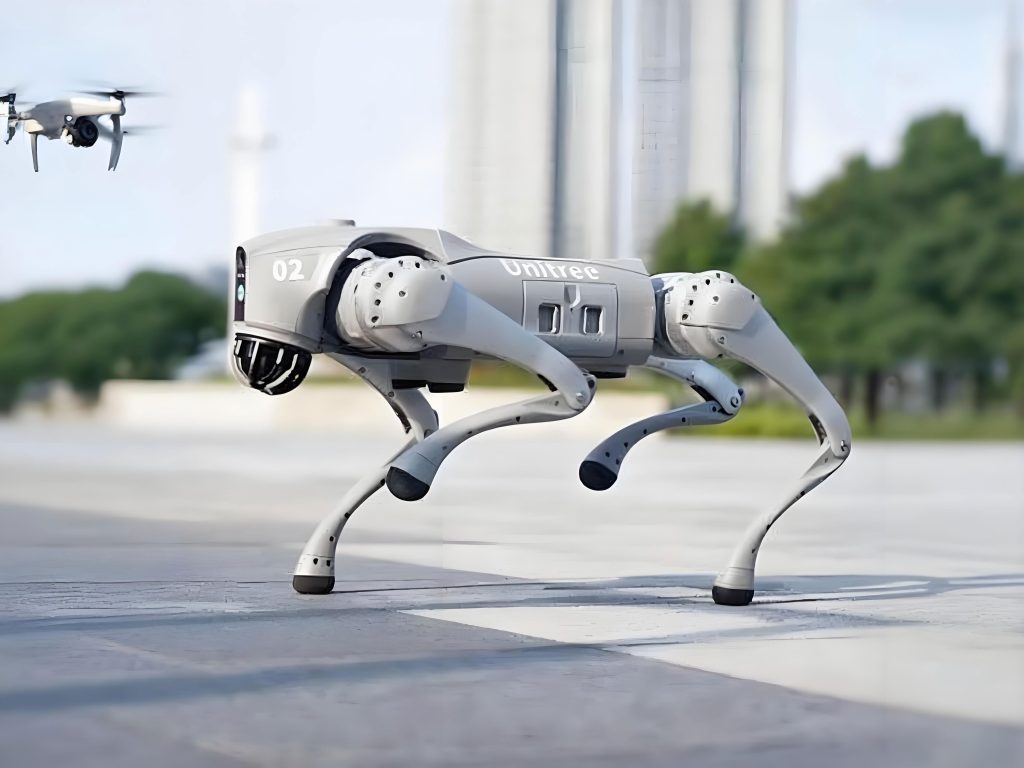
This image illustrates the conceptual design of the bionic robot, highlighting its leg structure and dual-mode capability. By mimicking biological systems, this bionic robot aims to achieve robust performance across various environments.
To analyze and control the bionic robot’s motion, I establish a kinematic model for a single leg using the Denavit-Hartenberg (D-H) method. For the right front leg, coordinate frames are assigned at the rotation joint (base frame {o}), hip joint {o1}, knee joint {o2}, and foot tip {op}. The D-H parameters are summarized in Table 1, where $l_0$, $l_1$, and $l_2$ represent the lengths of the rotation link, thigh, and calf, respectively; $\alpha_{i-1}$ is the twist angle; $d_i$ is the link offset; and $\theta_i$ is the joint variable.
| Frame | $l_{i-1}$ (mm) | $\alpha_{i-1}$ (°) | $d_i$ (mm) | Joint Variable $\theta_i$ (°) |
|---|---|---|---|---|
| o | 0 | 0 | 0 | $\theta_1$ |
| o1 | $l_0$ | $\frac{\pi}{2}$ | 0 | $\theta_2$ |
| o2 | $l_1$ | 0 | 0 | $\theta_3$ |
| op | $l_2$ | 0 | 0 | 0 |
The homogeneous transformation matrix from frame {i-1} to {i} is given by:
$$^{i-1}_i T = \begin{bmatrix} c\theta_i & -s\theta_i & 0 & l_{i-1} \\ s\theta_i c\alpha_{i-1} & c\theta_i c\alpha_{i-1} & -s\alpha_{i-1} & -d_i s\alpha_{i-1} \\ s\theta_i s\alpha_{i-1} & c\theta_i s\alpha_{i-1} & c\alpha_{i-1} & d_i c\alpha_{i-1} \\ 0 & 0 & 0 & 1 \end{bmatrix}$$
where $c$ and $s$ denote cosine and sine functions, respectively. The overall transformation from the base frame to the foot tip is computed as:
$$^B_p T = ^0_1 T \cdot ^1_2 T \cdot ^2_3 T \cdot ^3_P T$$
Substituting the parameters yields the foot tip position coordinates $(P_x, P_y, P_z)$:
$$ \begin{bmatrix} P_x \\ P_y \\ P_z \end{bmatrix} = \begin{bmatrix} l_2 c_1 c_{23} + l_1 c_1 c_2 + l_0 c_1 \\ l_2 s_1 c_{23} + l_1 s_1 c_2 + l_0 s_1 \\ l_2 s_{23} + l_1 s_2 \end{bmatrix} $$
Here, $c_{ij} = \cos(\theta_i + \theta_j)$ and $s_{ij} = \sin(\theta_i + \theta_j)$. This kinematic model is essential for gait planning and parameter optimization of the bionic robot.
The leg dimensions critically influence the bionic robot’s performance, particularly the foot workspace. To ensure optimal motion, I aim to maximize the area of the foot trajectory within a valid region defined by the maximum step length $S = 120$ mm and leg lift height $h = 50$ mm, while minimizing energy-wasting extra space. Constraints include total leg length between 200 mm and 220 mm, thigh length $l_1$ between 20 mm and 180 mm, and calf length $l_2$ between 20 mm and 180 mm. Using MATLAB and Monte Carlo simulations, I analyze the foot workspace for different thigh-to-calf ratios from 1:9 to 9:1. The results, presented in Table 2, show the area inside and outside the valid region.
| Leg Length Ratio (Thigh:Calf) | Area Inside Valid Region (mm²) | Area Outside Valid Region (mm²) | Percentage Inside Valid Region (%) |
|---|---|---|---|
| 1:9 | 141 | 1629 | 2.01 |
| 2:8 | 650 | 2471 | 9.28 |
| 3:7 | 3415 | 3981 | 48.78 |
| 4:6 | 5760 | 5893 | 82.28 |
| 1:1 | 6249 | 5731 | 89.27 |
| 6:4 | 6048 | 5613 | 86.40 |
| 7:3 | 5270 | 5496 | 75.28 |
| 8:2 | 3726 | 3901 | 53.23 |
| 9:1 | 1572 | 4175 | 22.46 |
The analysis reveals that ratios between 4:6 and 6:4 yield over 80% of the foot workspace within the valid region, indicating efficient motion. Considering overall size and assembly constraints, I select a ratio of 9:11, with thigh length $l_1 = 90$ mm and calf length $l_2 = 110$ mm. The rotation link length is set to $l_0 = 50$ mm to accommodate actuators. This optimization ensures that the bionic robot’s legs provide a balanced workspace for effective locomotion.
Gait parameters, including leg lift height $h$, step length $S$, and gait cycle $T$, significantly impact the bionic robot’s speed and stability. To evaluate these effects, I define a comprehensive evaluation function $K$ that incorporates average forward speed $v_x$, vertical抖动 $\delta_{dz}$, roll angle $\delta_R$, pitch angle $\delta_P$, and yaw angle $\delta_Y$:
$$ K = A v_x + B \delta_{dz} + C \delta_R + D \delta_P + E \delta_Y $$
Weight coefficients are assigned based on simulation experience and desired outcomes: $A = 0.5$ (since $v_x$ is beneficial), $B = -2$, $C = -1$, $D = -1$, and $E = -1$ (as stability metrics are detrimental when high). A higher $K$ value indicates better overall performance, with $K > 85$ denoting excellent motion, $75 \leq K < 85$ acceptable, and $K < 75$ poor or failed motion.
First, I investigate the effect of leg lift height $h$ on stability, setting a constant speed of 220 mm/s. Simulations are conducted for $h$ ranging from 15 mm to 60 mm in 5 mm increments. Results show that for $h < 25$ mm, foot dragging occurs, and for $h > 55$ mm, the bionic robot tips over. Valid data for $h$ between 25 mm and 50 mm indicate that stability degrades as $h$ increases, with $K$ values above 85 for $h$ between 25 mm and 35 mm. To balance obstacle clearance and stability, I choose $h = 35$ mm for the bionic robot.
Next, I perform aggregated crossover experiments to study the coupled effects of step length $S$ and gait cycle $T$ on speed and stability. $S$ varies from 30 mm to 100 mm in 10 mm steps, and $T$ from 0.2 s to 1.0 s in 0.2 s steps, resulting in 48 simulation sets. Invalid simulations due to dragging, no kinematic solution, or overturning are discarded. The results are summarized in Table 3, showing stability metrics ($\delta_{dz}$, $\delta_R$, $\delta_P$, $\delta_Y$) for each combination.
| $S$ (mm) | $T$ (s) | $\delta_{dz}$ (mm) | $\delta_R$ (°) | $\delta_P$ (°) | $\delta_Y$ (°) |
|---|---|---|---|---|---|
| 30 | 0.2 | 15.4 | 4.5 | 7.4 | 11.6 |
| 0.4 | 4.5 | 1.8 | 4.5 | 1.7 | |
| 0.6 | 4.8 | 2.5 | 7.7 | 1.9 | |
| 0.8 | 3.9 | 2.5 | 4.0 | 2.2 | |
| 1.0 | 4.4 | 2.8 | 4.6 | 1.8 | |
| 40 | 0.2 | 28.6 | 8.1 | 23.4 | 12.0 |
| 0.4 | 5.2 | 2.2 | 5.7 | 1.9 | |
| 0.6 | 5.2 | 2.7 | 8.7 | 2.1 | |
| 0.8 | 4.6 | 2.8 | 4.4 | 2.4 | |
| 1.0 | 4.1 | 2.6 | 5.3 | 2.5 | |
| 50 | 0.2 | 38.7 | 9.0 | 26.3 | 14.9 |
| 0.4 | 5.7 | 2.8 | 8.8 | 1.1 | |
| 0.6 | 5.5 | 3.0 | 10.6 | 1.9 | |
| 0.8 | 4.0 | 2.9 | 7.2 | 2.5 | |
| 1.0 | 4.0 | 2.3 | 7.9 | 3.4 | |
| 60 | 0.2 | 15.6 | 6.4 | 19.8 | 26.3 |
| 0.4 | 6.3 | 2.7 | 10.2 | 1.4 | |
| 0.6 | 4.8 | 3.3 | 13.2 | 1.6 | |
| 0.8 | 4.0 | 3.0 | 9.8 | 1.4 | |
| 1.0 | 3.8 | 2.5 | 10.0 | 1.4 | |
| 70 | 0.2 | Overturned | |||
| 0.4 | 7.3 | 3.1 | 9.7 | 2.2 | |
| 0.6 | 4.6 | 2.8 | 13.2 | 1.5 | |
| 0.8 | 3.8 | 3.1 | 11.4 | 1.3 | |
| 1.0 | 3.6 | 2.6 | 12.2 | 1.3 | |
| 80 | 0.2 | Overturned | |||
| 0.4 | 13.1 | 3.3 | 9.1 | 2.3 | |
| 0.6 | 5.8 | 2.8 | 12.8 | 1.6 | |
| 0.8 | 7.2 | 3.3 | 12.8 | 1.2 | |
| 1.0 | 8.0 | 2.8 | 12.9 | 1.2 | |
| 90 | 0.2 | Overturned | |||
| 0.4 | 15.5 | 3.9 | 9.0 | 2.5 | |
| 0.6 | 7.9 | 3.2 | 12.8 | 1.9 | |
| 0.8 | 8.9 | 4.1 | 14.2 | 1.1 | |
| 1.0 | Foot dragging | ||||
| 100 | 0.2 | Overturned | |||
| 0.4 | 18.5 | 4.3 | 8.8 | 2.6 | |
| 0.6 | 9.8 | 3.6 | 13.5 | 3.2 | |
| 0.8 | Foot dragging | ||||
| 1.0 | Foot dragging | ||||
Using MATLAB, I fit surfaces to the data to derive relationships between $S$, $T$, and performance metrics. The fitted functions for speed $Z_1$, stability $Z_2$ (represented as a composite index), and evaluation function $K$ are:
$$ Z_1 = \frac{5.63 – 46.83T + 3.37S – 0.05S^2}{1 – 3.24T + 6.19T^2 – 3.37T^3 – 0.03S} $$
$$ Z_2 = 162.5 – 421.18T – 0.14S + 277.91T^2 + 0.0028S^2 + 0.234ST $$
$$ K = \frac{58.25 + 775.85S – 7.7T + 0.076T^2}{1 – 1.43S + 8.13S^2 – 4.03S^3 – 0.03T} $$
Analysis shows that speed increases with larger $S$ and smaller $T$, peaking at $T = 0.34694$ s and $S = 100$ mm with $Z_1 = 425.61$ mm/s. Stability improves with smaller $S$ and moderate $T$, optimal at $T = 0.73878$ s and $S = 30$ mm. The evaluation function $K$ reaches a maximum at $T = 0.386$ s and $S = 64.285$ mm, giving $K = 316.176$. Rounding these values, I select optimal gait parameters: $T = 0.4$ s and $S = 65$ mm. This combination ensures the bionic robot achieves high speed and good stability simultaneously.
To validate the optimized design, I create a virtual prototype of the bionic robot in ADAMS using the determined leg lengths ($l_0 = 50$ mm, $l_1 = 90$ mm, $l_2 = 110$ mm) and gait parameters ($h = 35$ mm, $S = 65$ mm, $T = 0.4$ s). A control simulation is performed with pre-optimized parameters for comparison. The results, depicted in motion plots, indicate that the optimized bionic robot travels 560 mm in 2.4 s, a 73% increase in distance covered compared to the pre-optimized version. Although vertical抖动 slightly increases, the roll, pitch, and yaw angles are reduced, demonstrating enhanced stability. Overall, the optimization boosts both speed and stability, confirming the effectiveness of the bionic robot’s design.
In conclusion, this work presents a bionic robot inspired by turtle crawling and goat walking, capable of dual-mode locomotion for diverse terrains. Through kinematic modeling and parameter optimization, I derive optimal leg dimensions and gait parameters that maximize foot workspace and balance speed with stability. The use of MATLAB for analysis and ADAMS for simulation validates the improvements, showing significant gains in performance. Future research could explore dynamic control strategies or incorporate sensors for adaptive gait adjustment. This bionic robot exemplifies how bio-inspired design can address real-world robotics challenges, paving the way for more versatile and efficient machines.