
In recent years, the rapid advancement of science and technology has propelled the intelligence of robots to unprecedented heights, significantly expanding their application domains across various sectors. Among these, bionic robots—machines inspired by biological systems—have captured the attention of researchers worldwide. As a field that merges biology, engineering, and computer science, the study of bionic robots aims to replicate the efficiency, adaptability, and robustness found in nature. This article delves into the current research landscape and explores the promising directions for the future of bionic robots, emphasizing key trends and technological innovations. Throughout this discussion, the term “bionic robot” will be frequently highlighted to underscore its centrality in modern robotics.
The fascination with bionic robots stems from their potential to operate in complex, unstructured environments where traditional robots falter. By mimicking biological mechanisms, such as locomotion, sensing, and decision-making, these robots can achieve remarkable feats. From medical interventions to disaster response, the applications are vast and growing. This analysis will first outline the global research status, then delve into specific developmental directions, supported by tables and formulas to summarize critical aspects. The integration of micro-electromechanical systems, adaptive morphologies, and swarm intelligence will be examined in detail, providing a holistic view of where bionic robot technology stands and where it is headed.
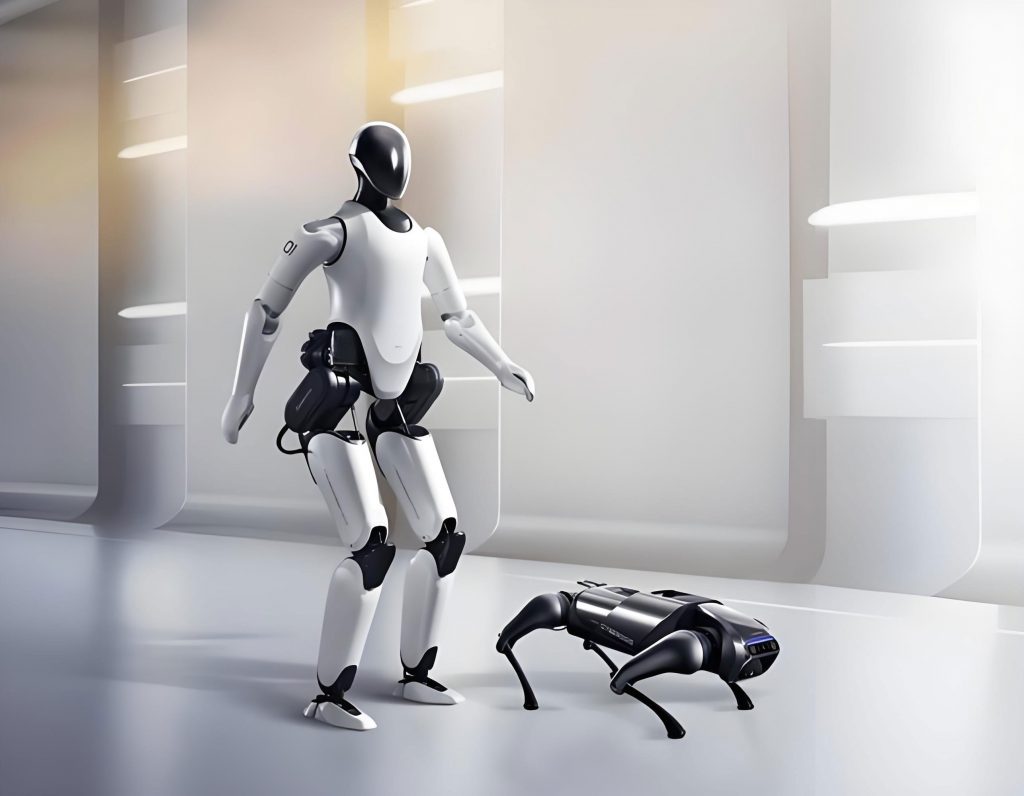
Current research on bionic robots spans multiple dimensions, including mechanical design, control algorithms, material science, and artificial intelligence. Globally, efforts are focused on creating machines that not only resemble biological entities in form but also replicate their functions. For instance, in locomotion, bionic robots often imitate the gait of animals like insects, birds, or humans, utilizing principles from biomechanics to enhance mobility. The control systems of these bionic robots leverage neural networks and learning algorithms to adapt to dynamic environments. A notable trend is the miniaturization of bionic robot components, enabling operations in confined spaces. Below is a table summarizing key areas of bionic robot research and their characteristics:
| Research Area | Key Focus | Example Applications | Technological Challenges |
|---|---|---|---|
| Locomotion and Mobility | Imitating animal gaits (e.g., walking, flying, swimming) | Search and rescue, exploration | Energy efficiency, stability control |
| Sensing and Perception | Biologically inspired sensors (e.g., vision, tactile) | Autonomous navigation, object manipulation | Sensor fusion, real-time processing |
| Materials and Structures | Soft robotics, self-healing materials | Medical devices, wearable tech | Durability, scalability |
| Control and Intelligence | Neural networks, reinforcement learning | Adaptive behavior, human-robot interaction | Algorithm complexity, computational load |
| Energy and Power | Bio-inspired energy harvesting (e.g., solar, kinetic) | Long-duration missions, remote operations | Power density, sustainability |
In terms of mathematical modeling, the dynamics of a bionic robot can be described using Lagrangian mechanics, which is essential for understanding motion and control. For a bionic robot with multiple degrees of freedom, the Lagrangian \( L \) is defined as the difference between kinetic energy \( T \) and potential energy \( V \):
$$ L = T – V $$
The equations of motion are derived from the Euler-Lagrange equation:
$$ \frac{d}{dt} \left( \frac{\partial L}{\partial \dot{q}_i} \right) – \frac{\partial L}{\partial q_i} = Q_i $$
where \( q_i \) represents the generalized coordinates, \( \dot{q}_i \) the generalized velocities, and \( Q_i \) the non-conservative forces. This formulation is widely used in simulating bionic robot movements, such as walking or grasping. Additionally, optimization algorithms play a crucial role in enhancing bionic robot performance. For example, to minimize energy consumption during locomotion, an objective function can be defined:
$$ J = \int_{0}^{T} P(t) \, dt $$
where \( P(t) \) is the power input at time \( t \), and \( T \) is the total operation time. Such mathematical frameworks underpin the development of efficient bionic robot systems.
Looking ahead, the future directions for bionic robots are multifaceted, driven by both technological push and market pull. One prominent trend is the miniaturization of bionic robot structures. Micro bionic robots, often inspired by insects or microorganisms, are designed to operate in environments where size constraints are critical. These robots leverage micro-electromechanical systems (MEMS) to integrate actuators, sensors, and controllers into a compact form. The governing equation for scaling effects in miniaturization can be expressed using the Reynolds number \( Re \), which affects fluid dynamics at small scales:
$$ Re = \frac{\rho v L}{\mu} $$
where \( \rho \) is density, \( v \) velocity, \( L \) characteristic length, and \( \mu \) viscosity. As \( L \) decreases, viscous forces dominate, requiring specialized designs for bionic robot locomotion in fluids or air. Applications include pipeline inspection, medical diagnostics, and environmental monitoring. The following table compares different types of miniaturized bionic robots:
| Type of Mini Bionic Robot | Inspiration Source | Size Range | Primary Applications |
|---|---|---|---|
| Insect-inspired robots | Beetles, ants | 1-10 cm | Surveillance, agriculture |
| Micro-swimmers | Bacteria, fish | 1-1000 µm | Drug delivery, lab-on-a-chip |
| Flying micro-robots | Bees, flies | 1-5 cm | Disaster assessment, pollination |
Another key direction is the similarity and mutability of bionic robots. To perform tasks effectively, a bionic robot must closely resemble its biological counterpart in appearance and behavior. This involves advanced materials and morphing structures that allow shape adaptation. For instance, modular bionic robots consist of multiple units that can reconfigure themselves based on environmental cues. The control of such systems can be modeled using graph theory, where each module is a node, and connections are edges. The reconfiguration efficiency \( \eta \) can be quantified as:
$$ \eta = \frac{N_{\text{connected}}}{N_{\text{total}}} \times 100\% $$
where \( N_{\text{connected}} \) is the number of functional connections, and \( N_{\text{total}} \) is the total possible connections. This adaptability enables bionic robots to traverse varied terrains or manipulate objects of different shapes. Moreover, multifunctionality is becoming increasingly important for bionic robots, especially in societal contexts like elderly care or domestic assistance. A multifunctional bionic robot might integrate locomotion, manipulation, and communication capabilities, requiring sophisticated control architectures. The overall system performance \( P_s \) can be evaluated using a weighted sum of individual functions:
$$ P_s = \sum_{i=1}^{n} w_i f_i $$
where \( w_i \) is the weight for function \( i \), and \( f_i \) is its performance score. This approach helps in designing bionic robots that balance multiple tasks efficiently.
Swarm intelligence in bionic robots represents a burgeoning area of research. Inspired by social insects like ants or bees, bionic robot swarms leverage collective behavior to accomplish complex goals that are beyond the capability of a single unit. The coordination within a bionic robot swarm can be described using algorithms such as particle swarm optimization (PSO). In PSO, each robot adjusts its position based on personal and global bests, with updates given by:
$$ v_{id}^{t+1} = w v_{id}^t + c_1 r_1 (p_{id} – x_{id}^t) + c_2 r_2 (g_d – x_{id}^t) $$
$$ x_{id}^{t+1} = x_{id}^t + v_{id}^{t+1} $$
where \( v_{id} \) is velocity, \( x_{id} \) position, \( w \) inertia weight, \( c_1, c_2 \) acceleration coefficients, \( r_1, r_2 \) random numbers, \( p_{id} \) personal best, and \( g_d \) global best. This mimics the foraging behavior of birds or fish, enabling bionic robot swarms to search areas collaboratively. Applications include environmental monitoring, construction, and military operations. The table below outlines the advantages of swarm bionic robots over solitary ones:
| Aspect | Solitary Bionic Robot | Swarm Bionic Robot |
|---|---|---|
| Robustness | Single point of failure | Redundant, fault-tolerant |
| Scalability | Limited by design | Easily scalable by adding units |
| Task Complexity | Suitable for simple tasks | Can handle complex, distributed tasks |
| Flexibility | Fixed capabilities | Adaptive through reconfiguration |
In the realm of materials science, advancements are crucial for the evolution of bionic robots. The development of stimuli-responsive materials, such as shape-memory alloys or polymers, allows bionic robots to change form in response to external triggers like temperature or pH. The actuation strain \( \epsilon \) in such materials can be modeled as:
$$ \epsilon = \alpha \Delta T $$
where \( \alpha \) is the thermal expansion coefficient and \( \Delta T \) the temperature change. Similarly, self-healing materials enhance the durability of bionic robots by autonomously repairing damages, extending operational lifespans in harsh environments. These innovations are integral to creating bionic robots that are both resilient and efficient.
Control systems for bionic robots increasingly rely on machine learning techniques. Deep reinforcement learning (DRL) enables a bionic robot to learn optimal policies through trial and error. The Bellman equation in reinforcement learning provides a foundation for value iteration:
$$ V(s) = \max_a \left( R(s,a) + \gamma \sum_{s’} P(s’|s,a) V(s’) \right) $$
where \( V(s) \) is the value of state \( s \), \( R(s,a) \) the reward, \( \gamma \) the discount factor, and \( P(s’|s,a) \) the transition probability. By training in simulated or real environments, a bionic robot can master complex tasks like navigation or object manipulation. Furthermore, neuromorphic computing, which mimics the brain’s neural architecture, is being explored to process sensory data more efficiently in bionic robots.
Energy autonomy remains a significant challenge for bionic robots. Bio-inspired energy harvesting methods, such as piezoelectric materials that convert mechanical stress to electricity, are being integrated. The power output \( P_{\text{piezo}} \) can be approximated by:
$$ P_{\text{piezo}} = \frac{1}{2} k d^2 f $$
where \( k \) is the material constant, \( d \) the displacement, and \( f \) the frequency of motion. Solar cells inspired by photosynthesis are also under development for outdoor bionic robots. These technologies aim to reduce dependency on external power sources, making bionic robots more sustainable for long-term deployments.
Ethical and societal implications of bionic robots cannot be overlooked. As these machines become more pervasive, issues related to privacy, security, and job displacement arise. It is essential to establish guidelines for the responsible development and deployment of bionic robots, ensuring they benefit humanity without causing harm. Research into human-robot interaction (HRI) is vital to create intuitive interfaces for collaborating with bionic robots.
In conclusion, the field of bionic robots is rapidly evolving, with current research emphasizing biomimicry in design, control, and materials. The future directions highlight miniaturization, adaptability, multifunctionality, swarm intelligence, and energy sustainability. Mathematical models and algorithms play a pivotal role in advancing these areas, as illustrated by the formulas and tables presented. The continuous integration of biological principles with engineering innovations promises to unlock new capabilities for bionic robots, enabling them to tackle real-world challenges from healthcare to exploration. As technology progresses, the bionic robot will undoubtedly become more sophisticated, blurring the lines between natural and artificial systems. Ultimately, the journey of bionic robot development is a testament to human ingenuity in learning from nature to create machines that enhance our world.