
As I delve into the fascinating world of bionics, I am continually amazed by how nature’s designs inspire technological innovation. Bionics, the science of mimicking biological systems, has profoundly impacted robotics, leading to the development of bionic robots. These machines emulate the structures, functions, and behaviors of living organisms, offering solutions to complex engineering challenges. In this article, I explore the advances and trends in bionic robotics, drawing from global research efforts. The integration of bionics into robotics has not only expanded the capabilities of robots but also opened new frontiers in automation, healthcare, and exploration.
The concept of bionics dates back to the 1960s, but its application in robotics has gained momentum in recent decades. Bionic robots leverage insights from biology to achieve efficiency, adaptability, and resilience. From underwater swimmers to aerial fliers, these robots demonstrate the power of biomimicry. As I reflect on the progress, I see bionic robots evolving from simple mechanical replicas to sophisticated systems with embedded intelligence. This journey highlights the interdisciplinary nature of bionic robotics, merging biology, engineering, and computer science.
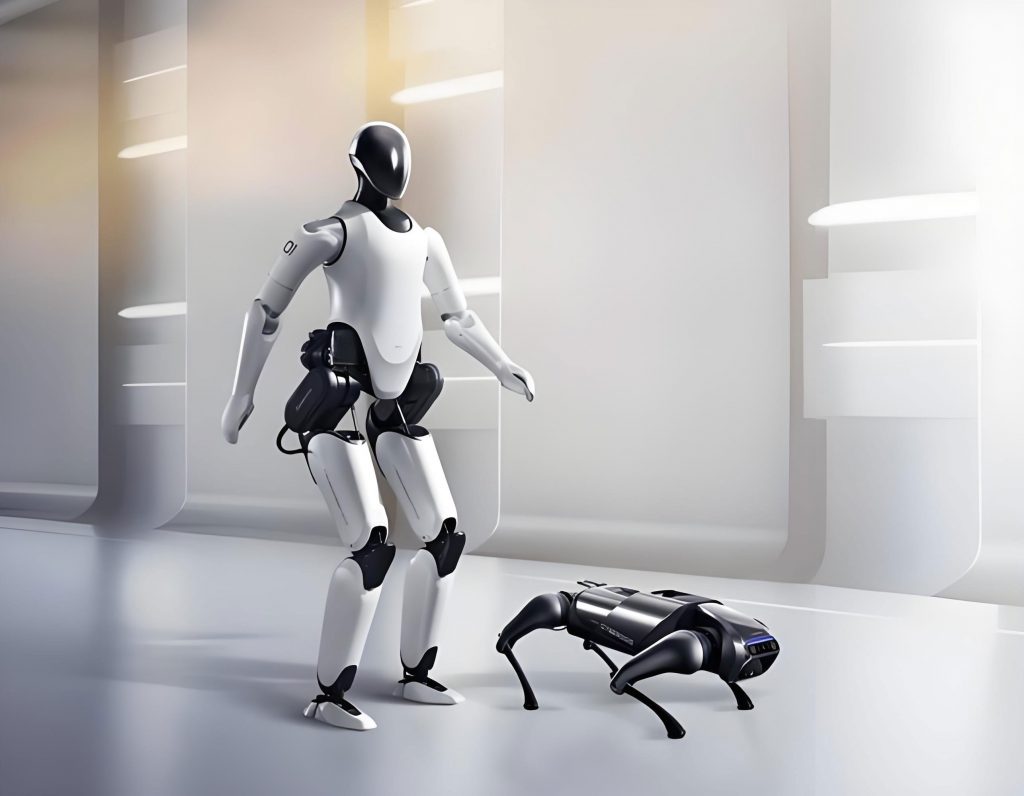
In my analysis, I categorize bionic robots based on their operational environments: aquatic, terrestrial, and aerial. Each domain presents unique challenges and opportunities for bionic robots. For instance, underwater bionic robots must cope with pressure and visibility issues, while aerial bionic robots require lightweight structures and efficient propulsion. The development of bionic robots often involves mathematical modeling to simulate biological motions. For example, the swimming dynamics of fish-inspired robots can be described using fluid dynamics equations. Consider the thrust generated by a oscillating tail, which can be approximated as:
$$ F_t = \frac{1}{2} \rho C_t A v^2 $$
where $\rho$ is the fluid density, $C_t$ is the thrust coefficient, $A$ is the area, and $v$ is the velocity. Such formulas help optimize the design of bionic robots. Moreover, control algorithms for bionic robots frequently employ neural networks inspired by biological systems, enhancing their autonomy. The keyword “bionic robot” encapsulates this synergy between nature and machinery, and I will emphasize it throughout this discussion.
Aquatic Bionic Robots: Navigating the Depths
Underwater environments are notoriously harsh, yet bionic robots have made significant strides in this domain. I observe that aquatic bionic robots often mimic fish, crustaceans, and marine mammals to achieve efficient locomotion and maneuverability. Early projects focused on replicating the streamlined bodies of tuna, leading to robots with enhanced propulsion efficiency. These bionic robots use undulatory or oscillatory motions, reducing energy consumption compared to traditional propellers. The hydrodynamic efficiency of a bionic robot can be modeled as:
$$ \eta = \frac{P_{\text{useful}}}{P_{\text{input}}} = \frac{T \cdot v}{\omega \cdot \tau} $$
where $T$ is thrust, $v$ is speed, $\omega$ is angular velocity, and $\tau$ is torque. This formula underscores the importance of biomechanical principles in designing bionic robots.
Research institutions worldwide have contributed to aquatic bionic robots. For example, a notable project involved a robotic tuna that demonstrated high-speed swimming capabilities. Another innovation was a lobster-inspired bionic robot capable of walking and swimming, equipped with sensors for obstacle detection. These bionic robots often incorporate waterproof materials and advanced power systems to withstand prolonged submersion. In my view, the future of aquatic bionic robots lies in swarm intelligence, where multiple units collaborate for tasks like ocean monitoring or pipeline inspection. The adaptability of bionic robots makes them ideal for such applications.
| Type | Inspiration | Key Features | Applications |
|---|---|---|---|
| Fish-like | Tuna, Carp | Undulatory motion, low drag | Marine exploration, pollution detection |
| Crustacean-like | Lobster, Crab | Legged locomotion, stability in currents | Seafloor mapping, rescue operations |
| Mammal-like | Dolphin, Whale | Echolocation, agile maneuvering | Underwater communication, surveillance |
The design of aquatic bionic robots often involves computational fluid dynamics (CFD) simulations to optimize shape and motion. I recall that one approach uses the Navier-Stokes equations to model flow around the bionic robot:
$$ \rho \left( \frac{\partial \mathbf{v}}{\partial t} + \mathbf{v} \cdot \nabla \mathbf{v} \right) = -\nabla p + \mu \nabla^2 \mathbf{v} + \mathbf{f} $$
where $\mathbf{v}$ is velocity, $p$ is pressure, $\mu$ is viscosity, and $\mathbf{f}$ is body force. By solving these equations, engineers can enhance the performance of bionic robots. Additionally, materials science plays a crucial role; for instance, flexible silicone skins mimic fish scales, reducing turbulence. The integration of sensors, such as sonar and cameras, enables bionic robots to navigate murky waters. As I look ahead, I anticipate aquatic bionic robots becoming more autonomous, using machine learning to adapt to changing environments. The term “bionic robot” thus represents a convergence of multiple technologies.
Terrestrial Bionic Robots: Mastering the Land
On land, bionic robots face challenges like uneven terrain and obstacles. I have studied various terrestrial bionic robots inspired by insects, reptiles, and mammals. For example, gecko-inspired bionic robots utilize van der Waals forces to climb vertical surfaces. This adhesion mechanism relies on micro- or nano-scale hairs that increase contact area, described by:
$$ F_{\text{adhesion}} = \frac{A \cdot R}{d^2} $$
where $A$ is the Hamaker constant, $R$ is the radius of contact, and $d$ is the separation distance. Such bionic robots are valuable for inspection tasks in hazardous environments. Another remarkable innovation is snake-like bionic robots, which employ serpentine locomotion for traversing confined spaces. The kinematics of a snake robot can be represented using a series of joint angles:
$$ \theta_i(t) = A \sin(\omega t + \phi_i) $$
where $\theta_i$ is the angle of the $i$-th joint, $A$ is amplitude, $\omega$ is frequency, and $\phi_i$ is phase offset. This allows the bionic robot to generate traveling waves for propulsion.
In my exploration, I note that terrestrial bionic robots often incorporate biomimetic sensors, such as antennae for tactile feedback or vision systems inspired compound eyes. These features enhance their ability to interact with the environment. For instance, a hexapod bionic robot modeled after a cockroach can rapidly navigate rough terrain using distributed control. The efficiency of legged locomotion in bionic robots can be analyzed through dynamic modeling:
$$ M(q)\ddot{q} + C(q, \dot{q})\dot{q} + G(q) = \tau $$
where $M$ is the inertia matrix, $C$ accounts for Coriolis forces, $G$ is gravity, $q$ are generalized coordinates, and $\tau$ are joint torques. Optimizing these parameters is key to developing agile bionic robots.
| Inspiration | Locomotion Method | Advantages | Potential Uses |
|---|---|---|---|
| Gecko | Climbing via adhesion | Silent operation, no suction needed | Building maintenance, espionage |
| Snake | Serpentine crawling | Access to tight spaces, robustness | Disaster response, pipeline inspection |
| Cheetah | High-speed running | Rapid movement, stability | Delivery services, military reconnaissance |
The control systems for terrestrial bionic robots are increasingly based on neural networks, mirroring biological nervous systems. I believe that the future of these bionic robots involves adaptive learning, where they can modify their gait based on terrain feedback. Moreover, energy efficiency is critical; some bionic robots use elastic elements to store and release energy, similar to animal tendons. The interdisciplinary approach in designing bionic robots—combining mechanics, electronics, and biology—is what makes this field so exciting. As I continue my research, I see terrestrial bionic robots becoming integral to agriculture, logistics, and healthcare.
Aerial Bionic Robots: Soaring to New Heights
Aerial bionic robots, often called flapping-wing robots, draw inspiration from birds, insects, and bats. I am particularly intrigued by their ability to achieve agile flight with low power consumption. The aerodynamics of flapping wings is complex, involving unsteady flow phenomena. The lift generated by a flapping wing can be approximated using:
$$ L = \frac{1}{2} \rho v^2 S C_L(\alpha, Re) $$
where $S$ is wing area, $C_L$ is lift coefficient depending on angle of attack $\alpha$ and Reynolds number $Re$. Bionic robots like robotic flies or hummingbirds mimic these principles to hover and maneuver precisely. These bionic robots are typically lightweight, using materials like carbon fiber and Mylar for wings.
Recent advancements in micro-electromechanical systems (MEMS) have enabled the creation of tiny aerial bionic robots. For example, a bee-inspired bionic robot can perform pollination or surveillance tasks. The flight control of such bionic robots often relies on gyroscopes and accelerometers, with algorithms tuned to mimic insect reflexes. I have also studied bat-inspired bionic robots with flexible wings that allow morphing during flight, enhancing efficiency. The dynamics can be modeled with coupled equations for wing deformation and body motion:
$$ I \ddot{\phi} + D \dot{\phi} + K \phi = \tau_{\text{aerodynamic}} $$
where $I$ is moment of inertia, $D$ is damping, $K$ is stiffness, $\phi$ is wing angle, and $\tau_{\text{aerodynamic}}$ is torque from air forces. This highlights the integrated design of bionic robots.
| Inspiration | Wing Type | Flight Characteristics | Applications |
|---|---|---|---|
| Dragonfly | Two pairs of independent wings | High maneuverability, stable hover | Aerial photography, environmental monitoring |
| Eagle | Broad wings for gliding | Energy-efficient long-distance flight | Weather sensing, border patrol |
| Mosquito | High-frequency flapping | Stealthy operation, small size | Medical delivery inside body, swarm robotics |
In my opinion, the miniaturization of aerial bionic robots is a key trend. These micro-robots can access confined spaces, making them useful for search-and-rescue or infrastructure inspection. However, challenges remain in power supply and communication. I envision future aerial bionic robots leveraging solar cells or wireless charging, with swarm coordination for complex tasks. The use of bionic robots in this domain exemplifies how biology inspires innovation. As I analyze the progress, I see aerial bionic robots becoming more autonomous, with embedded AI for obstacle avoidance and path planning.
Trends and Future Directions in Bionic Robotics
Looking forward, I identify several emerging trends in bionic robotics. First, there is a shift from traditional electromechanical systems to bio-hybrid designs. This involves integrating living tissues or cells with robotic components, creating bionic robots that respond to neural signals. For instance, muscle cells could actuate a bionic robot, controlled by external stimuli. This blurs the line between robots and organisms, opening ethical discussions but also promising advancements in prosthetics and rehabilitation.
Second, miniaturization is driving the development of nano-scale bionic robots. These tiny machines could operate inside the human body for targeted drug delivery or surgery. The fabrication techniques, such as 3D printing at micro-scale, enable complex geometries akin to biological structures. The motion of such bionic robots in viscous environments can be described by Stokes’ law:
$$ F_d = 6 \pi \mu r v $$
where $r$ is radius, $\mu$ is viscosity, and $v$ is velocity. Understanding these forces is crucial for designing effective medical bionic robots.
Moreover, intelligence and adaptability are becoming central to bionic robots. I anticipate more use of evolutionary algorithms to optimize designs, mimicking natural selection. For example, a population of bionic robot designs can be simulated and selected based on performance metrics. The fitness function might include energy efficiency, speed, and durability:
$$ F = w_1 \cdot \text{Efficiency} + w_2 \cdot \text{Speed} – w_3 \cdot \text{Cost} $$
where $w_i$ are weights. This computational approach accelerates the innovation cycle for bionic robots.
| Trend | Description | Impact on Bionic Robots |
|---|---|---|
| Bio-hybrid Systems | Integration of biological components | Enhanced responsiveness and energy efficiency |
| Nano-scale Fabrication | Miniaturization using advanced materials | Applications in healthcare and micro-assembly |
| AI and Machine Learning | Adaptive control and swarm intelligence | Greater autonomy and collaboration in bionic robots |
| Soft Robotics | Use of compliant materials | Improved safety and interaction with humans |
Another trend is the convergence of bionic robots with the Internet of Things (IoT). Imagine networks of bionic robots communicating data in real-time for environmental monitoring or smart cities. This requires robust wireless protocols and energy harvesting methods. As I reflect on these trends, I see bionic robots becoming ubiquitous in society, from domestic helpers to industrial workers. The keyword “bionic robot” will likely become synonymous with next-generation automation.
Mathematical Modeling and Simulation in Bionic Robotics
In my research, I rely heavily on mathematical models to design and analyze bionic robots. These models capture the essence of biological phenomena and translate them into engineering principles. For locomotion, the equations of motion are fundamental. Consider a generalized bionic robot with multiple degrees of freedom; its dynamics can be expressed using Lagrangian mechanics:
$$ \frac{d}{dt} \left( \frac{\partial L}{\partial \dot{q}_i} \right) – \frac{\partial L}{\partial q_i} = Q_i $$
where $L = T – V$ is the Lagrangian, $T$ is kinetic energy, $V$ is potential energy, $q_i$ are generalized coordinates, and $Q_i$ are non-conservative forces. This framework helps simulate the motion of bionic robots, whether they swim, walk, or fly.
For fluid-structure interaction in aquatic or aerial bionic robots, coupled partial differential equations are used. The Navier-Stokes equations for fluid flow are paired with structural dynamics equations:
$$ \rho_f \frac{D \mathbf{u}}{Dt} = -\nabla p + \mu \nabla^2 \mathbf{u} + \mathbf{f}_s $$
$$ \rho_s \frac{\partial^2 \mathbf{d}}{\partial t^2} = \nabla \cdot \sigma + \mathbf{f}_f $$
where $\mathbf{u}$ is fluid velocity, $\mathbf{d}$ is structural displacement, $\sigma$ is stress tensor, and $\mathbf{f}_s$, $\mathbf{f}_f$ are interaction forces. Solving these numerically allows optimizing the shape and motion of bionic robots for minimal drag or max lift.
Control theory also plays a vital role. Many bionic robots use feedback control loops inspired by biological homeostasis. A simple PID controller can be written as:
$$ u(t) = K_p e(t) + K_i \int_0^t e(\tau) d\tau + K_d \frac{de(t)}{dt} $$
where $u$ is control input, $e$ is error, and $K_p$, $K_i$, $K_d$ are gains. For more complex behaviors, neural networks or reinforcement learning are employed, enabling bionic robots to learn from experience. I often simulate these controllers in software before hardware implementation, reducing development costs.
Energy management is another critical aspect. The power consumption of a bionic robot can be modeled as:
$$ P_{\text{total}} = P_{\text{motion}} + P_{\text{sensing}} + P_{\text{computation}} $$
where each component depends on design choices. For instance, $P_{\text{motion}}$ for a flapping-wing bionic robot might scale with flapping frequency cubed. By minimizing $P_{\text{total}}$, we extend the operational life of bionic robots. These mathematical insights drive innovation, making bionic robots more practical and efficient.
Applications and Societal Impact of Bionic Robots
As I consider the real-world implications, bionic robots offer transformative applications across sectors. In healthcare, bionic robots can assist in surgery or rehabilitation. For example, a snake-like bionic robot might navigate through the body for minimally invasive procedures. In agriculture, insect-inspired bionic robots could pollinate crops or monitor soil conditions. The versatility of bionic robots stems from their biomimetic designs, which often outperform conventional robots in unstructured environments.
Disaster response is another area where bionic robots shine. Their ability to traverse rubble or flooded areas makes them ideal for search-and-rescue missions. I envision teams of bionic robots working together, communicating via ad-hoc networks. The societal impact includes reducing human risk in dangerous tasks and improving efficiency in industries like logistics and construction.
However, challenges remain, such as ethical concerns about autonomy or job displacement. As a researcher, I advocate for responsible development of bionic robots, with guidelines for safety and fairness. The potential benefits, from environmental monitoring to elder care, are immense. By continuing to draw inspiration from nature, we can create bionic robots that harmonize with our world.
In conclusion, the field of bionic robotics is dynamic and promising. From underwater explorers to aerial swarms, bionic robots demonstrate the power of biomimicry. The trends toward bio-hybrid systems and miniaturization will further blur the boundaries between life and machine. As I continue to study and contribute to this field, I am excited by the possibilities. The journey of bionic robots is just beginning, and their evolution will undoubtedly shape our future.
Through this article, I have shared my perspective on the advances and trends in bionic robotics. The integration of mathematics, biology, and engineering is key to developing these remarkable machines. Whether through formulas, tables, or simulations, the goal is to create bionic robots that enhance our capabilities and understanding. Let us embrace this interdisciplinary adventure, pushing the boundaries of what bionic robots can achieve.