
As an observer and researcher in the field of robotics and electrical infrastructure maintenance, I am deeply fascinated by the evolution of automation in challenging environments. The vast expanse of overhead high-voltage transmission networks presents a unique set of difficulties for routine inspection and maintenance. In densely populated regions, the grid is extensive and highly interconnected, whereas in remote areas, the lines stretch across great distances with sparse human presence. This geographical disparity makes timely manual inspection to ensure power supply security and reliability a formidable, costly, and sometimes dangerous task. The continuous demand for electricity, driven by rapid economic development and expanding infrastructure, places an ever-higher premium on the safety, reliability, and uninterrupted operation of the power system. Transmission lines and their supporting towers are completely exposed to harsh natural conditions, susceptible to material fatigue, mechanical aging, constant tensile stress, electrical flashovers, and environmental corrosion, leading to wear, strand breakage, and deterioration. Failure to promptly detect and repair these faults can trigger cascading failures and widespread blackouts, resulting in significant economic and social disruption. It is within this critical context that the development of specialized inspection robots, particularly those inspired by nature—**bionic robots**—has emerged as a transformative solution.
The operational domain for a high-voltage line inspection robot is the cable itself. Early designs often resembled cable cars, rolling along the line. However, the fundamental challenge lies not in straight-line travel but in navigating the numerous obstacles found on a transmission line, such as suspension clamps, vibration dampers, and spacer dampers. This necessity for obstacle-crossing capability drove innovators to look towards nature. The field of bionics, by definition, involves studying the structures, functions, and behavioral principles of living organisms to inspire new engineering designs and technological solutions. Nature, through billions of years of evolution, has optimized countless creatures for movement in specific niches. By observing, researching, and mimicking these unique biological adaptations—be it in form, movement, or function—engineers can develop robotic systems with unparalleled capabilities for specific tasks. This fusion of biology and robotics has given rise to a generation of **bionic robots** designed to operate where humans cannot, or should not, go.
The core principle behind a **bionic robot** for power line inspection is to replicate the stable, adaptive locomotion of animals that naturally move along narrow paths or branches. Several biological models have been explored, leading to distinct robotic architectures. The following table summarizes the primary biological inspirations and their robotic counterparts:
| Biological Inspiration | Key Bionic Principle | Robotic Archetype | Primary Advantage | Primary Challenge |
|---|---|---|---|---|
| Primates (Gibbons, Humans) | Brachiation; Alternating grip and swing; Use of arms for balance and propulsion. | Multi-Arm Suspension Robot | Stable, large workspace for manipulation; Good weight distribution. | Complex control sequence; Mechanical complexity of arms. |
| Snakes | Serpentine locomotion; Multi-segment body with sequential ground contact. | Hyper-Redundant (Snake-like) Robot | High adaptability to complex shapes; Can navigate tightly around obstacles. | Lower payload capacity; Control complexity for many degrees of freedom. |
| Insects (Caterpillars, Inchworms) | Inchworm motion; Anchoring and stretching between two fixed points. | Dual-Clamp Telescoping Robot | Simple, robust mechanical principle; Inherently stable gait. | Slower movement; Limited to linear stretching motion. |
| Birds (Perching) | Gripping mechanism with tendons; Passive lock-on. | End-Effector with Bi-stable Gripper | Secure, energy-efficient gripping; Can withstand disturbances. | Requires precise alignment; May complicate obstacle crossing. |
Bionic Principles and Locomotion Mechanics
The design of a **bionic robot** starts with a deep analysis of the target organism’s movement. For line-walking, stability is paramount. A simple model for analyzing the robot’s stability on the line can be derived from static equilibrium. The robot must not tip over or slide off. The condition for not tipping (maintaining contact with the line) often involves ensuring the center of mass projects vertically within the support polygon formed by the contact points. For a robot suspended from a line, the primary concerns are the moments generated by its weight and any external forces (like wind). A basic equilibrium condition is:
$$ \sum \tau = 0 \quad \text{or} \quad \sum F = 0 $$
Where $\tau$ represents torque around a pivot point (e.g., the attachment point on the line) and $F$ represents forces (gravity, grip force, etc.). A common strategy in **bionic robot** design is to use multiple, strategically placed attachment points, much like a primate uses multiple limbs, to manage these forces and moments effectively during both stationary phases and movement.
Motion itself is achieved by coordinating the degrees of freedom (DOF) in the robot’s limbs or body segments. The kinematics—the study of motion without considering forces—describes this. For a robotic arm mimicking a primate’s arm, forward kinematics uses the Denavit-Hartenberg parameters to find the end-effector position $(x, y, z)$ based on joint angles $(\theta_1, \theta_2, …)$ and link lengths $(a_1, a_2, …)$. The transformation from one joint to the next is given by a homogeneous transformation matrix. For a simple 2D case with a revolute joint followed by a prismatic (linear) joint, the position might be described as:
$$ x = L_1 \cos(\theta_1) + d_2 \cos(\theta_1) $$
$$ y = L_1 \sin(\theta_1) + d_2 \sin(\theta_1) $$
Here, $L_1$ is the length of the first link, $\theta_1$ is its rotation angle, and $d_2$ is the extension of the second, prismatic link. The coordinated control of these parameters across multiple limbs enables the robot to perform an “obstacle-crossing gait,” a carefully sequenced dance of releasing, moving, and re-gripping the conductor.
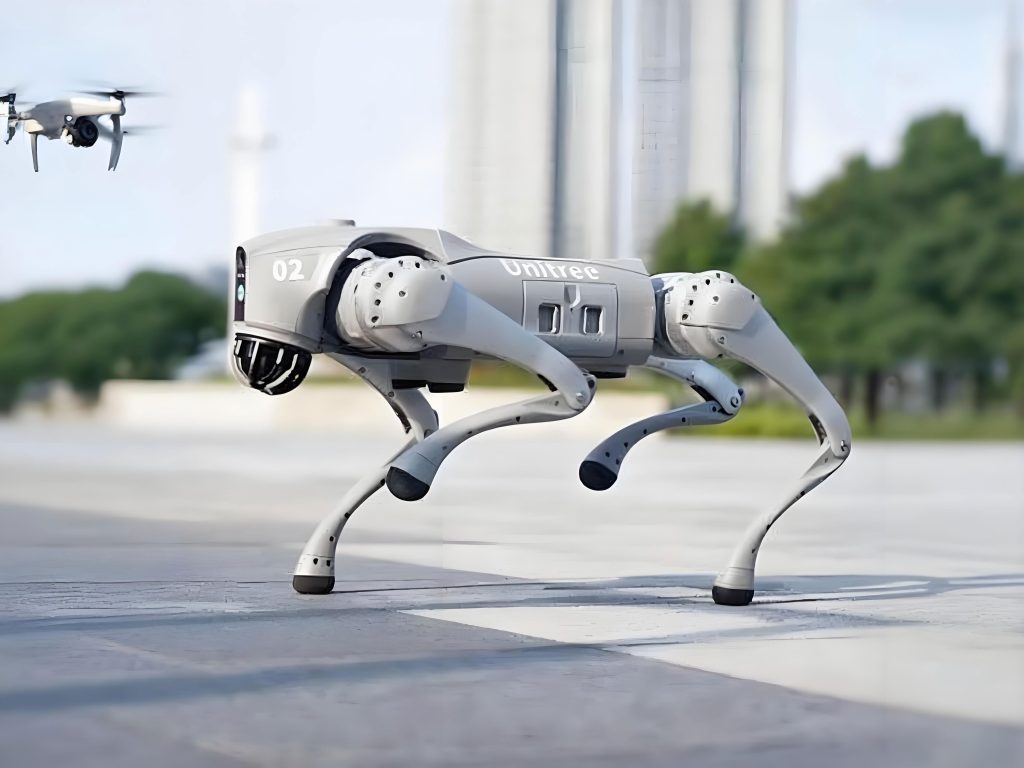
This image illustrates a sophisticated implementation of the primate-inspired **bionic robot**. It features a multi-arm suspension design where the arms work in concert to transfer the robot’s body past an obstacle on the line. The central arm likely acts as a balancing or primary support arm, while the outer arms perform the reaching and re-gripping motions. This configuration provides a large dexterous workspace and inherently stable weight distribution, key advantages drawn from its biological model.
Archetypes of Bionic Inspection Robots
Primate-Inspired Multi-Arm Robots
This category represents one of the most mature and widely researched paradigms. The core idea is to mimic the brachiation of gibbons or the careful hand-over-hand motion of a human on a rope. These **bionic robots** typically feature two or more symmetrical arms mounted on a central chassis.
- Two-Arm / Four-Arm Designs: Early conceptual robots employed a simple two-arm, inchworm-like motion. A significant advancement was the development of a three-arm symmetrical robot. This design includes a left arm, a right arm, and a central balance arm. The left and right arms act as the primary “obstacle-crossing arms,” alternately gripping and swinging. The central arm, fixed to the main chassis, serves a critical role as a “gravity balancing arm.” When one of the outer arms detaches to swing forward, the robot’s center of mass can shift, creating a destabilizing torque that might cause the body to swing or rotate. The central arm counteracts this, much like a primate’s torso and tail contribute to balance, providing a stable pivot point and drastically simplifying control. The gait can be described as a planar, interactive climbing motion.
- Four-Arm Robots with Articulated Body: Further evolution led to four-arm designs with an articulated body. In one prominent model, four independently driven arms are arranged in an anti-symmetrical layout on front and rear chassis modules. A passive铰接盘 (articulated disk) connects these two modules. Each arm often incorporates both a rotary joint for swinging and a prismatic (linear) joint for reaching. This additional body degree of freedom allows the robot to better conform to slopes and manage its force distribution on the line, significantly improving climbing performance on inclined spans. The force analysis on a slope involves resolving the weight component along the line: $F_{gravity, parallel} = mg \sin(\alpha)$, where $\alpha$ is the incline angle. The gripping wheels must provide sufficient friction to overcome this force plus any motion resistance.
Snake-Inspired Hyper-Redundant Robots
Diverging from the limb-based approach, another school of thought looks to serpents. A snake’s ability to traverse complex, cluttered environments by conforming its body to the terrain is highly desirable for navigating the dense array of hardware on a transmission line. A snake-like **bionic robot** consists of multiple identical segments or modules linked in series, each with one or more degrees of freedom (typically pitch and yaw).
- Locomotion Gait: The robot propagates a traveling wave of lateral undulations along its body. By controlling the phase and amplitude of the joint angles in each module, it can push against the conductor and any surrounding fixtures to generate forward propulsion. This is analogous to lateral undulation in biological snakes. The curvature of the body as a function of segment number $i$ and time $t$ can be modeled as: $\theta_i(t) = A \sin(\omega t + \delta i)$, where $A$ is the amplitude, $\omega$ is the temporal frequency, and $\delta$ is the spatial phase difference between segments.
- Obstacle Navigation: The key advantage is that such a robot does not need to “release” its grip to cross an obstacle. Instead, it can literally wrap its body around the obstacle, maintaining multiple points of contact at all times for stability, and slowly thread itself through. This continuous contact gait can be more energy-efficient for certain obstacle types. A specific variant employed a parallelogram linkage structure in its segments. This mechanism provides an extended lateral reach for each module, increasing the effective workspace and allowing the robot to better maneuver around hardware without increasing the number of active joints per segment excessively.
Other Bionic and Hybrid Concepts
Beyond primates and snakes, other biological concepts have been explored. Some designs take inspiration from the gripping feet of birds or the multi-legged stability of insects. For instance, a robot might use a pair of rotating grippers that mimic a perching mechanism, allowing it to roll along the line but lock securely when powered off. Another concept could involve six or eight legs, walking along the conductor like an insect on a twig, providing extreme stability but with a more complex gait generation system. The fundamental comparison can be expanded:
| Robot Type | Typical # of DOF | Obstacle-Crossing Strategy | Energy Efficiency | Payload Capacity | Control Complexity |
|---|---|---|---|---|---|
| Primate-Inspired (3-Arm) | Moderate (6-9) | Sequential arm detachment & swing-over | Medium | High | High (sequence planning) |
| Snake-Inspired | High (10+) | Body conformation & threading | Variable (can be low if dragging) | Low-Medium | Very High (gait control) |
| Inchworm (Dual-Clamp) | Low (2-3) | Clamp A locks, body extends, Clamp B locks, etc. | Low (start-stop) | Medium | Low |
| Multi-Legged (Insect) | High (12+) | Static walking gait, always 3+ points of contact | Low (many actuators) | High | High (leg coordination) |
Performance Metrics and Design Equations
Evaluating a **bionic robot** design requires quantifying its performance. Key metrics include speed, stability margin, climbing ability, energy consumption, and obstacle-crossing success rate.
1. Climbing Incline: The maximum slope $\alpha_{max}$ a robot can climb is determined by the traction force its drive wheels or grippers can exert versus the component of gravity pulling it backwards. The condition is:
$$ n \cdot \mu \cdot F_{grip} \geq m g \sin(\alpha_{max}) + F_{rolling} $$
where $n$ is the number of driving contact points, $\mu$ is the effective coefficient of friction, $F_{grip}$ is the normal force per gripper, $m$ is robot mass, $g$ is gravity, and $F_{rolling}$ is other resistive forces. Primate-inspired robots often have an advantage here as they can dynamically shift weight to increase $F_{grip}$ on the driving arms.
2. Energy Consumption: The energy $E$ used to travel a distance $d$ is the integral of power over time. Power for movement $P_{motion}$ comes from actuators fighting friction, gravity, and acceleration. For a joint motor, power is related to torque $\tau$ and angular velocity $\omega$: $P_{motor} = \tau \cdot \omega$. A key goal for a **bionic robot** is to minimize energy per meter traveled to maximize mission range. This involves optimizing gait patterns and using energy-efficient mechanisms like passive grippers.
$$ E = \int_{0}^{T} P_{total}(t) \, dt = \int_{0}^{T} \left( \sum P_{motors} + P_{electronics} \right) dt $$
3. Dynamics and Vibration: On a flexible conductor, the robot’s motion can induce oscillations. A simple model treats the robot as a mass $m$ on a spring (the cable sag) with stiffness $k$ and damping $c$. The equation of motion for vertical displacement $y$ is:
$$ m\ddot{y} + c\dot{y} + ky = F(t) $$
where $F(t)$ are forces from the robot’s gait. A **bionic robot** with a smooth, continuous gait (like some snake robots) may induce less disruptive vibration than one with abrupt start-stop motions (like an inchworm robot).
Future Trends and Integrated Development
The trajectory for **bionic robots** in power line inspection points towards greater autonomy, intelligence, and integration. The future is not just about a better mechanical copy of an animal, but about creating a sophisticated cyber-physical system.
1. Multi-Sensor Fusion and Perception: A truly autonomous **bionic robot** will be a mobile sensor platform. It will integrate visual cameras (visible, infrared for thermal inspection), LiDAR for 3D mapping, ultrasonic sensors for internal corrosion detection, and electromagnetic sensors for current and corona discharge measurement. Data from these heterogeneous sensors must be fused in real-time using algorithms like Kalman filters or deep learning models to create a comprehensive understanding of the line’s health and the immediate environment for navigation. The perception system must identify obstacles, classify their type (damper, clamp, bird nest), and precisely localize them to plan a crossing maneuver.
2. AI, Machine Learning, and Adaptive Control: The next generation of **bionic robot** control will move beyond pre-programmed gait sequences. Machine learning, particularly reinforcement learning, will allow robots to learn optimal crossing strategies for novel obstacle configurations or to adapt their gait in real-time to changing conditions like wind or ice. The control policy $\pi(s)$ mapping state $s$ (joint angles, sensor data, target) to action $a$ (motor commands) will be learned, not explicitly coded.
3. Swarm and Multi-Modal Operations: Instead of a single, large robot attempting all tasks, future systems may employ heterogeneous swarms. A lightweight, fast **bionic robot** (e.g., a rolling/brachiating type) could perform routine visual patrols, while a specialized, heavy-duty **bionic robot** (e.g., a powerful multi-arm robot) is deployed only to specific coordinates for detailed inspection or repair tasks reported by the first. This “combination of multiple operation modes” platform shares information and tasks, increasing overall system efficiency and robustness.
4. Integration with IoT and Digital Grids: The **bionic robot** will become a node in the Internet of Things (IoT) for the smart grid. It will communicate via secure wireless links (5G, satellite) not only with a ground station but directly with the grid’s supervisory control and data acquisition (SCADA) system and digital twin. Real-time fault data can trigger automated maintenance workflows. The robot’s path and inspection schedule could be dynamically optimized by grid management software based on weather forecasts, load patterns, and reliability analytics.
5. Advanced Materials and Energy Systems: Continued development in lightweight composite materials, shape-memory alloys for adaptive structures, and high-energy-density batteries or onboard energy harvesting (e.g., from solar, electromagnetic fields, or vibration) will directly enhance the **bionic robot**’s payload capacity, durability, and mission endurance, which are critical for covering long, remote transmission corridors.
In conclusion, the journey of the **bionic robot** for power line inspection is a compelling example of biomimicry solving a critical industrial challenge. From early cable cars to sophisticated multi-arm and serpentine machines, the field has matured by deeply understanding and emulating nature’s solutions for movement and stability. The forward path is clear: integrating these ingenious mechanical designs with advanced perception, artificial intelligence, and networked communication. The ultimate goal is to create not just a tool, but an intelligent, resilient, and integrated ecosystem of **bionic robots** that autonomously ensure the health and security of our vital power transmission infrastructure, transforming a traditionally hazardous and labor-intensive task into a safe, efficient, and data-driven process.