
Every great advance in human technology has long been recorded in the story of tools, of language, and of the command of energy. When a humanoid robot can run freely on a track and even surpass records set by human beings, the curtain on a new technological revolution has already begun to rise.
“This is only the beginning.” That was the assessment offered by Zhao Dongwei, deputy director of the organizing committee office and chairman of Beiao Group, the state-owned enterprise connected with the “Double Olympic” legacy that once again joined forces to operate the second World Humanoid Robot Games. According to Zhao Dongwei, the competition expanded from 26 events to 51, the number of teams grew from 280 to 666, the number of robots increased from roughly 500 to 2,056, and the schedule stretched from three days to five days.
Turn the gaze toward the newly added dexterous hand special competition and the picture becomes vivid: powder weighing, bottle cap prying, picking up beans with tweezers. These are trivial daily tasks that any ordinary person can complete with two hands. For a humanoid robot, however, they represent a mountain at the fingertips, one that demands the simultaneous integration of vision, touch, force control, and decision-making nerves.
| Indicator | First World Humanoid Robot Games | Second World Humanoid Robot Games |
|---|---|---|
| Competition events | 26 | 51 |
| Participating teams | 280 | 666 |
| Robots on site | Approximately 500 | 2,056 |
| Competition days | 3 | 5 |
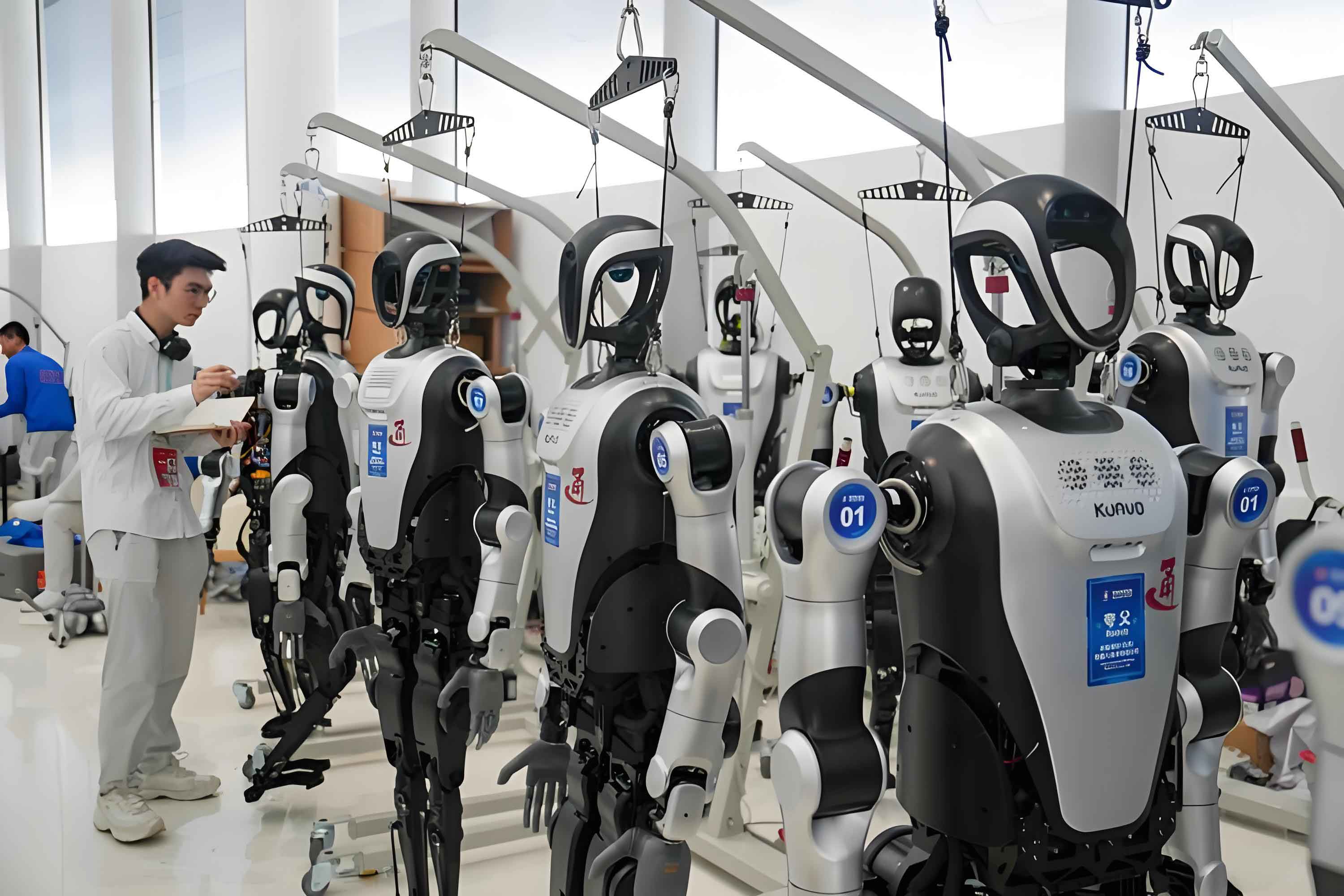
1. From Arena Champions to Skilled Craftsmen
The reason the dexterous hand was singled out for its own competition, out of all the components that make up a humanoid robot, is simple and consequential. The legs determine where a humanoid robot can go. The hand determines what it can ultimately become, and whether it can genuinely fulfill a mission.
That orientation is written directly into the design of the competition. Take block building as an example. The rules require a humanoid robot to assemble blocks within a set time and to hold the structure stable for five seconds. This demands micro-distance vision that can “see clearly,” planning logic that can “think comprehensively,” gripping force that can “hold steadily,” and precision control that can “perform finely.” Only then can the dexterity and manipulation capability of a human finger be genuinely reproduced.
The electric tool assembly event tests compliant force control and precise positioning. The tweezers and bean event tests micro-force manipulation. The cable connection event tests hand-eye coordination. Eight sub-events together amount to the full repertoire of martial arts at a robot’s fingertips.
The embodied intelligence company Lingxin Qiaoshou took part in all eight competitive sub-events of the dexterous hand special competition this year. This year, the company won the grand championship of the ninth Zhongguancun International Frontier Technology Competition with a project described as an embodied intelligence platform built around dexterous hands and cloud-based intelligence. Through a series of independent research and development efforts covering finger joint module innovation, self-developed micro motor technology, and core material innovation, the company has achieved independent controllability of key components and has overcome critical technical difficulties that arise in the research and development of humanoid robots. On the strength of that hardcore technical capability, it has entered the ranks of the world’s leading suppliers in the field of robotic dexterous hands. Of every ten high-degree-of-freedom dexterous hands in the world, eight originate from this company.
2. Eight Examinations at the Fingertips
In the powder weighing event, a humanoid robot must use a spoon to take and place 20 grams of powder, with the error controlled within a range of plus or minus 0.5 grams. In the bottle cap prying event, the robot must use a bottle opener to pry a cap off a glass bottle mouth, and the number of effective openings completed within five minutes becomes the competition result. This requires the dexterous hand to apply force precisely within a narrow space, placing extremely high demands on force control accuracy, dynamic coordination, and real-time feedback capability.
Zuo Jiaping, co-founder of Lingxin Qiaoshou, explained the difficulty in plain terms. It is not merely that one hand must hold the bottle steadily. Another hand must also pick up the bottle opener, and the posture, force, and position used to pick up that opener all affect the speed and quality of the opening. In the process, therefore, the humanoid robot must genuinely use a tool, in the way a person uses a tool.
Another key feature event connected to the dexterous hand this year was pitch-pot. In this year’s pitch-pot event, the inner diameter of the pot mouth was 13 centimeters, and the horizontal distance from the center point to the throwing line was 1.5 meters. The humanoid robot was required to maintain a standing posture within three minutes and complete the full sequence of grasping and throwing. At its core, the event assesses hand-eye coordination, visual target recognition, upper limb trajectory planning, stable grasping by the dexterous hand, and precise control of throwing force and angle. It concentrates the examination of fine manipulation capability while also testing static standing balance.
“Pitch-pot requires the humanoid robot to see clearly and to make a definite judgment about the distance to the surrounding environment,” Zuo Jiaping said. “It must hold steadily, so the hand must grip the pitch-pot arrow very accurately and stably. It must also throw accurately, which means the force output and overall stability must be very good. It needs explosive power, and it needs relevant angle calculations. This requires a clever brain that can calculate distance, force, and position. It is a comprehensive examination of both hand and brain.”
3. All-Autonomous Teams Exceed Expectations
Teams entering the dexterous hand events this year delivered striking performances. Wang Shilong, chief judge of the dexterous hand special competition, told reporters that the performance of fully autonomous teams was better than previously expected, and that a considerable number of fully autonomous teams achieved solid results. He explained that because the fully autonomous mode is more difficult, such humanoid robots enjoy an advantage in scoring compared with the teleoperation mode, and this is intended to encourage teams to develop robots that run purely autonomously to complete tasks.
It must also be recognized, however, that once the material, softness or hardness, and placement angle of an object that comes into contact with the robot change even slightly, autonomous decision-making may still deviate. This uncertainty in the face of the real physical world is precisely the most core technical difficulty at present, and it is precisely the direction the organizing committee hopes to keep pushing forward through competition.
“Competition is not the end point, but the starting point.” Gong Xiao, a member of the organizing committee and deputy director of the China Software Testing Center, said that behind every arena task lies a question drawn from a real production and daily-life scenario. Using real combat to test, and taking demand as the guide, is the original aspiration and mission of holding the games.
4. From Arena Competition to Production Lines
Changes in the design of competition events are often the earliest mirror of an industry’s direction. In fact, this shift was on full display in 2026. On August 19, the 2026 World Robot Conference opened under the theme of human-machine symbiosis and the integration of production and demand, and the dexterous hand became a protagonist that attracted considerable attention.
As a core component of the humanoid robot, the dexterous hand integrates mechanical structure, motors, sensors, and control algorithms into a single unit, making it one of the most difficult core modules to master in the entire machine. This is no exaggeration. The human hand possesses more than 20 degrees of freedom, and the robotic dexterous hand draws precisely on this structural logic. The higher the degree of freedom, the richer the movements that can be completed, and the more work the hand can take on.
But the hand of a robot occupies a very small space. Dozens of joints, actuators, and sensors must be packed into an extremely narrow volume while response speed and reliability are still guaranteed. The engineering difficulty far exceeds the simple rotation of large joints such as the upper arm or the thigh.
At the World Robot Conference site, Lingxin Qiaoshou displayed multiple products and scenario application solutions, mainly including a fully automatic robotic arm production line, the Linker Hand series of dexterous hands, and a robot band. Among them, the fully automatic robotic arm production line is composed of a cluster of several Lingxin Qiaoshou workstations. Each workstation adopts a dual-arm, dual-hand configuration equipped with Linker Hand series dexterous hands. Through visual recognition and force control technology, combined with anti-interference capability and generalized tool-use functions, the production line realizes coordinated operation across multiple workstations and can complete the entire process from parts grasping and assembly to finished product offloading. Each workstation possesses tool operation, production skill switching, and process coordination capabilities, and a single workstation can complete the assembly of multiple components including the robotic arm shoulder, elbow, upper and lower arm, and wrist.
At the Zhaowei dexterous hand booth, the fingertips, joints, and palm of a humanoid dexterous hand were covered with flexible sensing materials and linked to a tablet screen nearby. When a visitor pressed a fingertip, the screen displayed the force point, the magnitude of the applied force, the duration, and the pressure change curve in real time. A relevant person in charge at the company explained that the dexterous hand carries a piezoresistive flexible array tactile solution, with hundreds of sensing points integrated into each finger. After the sensor identifies the magnitude and direction of the applied force, it returns the data, and the system dynamically adjusts the gripping force accordingly, preventing grasped objects from being crushed or slipping out of the hand and achieving flexible and safe operation.
5. A Concentrated Breakthrough in Technical Parameters
In 2026, domestic dexterous hands experienced a concentrated surge in technical parameters, with multiple indicators reaching or surpassing comparable international products.
Among the fully direct-drive dexterous hand XHAND series from the embodied intelligence company Xingdong Jiyuan, the XHAND 1 possesses 12 active degrees of freedom, a maximum single-hand grip force of 80 newtons, and the ability to lift a 25-kilogram weight, with a repeated opening and closing speed of about 10 times per second. The company states that it can complete more than 100 kinds of operation tasks. The XHAND 1 PRO is configured with 21 active degrees of freedom and 18 tactile sensors, with a repeated positioning accuracy of plus or minus 0.1 millimeters and a backlash of plus or minus 1 millimeter. It is compatible with data collection gloves such as Manus Pro and Manus Haptic Pro, supports robotic arm interfaces such as UR and Franka, and covers communication protocols including RS-485, EtherCAT, and CAN.
| Model | Active Degrees of Freedom | Maximum Single-Hand Grip Force | Lifting Capacity | Repeated Opening and Closing Speed | Tactile Sensors | Repeated Positioning Accuracy | Backlash |
|---|---|---|---|---|---|---|---|
| XHAND 1 | 12 | 80 N | 25 kg | About 10 times per second | Not specified | Not specified | Not specified |
| XHAND 1 PRO | 21 | Not specified | Not specified | Not specified | 18 | Plus or minus 0.1 mm | Plus or minus 1 mm |
It is understood that the core components required for dexterous hands have already achieved domestic mass production and independent controllability, and the landing of large-scale production lines has also brought down product costs, laying the foundation for the large-scale popularization of humanoid robots. This also means that the dexterous hand, as the last centimeter through which a robot enters daily life and becomes a genuine assistant, is striving to move from the exhibition booth into more concrete scenarios.
6. From Patient Capital to Skilled Hands
At the end of 2023, Beijing established two funds each at the level of 10 billion yuan, namely the robot industry development investment fund and the artificial intelligence industry investment fund, both managed by professional institutions under Beijing Guoguan, a municipal state-owned enterprise. But this is only the tip of the iceberg. Beijing has established a government investment fund with a total scale reaching 100 billion yuan, increasing investment in future industry fields represented by humanoid robots.
As the core management platform for Beijing municipal government investment funds, Beijing Guoguan currently manages eight municipal-level government investment funds and has built a capital matrix covering strategic emerging industries and future industries. In 2025, Beijing Guoguan participated in multiple investments in the embodied intelligence track, mainly concentrating on leading Beijing humanoid robot companies. Lingxin Qiaoshou, which holds more than 80 percent of the global dexterous hand market, completed six consecutive financing rounds within one year after starting its financing process in 2025, with shareholders including Sequoia China, Ant Group, CICC Capital, Beijing Guoguan, and a number of other well-known institutions. The backing of Beijing Guoguan helps core component enterprises such as dexterous hand makers rapidly expand capacity and reduce costs, benefiting the entire downstream complete machine industry.
In addition, as a representative enterprise of the Shougang Fund embodied intelligence ecological base, Inspira Robot, a leading enterprise in the field of humanoid robot core components, participated deeply in the energy transmission segment of the World Humanoid Robot Games, delivering innovative strength to the event. At the same time, Inspira Robot provided complete dexterous hand hardware support and specialized technical empowerment to multiple participating teams, ensuring the fine manipulation capability of participating humanoid robots from dexterous hand products to technical debugging. Inspira Robot has achieved full-process independent research, development, and production of dexterous hands, and its products have been widely used in industrial, service, medical, and other scenarios. Serving a top-level event this time is precisely a real-combat test of its core component localization strength.
While real-combat testing on the arena is in full swing, the assault on industrial challenges outside the arena is also advancing in parallel.
7. A Municipal Key Laboratory for Embodied Intelligent Dexterous Manipulation
Recently, the Beijing Municipal Science and Technology Commission and the Administrative Committee of Zhongguancun Science Park officially released the 2026 Beijing key laboratory recognition results. The “Embodied Intelligent Dexterous Manipulation Beijing Key Laboratory,” declared with Lingxin Qiaoshou as the lead applicant, was successfully approved, becoming the first provincial-level key laboratory in the country centered on dexterous hand manipulation and focused on system-level innovation of end effectors. The laboratory is jointly built by Lingxin Qiaoshou together with the University of Science and Technology Beijing and Beijing Information Science and Technology University. It will comprehensively enhance the industry’s professional capability in dexterous hand manipulation and build an open, collaborative, and globally leading embodied dexterous hand innovation ecosystem.
On the arena, a robot uses tweezers to pick up a single soybean, uses a spoon to weigh out 20 grams of powder, and uses a fingertip to insert a USB cable accurately. These seemingly tiny movements are backed by a series of bottleneck problems that have not yet been fully overcome. The establishment of the laboratory is intended to solve these problems at the root.
Embodied intelligence is a future industry under China’s forward-looking layout for the fifteenth five-year plan, and it is a key track for cultivating new quality productive forces and building new advantages in science and technology competition. The dexterous hand is a core segment of embodied intelligence implementation, directly determining the manipulation capability of a humanoid robot and the depth of its industrial application. The key laboratory approved this time is closely tied to the national strategy and the capital’s industrial layout, focusing on four core directions: high-precision sensing dexterous hands, large-scale multimodal datasets, intelligent creation large models, and integrated dexterous manipulation systems and scenario applications. It concentrates on overcoming bottleneck technologies such as high-degree-of-freedom precision control, multimodal perception fusion, virtual-to-real scenario transfer, and cross-domain skill generalization, developing independently controllable and performance-leading dexterous manipulation equipment, systematically enhancing the professional capability of China’s embodied intelligence end manipulation, and solidifying the technical foundation for high-quality industrial development.
In other words, the results achieved through those ingenious arena events will one day become a screw tightened in a factory or a glass of water handed over by a robotic hand in a home. This is precisely the distant place the laboratory intends to reach.
8. Building a Full-Chain Innovation Ecosystem
Building a laboratory is not only about breaking through a single technology. It is also about building a full-chain innovation ecosystem led by standards, supported by data, empowered by models, and driven by applications, pushing the industry from single-point research and development toward ecological co-construction.
On the hardware side, relying on the fully self-developed Linker Hand series of dexterous hands from Lingxin Qiaoshou, which covers multiple degree-of-freedom technical routes, the laboratory will work with the industrial chain to formulate unified hardware interfaces, communication protocols, and evaluation standards, ending the fragmented development of the industry and promoting the standardization and generalization of dexterous manipulation hardware.
On the data side, the DexSkill-Net dexterous manipulation dataset will continue to be expanded and upgraded, pushing its volume from the million level toward the billion level and covering diverse scenarios such as industry, healthcare, and livelihood, providing a high-quality data foundation for global embodied intelligence research.
On the model side, an intelligent creation large model oriented toward the physical world will be developed, deeply integrating vision, touch, and action capabilities, strengthening the reasoning, planning, and skill generalization level of robots, and empowering the overall manipulation capability of the industry to leap forward.
On the application side, the full process of research and development, pilot testing, and implementation will be connected, standardized solutions will be output, and the real-world landing of technology will be accelerated, forming a closed loop of technology, data, models, and applications, and creating a globally leading dexterous hand manipulation industry ecosystem.
The laboratory builds a pattern of deep industry-university-research integration featuring enterprise leadership, university empowerment, collaborative research, and shared outcomes. The three parties complement each other’s strengths and join forces to open up the entire chain of basic research, technical breakthroughs, achievement transformation, and talent cultivation. As a leading enterprise in the global dexterous manipulation field, Lingxin Qiaoshou possesses complete industrial capabilities spanning full-stack self-development, large-scale mass production, and scenario-based implementation, providing the laboratory with a hardware platform, engineering support, and industrial resource guarantees. The University of Science and Technology Beijing has deep accumulation in robot control and fundamental artificial intelligence theory, providing cutting-edge theoretical support. Beijing Information Science and Technology University has long been engaged in precision sensing, intelligent manufacturing, and system integration, empowering the engineering implementation of technology. The three parties work together to comprehensively enhance the industry’s dexterous manipulation research and development level and professional capability, and to cultivate a high-level team of innovative talent.
As the first provincial-level key laboratory in the country focused on dexterous hand manipulation, Lingxin Qiaoshou shoulders the mission of the era to break through core technologies, improve the industrial ecosystem, enhance industry capability, and lead industry standards. In the future, the laboratory will consistently adhere to the four orientations, closely follow the national strategy and the capital’s functional positioning, deepen research and development and ecosystem building in dexterous hand manipulation technology, accelerate key technology breakthroughs and achievement transformation, help Beijing build a global artificial intelligence innovation highland, and build a future of human-machine symbiosis for the high-quality development of China’s embodied intelligence industry.
9. The Long March of the Industry Has Only Just Begun
In 2026, domestic dexterous hands achieved dense breakthroughs in indicators including degrees of freedom, grip force, load bearing, and tactile resolution. The second World Humanoid Robot Games listed the dexterous hand as a special competition event for the first time, making micro-manipulation at the fingertips a new scale for measuring the evolutionary level of a humanoid robot.
The glory of the competition belongs to the present, while the long march of the industry has only just begun. As the industry develops, the humanoid robot will no longer be merely a display item that can run and jump. It will gradually grow into a robot that can truly extend both hands and take on real work in complex scenarios.
From the arena to the production line, from a soybean gripped by tweezers to a component assembled on a workstation, from a bottle cap pried open within five minutes to a USB cable inserted with precision, each of these tasks maps onto a demand that already exists in factories, hospitals, warehouses, and homes. The dexterous hand is where that mapping becomes physical. It is the final centimeter between a humanoid robot that performs and a humanoid robot that works, and closing that centimeter is the task that competition, capital, research institutions, and enterprises have now set for themselves.
The humanoid robot of the near future will be judged not only by how fast it runs or how high it jumps, but by whether it can pick up a spoon, hold a tool, and hand a person a glass of water without spilling it. That is the standard the dexterous hand special competition has placed on the table, and it is the standard the entire industry is now racing to meet.