
The convergence of industry, big data, and the Internet represents an undeniable global trend. Compared to the first three industrial revolutions, the significant advancement of Industry 4.0 lies in its use of the Internet to activate traditional industrial processes, making factories intelligent—capable of “speaking” and “thinking.” I have been actively engaging with experts across the automation sector, driven by the mission to identify new breakthroughs for the development of robotics and automation in China.
While nations like the United States advanced the Third Industrial Revolution and Germany launched its Industry 4.0 strategy, China has announced its own ambitious roadmap. The signal was clear in a recent government work report with the first mention of the “Made in China 2025” initiative. This represents the first strategic step in transitioning China’s manufacturing sector from a position of scale to one of strength.
However, an honest assessment reveals a considerable gap between China’s industrial base and that of developed nations like Germany and Japan, whether examined through the lens of historical legacy, talent pool, or core technology. The stage of industrial automation and the China robot industry remains relatively foundational. A critical disconnect exists between three core pillars:本体制造 (本体制造, ontology manufacturing—referring to robot本体制造), software development, and end-user applications. This fragmented chain makes the full realization of unmanned workshops, let alone smart factories, a distant goal. Germany’s Industry 4.0 concept heavily emphasizes the application of data and the Internet in automation, which feels somewhat detached from our current, more pressing needs. Therefore, a direct transplant is not the solution. China’s present industrial reality aligns more closely with a stage between Industry 2.0 and 2.5, perhaps reaching 3.0 in its most advanced pockets.
Industry 4.0 as a Guiding Concept
Industry 4.0, as championed by Germany, is a “next-generation smart factory plan.” It is predicated on the Internet of Things (IoT) and emphasizes transforming current industrial production and service models through the fusion of information networks and physical production systems. In the Industry 4.0 era, products and production equipment, as well as different pieces of equipment, are interconnected via data exchange. This integration forms an intelligent production network, vertically within a factory and horizontally across factories.
Within the China robot and manufacturing context, traditional production inevitably faces challenges in resource integration. The innovative fusion of automation, informatization, big data, and the Internet is destined to become the prevailing trend. Over thirty years of manufacturing development have, in many cases, fostered an inward-looking, product-centric mentality rather than a market- and customer-centric one. This inherent disconnect hinders long-term enterprise development.
The globalization of resource allocation means a nation’s or a company’s competitiveness no longer depends solely on its endogenous technological or talent resources but increasingly on its ability to integrate社会化 and international resources. The era of孤立地开发产品 in isolation is over; no single entity can maintain superiority across an entire product’s value chain. Resource整合 has become the new normal in global manufacturing.
Scholars point out that the expanding scope of knowledge and technology, coupled with the inherent limitations of any single organization’s knowledge structure, makes the externalities of innovation more pronounced. The evolution from endogenous, closed independent innovation to alliance-based collaborative innovation, and further to boundary-less, platform-driven open innovation, reflects the intrinsic规律 of technological development.
The trends toward precision,高端化, automation, and informatization in manufacturing drive continuous industrial升级, culminating in advanced “unmanned factories” and “lights-out factories.” The current领先 position of German manufacturing stems precisely from the seamless integration of Robot + Big Data + Internet, achieving truly intelligent workshops.
The elevation of the “Internet Plus” concept to a national strategy embodies this essence of融合创新. “Internet Plus” strategy utilizes the Internet as a foundational platform, leveraging information and communication technologies to integrate the Internet with all traditional industries, thereby creating a new ecology in new domains.
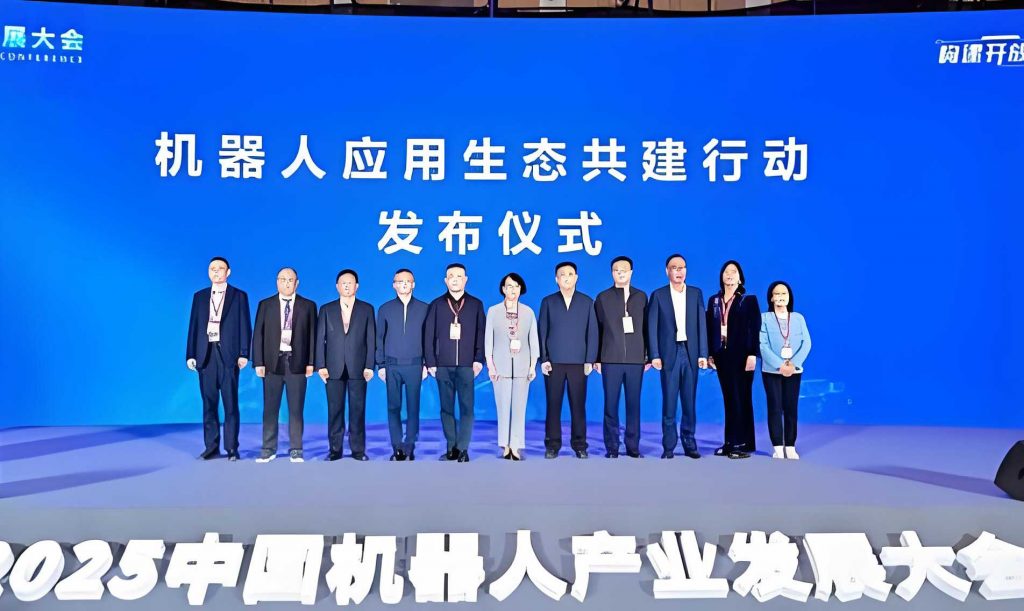
The Imperative for an Ecosystem
A complete industrial ecosystem for the China robot sector comprises three interlinked rings:本体制造 (Robot本体制造), system integration, and终端应用 (end-user application). The current domestic landscape is problematic:本体制造商 often focus solely on hardware assembly, system integrators lack deep manufacturing capabilities, and crucially, both lack a synergistic platform that fully leverages the other’s strengths. This siloed approach is unsustainable for long-term, competitive growth.
The mission, therefore, is to串联 and completely打通 these three rings, constructing a holistic机器人生态产业链. The表面上火爆 automation and China robot industry masks a reality where many players are struggling. The root cause is that robotics serves the manufacturing sector; when manufacturing faces headwinds, the automation sector naturally suffers. More critically, many in the China robot field are engaged in basic assembly—”打铁的工作”—without core technologies, proprietary software, or substantive发明专利. Relying on assembling others’ components leads to a lack of核心竞争力, creating future dependency for upgrades and optimization.
In contrast, a true leader in the China robot space must maintain a firm grasp on core R&D. This mastery grants the主动权 to provide solutions characterized by four unique advantages: upgradability, replicability, versatility, and openness. Achieving this requires significant investment in talent. Securing top-tier technical expertise from around the globe is not an expense but an investment in the第一竞争力. Without such high-end talent, neither enterprises nor the national industry can achieve long-term,领先 development.
Making Automation Accessible: The “One-Year ROI” Principle
The “Made in China 2025” blueprint is a pivotal moment. While China regained its status as the world’s largest manufacturer, the journey from manufacturing giant to manufacturing强国 requires concerted effort and a tailored path.
Blindly copying technology from Germany or Japan is not the answer. The path for the China robot industry must be grounded in the actual conditions of China’s vast and diverse manufacturing base. The goal is to探索 a practical route for Chinese manufacturers to upgrade from traditional methods toward automation and intelligence. This means being truly接地气—贴近市场 and贴近客户 to ensure产品市场化.
Many manufacturing enterprises still view industrial automation and China robot solutions as unattainable “空中楼阁,” considering talk of Industry 4.0 premature. Addressing this perception is key. The focus must be on delivering tangible, immediate value. This is encapsulated in the “一年回本” (one-year return on investment) principle for automation solutions. The approach starts with R&D, continuously exploring core technologies and optimizing production processes and工艺 to enhance product quality and save costs for the client—never through简单的偷工减料.
The objective is to redefine “high-end” for the local context, transforming工业自动化 and China robot systems from perceived “luxuries” into essential “necessities” for competitive manufacturing.
The current phase in China can be described as one of human-machine collaboration. While automation is progressively replacing humans in dangerous, monotonous, and high-labor-intensity roles, certain柔性 tasks remain difficult for current equipment to master fully. This is a primary reason why China has not yet achieved pervasive unmanned or smart workshops.
Another fundamental barrier is the lack of integrated data and information flows. Even when automation is implemented, the absence of a comprehensive information layer—which requires extracting big data on production capacity, machine动力, order scheduling, and delivery rhythms—prevents the软硬结合 necessary for a lights-out factory. Furthermore, the nature of much Chinese manufacturing, characterized by代工 (OEM) production with its small batch sizes, high variety, and frequent line changeovers, presents inherent challenges to the standardized, high-uptime model ideal for full automation.
The公式 for calculating a simple Return on Investment (ROI) to justify automation, crucial for the adoption of China robot solutions, can be expressed as:
$$ \text{ROI} = \frac{\text{Net Annual Savings from Automation} – \text{Annualized Cost of Automation}}{\text{Annualized Cost of Automation}} \times 100\% $$
Where Net Annual Savings include labor cost reduction, quality yield improvement, and energy savings, and Annualized Cost includes the purchase price, installation, and maintenance spread over the system’s lifespan. The “One-Year ROI” target implies aiming for an ROI ≥ 100% within the first 12 months.
The productivity gain from introducing a China robot in a collaborative setup can be modeled. If a human worker’s output rate is \( R_h \) (units/hour) and a robot’s assisted rate is \( R_r \), the combined collaborative cell output \( R_c \) is often greater than the sum, thanks to optimized division of labor:
$$ R_c = \alpha R_h + \beta R_r + \gamma $$
where \( \alpha \) and \( \beta \) are efficiency coefficients (often \( 0 < \alpha < 1, \beta > 1 \)) reflecting the reallocation of human effort to higher-value tasks, and \( \gamma \) represents a synergy factor from continuous operation.
| Stage | Core Driver | China Robot Industry Relevance | Typical Factory State |
|---|---|---|---|
| Industry 2.0 | Mass Production, Electrical Energy | Basic mechanization, fixed automation. | Assembly lines with dedicated machines. |
| Industry 3.0 | Automation, Computers & PLCs | Programmable robots and logic controllers emerge. | Automated islands of production, data silos. |
| Industry 4.0 | Cyber-Physical Systems, IoT, Data | Smart, connected China robots integrated into a digital thread. | Smart, adaptive, and decentralized production. |
| China’s Current Reality | Hybrid: Automation + Connectivity | Focus on reliable robot本体制造 & integration, building data foundations. | Widespread human-robot collaboration (HRC), moving from islands toward connected systems. |
| Ecosystem Ring | Core Function | Current Challenge in China Robot Market | Requirement for a Healthy Ecosystem |
|---|---|---|---|
| 本体制造 (Ontology Manufacturing) | Design and production of robot arms, controllers, drives. | Often lacks deep integration with application software; heavy reliance on imported core components (e.g., reducers, servos). | Must develop core technologies and open interfaces for seamless data exchange with other rings. |
| System Integration | Engineering robot workcells, programming for specific tasks (welding, palletizing, etc.). | Projects are often one-off, non-scalable “custom crafts”; limited ability to feed application data back to improve本体制造. | 需要 standardized modules and a platform to share application algorithms and best practices. |
| 终端应用 (End-User Application) | The actual use of robots in manufacturing (auto, electronics, food, etc.). | Lacks channels to communicate real-world performance needs and pain points back to integrators and manufacturers. | 需要 a feedback loop where operational data (OEE, failure modes) informs product and solution evolution. |
The Path Forward: Integration, Data, and a Unique Value Proposition
The future of the China robot industry hinges on closing these gaps. The vision involves creating a platform or a set of standards that allow these three rings to interact dynamically. Data from end-user applications must flow back to inform better integration software and下一代 robot本体制造 designs. This creates a virtuous cycle of improvement.
The ultimate goal transcends mere automation. Humans possess灵性和智慧 that machines do not. The purpose of the China robot ecosystem should be to liberate human workers from枯燥 and危险 tasks, reallocating human potential to more innovative, creative, and strategic roles. This aligns with a profound value主张: enabling工业文明 to回归自然之美—where technology enhances human work rather than merely replacing it, fostering a more harmonious and productive industrial environment.
The strategic formula for the future China robot ecosystem can thus be summarized as:
$$ \text{Sustainable China Robot Ecosystem} = \underbrace{\text{Core Tech R&D}}_{\text{Autonomy}} + \underbrace{\text{Open Integration Platform}}_{\text{Connectivity}} + \underbrace{\text{Application-Led Data Feedback Loop}}_{\text{Intelligence}} $$
This path, distinct from simply following Western models, is what will enable the China robot industry to build a resilient, innovative, and globally competitive ecosystem tailored to the unique scale and needs of Chinese manufacturing, ultimately contributing to the realization of “Made in China 2025” and beyond.