
Chengdu, March 14, 2025 – The Chengdu Civil Affairs Bureau and Municipal Health Commission unveiled the city’s inaugural demand list for medical and wellness robots during a supply-demand对接会 (duijiehui) on March 12. This pioneering initiative identifies 22 categories of robotic technologies required across nursing homes and hospitals, signaling a major advancement in healthcare automation.
-
Comprehensive Demand List Targets Multiple Care Scenarios
The dual lists specify robotic solutions for eldercare facilities and hospitals. Four senior care institutions submitted five projects requesting humanoid robots for daily living assistance including feeding support, turning assistance for bedridden patients, mobility aid, and emotional companionship. Nine medical facilities proposed ten projects requiring robotic applications in medical assistance, intelligent triage, medication delivery, and four AI diagnostic scenarios. The demand list explicitly includes rehabilitation robots for lower-limb active/passive training at Sichuan Third Veterans Hospital and comprehensive care humanoid robots at Chengdu First Social Welfare Institute.
-
Industry Responds with Specialized Solutions
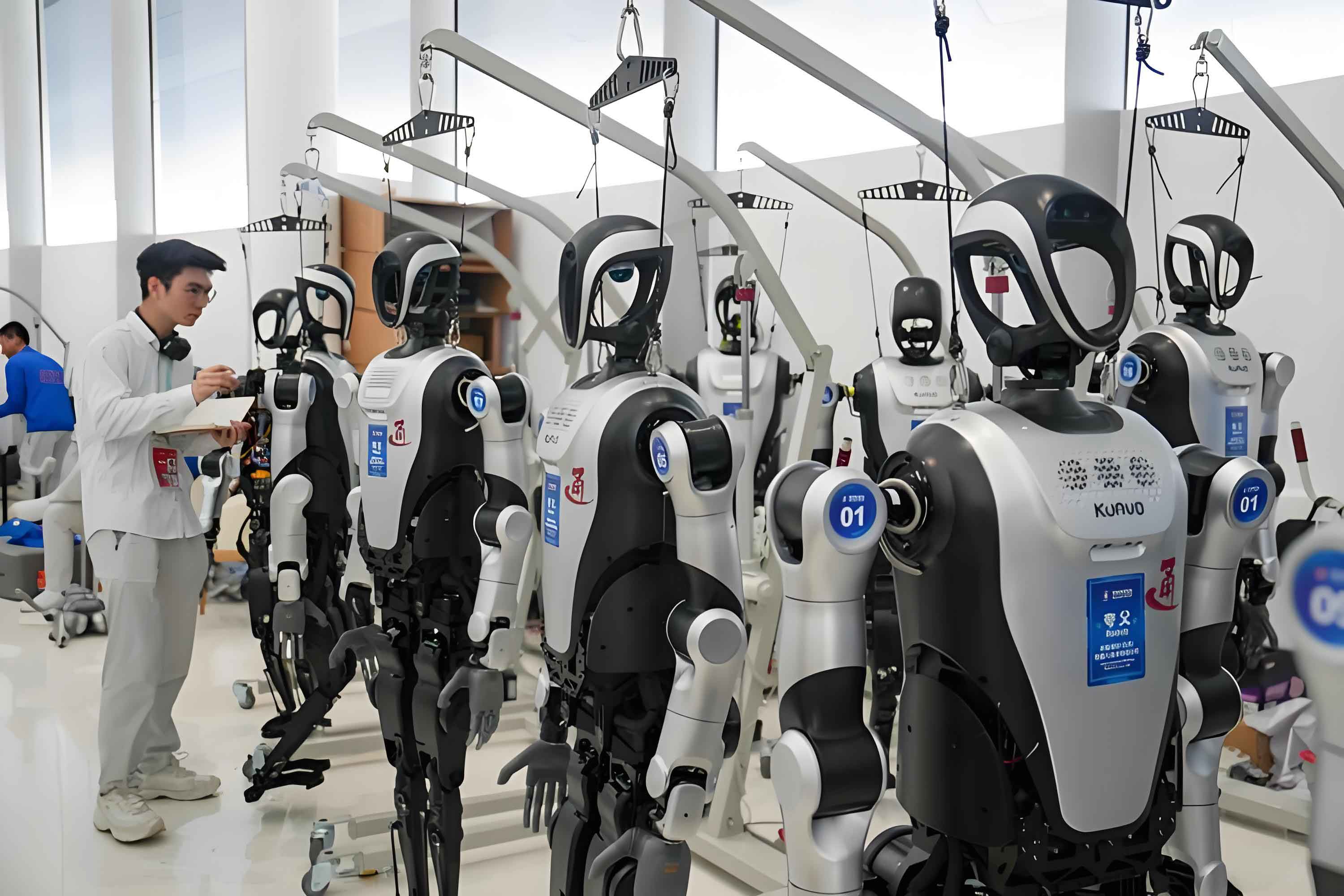
Technology providers immediately showcased innovations aligning with the demand list. West China Medical Robot Research Institute is developing over 20 medical devices, including humanoid assistive robots for sit-to-stand rehabilitation, cardiovascular surgical robots, and an intelligent 3D medical printing system for customized orthopedic solutions. “Our printing technology replaces traditional external fixation methods, enabling precise personalized treatment for limb trauma,” stated Sun Miao, General Manager of the institute.
Chengdu Xinnao Technology demonstrated a brain-computer interface helmet capable of 90% accuracy in early autism spectrum disorder (ASD) detection through brainwave analysis. “This humanoid robot-compatible system identifies neural patterns during task execution, revolutionizing early childhood diagnostics,” explained CEO Feng Rui. The technology is currently piloted in Jinjiang District.
-
Institutional Barriers Challenge Humanoid Robot Deployment
Despite Chengdu’s robust ecosystem – home to 1,006 AI and robotics enterprises and leading institutions like West China Hospital and University of Electronic Science and Technology – innovators face regulatory hurdles. Feng Rui highlighted administrative fragmentation: “Establishing rehabilitation centers across districts requires duplicate licensing. Current systems create prohibitive timelines for citywide humanoid robot-assisted therapy deployment.”
Liu Sha, Director of the Equipment Manufacturing Division at Chengdu’s Economy and Information Technology Bureau, acknowledged the need for institutional innovation: “Next-generation humanoid robot products necessitate governmental process redesign. We’re actively reforming policies to accelerate medical humanoid robot adoption.” The bureau is developing streamlined regulatory frameworks to facilitate robotic integration in healthcare settings.
-
Strategic Advantages Position Chengdu as Robotics Hub
Chengdu leverages unique strengths in its humanoid robot initiative. The concentration of top-tier medical facilities provides real-world testing grounds, while academic powerhouses like Sichuan University drive R&D in humanoid robot kinematics and AI behavioral algorithms. Industry clusters along the AI and robotics supply chain enable rapid prototyping of humanoid robot components from actuators to sensory systems.
The demand list functions as a market signal to attract global robotics investments. Companies developing humanoid robots for delicate caregiving tasks receive priority access to Chengdu’s senior care networks, while surgical humanoid robot innovators gain pathways to clinical validation in the city’s advanced medical centers.
-
Implementation Roadmap and Future Expansion
Phase one deployments will commence in listed institutions within Q2 2025, with efficacy metrics tracking care efficiency improvements and patient outcomes. Successful humanoid robot models may expand to all 423 Chengdu eldercare facilities and 135 hospitals by 2026. The government plans incentive packages including tax benefits for humanoid robot manufacturers and subsidies for healthcare providers adopting the technology.
Future demand lists will incorporate care robots for dementia patients and humanoid robotic systems for remote surgery. “This initiative establishes Chengdu as the testing ground for Asia’s next-generation medical humanoid robots,” concluded a municipal spokesperson. “Our systematic approach connects innovators directly with end-users, accelerating the realization of intelligent healthcare ecosystems where humanoid robots and human professionals collaborate seamlessly.”