
In the context of the global scientific revolution and industrial transformation, humanoid robots represent a profound integration of artificial intelligence and advanced manufacturing, serving as a critical benchmark for national innovation capabilities and industrial competitiveness. As an emerging field, humanoid robots encapsulate the convergence of multiple disciplines, including AI, perception, control, and human-computer interaction. In this article, I explore the technological autonomy, application scenarization, and ecosystem integration of China’s humanoid robot industry, drawing on systemic analyses to outline pathways for strategic advancement. The development of humanoid robots is not merely a technological pursuit but a strategic imperative for fostering new quality productive forces and achieving high-quality economic growth. Through this examination, I aim to provide insights into how China can transition from a technology follower to an ecosystem leader in the global landscape.
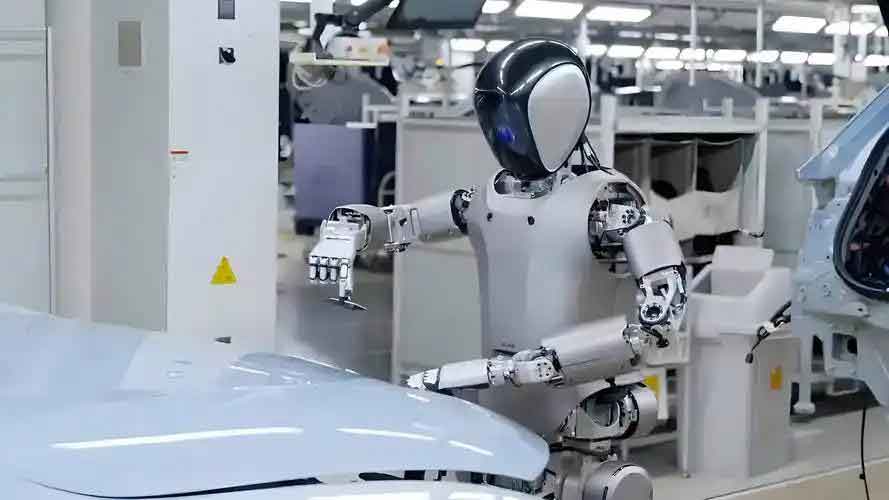
The core technological architecture of humanoid robots encompasses several integrated systems that enable their functionality and adaptability. These systems include the本体 structure, perception and decision-making, control, and human-robot interaction modules. Each component relies on advanced algorithms and hardware to mimic human-like behaviors. For instance, the perception system often employs multi-sensor fusion, which can be modeled using Bayesian frameworks to enhance reliability. A key formula in sensor fusion is the Bayesian update rule: $$ p(x|z) = \frac{p(z|x)p(x)}{p(z)} $$ where \( p(x|z) \) represents the posterior probability of state \( x \) given measurement \( z \), \( p(z|x) \) is the likelihood, \( p(x) \) is the prior, and \( p(z) \) is the evidence. This underpins the environmental understanding capabilities of humanoid robots, allowing them to operate in dynamic settings. Moreover, the control system involves dynamics equations, such as the Lagrangian formulation for motion: $$ L = T – V $$ where \( T \) is kinetic energy and \( V \) is potential energy, leading to equations of motion like $$ \frac{d}{dt} \left( \frac{\partial L}{\partial \dot{q}} \right) – \frac{\partial L}{\partial q} = \tau $$ with \( q \) as generalized coordinates and \( \tau \) as generalized forces. Such formulas are essential for stable bipedal locomotion and task execution in humanoid robots.
To summarize the core components, I present a table detailing the key systems and their functions in humanoid robots:
| System | Key Components | Primary Functions |
|---|---|---|
| Ontology Structure | High-DOF joints, lightweight materials | Enables flexible movement and posture coordination |
| Perception and Decision | Multi-modal sensors, AI algorithms | Facilitates environment sensing and task planning |
| Control System | Servo drives, kinematic solvers | Ensures motion stability and precision |
| Human-Robot Interaction | NLP, emotion recognition | Supports natural communication and empathy |
Globally, the development of humanoid robots is characterized by trends toward high performance, scenarization, and cost reduction. Leading nations have adopted distinct strategies based on their technological strengths. For example, the United States emphasizes general AI and engineering integration, with robots like Atlas showcasing advanced dynamics control. Japan focuses on service-oriented applications with emotional interaction, as seen in Pepper, while South Korea leverages manufacturing prowess for industrial collaboration. Europe prioritizes medical assistance and ethical considerations. The commercialization paths vary, including scenario-first approaches and cost-control mechanisms. In terms of technological progress, the performance of humanoid robots can be quantified using metrics such as the cost function in optimization: $$ J = \sum_{t=0}^{T} (x_t – x_{ref})^T Q (x_t – x_{ref}) + u_t^T R u_t $$ where \( x_t \) is the state vector, \( x_{ref} \) is the reference, \( u_t \) is the control input, and \( Q \) and \( R \) are weighting matrices. This formula is often used in model predictive control for humanoid robots to achieve desired trajectories while minimizing energy consumption.
In China, the pursuit of technological autonomy in humanoid robots has seen initial breakthroughs in perception, actuation, and system integration. However, structural challenges persist, including reliance on imported core components and gaps in original innovation. The autonomous development mechanism involves a tripartite collaboration: national strategic guidance, corporate R&D leadership, and academic research support. For instance, national projects like the “Artificial Intelligence +” initiative provide policy frameworks, while enterprises drive industrialization through iterative product development. Universities contribute foundational research in areas such as biomimetic motion and human-robot ethics. A critical aspect is the enhancement of core零部件, where domestic alternatives are emerging. The progress in key areas can be summarized in the following table:
| Technology Area | Autonomy Progress | Remaining Challenges |
|---|---|---|
| Perception Systems | Multi-sensor fusion capabilities improved | Limited high-precision sensor domestic production |
| Actuation Systems | Integrated servo drives developed | Dependence on imported reducers and motors |
| Control Algorithms | AI-driven decision-making implemented | Gaps in dynamic stability algorithms |
| System Integration | Full-process R&D chains established | Standardization and interoperability issues |
Mathematically, the improvement in perception systems can be modeled using Kalman filters for state estimation: $$ \hat{x}_{k|k-1} = F_k \hat{x}_{k-1|k-1} + B_k u_k $$ $$ P_{k|k-1} = F_k P_{k-1|k-1} F_k^T + Q_k $$ where \( \hat{x} \) is the state estimate, \( F \) is the state transition matrix, \( B \) is the control matrix, \( u \) is input, \( P \) is error covariance, and \( Q \) is process noise. This is crucial for humanoid robots to navigate uncertain environments. Additionally, the cost reduction efforts align with economies of scale, expressed as \( C(n) = C_0 n^{-b} \), where \( C(n) \) is unit cost for \( n \) units, \( C_0 \) is initial cost, and \( b \) is the experience exponent, highlighting how mass production can make humanoid robots more affordable.
The application scenarization of humanoid robots in China follows a structured evolution across industrial, service, and public domains. In industrial settings, humanoid robots are transitioning from manual replacement to human-robot collaboration, enhancing flexibility in manufacturing. Service scenarios are deepening from functional support to situational interaction, with robots employed in healthcare, education, and companionship. Public applications expand from辅助 roles to task-oriented functions, such as security patrols and emergency response. The product design is increasingly task-customized, with modularity enabling cross-scene adaptability. For example, the control performance in industrial tasks can be optimized using PID controllers: $$ u(t) = K_p e(t) + K_i \int_0^t e(\tau) d\tau + K_d \frac{de(t)}{dt} $$ where \( e(t) \) is the error signal, and \( K_p \), \( K_i \), \( K_d \) are gains tuned for specific scenarios. This ensures precise motion control for humanoid robots in repetitive tasks.
To illustrate the scenarization logic, I provide a table outlining the application domains and their characteristics:
| Application Domain | Key Features | Example Tasks |
|---|---|---|
| Industrial | High precision, dynamic environments | Assembly, quality inspection |
| Service | Emotional interaction, personalization | Elderly care, education |
| Public | Safety, autonomy in complex settings | Disaster response, urban management |
Business model innovations are driving the scenarization of humanoid robots, with B-end and C-end markets co-evolving. In B-end sectors, customized solutions dominate, while C-end focuses on affordability and user experience. The shift from hardware sales to service subscriptions is evident, with value derived from data and platform ecosystems. For instance, the revenue model can be expressed as \( R = S + D \), where \( R \) is total revenue, \( S \) is subscription fees, and \( D \) is data-driven增值 services. This aligns with the software-defined nature of modern humanoid robots, where functionality is updated via algorithms rather than hardware changes. The ecosystem surrounding humanoid robots is crucial for sustained growth, involving upstream components, midstream integration, and downstream applications.
The ecosystem integration of China’s humanoid robot industry encompasses upstream core components, midstream system integration, and downstream application services, supported by standards, finance, and education. A distinctive Chinese approach involves policy-guided clustering in regions like the Greater Bay Area, Yangtze River Delta, and Beijing-Tianjin-Hebei, each leveraging local advantages. Cross-sector integration with AI, healthcare, and education fosters innovation, while institutional supports like ethical governance and talent development underpin long-term resilience. The ecosystem’s health can be assessed using network theory metrics, such as the connectivity index: $$ C = \frac{2E}{N(N-1)} $$ where \( E \) is the number of edges (collaborations) and \( N \) is the number of nodes (entities) in the industrial network. A higher \( C \) indicates better integration and knowledge flow among stakeholders in the humanoid robot ecosystem.
I summarize the core构成 of the ecosystem in the following table:
| Ecosystem Layer | Components | Role in Value Chain |
|---|---|---|
| Upstream | Servo motors, sensors, materials | Provides foundational technologies |
| Midstream | 整机 assembly, control algorithms | Integrates systems for functionality |
| Downstream | Industrial, service, public apps | Delivers value through deployment |
| Support Systems | Standards, finance, laws, education | Ensures sustainable development |
Looking ahead, the systemic evolution of China’s humanoid robot industry points toward high intelligence, adaptability, and ecosystem dominance. Intelligence is advancing from rule-based execution to human-like cognition, driven by generative AI and multi-modal learning. Adaptability is enhanced through flexible structures and materials, enabling operation in extreme environments. The transition to ecosystem leadership requires holistic policy paths, including strengthening basic research, activating scenario-driven innovation, and完善 institutional supports. For example, the innovation output can be modeled using a production function: $$ Y = A K^\alpha L^\beta $$ where \( Y \) is output (e.g., number of deployed humanoid robots), \( A \) is total factor productivity, \( K \) is capital investment, \( L \) is labor (talent), and \( \alpha \), \( \beta \) are elasticities. Policies that boost \( A \) through R&D and collaboration are vital for scaling the industry.
In terms of policy recommendations, I propose a focus on foundational research to overcome bottlenecks in areas like brain-inspired computing and flexible control. Ecosystem building should emphasize full-chain coordination, from components to services, while scenario activation mechanisms can demonstrate practical value in pilots. Institutional supports must cover standards, ethics, and capital access. The effectiveness of policies can be evaluated using cost-benefit analysis: $$ NPV = \sum_{t=0}^{T} \frac{B_t – C_t}{(1 + r)^t} $$ where \( NPV \) is net present value, \( B_t \) and \( C_t \) are benefits and costs in period \( t \), and \( r \) is the discount rate. This helps prioritize investments in humanoid robot initiatives that yield long-term societal benefits.
In conclusion, the journey of humanoid robots in China is a multifaceted endeavor involving technological self-reliance, scenario-based expansion, and ecosystem synergy. As humanoid robots evolve from prototypes to industrial pillars, they hold the potential to reshape labor structures, service models, and societal norms. By embracing a systemic perspective that balances innovation with governance, China can not only achieve global competitiveness but also foster a harmonious integration of intelligent systems and human values. The repeated emphasis on humanoid robots throughout this discussion underscores their centrality in the future of automation and AI-driven progress.