
From the era of “machine substitution” to the era of the “future factory,” I have watched the manufacturing sector in my region move toward intelligent and green transformation at a pace that continuously reshapes what vocational education must deliver. The rapid growth of the industrial robots industry has created an urgent demand for high-skilled talent who can install, program, integrate, maintain, and improve industrial robots in real production environments. In my role as an educator in a secondary vocational school, I do not treat industrial robots as a single subject. I treat them as a living ecosystem that connects government policy, enterprise needs, curriculum design, teaching methods, assessment, and student development. My school is rooted in a robot industrial park ecosystem. We closely align with the talent needs of the regional high-end intelligent manufacturing industry. Facing the real problems in the transformation of the secondary vocational industrial robots major, I work with government, enterprises, and other stakeholders through deep cooperation and collaborative education. This work lays a solid foundation for students’ high-quality employment and development. It also provides talent support and intellectual support for regional industrial upgrading.
In this article, I explain how I understand the problems in school-enterprise collaboration for the industrial robots major, how I have participated in practical exploration, and what results I have observed. I use first-person reflection because collaborative education is not an abstract system. It is a daily practice of negotiation, design, experimentation, and revision. I also use tables and formulas to summarize the logic that I have found most useful. The phrase “industrial robots” appears throughout because it is the center of gravity for the entire talent ecosystem. Without a clear focus on industrial robots, curriculum reform can become generic. With that focus, every decision becomes concrete: which industrial robots to use, which production scenarios to simulate, which programming tasks to teach, which maintenance routines to practice, and which innovation projects to launch.
The shift from “machine substitution” to the “future factory” is not merely a change in equipment. It is a change in the relationship among people, industrial robots, data, and production systems. In the earlier stage, machine substitution often meant replacing repetitive manual work with automated equipment. In the future factory stage, industrial robots become connected nodes inside a cyber-physical production system. They exchange data with sensors, conveyors, machine tools, warehouse systems, and enterprise resource planning platforms. They are no longer isolated machines. They are part of a network. This means that the skills required by students are no longer limited to operating a single industrial robot. Students must understand the logic of industrial robots in a full production chain. They must be able to troubleshoot when an industrial robot stops, reconfigure when a production line changes, optimize when cycle time becomes a bottleneck, and collaborate when a new product is introduced.
For me, the central question is this: how can a secondary vocational school, together with government and enterprises, build a collaborative education system that keeps industrial robots talent development synchronized with industrial upgrading? The answer I have pursued is not a single course, a single laboratory, or a single internship. It is an integrated model that includes micro-scaled full-chain scenarios, dynamically updated curriculum, modular courses, dual mentor flowcharts, digital twin learning analytics, and continuous evaluation. I shall describe each part and show how they connect.
| Dimension | Machine Substitution Stage | Future Factory Stage | Implication for Industrial Robots Talent |
|---|---|---|---|
| Production logic | Replace repetitive labor with automated equipment | Connect people, industrial robots, data, and systems | Students need system thinking, not only operation skills |
| Equipment role | Standalone machine | Networked cyber-physical node | Students must understand interfaces and data flow |
| Work organization | Fixed workstation | Flexible reconfigurable line | Students must adapt to changing tasks |
| Key competence | Basic operation and maintenance | Integration, optimization, troubleshooting, innovation | Curriculum must combine technology, process, and problem solving |
| Teacher role | Instructor of equipment use | Facilitator of learning in real and virtual scenarios | Teachers need enterprise collaboration and digital tools |
| Enterprise role | Equipment provider or internship host | Co-designer of learning scenarios and assessment | Enterprises must be inside the curriculum cycle |
| Student outcome | Entry-level operator | High-skilled technician with development potential | Students need career resilience and innovation ability |
When I diagnose the problems in school-enterprise collaboration for the industrial robots major, I see three interconnected gaps. The first gap is that teaching scenarios cannot synchronize with industrial upgrading and iteration. Industrial robots are an emerging major. The corresponding new industrial chain technologies and equipment iterate rapidly. Secondary vocational schools often lack new training equipment. The distance between school conditions and enterprise needs is large. Therefore, we must construct new teaching scenarios. The second gap is that curriculum content is difficult to match industrial development and renewal. Industrial robots have complex application scenarios. Enterprise production lines are diverse. Secondary vocational schools often lack teaching resources. There is an adaptation gap between curriculum content and real enterprise production. Therefore, we must develop new professional courses. The third gap is that learning methods are difficult to adapt to industrial job requirements. Industrial robots technology has a high degree of integration and a high degree of interdisciplinary intersection. Secondary vocational students’ learning foundations and job requirements often differ greatly. Traditional learning methods struggle to achieve precise connections. Therefore, we must explore new learning methods.
I summarize the talent gap as a multidimensional distance between what industry requires and what students currently can do. If I denote required competence in dimension \(i\) as \(R_i\), actual student competence as \(A_i\), and the weight of that dimension as \(w_i\), then the weighted gap \(G\) can be expressed as:
$$G = \sum_{i=1}^{n} w_i \max(0, R_i – A_i)$$
This formula reminds me that a gap is not a single number. It is a profile. For industrial robots, the profile includes mechanical assembly, electrical wiring, sensor calibration, programming, simulation, integration, fault diagnosis, safety, teamwork, and continuous learning. If I only measure one dimension, I may produce students who can pass an exam but cannot solve a real production problem. Collaborative education must reduce each weighted gap while keeping the curriculum connected to the evolving industrial robots ecosystem.
I also use a demand alignment index to evaluate whether our teaching scenario is moving in the same direction as industrial robots industry needs. Let \(C_{cur}\) be curriculum coverage of current industrial robots technology, \(C_{ind}\) be industry demand for that coverage, \(E_{equ}\) be equipment fidelity, \(E_{ind}\) be industry equipment level, \(P_{ped}\) be pedagogical support, and \(P_{ind}\) be industry problem complexity. Then a simplified alignment index is:
$$DAI = \alpha \frac{C_{cur}}{C_{ind}} + \beta \frac{E_{equ}}{E_{ind}} + \gamma \frac{P_{ped}}{P_{ind}}$$
where \(\alpha + \beta + \gamma = 1\). I do not treat this formula as a precise measurement tool. I treat it as a design checklist. It forces me to ask whether the curriculum, equipment, and pedagogy are all aligned with industrial robots reality. If one ratio is low, the collaborative education system is unbalanced. For example, if the school has advanced industrial robots but the curriculum remains theoretical, then \(C_{cur}/C_{ind}\) may be low. If the school has a good curriculum but old industrial robots, then \(E_{equ}/E_{ind}\) may be low. If both are high but students cannot solve open-ended problems, then \(P_{ped}/P_{ind}\) may be low.
My practical exploration begins with micro-scaled design of full industrial chain scenarios for industrial robots. I focus on core enterprises in the industrial robots full industrial chain. Together with the robot industrial park, we develop a digital-intelligent full-real micro-station. This micro-station supports high-quality skilled talent cultivation. We comprehensively sort the needs of the industrial robots industrial chain. Through joint decision-making with the robot industrial park, based on real equipment, real projects, and real problems, we reconstruct real industrial chain scenarios under micro-scaled design thinking. We retain core technical elements such as industrial robots control systems. We integrate typical tools. We also equip virtual micro-scenes and teaching micro-resources. Together, we build a virtual-real symbiotic full-real micro-station characterized by “industry demand early warning—teaching resource response.” We embed visual intelligent teaching terminals. This makes the teaching space an intelligent scene that connects real industrial robots needs with teaching responses.
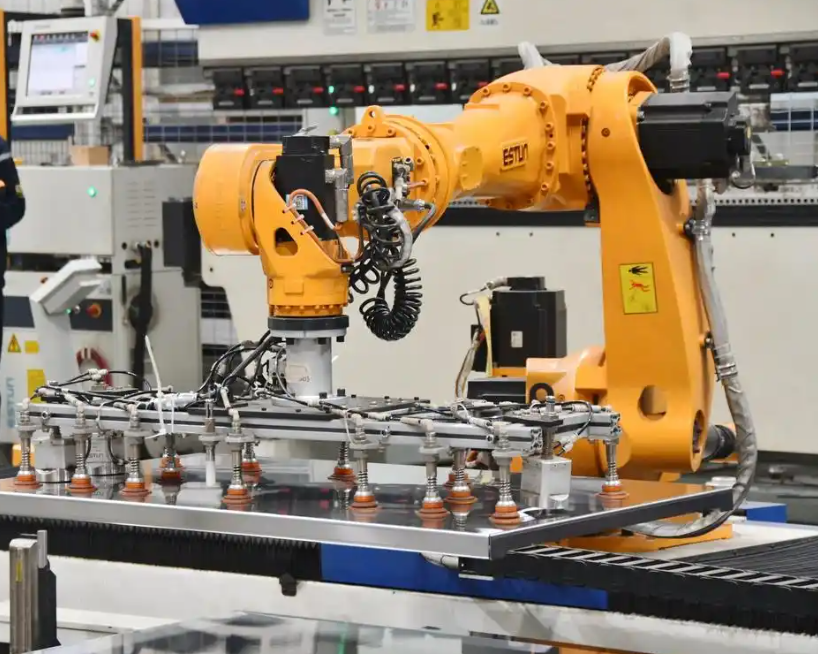
The micro-station is not a miniature factory for display. It is a learning environment where industrial robots tasks are compressed without losing their essential complexity. For example, a full production line might include feeding, positioning, processing, inspection, assembly, palletizing, and warehousing. In a micro-station, I cannot reproduce every meter of the line. But I can preserve the logic: how an industrial robot receives a signal, how it locates a workpiece, how it coordinates with a machine tool, how it reports status, and how a fault propagates. The micro-station allows students to experience the full chain in a manageable space. It also allows teachers to adjust parameters, introduce disturbances, and create problem scenarios. The industrial robots become the central actors in a controllable learning drama.
To evaluate the fidelity of a micro-station, I use a weighted fidelity formula. Let there be \(m\) key elements. Let \(v_j\) be the importance weight of element \(j\). Let \(x_j \in [0,1]\) be the degree to which that element is preserved in the micro-station. Then fidelity \(F\) is:
$$F = \frac{\sum_{j=1}^{m} v_j x_j}{\sum_{j=1}^{m} v_j}$$
I have found that industrial robots control logic, safety logic, sensor feedback, and task sequencing should have high weights. Physical scale can have a lower weight. This is a crucial insight. A micro-station does not need to be full size. It needs to be full logic. When students work with industrial robots in this environment, they learn to see the chain, not just the machine.
| Micro-Station Layer | Key Components | Industrial Robots Connection | Learning Outcome |
|---|---|---|---|
| Physical layer | Industrial robots, end effectors, conveyors, fixtures, sensors | Motion, gripping, positioning, collision avoidance | Basic operation and safety awareness |
| Control layer | PLC, robot controller, HMI, communication bus | Signal exchange, sequence control, interlocks | Programming and integration understanding |
| Digital layer | Simulation software, digital twin, data dashboard | Virtual commissioning, trajectory planning, cycle time analysis | Digital literacy and optimization thinking |
| Process layer | Work orders, process cards, quality checkpoints | Task execution, inspection, rework | Process discipline and quality awareness |
| Problem layer | Fault injection, abnormal conditions, change requests | Diagnosis, adjustment, debugging | Problem solving and innovation |
| Collaboration layer | Team roles, handover, documentation | Work cell coordination | Communication and teamwork |
After building the micro-station, I turn to curriculum content. I sort the industrial chain characteristics and enterprise types of the robot industrial park. I deconstruct the full industrial chain needs of industrial robots in “production and manufacturing, integrated application, and engineering service.” I desensitize real enterprise projects. I transform typical work tasks of industrial robots positions into progressive learning tasks. I reconstruct learning fields according to the process “vocational post group—typical vocational activity—work task—vocational ability.” I use loose-leaf work orders to promote real-time alignment between teaching content and job requirements. I build a “curriculum follows the chain” dynamic update mechanism.
The phrase “curriculum follows the chain” means that curriculum is not a static document. It is a responsive system. When the industrial robots chain changes, the curriculum changes. When a new application appears, a new learning task appears. When a new standard is released, the assessment criteria change. When an enterprise introduces a new industrial robot model, the teaching resources change. This mechanism is essential because industrial robots technology does not wait for textbook revision cycles. If curriculum revision takes five years while industrial robots applications change every eighteen months, the gap becomes structural. The dynamic update mechanism reduces that gap.
| Curriculum Update Input | Transformation Process | Curriculum Output | Industrial Robots Focus |
|---|---|---|---|
| Enterprise equipment list | Map equipment functions to learning tasks | Updated micro-station tasks | New industrial robots models and controllers |
| Production process changes | Deconstruct sequence into teachable steps | Revised work orders | New industrial robots integration workflows |
| Quality problem reports | Convert defects into diagnostic cases | Case library and assessments | Industrial robots fault diagnosis and prevention |
| New national standards | Align competency statements and rubrics | Updated course standards | Safety and performance requirements for industrial robots |
| Student learning data | Identify weak competencies and misconceptions | Targeted micro-lessons | Personalized industrial robots skill development |
| Teacher reflection | Revise scaffolding and pacing | Improved learning paths | More effective industrial robots instruction |
I model the curriculum update process as a dynamic adjustment. Let \(C_t\) be the curriculum at time \(t\). Let \(D_t\) be the industry demand profile at time \(t\). Let \(T_t\) be the technology profile at time \(t\). Let \(\lambda\) and \(\mu\) be adjustment rates. Then a simplified update rule is:
$$C_{t+1} = C_t + \lambda (D_t – C_t) + \mu (T_t – C_t)$$
This formula expresses a practical principle: curriculum should move toward demand and technology, but not blindly. If \(\lambda\) and \(\mu\) are too high, the curriculum becomes unstable. If they are too low, the curriculum becomes obsolete. Collaborative governance with government, enterprises, and teachers helps set these rates. For industrial robots, I prefer a steady but frequent update. Each semester, we review new industrial robots applications. Each year, we revise modules. Every three years, we reconstruct the curriculum framework. This layered rhythm keeps the curriculum alive without exhausting teachers.
Next, I define core technologies, key processes, and application scenarios. Using national standards as the baseline, I reconstruct the curriculum system. I develop modular courses in “walking into series, application series, and innovation series.” This series of courses enhances students’ vocational cognition, cultivates students’ vocational ability, and strengthens their development ability and innovative thinking. The “walking into” series helps students understand what industrial robots are, where they are used, and how they relate to safety and ethics. The “application” series helps students program, integrate, debug, and maintain industrial robots in representative work cells. The “innovation” series helps students improve a process, design a fixture, optimize a trajectory, reduce cycle time, or create a small intelligent production solution with industrial robots.
| Course Series | Representative Modules | Industrial Robots Learning Focus | Competency Development |
|---|---|---|---|
| Walking Into Series | Industrial robots overview, safety, industrial chain, career paths | Recognition of industrial robots types, applications, and safety rules | Vocational cognition and identity |
| Application Series | Programming, simulation, integration, maintenance, fault diagnosis | Operation and integration of industrial robots in work cells | Vocational ability and technical precision |
| Innovation Series | Process improvement, fixture design, trajectory optimization, smart work cell | Optimization and creative use of industrial robots | Development ability and innovative thinking |
| Cross-Series Projects | Real enterprise micro-projects | Full-chain industrial robots problem solving | Integration, teamwork, and project management |
I also pay attention to the learning process. The training points toward problem solving and innovative thinking. Teachers and master craftsmen act as co-guides. We create flowcharts and build visual learning scaffolds. We invite craftsmen from the industrial park to serve as part-time mentors. This lays a foundation for cultivating high-quality skilled talent who can adapt to rapid technological development. School teachers and park mentors jointly plan learning paths. They develop flowcharts as learning scaffolds. They organically integrate learning elements and work elements into the flowcharts.
The flowchart is not a decoration. It is a cognitive tool. For industrial robots, a work process can be complex. Students may see many buttons, cables, programs, and alarms. A flowchart reduces cognitive load by showing the sequence and decision points. It also makes expert thinking visible. When a mentor diagnoses an industrial robots fault, the mentor does not simply say the answer. The mentor points to the flowchart and asks, “Which signal should be present here? What happens if this interlock is false? What is the next safe check?” In this way, the flowchart becomes a shared language between teacher, student, and enterprise mentor.
| Flowchart Type | Function | Industrial Robots Example | Student Thinking Skill |
|---|---|---|---|
| Work flowchart | Capability navigation system | From task receipt to industrial robots program deployment | Discover—analyze—solve problem chain |
| Process flowchart | Technical decoder | Teaching programming logic for industrial robots motion paths | Extracting key programming experience |
| Spatial flowchart | Thinking rearview mirror | Reverse deduction of industrial robots debugging process | Reflection and iterative improvement |
| Decision flowchart | Diagnostic guide | Checking sensors, interlocks, and industrial robots alarms | Systematic troubleshooting |
| Collaboration flowchart | Team coordination map | Handover between industrial robots operators and maintenance staff | Communication and role clarity |
I highlight the visualization of learning trajectories. We use an intelligent teaching system to build a learning behavior database. It records each student’s growth trajectory in each link. Through digital twin technology, we realize mirror restoration of the learning process. We innovate and apply three types of flowcharts. The work flowchart serves as a capability navigation system. It builds a clear and efficient “discover—analyze—solve” problem-solving chain. The process flowchart serves as a technical decoder. It distills key programming experience. The spatial flowchart serves as a thinking rearview mirror. It reversely deduces the evolution trajectory of the debugging process.
I represent a student’s learning trajectory as a weighted sum of episode performances. Let \(L_i(t)\) be the learning trajectory of student \(i\) at time \(t\). Let \(p_{ik}(t)\) be the performance in episode \(k\) at time \(t\). Let \(w_k\) be the weight of that episode. Then:
$$L_i(t) = \sum_{k=1}^{K} w_k \cdot p_{ik}(t)$$
The digital twin mirror can be represented as an approximation of the real learning trajectory with a transformation \(M\) and an error term \(\epsilon\):
$$\hat{L}_i(t) = M(L_i(t)) + \epsilon$$
The purpose of the digital twin is not to replace the teacher. It is to reveal patterns that are difficult to see in daily teaching. For example, the digital twin may show that a student consistently struggles at the transition from simulation to real industrial robots operation. Another student may solve simple tasks quickly but fail when multiple industrial robots coordinate. Another student may have strong programming skills but weak safety awareness. These patterns allow me to intervene precisely.
| Learning Data Dimension | Example Indicator | Industrial Robots Task Link | Pedagogical Response |
|---|---|---|---|
| Task completion | Success rate, time, cycle time | Industrial robots program execution | Adjust difficulty and practice amount |
| Error pattern | Type, frequency, location of faults | Industrial robots debugging | Provide targeted micro-lessons |
| Process compliance | Safety checks, work order completion | Industrial robots operation standards | Reinforce discipline and habits |
| Collaboration | Role rotation, communication moves | Industrial robots work cell teamwork | Coach teamwork and handover |
| Reflection | Quality of debugging notes | Industrial robots problem-solving log | Improve metacognition |
| Innovation | Number and quality of improvement ideas | Industrial robots process optimization | Support project-based extension |
I also use a capability navigation formula to describe how knowledge, skill, and attitude combine in industrial robots learning. Let \(K\) be conceptual knowledge, \(S\) be operational skill, and \(A\) be professional attitude. A simplified capability expression is:
$$Cap = K \cdot S \cdot A$$
Because this is multiplicative, a zero in any factor produces zero capability. This reflects my experience. If a student knows industrial robots theory but cannot operate safely, capability is not real. If a student can operate but does not understand why, capability is fragile. If a student has both but ignores safety and quality, capability is dangerous. Collaborative education must develop all three factors together. The micro-station develops \(S\). The dynamic curriculum develops \(K\). The mentor flowcharts and assessment culture develop \(A\).
I further model problem-solving ability in industrial robots tasks as a chain. Let \(D\) be discovery, \(A\) be analysis, \(S\) be solution, and \(R\) be reflection. Then:
$$P = D \rightarrow A \rightarrow S \rightarrow R$$
This chain is embedded in the work flowchart. When students encounter an industrial robots alarm, they first discover the symptom. Then they analyze possible causes using sensors, program logic, and process knowledge. Then they implement a solution. Then they reflect on what worked and what did not. The spatial flowchart supports the reflection stage by allowing students to reverse the debugging process and see where they took a wrong turn. This transforms a simple repair into a learning event.
In implementation, I have learned that school-enterprise collaboration requires governance, not only goodwill. We establish joint decision-making with the industrial park. We define roles for government, enterprises, school leaders, teachers, students, and mentors. We create regular review meetings. We use data to discuss curriculum updates. We protect student safety and enterprise confidentiality. We desensitize real projects before using them in teaching. We ensure that enterprise mentors receive basic pedagogical training. We ensure that teachers spend time in enterprise practice. We document every collaborative activity so that it can be repeated and improved.
| Stakeholder | Primary Role | Industrial Robots Contribution | Governance Mechanism |
|---|---|---|---|
| Government | Policy guidance and resource coordination | Standards, funding, industry-education integration platforms | Policy briefings and performance review |
| Industrial park | Ecosystem connector | Access to industrial robots enterprises and real scenarios | Joint decision-making committee |
| Enterprises | Technology and project providers | Real industrial robots projects, equipment, mentors | Project agreements and confidentiality protocols |
| School leaders | Strategic alignment and resource allocation | Curriculum reform, teacher development, facilities | Annual planning and quality assurance |
| Teachers | Learning designers and facilitators | Micro-station tasks, modular courses, flowcharts | Teaching research and peer review |
| Enterprise mentors | Practice guides and assessors | Industrial robots troubleshooting and process expertise | Mentor training and co-assessment |
| Students | Active learners and co-creators | Learning data, feedback, improvement ideas | Learning contracts and portfolio review |
I have also developed a collaborative education function to remind myself that quality is not produced by one factor alone. Let \(S\) be school capability, \(E\) be enterprise capability, \(G\) be governance quality, and \(T\) be technology platform quality. Then:
$$Q = f(S, E, G, T) = S^\alpha E^\beta G^\gamma T^\delta$$
where \(\alpha, \beta, \gamma, \delta > 0\) and \(\alpha + \beta + \gamma + \delta = 1\). In my practice, governance and technology platform quality are often underestimated. A school may have good teachers, and an enterprise may have advanced industrial robots, but if governance is weak, collaboration becomes episodic. If the technology platform is weak, learning data cannot support timely intervention. The function is a reminder that collaborative education for industrial robots is a system property.
Assessment is another critical part. I do not assess students only by final examination. I use a combination of process assessment, work order assessment, project assessment, safety assessment, and innovation assessment. For industrial robots, safety must be a gate. A student who can program an industrial robot but ignores safety cannot pass. A student who can complete a task but cannot explain the process receives limited credit. A student who improves a process receives recognition. The assessment rubric includes technical accuracy, process compliance, troubleshooting efficiency, teamwork, documentation, and reflection quality.
| Assessment Dimension | Weight Example | Evidence Source | Industrial Robots Focus |
|---|---|---|---|
| Safety and discipline | Gate or 20% | Observation, checklist, incident log | Safe operation of industrial robots |
| Technical operation | 25% | Work order, task result, cycle time | Programming and integration of industrial robots |
| Problem solving | 20% | Debugging log, flowchart use, solution quality | Diagnosis and repair of industrial robots faults |
| Process and quality | 15% | Process card, inspection record | Standardized industrial robots workflows |
| Teamwork and communication | 10% | Peer review, handover record | Collaborative industrial robots work cells |
| Innovation and reflection | 10% | Improvement proposal, reflection portfolio | Optimization of industrial robots applications |
I have observed several practical results. First, cluster upgrading and innovative cultivation of high-quality skilled talent have strong demonstration and leading effects. The quality of talent cultivation in the high-end intelligent manufacturing professional group, led by the industrial robots major, continues to improve. Second, active iteration leads related majors within the province. The school is a lead school in the integrated curriculum reform of secondary and higher vocational industrial robots majors. It is a provincial vocational school internship and training base. It is a governing unit of a national-level industry-education integration community for industrial robots and industrial digitalization. Third, demonstration and radiation lead the professional construction and curriculum construction of secondary vocational schools nationwide. We have produced national planned textbooks, national online premium courses, and textbooks from national publishers.
| Outcome Area | Observed Result | Industrial Robots Connection | Scaling Value |
|---|---|---|---|
| Talent quality | Improved employability and development potential | Stronger industrial robots skills and system thinking | Model for other manufacturing majors |
| Curriculum reform | Dynamic and modular curriculum system | Faster response to industrial robots technology change | Reusable update mechanism |
| Teaching resources | Micro-stations, flowcharts, work orders, digital resources | Practice-rich industrial robots learning | Adaptable to different school contexts |
| Teacher development | Dual mentor teams and enterprise practice | Teachers stay current with industrial robots applications | Professional learning community |
| Industry-education integration | Joint decision-making and co-assessment | Enterprises shape industrial robots talent pipeline | Sustainable collaboration platform |
| Student motivation | Visible progress and meaningful tasks | Students see industrial robots as career, not just subject | Improved retention and engagement |
I have also learned to manage risks. One risk is that enterprise needs may dominate and turn students into short-term labor. To prevent this, I protect the educational purpose of every task. Industrial robots tasks must be developmental, not merely repetitive. Another risk is that technology changes too fast for teachers. To prevent this, I build teacher teams and enterprise mentor partnerships. Another risk is that digital systems collect data without improving teaching. To prevent this, I link every data indicator to a pedagogical action. Another risk is that micro-stations become simplified to the point of losing industrial robots complexity. To prevent this, I use the fidelity formula and review key elements regularly. Another risk is that curriculum updates become chaotic. To prevent this, I use the dynamic update formula and a governance calendar.
| Risk | Early Warning Sign | Mitigation | Industrial Robots Focus |
|---|---|---|---|
| Enterprise exploitation | Students repeat one task for long periods | Learning contracts and task rotation | Broad industrial robots competence |
| Teacher obsolescence | Teachers avoid new industrial robots features | Enterprise practice and co-teaching | Updated industrial robots knowledge |
| Data without action | Dashboards are ignored | Data review meetings and intervention plans | Targeted industrial robots remediation |
| Low fidelity | Students succeed in micro-station but fail in enterprise | Fidelity review and enterprise immersion | Realistic industrial robots scenarios |
| Curriculum instability | Frequent changes confuse teachers and students | Layered update rhythm and version control | Stable core and flexible industrial robots modules |
| Safety complacency | Students skip safety checks | Safety gates and mentor observation | Safe industrial robots operation culture |
For scaling, I use a framework that connects vision, architecture, content, pedagogy, assessment, and governance. I do not simply copy a successful industrial robots laboratory. I transfer the design principles. The principles are: start from real industrial robots needs, preserve core chain logic in micro-scenarios, update curriculum through a defined mechanism, use modular courses to balance stability and flexibility, scaffold problem solving with flowcharts, use learning data to personalize support, and govern collaboration through shared responsibility. These principles can be adapted to different regions, different industrial robots applications, and different school capacities.
| Scaling Layer | Design Principle | Industrial Robots Application | Indicator of Success |
|---|---|---|---|
| Vision | Align with intelligent and green transformation | Industrial robots as part of future factory | Shared roadmap with industry |
| Architecture | Build full-chain micro-stations | Core industrial robots logic preserved | High fidelity and safe access |
| Content | Use dynamic curriculum updates | Responsive to industrial robots upgrades | Timely module revision |
| Pedagogy | Scaffold with flowcharts and projects | Problem solving in industrial robots tasks | Improved transfer and innovation |
| Assessment | Use multi-dimensional rubrics | Safety, skill, process, innovation in industrial robots | Valid and reliable evidence |
| Governance | Share responsibility and data | Joint decisions on industrial robots talent needs | Sustainable collaboration |
In my first-person practice, I have come to see that the most important resource is not a specific industrial robots model. It is the relationship between the school and the industrial ecosystem. A new industrial robot can become obsolete. A strong relationship can continuously update equipment, projects, mentors, and curriculum. The industrial robots industry is fast-moving. The school cannot move alone. Government policy provides direction. Enterprises provide real problems, equipment, and mentors. The industrial park provides ecosystem access. Teachers provide learning design and care. Students provide energy, data, and feedback. When these actors work together, the industrial robots major becomes more than a training program. It becomes a talent pipeline for regional upgrading.
I also recognize that green transformation and intelligent transformation are connected. Industrial robots can improve energy efficiency, reduce waste, and increase precision. But they can also consume energy and create electronic waste if not managed well. In my teaching, I include green considerations in industrial robots projects. Students analyze cycle time and energy use. They consider lightweight design, efficient trajectories, and standby modes. They learn that intelligent manufacturing is not only about automation. It is about sustainable value creation. This adds another dimension to the industrial robots curriculum and helps students see their work in a broader social and environmental context.
I use one more formula to summarize the relationship between collaborative intensity and learning outcome. Let \(I\) be the intensity of collaboration, \(D\) be the diversity of partners, and \(A\) be the alignment of goals. Then a simplified collaboration value is:
$$V = I \cdot D \cdot A$$
If any factor is zero, value is zero. High intensity without alignment creates conflict. High diversity without intensity creates fragmentation. High alignment without diversity creates insularity. For industrial robots, I need intense, diverse, and aligned collaboration. That means frequent interaction with enterprises, multiple types of partners across the industrial robots chain, and a shared goal of student development and regional upgrading.
I have also found that student voice is essential. Students experience the industrial robots curriculum every day. They know where they get stuck. They know which flowcharts help. They know which micro-station tasks feel artificial. I regularly collect student feedback and use it in curriculum review. This does not mean students decide everything. It means they participate in improving the learning system. When students see their feedback change a task or a resource, they become co-owners of the industrial robots learning environment. This increases motivation and responsibility.
In the future, I plan to deepen several areas. First, I will expand the digital twin database to include more industrial robots tasks and more diverse student profiles. Second, I will strengthen the early warning function so that curriculum response can happen even faster. Third, I will develop more interdisciplinary projects that combine industrial robots with artificial intelligence, internet of things, and green manufacturing. Fourth, I will improve mentor training so that enterprise experts can use flowcharts and assessment rubrics more effectively. Fifth, I will document the model in an open and reusable way so that other schools can adapt it without losing the core principles. Each of these plans keeps industrial robots at the center while connecting to broader intelligent manufacturing trends.
My conclusion is that school-enterprise collaborative education for industrial robots is not a project with a beginning and an end. It is a continuous cycle. The cycle begins with industrial robots industry demand. It moves through micro-scaled scenario design, dynamic curriculum updating, modular course development, flowchart-based scaffolding, digital twin learning analysis, multi-dimensional assessment, and governance review. Then it returns to industry demand with new questions. Each turn of the cycle improves alignment. Each turn deepens collaboration. Each turn produces better learning experiences for students and stronger talent support for regional industrial upgrading. I have seen that when the cycle is well designed, students do not merely learn about industrial robots. They learn to think with industrial robots, solve problems with industrial robots, innovate with industrial robots, and grow into high-quality skilled talent who can carry the future factory forward.