
As I reflect on the rapid evolution of technology, I am struck by the profound impact of humanoid robots on our society. These advanced machines, designed to mimic human form and functions, are no longer confined to science fiction but are steadily integrating into various aspects of daily life. In my analysis, the commercialization of humanoid robots represents a pivotal shift in how we perceive automation, artificial intelligence, and human-robot collaboration. The journey from laboratory prototypes to market-ready products is fraught with challenges, yet it holds immense potential for transforming industries and improving quality of life. Through this exploration, I aim to delve into the multifaceted aspects of humanoid robot development, market dynamics, technological hurdles, and future prospects, all while emphasizing the critical role of innovation in driving this field forward.
Humanoid robots have garnered significant attention due to their versatility and ability to operate in human-centric environments. In my view, the core appeal lies in their potential to perform tasks that require dexterity, mobility, and social interaction—capabilities that traditional robots often lack. For instance, I have observed how humanoid robots can navigate complex spaces, manipulate objects with precision, and even engage in basic communication, making them ideal for applications in healthcare, manufacturing, and domestic settings. The global interest in humanoid robots is not merely a trend; it is a reflection of broader technological advancements in AI, sensor technology, and mechanical engineering. As I consider the data, it becomes clear that the market for humanoid robots is expanding at an unprecedented rate, driven by both consumer demand and industrial needs.
To quantify the growth of the humanoid robot industry, I have compiled key statistics and projections into a comprehensive table. This data highlights the exponential increase in market size, the distribution of companies, and the anticipated economic impact. According to my research, the number of enterprises dedicated to humanoid robot development has surged globally, with a significant concentration in certain regions due to favorable policies and investment climates. The table below summarizes these insights, illustrating how humanoid robots are becoming a cornerstone of the robotics sector.
| Year | Global Companies | Market Size (USD Billion) | Annual Growth Rate (%) | Key Applications |
|---|---|---|---|---|
| 2021 | ~50 | 1.2 | — | Research, Prototyping |
| 2025 | ~160 | 15.5 | 71 | Industrial, Service |
| 2030 | ~300 (Projected) | ~120 | 68.6 | Healthcare, Home Care |
| 2035 | ~500 (Projected) | ~1103 | 98.2 | Mass Adoption in Multiple Sectors |
From my perspective, the data underscores a compound annual growth rate (CAGR) that far exceeds many other technology sectors. For example, the CAGR for humanoid robots from 2021 to 2030 is estimated at 71%, which can be modeled using the formula for exponential growth: $$ A = P \times (1 + r)^t $$ where \( A \) is the future market size, \( P \) is the initial market size, \( r \) is the growth rate, and \( t \) is the time in years. Applying this to the humanoid robot market, if we take \( P = 1.2 \) billion USD in 2021 and \( r = 0.71 \), then by 2030, \( A \approx 1.2 \times (1.71)^9 \approx 120 \) billion USD, aligning with projections. This mathematical representation helps me appreciate the sheer velocity of expansion in this field.
In terms of technological foundations, I believe that the progress in humanoid robots hinges on advancements in artificial intelligence, mechanical design, and sensor integration. For instance, the ability of humanoid robots to perform complex tasks relies on algorithms for motion planning and control. One key equation I often reference is the inverse kinematics formula, which determines the joint angles required for a robot to achieve a desired position: $$ \theta = f^{-1}(x) $$ where \( \theta \) represents the joint angles and \( x \) is the end-effector position. This is crucial for humanoid robots to execute precise movements, such as those seen in dance performances or industrial assembly. Moreover, machine learning models, particularly reinforcement learning, enable humanoid robots to adapt to dynamic environments. The reward function in such models can be expressed as: $$ R = \sum_{t=0}^{T} \gamma^t r_t $$ where \( R \) is the cumulative reward, \( \gamma \) is the discount factor, and \( r_t \) is the immediate reward at time \( t \). This approach allows humanoid robots to learn from interactions, improving their efficiency in tasks like object manipulation or social engagement.
As I examine the application domains, I see humanoid robots making inroads into diverse sectors. The following table categorizes the primary use cases, highlighting the specific requirements and benefits in each area. This segmentation helps me understand how humanoid robots are tailored to meet unique demands, from high-precision industrial work to empathetic home care.
| Application Sector | Key Requirements | Examples of Tasks | Benefits of Humanoid Robots |
|---|---|---|---|
| Industrial Manufacturing | High accuracy, repeatability, efficiency | Assembly, packaging, quality control | Flexibility, reduced labor costs, 24/7 operation |
| Healthcare and Rehabilitation | Gentle interaction, hygiene, data monitoring | Patient assistance, therapy, surgical support | Improved patient outcomes, staff augmentation |
| Commercial Services | Customer interaction, mobility, multitasking | Retail assistance, hospitality, guidance | Enhanced user experience, operational efficiency |
| Home and Personal Care | Emotional intelligence, safety, adaptability | Companionship, cleaning, emergency response | Independence for elderly/disabled, convenience |
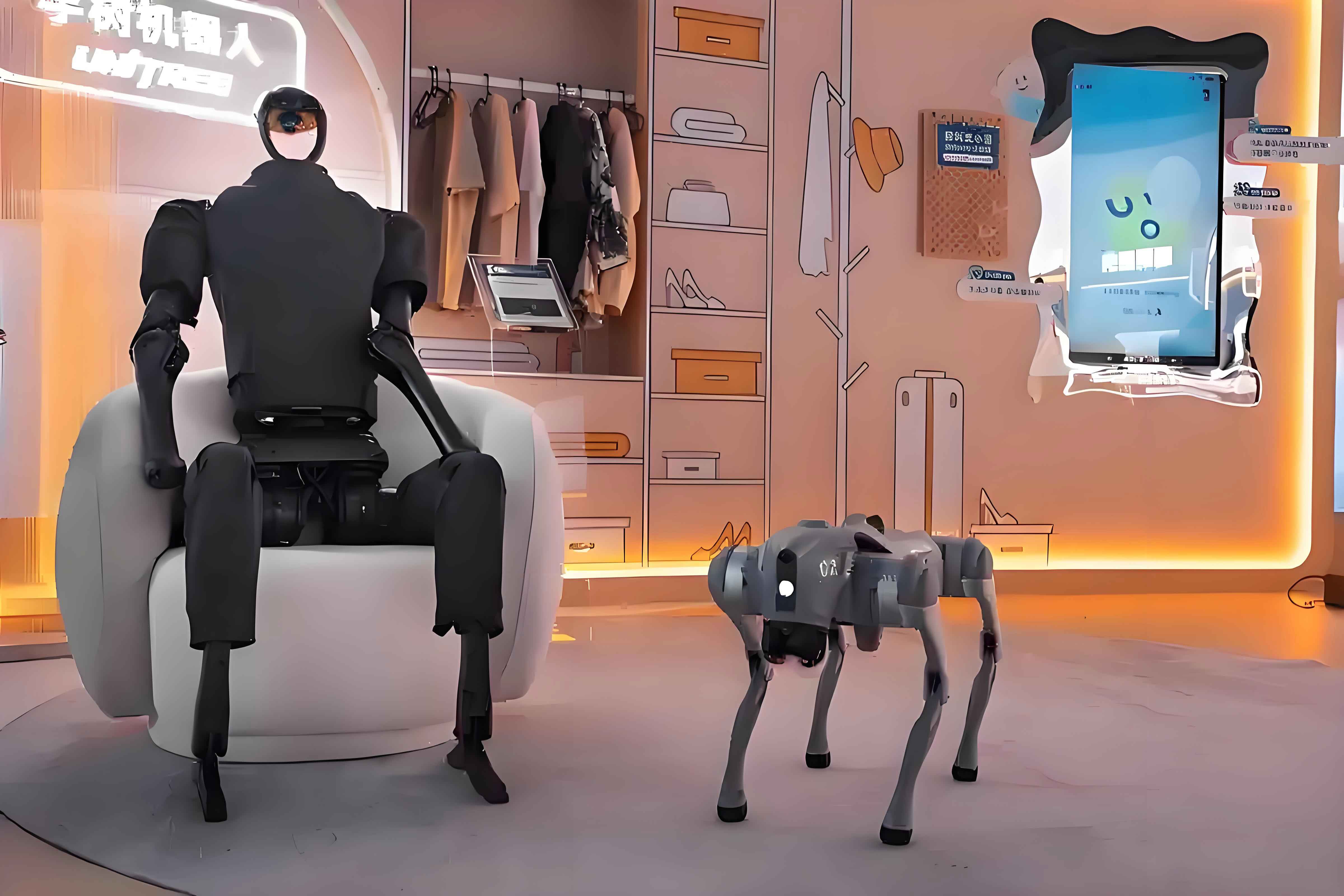
In my assessment, the visual representation of humanoid robots in action can greatly enhance understanding of their capabilities. For example, the integration of humanoid robots with other robotic systems, such as robotic dogs, demonstrates the synergy in modern automation. Below, I include an image that captures this dynamic, showing humanoid robots collaborating in a simulated environment. This illustration reinforces the concept of humanoid robots as versatile tools in both specialized and everyday settings.
From a technical standpoint, I am fascinated by the control systems that govern humanoid robots. The dynamics of bipedal locomotion, for instance, can be modeled using the Lagrangian mechanics equation: $$ L = T – V $$ where \( L \) is the Lagrangian, \( T \) is the kinetic energy, and \( V \) is the potential energy. This framework allows for the derivation of motion equations that ensure stability and balance in humanoid robots. Additionally, the force control in grippers or arms often involves PID controllers, described by: $$ u(t) = K_p e(t) + K_i \int_0^t e(\tau) d\tau + K_d \frac{de}{dt} $$ where \( u(t) \) is the control output, \( e(t) \) is the error signal, and \( K_p \), \( K_i \), \( K_d \) are proportional, integral, and derivative gains, respectively. Such mathematical models are essential for optimizing the performance of humanoid robots in real-world scenarios, whether they are performing delicate surgical procedures or heavy lifting in warehouses.
However, as I delve deeper, I recognize that the commercialization of humanoid robots faces significant obstacles. Cost is a major barrier; the development and production of advanced humanoid robots require substantial investment. To analyze this, I often use a cost-benefit analysis formula: $$ NPV = \sum_{t=0}^{N} \frac{C_t}{(1 + r)^t} $$ where \( NPV \) is the net present value, \( C_t \) is the net cash flow at time \( t \), \( r \) is the discount rate, and \( N \) is the project duration. For humanoid robot projects, high initial costs (\( C_0 \)) can lead to negative NPV if not offset by long-term benefits, such as labor savings or increased productivity. This economic perspective highlights the need for cost-reduction strategies, including mass production and material innovation. For instance, by scaling production, the average cost per unit can decrease according to the learning curve model: $$ C_n = C_1 n^{-b} $$ where \( C_n \) is the cost of the \( n \)-th unit, \( C_1 \) is the cost of the first unit, and \( b \) is the learning rate. Applying this to humanoid robots, if \( b = 0.2 \) and \( C_1 = 100,000 \) USD, then for \( n = 1000 \), \( C_n \approx 100,000 \times 1000^{-0.2} \approx 15,849 \) USD, making them more accessible.
Another challenge I have observed is the limited application scenarios for humanoid robots. While they show promise, many use cases are still in experimental phases. To address this, market segmentation and customization are crucial. The following table outlines potential strategies for expanding the application scope of humanoid robots, based on user needs and technological feasibility.
| Strategy | Description | Expected Outcome | Examples |
|---|---|---|---|
| Customization for Niche Markets | Tailoring robots for specific industries or user groups | Higher adoption rates, improved user satisfaction | Medical robots for rehabilitation, educational assistants |
| Integration with IoT and AI | Connecting robots to smart networks for data exchange | Enhanced functionality, real-time adaptation | Home robots syncing with smart devices, industrial robots in IoT ecosystems |
| Modular Design Approaches | Using interchangeable components for flexibility | Reduced costs, easier upgrades and repairs | Swapable arms or sensors for different tasks |
| Collaborative Robotics (Cobots) | Designing robots to work alongside humans safely | Increased productivity, broader acceptance | Assembly line partners, healthcare aides |
In my opinion, policy and ethical considerations are equally critical in the commercialization journey. As humanoid robots become more prevalent, issues such as data privacy, job displacement, and ethical decision-making arise. For example, the alignment of robot behavior with human values can be framed using utility functions: $$ U(s) = \sum_{i} w_i f_i(s) $$ where \( U(s) \) is the utility of state \( s \), \( w_i \) are weights representing ethical priorities, and \( f_i(s) \) are features like safety or fairness. Policymakers must establish guidelines to ensure that humanoid robots operate within legal and moral boundaries, fostering public trust. Moreover, international cooperation on standards can facilitate global adoption, as seen in other tech sectors.
Looking ahead, I am optimistic about the future of humanoid robots. With continued innovation, I anticipate that humanoid robots will evolve into ubiquitous assistants, seamlessly integrating into society. The convergence of technologies like 5G, edge computing, and advanced materials will further enhance their capabilities. For instance, the energy efficiency of humanoid robots can be improved using optimization algorithms, such as minimizing power consumption: $$ \min \int_0^T P(t) dt $$ subject to constraints on performance, where \( P(t) \) is the power usage at time \( t \). This could lead to longer battery life and reduced operational costs. Additionally, as AI becomes more sophisticated, humanoid robots may achieve greater autonomy, enabling them to handle unpredictable environments.
In conclusion, the commercialization of humanoid robots is a complex yet rewarding endeavor. From my first-person perspective, I see this as a transformative era where technology meets human needs in unprecedented ways. By addressing technical, economic, and societal challenges, we can unlock the full potential of humanoid robots, making them indispensable partners in our daily lives. The journey is just beginning, and I am excited to witness how humanoid robots will reshape our world in the decades to come.