
The demand for high-performance, miniaturized power transmission systems is rapidly growing across advanced fields including medical robotics, aerospace mechanisms, and portable defense equipment. These applications necessitate reducers that combine a high reduction ratio, substantial torque capacity, compact dimensions, and precise motion control within a single package. The rotary vector reducer, renowned for its high stiffness, excellent torsional rigidity, and superior load-bearing capability, is a prime candidate. However, conventional rotary vector reducer designs often result in radial dimensions exceeding 100 mm, making them unsuitable for space-constrained applications. This work presents the detailed design methodology and structural verification of a novel small-sized rotary vector reducer, aiming to achieve a significant reduction ratio while maintaining an exceptionally compact form factor.
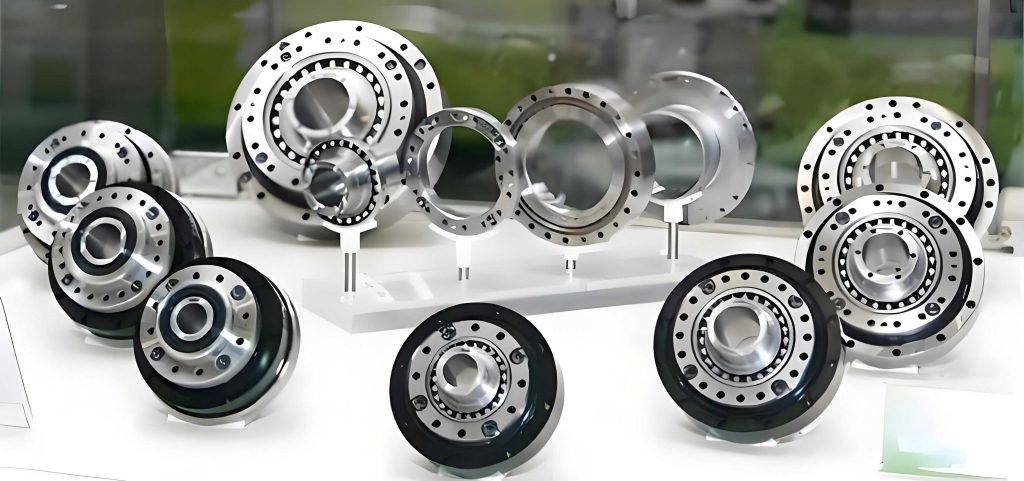
The core innovation lies in the meticulous integration and scaling down of the classic two-stage RV transmission principle. The proposed small-sized rotary vector reducer retains the fundamental advantages of its larger counterparts but is engineered for minimal radial footprint. The design process involves a systematic approach: first, establishing the fundamental geometric relationships and constraints for miniaturization; second, performing detailed force analysis and theoretical strength verification for critical components; and finally, validating the design through finite element simulation. This structured methodology ensures the feasibility and reliability of the compact rotary vector reducer before physical prototyping.
Structural Architecture and Transmission Principle
The proposed small-sized rotary vector reducer employs a two-stage differential gear system enclosed in a compact housing. The first stage consists of a standard involute planetary gear train, while the second stage utilizes a cycloidal-pin gear mechanism with a single tooth difference. This configuration is key to achieving a high reduction ratio in a small volume. The primary structural components include a central sun gear, multiple planetary gears, an eccentric shaft integrated with each planetary gear, a cycloid disc, a ring of stationary pin gears housed in a pin housing, and an output flange. Unlike larger designs, this compact rotary vector reducer incorporates miniature bearings to support the cycloid disc on the eccentric shaft, adapting to the severely limited internal space.
The kinematic principle follows the standard rotary vector reducer operation but on a reduced scale. Input rotation is provided to the sun gear. This drives the planetary gears, constituting the first-stage speed reduction. Each planetary gear is fixed to an eccentric shaft, causing the shaft to rotate at the planetary gear’s speed. The eccentric portion of this shaft drives the cycloid disc, forcing it into an eccentric motion (revolution) relative to the stationary pin gear ring. This engagement between the cycloid disc and the pin gears causes the cycloid disc to rotate slowly on its own axis (rotation). This self-rotation is transmitted directly to the output flange through a pin-in-slot mechanism (W pin mechanism). Crucially, the output flange’s rotation is fed back to the planetary gear carrier, creating a closed differential loop. The overall reduction ratio \( i_{RV} \) for this small-sized rotary vector reducer is given by:
$$ i_{RV} = 1 + \frac{z_b}{z_g} \times \frac{z_2}{z_1} $$
where \( z_1 \), \( z_2 \) are the teeth numbers of the sun and planetary gear (first stage), and \( z_g \), \( z_b \) are the teeth numbers of the cycloid gear and the pin gear (second stage). This compound structure allows for a high reduction ratio, such as 61:1 as targeted in this design, within a dramatically smaller envelope compared to traditional models.
Geometric Parameter Determination for Miniaturization
The design of a small-sized rotary vector reducer hinges on the simultaneous satisfaction of multiple geometric, strength, and assembly constraints. The goal is to determine a set of parameters that fulfill the target reduction ratio and torque capacity while minimizing the radial dimension, targeted here to be under φ70 mm.
First-Stage Involute Planetary Gear Design
The design of the planetary stage must consider load sharing, structural interference, and balanced sizing relative to the second stage. The following key constraints guide the parameter selection for this compact assembly:
- Load and Life Balance: To ensure comparable service life for the meshing sun and planetary gears, their profile shift coefficients are determined based on the principle of equalizing their maximum sliding ratios. This often leads to a positive shift for the smaller sun gear and a negative shift for the larger planetary gear.
- Torque and Size Limitation: To prevent excessive torque loading on the first stage and the eccentric shafts, the teeth ratio should satisfy \( z_2 / z_1 \geq 1.5 \). The sun gear teeth are typically limited to \( 9 \leq z_1 \leq 20 \) for manufacturability and wear considerations in small modules.
- Radial Balance: For force balance and stability of the compact rotary vector reducer, the center distance \( a \) of the planetary stage should be proportional to the pin gear distribution radius \( r_p \) of the second stage: \( a = (0.5 \sim 0.6) r_p \).
- Structural Compactness: The radial dimensions of both stages should be harmonious: \( m(z_1/2 + z_2) = (0.9 \sim 1.1) r_p \), where \( m \) is the gear module.
- Planetary Interference: To avoid physical clash between adjacent planetary gears, their tip diameter must satisfy \( d_{a2} < 2a \sin(\pi / n_w) \), where \( n_w \) is the number of planets.
Given a target reduction ratio \( i_{RV} = 61 \), a logical teeth number combination is selected: \( z_1=15 \), \( z_2=30 \), \( z_g=29 \), \( z_b=30 \). For miniaturization, a small module of \( m = 0.5 \) mm is chosen. Applying the equal sliding ratio condition, the profile shift coefficients are calculated as \( x_1 \approx 0.34 \) and \( x_2 \approx -0.34 \). The resulting geometric parameters for this stage of the small-sized rotary vector reducer are summarized below.
| Parameter | Symbol | Value |
|---|---|---|
| Module | \( m \) | 0.5 mm |
| Sun Gear Teeth | \( z_1 \) | 15 |
| Planetary Gear Teeth | \( z_2 \) | 30 |
| Profile Shift Coefficient (Sun) | \( x_1 \) | +0.34 |
| Profile Shift Coefficient (Planet) | \( x_2 \) | -0.34 |
| Operating Pressure Angle | \( \alpha’ \) | 20° |
| Center Distance | \( a \) | 11.25 mm |
| Contact Ratio | \( \epsilon_{\alpha} \) | 1.512 |
Second-Stage Cycloidal-Pin Gear Design
The cycloidal drive is the heart of the torque amplification in the rotary vector reducer. Its design focuses on achieving the required reduction while ensuring proper meshing and avoiding undercutting. The primary design constraints are:
- Size and Torque: The pin gear distribution circle radius \( r_p \) is initially estimated based on the output torque \( T_v \) or the target overall size. For this design, \( r_p = 20 \) mm is selected.
- Short Width Coefficient: The coefficient \( K_1 = e z_b / r_p \) (where \( e \) is eccentricity) critically influences torque capacity and efficiency. A value of \( K_1 \approx 0.65 \) is a common starting point, refined based on the desired reduction ratio.
- Tooth Profile Integrity: To prevent undercutting or pointed teeth on the cycloid disc, the minimum theoretical curvature radius \( \rho_{0min} \) of the cycloid profile must be greater than the pin radius \( r_{rp} \): \( \rho_{0min} > r_{rp} \).
- Pin Gear Strength: To ensure adequate wall thickness between pin holes in the housing, the pin radius must satisfy \( r_{rp} < r_p \sin(\pi / z_b) \). A pin diameter coefficient \( K_2 = \frac{r_p \sin(\pi / z_b)}{r_{rp}} \) between 1.5 and 2.0 is recommended.
For \( z_b=30 \) and \( z_g=29 \), the theoretical eccentricity is \( e = r_p / z_b = 0.666 \) mm for a standard cycloid. To increase load-sharing teeth and compactness, a shortened cycloid is used. Starting with \( K_1=0.65 \), \( e \) is calculated and rounded to a standard value (0.45 mm), then \( K_1 \) is recalculated precisely. The pin radius \( r_{rp} = 1.3 \) mm is chosen and verified against the constraints. The key parameters for the cycloidal stage of this small-sized rotary vector reducer are as follows.
| Parameter | Symbol | Value |
|---|---|---|
| Pin Distribution Circle Radius | \( r_p \) | 20.0 mm |
| Pin Radius | \( r_{rp} \) | 1.3 mm |
| Pin Gear Teeth | \( z_b \) | 30 |
| Cycloid Gear Teeth | \( z_g \) | 29 |
| Eccentricity | \( e \) | 0.45 mm |
| Short Width Coefficient | \( K_1 \) | 0.675 |
| Pin Diameter Coefficient | \( K_2 \) | 1.608 |
Design of the Output Mechanism and Bearing Selection
The output mechanism, typically a set of pins or rollers housed in the output flange engaging with holes in the cycloid disc, must accommodate the eccentric motion while transmitting torque. For a mechanism with \( n_w \) pins, the pin diameter \( d_w \) and the cycloid disc hole diameter \( d_{gw} \) are related by \( d_w = d_{gw} – 2e \). The hole pattern must leave sufficient material between holes (\( \delta_1 \)) and between the holes and the central bore (\( \delta_2 \)) for strength, typically requiring \( \delta_1, \delta_2 \geq 0.03 r_p \).
Bearing selection is critical in a small-sized rotary vector reducer. Standard needle roller bearings used in larger RV reducers are often too large. Therefore, miniature deep groove ball bearings (e.g., models MR95zz and MR104zz) are adopted to support the cycloid disc on the eccentric shaft (the turning arm bearing) and to support the eccentric shaft itself (the support bearing), respectively. This adaptation is a key enabler for the miniaturization of the rotary vector reducer assembly.
Force Analysis and Theoretical Strength Verification
To ensure the structural integrity of the downsized components under load, a detailed force analysis followed by strength checks is imperative. The analysis focuses on the most critically loaded elements: the involute gears and the cycloid-pin mesh.
Load Distribution in the Involute Planetary Stage
Assuming negligible friction, the force between the sun gear and a single planetary gear is analyzed. The tangential force \( F_{t21} \) on the sun gear from the planet is derived from the input torque \( T_1 \):
$$ F_{t21} = \frac{2 T_1}{n_w d_1} $$
where \( n_w \) is the number of planetary gears (typically 2 or 3 for balance in a small reducer), and \( d_1 \) is the sun gear’s reference diameter. The corresponding radial force is \( F_{r21} = F_{t21} \tan \alpha’ \). For an input power of \( P = 0.15 \) kW and speed \( n = 915 \) rpm, the input torque \( T_1 = 9550 P / n \approx 1.566 \) N·m. With \( n_w = 2 \), the forces are calculated.
| Component | Tangential Force \( F_t \) (N) | Radial Force \( F_r \) (N) |
|---|---|---|
| Sun Gear | -208.74 | -75.98 |
| Planetary Gear | +208.74 | +75.98 |
Load Distribution in the Cycloidal-Pin Stage
The force analysis for the cycloid disc is more complex due to multiple concurrent contact points. The disc is subjected to meshing forces from the pin gears and reaction forces from the turning arm bearing. The resultant of all pin contact forces acts through the instantaneous center of rotation. Using force equilibrium and the theory for torque transmission through a cycloid drive, the maximum force on a single pin gear tooth occurs when the line of action is perpendicular to the eccentric direction. This maximum force \( F_{max} \) is given by:
$$ F_{max} = \frac{2.2 T_v}{r_p K_1 z_g} $$
where \( T_v \) is the output torque. The efficiency \( \eta \) of the small-sized rotary vector reducer must be estimated to find \( T_v \). For the two-stage design, the efficiency can be approximated by considering the efficiencies of each mesh and the bearings. With an estimated overall efficiency \( \eta \approx 0.929 \), the output torque is \( T_v = 9550 (P / n) i_{RV} \eta \approx 88.75 \) N·m. Substituting values yields the critical contact force:
$$ F_{max} = \frac{2.2 \times 88.75}{20 \times 0.675 \times 29} \approx 498.7 \text{ N} $$
Theoretical Strength Check
Materials are selected for manufacturability and performance in a small-sized rotary vector reducer: 20CrMnTi for the involute gears (case-hardened) and GCr15 bearing steel for the cycloid disc and pins.
Involute Gear Check: Both bending and contact stress are calculated using standard AGMA-inspired formulas. The bending stress \( \sigma_F \) and contact stress \( \sigma_H \) for the more critical sun gear are:
$$ \sigma_F = \frac{K_F F_t}{m b} Y_{Fa} Y_{Sa} Y_{\epsilon} $$
$$ \sigma_H = \sqrt{ \frac{2 K_H T_1}{b d_1^2} \cdot \frac{u+1}{u} } \cdot Z_H Z_E Z_{\epsilon} $$
where \( K_F, K_H \) are application factors, \( b \) is face width, \( Y \) factors are geometry and stress correction factors, \( Z \) factors are contact geometry and material coefficients, and \( u = z_2/z_1 \). Calculations yield \( \sigma_{F1} \approx 697.8 \) MPa and \( \sigma_{H1} \approx 664.9 \) MPa. Comparing to the allowable stresses for 20CrMnTi (\( [\sigma_F] \approx 720 \) MPa, \( [\sigma_H] \approx 1260 \) MPa), the design is safe.
Cycloidal-Pin Contact Check: The contact between the cylindrical pin and the cycloid tooth is modeled as contact between two cylinders. The maximum contact stress \( \sigma_{H2} \) is computed using the Hertzian formula:
$$ \sigma_{H2} = 0.418 \sqrt{ \frac{F_{max}}{B} \cdot \frac{1}{\rho_d} \cdot \frac{2 E_1 E_2}{E_1 + E_2} } $$
where \( B \) is the cycloid disc width, \( E_1, E_2 \) are elastic moduli (206 GPa for GCr15), and \( 1/\rho_d \) is the relative curvature. The curvature \( \rho_0 \) of the cycloid profile varies with the rotation angle \( \phi_i \):
$$ \rho_0 = \frac{r_p (1 + K_1^2 – 2 K_1 \cos \phi_i)^{3/2}}{K_1(1+z_b)\cos\phi_i – (1 + z_b K_1^2)} $$
The relative curvature is \( 1/\rho_d = 1/r_{rp} – 1/(\rho_0) \). The maximum calculated contact stress is \( \sigma_{H2} \approx 263.8 \) MPa, which is well below the allowable contact stress for GCr15 (\( [\sigma_{H2}] \approx 1300 \) MPa). This confirms the viability of the compact design from a strength perspective.
Finite Element Simulation and Validation
To validate the theoretical models and further assess the structural behavior of the miniaturized components, finite element analysis (FEA) is performed. A 3D model of the small-sized rotary vector reducer assembly is created, and static structural analyses are conducted on the two primary meshing systems separately.
Simulation of the Involute Gear Pair
A single sun-planet gear pair is analyzed to reduce computational cost. The gears are assigned the material properties of 20CrMnTi (E = 207 GPa, \( \nu \) = 0.254). A fine tetrahedral mesh is generated, with refinement in the contact region. A frictional contact (µ=0.1) is defined between the gear teeth. The sun gear’s inner bore is constrained with a cylindrical support allowing only rotation about its axis, and an input torque of 1.566 N·m is applied. The planet gear is similarly constrained to rotate about its axis. The FEA results show a maximum total deformation of 0.126 mm, a maximum von Mises stress of 693.0 MPa, and a maximum contact stress of 703.3 MPa on the tooth flank.
Simulation of the Cycloidal-Pin Pair
For the cycloidal stage, the pin gear ring is modeled as a fixed rigid body to simplify the analysis, with material properties of GCr15 (E = 206 GPa, \( \nu \) = 0.3). The cycloid disc is meshed with a hex-dominant pattern, and frictionless contact is defined between the cycloid tooth flanks and the pins. The cycloid disc’s central hole is constrained with a cylindrical support allowing only rotation. An input torque equal to the load on a single cycloid disc (\( T_g = 0.55 T_v / 2 \approx 1.48 \) N·m) is applied to its inner surface. The FEA results show a very small total deformation of 0.0012 mm, a maximum von Mises stress of 276.7 MPa, and a maximum contact stress of 234.7 MPa.
Comparison and Verification
The critical results from the FEA simulations are compared with the theoretical calculations. The comparison for the maximum contact stress, a key indicator of surface durability, is shown below.
| Component | FEA Result \( \sigma_H \) (MPa) | Theoretical Result \( \sigma_H \) (MPa) | Allowable Stress \( [\sigma_H] \) (MPa) | Error |
|---|---|---|---|---|
| Involute Gear Pair | 703.3 | 664.9 | 1260 | ~5.8% |
| Cycloidal-Pin Pair | 234.7 | 263.8 | 1300 | ~11.0% |
The close agreement between the FEA and theoretical results, with errors within a reasonable engineering margin, strongly validates the accuracy of the force analysis models and the underlying geometric design. More importantly, both the calculated and simulated stresses are significantly lower than the material allowable limits. This confirms that the designed small-sized rotary vector reducer not only meets the stringent size requirements but also possesses sufficient structural strength and margin of safety for its intended load capacity. The successful integration of miniature bearings and the satisfaction of all geometric interference checks further demonstrate the practical feasibility of the compact assembly.
Conclusion
This work has systematically detailed the complete design process for a novel small-sized rotary vector reducer. Beginning with a clear set of geometric constraints for miniaturization, precise parameters for a two-stage (involute planetary and cycloidal-pin) transmission were determined to achieve a high reduction ratio of 61:1 within a radial dimension under 70 mm. A comprehensive force analysis was performed to identify loading conditions on the critical gear meshes. Theoretical strength calculations based on standard mechanical design formulas confirmed that the stresses in the downsized components, using appropriate materials like 20CrMnTi and GCr15, are within safe limits. Finally, finite element simulation provided a critical validation step. The close correlation between the simulated contact stresses and the theoretically predicted values (with errors of 5.8% and 11.0% for the two stages) verifies the correctness of the analytical models and, more fundamentally, the structural rationality of the proposed design.
The successful outcome demonstrates that the core advantages of the rotary vector reducer—high stiffness, high reduction ratio, and excellent load capacity—can be effectively engineered into a dramatically smaller package. This opens avenues for its application in sophisticated compact systems where space and weight are at a premium. The methodology presented, combining analytical design with FEA verification, provides a robust framework for the development and optimization of future generations of miniature and micro rotary vector reducers.