
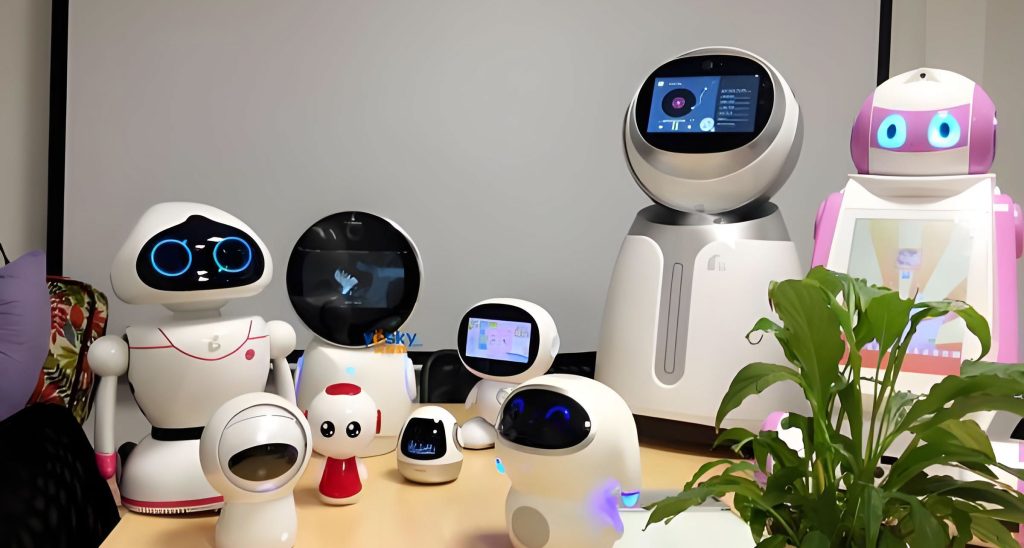
The landscape of domestic technology is continually evolving, and a particularly poignant segment within it is dedicated to our youngest users: children. The emergence and proliferation of the companion robot designed specifically for children represent a significant convergence of robotics, educational theory, developmental psychology, and industrial design. As a designer and researcher in this field, I observe a fascinating paradigm: these devices are no longer mere tools or simple toys; they are engineered entities intended to fulfill complex roles as tutors, playmates, and emotional supporters. The core challenge, and the central theme of my exploration, lies in the intentional translation of these functional goals into tangible form and interactive experience. How does the physical and interactive design of a companion robot—its shape, color, material, and behavior—mediate its relationship with a child? This inquiry is not merely aesthetic; it is fundamentally about crafting a bridge between silicon and sentiment, between programmed responses and genuine connection. The market offers a spectrum of solutions, from sleek, high-tech humanoids to soft, biomimetic creatures, each attempting to answer this question differently. In this analysis, I will delve into the foundational principles of product design as applied to companion robots, dissect the framework of emotional design, and propose a synthesized, formulaic approach to understanding and creating these sophisticated artifacts for childhood.
The initial conception of any companion robot must begin with a deep understanding of its intended role and the developmental stage of its user. The target demographic, typically ranging from infancy to age 12, is not monolithic. A robot for a toddler focuses on sensory stimulation and cause-and-effect learning, while one for a school-aged child might prioritize educational content, storytelling, or social skill development. The primary caregiver cohort today, often from generations deeply familiar with digital technology, seeks solutions that augment parenting in an era of busy schedules. They look for products that are not only functionally effective—capable of teaching alphabets or monitoring safety—but also emotionally resonant, capable of providing comfort and positive engagement in their absence. This dual demand creates the essential design brief: the companion robot must be a credible agent (perceived as capable and reliable) and a likable companion (perceived as friendly and engaging). The entire design process orbits around fulfilling these two, sometimes competing, objectives.
Deconstructing Form: The Core Elements of Robot Aesthetics
The physical embodiment of a companion robot is its primary interface with the world. Before it speaks or moves, it is seen and potentially touched. Its造型设计 (modeling design) is a language in itself, composed of three fundamental lexicons: color, morphology, and material. A systematic approach to these elements is crucial for achieving desired perceptual outcomes.
1. Chromatic Language: Color as Signal and Emotion
Color is the most immediate visual stimulus. In the context of a child’s companion robot, it serves multiple, critical functions that can be summarized as a set of guiding equations. First, color establishes identity and attracts attention. Second, it conveys symbolic meaning and emotional tone. Third, it must satisfy ergonomic and safety requirements.
We can model the color selection as a multi-variable optimization problem. Let a color scheme \( C \) be defined by a set of hues, saturations, and values (HSB/HSL). The perceived effect \( E_{color} \) on a child user is a function of this scheme, contextualized by cultural norms \( N \), the child’s age \( A \), and the intended robot personality \( P_{robot} \).
$$ E_{color} = f(C, N, A, P_{robot}) $$
For instance, high-saturation, primary colors (Red, Blue, Yellow) are often associated with energy, simplicity, and are highly attention-grabbing for younger children. Pastel schemes (soft pinks, blues, yellows) typically communicate calmness, gentleness, and are often used for nurturing or bedtime-focused companion robots. A monochromatic or achromatic scheme (whites, greys, black) can signal technological sophistication, neutrality, or a “blank canvas” for personalization.
The following table categorizes common color strategies and their associated perceptual impacts:
| Color Strategy | Typical Hues | Perceived Emotional Tone | Common Application in Companion Robots |
|---|---|---|---|
| Primary / High-Contrast | Red, Blue, Yellow, Green | Energetic, Playful, Stimulating, Clear | Educational toys, Activity-promoting robots |
| Pastel / Soft | Pink, Light Blue, Mint, Lavender | Calm, Soothing, Nurturing, Friendly | Bedtime companions, Emotional comfort robots |
| Monochromatic / Achromatic | White, Grey, Black | Modern, Technical, Neutral, Sophisticated | High-tech humanoids, Multi-purpose home assistants |
| Biomimetic | Browns, Oranges, Greys (fur/animal patterns) | Natural, Familiar, Lifelike, Comforting | Pet-like or creature-like companion robots |
The choice is never arbitrary. A robot designed for active, educational play might leverage a primary color strategy (\(C_{primary}\)) to achieve \(E_{color}(stimulating, clear)\). A robot designed for anxiety reduction would select a pastel scheme (\(C_{pastel}\)) to achieve \(E_{color}(calm, soothing)\).
2. Morphological Grammar: Shape, Proportion, and Stability
The form or morphology of a companion robot is its structural syntax. It communicates functionality, implies movement, and fundamentally affects its perceived character—is it friendly, formidable, silly, or smart? Design principles from product design and animation are key here. Forms built from large, simple geometric volumes appear sturdy and approachable. Sharp angles and complex silhouettes can feel technical or intimidating. Organic, curvilinear forms are typically associated with friendliness and safety.
A useful formal analysis can employ concepts from centroid and base-of-support calculations. A form’s visual stability is often subconsciously assessed. A robot with a low center of mass and a wide base appears stable, reliable, and safe—a critical perception for a child’s companion robot. This can be abstracted. Let the robot’s profile be approximated by a 2D polygon. Its visual stability metric \( S_v \) can be related to the ratio of its average width \( W_{avg} \) to its height \( H \), and the vertical location of its centroid \( y_c \).
$$ S_v \propto \frac{W_{avg}}{H} \cdot \frac{1}{y_c} $$
Higher \( S_v \) values correlate with perceptions of greater stability and, by extension, safety and reliability. Furthermore, morphological design is heavily constrained by functional anatomy. The degrees of freedom (DOF) required for movement directly influence form. A robot with many articulated joints (e.g., for expressive gestures) will have a different morphological grammar than a simple, wheeled robot with a static body but an expressive screen face. The form factor \( F \) is thus a function of intended mobility \( M \), interactive surfaces \( I \) (like screens or touch sensors), and internal component architecture \( K \).
$$ F = g(M, I, K) $$
For example, a humanoid companion robot aiming for social mimicry (\(M_{human-like}\)) will necessitate a form \(F\) with distinct head, torso, and limb segments, directly dictated by the kinematic chain \(K\) of servos and actuators.
3. Material Textonics: The Haptic Dialogue
If color is seen and form is perceived, material is felt. The materiality of a companion robot completes the sensory triangle and is vital for emotional connection, especially for younger children who explore the world tactiley. Material choice is a multi-objective decision involving tactile quality, durability, safety, cost, and manufacturability.
The haptic response \( H_{exp} \) can be modeled as a function of material properties \( Mat \) (hardness, thermal conductivity, surface texture) and the resulting psychological association \( \Psi \).
$$ H_{exp} = h(Mat, \Psi) $$
For instance:
- Soft, Fuzzy Materials (Plush, Silicone): \( Mat_{soft} \) → \( \Psi_{warmth, comfort, safety} \) → \( H_{exp}(nurturing, inviting) \). These materials lower barriers to physical interaction, encouraging hugging and holding.
- Smooth, Hard Plastics (ABS, Polished): \( Mat_{hard-smooth} \) → \( \Psi_{cleanliness, efficiency, technology} \) → \( H_{exp}(modern, precise) \). They communicate durability and are easy to clean but may feel cold or impersonal.
- Textured, Grippy Materials (Rubber, Matte coatings): \( Mat_{textured} \) → \( \Psi_{stability, control, robustness} \) → \( H_{exp}(secure, toy-like) \). They aid in handling and suggest durability for play.
The synthesis of color, form, and material creates the foundational “persona” of the companion robot before it even activates. A robot with a pastel color, rotund form, and soft fur texture is unmistakably crafted for cuddles and comfort. One with a white glossy finish, angular joints, and visible mechanical parts broadcasts its identity as a advanced technological artifact. This foundational persona sets the stage for the deeper, more dynamic layer of engagement: emotional design.
The Emotional Calculus: A Three-Level Framework for Connection
Moving beyond pure aesthetics, the profound goal of a companion robot is to establish a meaningful, positive, and sustained relationship with the child. This is the domain of emotional design. The widely adopted framework proposed by Donald Norman provides an excellent lens: emotional responses occur across three interconnected levels—Visceral, Behavioral, and Reflective. For a companion robot, each level must be deliberately addressed through design.
Level 1: The Visceral Layer – Immediate Perception
This is the pre-cognitive, instinctive reaction to the sensory input of the companion robot. It answers the question: “How does it look and feel at first glance/touch?” The design vectors from the previous section (Color \(C\), Form \(F\), Material \(Mat\)) are the direct inputs to this layer. The output is an immediate affective response \( R_v \) (e.g., attraction, wariness, curiosity, delight).
$$ R_v = V(C, F, Mat) $$
The objective here is to design for positive valence \( R_v^+ \). For a child’s companion robot, this almost universally means employing cues associated with neoteny (childlike features): large head-to-body ratios, large eyes, rounded forms, soft textures, and warm, non-threatening colors. These cues trigger innate caregiving and affiliative responses. A negative visceral reaction \( R_v^- \), caused by sharp edges, cold metals, harsh colors, or unsettling proportions, can be impossible to overcome, regardless of the robot’s advanced capabilities.
Level 2: The Behavioral Layer – The Experience of Use
This level concerns the experience of interacting with the companion robot. It answers: “Is it effective, satisfying, and easy to use?” This is where the robot’s functionality, usability, and physical performance live. Key parameters include:
- Responsiveness (\( \rho \)): The latency between a child’s action (verbal, touch) and the robot’s perceptible reaction.
- Functionality Efficacy (\( \epsilon \)): How well the robot performs its stated tasks (e.g., accuracy of educational content, clarity of speech).
- Usability (\( \upsilon \)): The intuitiveness of its controls (physical buttons, touch interface, voice commands).
- Physical Performance (\( \phi \)): Smoothness of movement, quality of audio, robustness to physical play.
The behavioral-level satisfaction \( S_b \) is a composite function of these parameters:
$$ S_b = B(\rho, \epsilon, \upsilon, \phi) $$
A high \( S_b \) is achieved when the companion robot feels competent and reliable. Frustration arises from high latency (\( \rho \downarrow \)), poor speech recognition (\( \epsilon \downarrow \)), or confusing interfaces (\( \upsilon \downarrow \)). This layer is critical for building trust and perceived usefulness. A robot that is fun to look at (high \( R_v \)) but frustrating to play with (low \( S_b \)) will quickly be abandoned.
Level 3: The Reflective Layer – Meaning and Relationship
This is the highest level, involving conscious thought, interpretation, and the formation of lasting impressions. It answers: “What does this robot mean to me? What does my interaction with it say about me?” This layer is influenced by the child’s (and family’s) personal history, culture, and values. Design influences this layer through:
- Narrative and Character: Does the robot have a name, a backstory, a consistent personality?
- Long-Term Adaptation & Memory: Does it remember the child’s name, preferences, or past interactions?
- Social Catalysis: Does it encourage sharing or play with others, or does it foster isolation?
- Value Alignment: Does it promote learning, creativity, or kindness, aligning with parental values?
The reflective evaluation \( E_r \) is a slow-forming, complex judgment:
$$ E_r = R(S_b, R_v, N_{arrative}, M_{emory}, T_{ime}, U_{ser\ Context}) $$
This is where a true sense of companionship is forged. A companion robot that successfully operates on this level transitions from being a “cool device” to becoming “my friend who remembers my favorite stories and gets excited when I come home.” The emotional bond is a product of consistent, positive interactions (\( S_b \)) framed within an appealing and trustworthy persona (\( R_v \)), over time (\( T \)).
The ultimate emotional impact \( EI \) of a companion robot can be conceptualized as the integrated outcome across all three levels over the duration of interaction \( T \).
$$ EI(T) = \int_{0}^{T} [ \alpha R_v(t) + \beta S_b(t) + \gamma E_r(t) ] dt $$
Where \( \alpha, \beta, \gamma \) are weighting coefficients that may vary per child and context, but where neglect of any term degrades the overall result.
Archetypal Analysis: Applying the Framework to Companion Robot Genres
By applying the造型设计 elements and the three-level emotional framework, we can analyze prevailing companion robot archetypes. The following table summarizes four distinct design philosophies, mapping their characteristics to the emotional layers.
| Robot Archetype | Core Design Tenets | Visceral Design (R_v) | Behavioral Design (S_b) | Reflective Design (E_r) |
|---|---|---|---|---|
| The High-Tech Humanoid | Mimics human form/articulation; showcases technical prowess; exposed mechanics; sleek surfaces. | Awe, curiosity, fascination with technology. Can also be intimidating or cold if not carefully softened. | High on functional performance (precise movement, programmed routines). Usability may be complex. Demonstrates clear capability. | Associated with futurism, learning STEM. May be seen as a “cool tool” or assistant rather than an emotional peer. Pride in ownership of advanced tech. |
| The Biomimetic Pet | Faithfully模仿 (mimics) animal features (dog, cat); soft or realistic textures; organic forms; expressive animal-like gestures. | Immediate familiarity and affection triggered by neotenic animal cues. Strong instinct to nurture and interact. | Satisfaction from lifelike, responsive interactions (petting -> tail wag, voice -> head turn). High on intuitive, natural interaction. | Fosters a sense of responsibility and unconditional companionship. Lowers barriers to emotional attachment. Viewed as a “pet” with unique benefits. |
| The Abstract Soft Companion | Non-representational form; emphasis on extreme softness, huggability; simple, rounded shapes; calming colors. | Profound sense of safety, comfort, and soothing. Zero visual threat. Invites close physical contact. | Functionality is often simple (warming, heartbeat sounds, gentle motion). The primary behavior is “being there to hold.” High usability. | Associated with emotional security, bedtime, anxiety relief. Becomes a transitional object or comfort giver. Meaning is deeply personal and affective. |
| The Screen-Based Interactive Pod | Form is a simple housing for a primary display screen; focus is on facial/character animation on screen; physical form is minimal. | Attention is dominated by the animated character. The physical pod aims for neutrality or pleasant simplicity. | Richness of interaction comes from software: games, conversations, lessons. Responsiveness \(\rho\) and content efficacy \(\epsilon\) are paramount. | Relationship is with the digital character. Can enable deep customization and learning progression. May be seen as a tutor or playmate defined by its software. |
This analysis reveals that there is no single “best” design. The optimal choice is dictated by the primary goal of the companion robot. A robot designed for structured educational coaching might effectively adopt a High-Tech Humanoid or Screen-Based Pod archetype, leveraging its technological aura (\( R_v \)) to command attention for learning, and its precise functionality (\( S_b \)) to deliver content. Its reflective meaning (\( E_r \)) is tied to achievement and growth.
Conversely, a robot designed primarily for emotional support and anxiety reduction would be profoundly mismatched as a angular, metallic humanoid. The Abstract Soft Companion or Biomimetic Pet archetypes are far more effective, as their very form (\( F \)), material (\( Mat \)), and implied behavior communicate safety and unconditional positive regard at the visceral level, creating the foundation for a reflective bond built on comfort.
The most sophisticated companion robots attempt to blend these archetypes. For example, a robot might have the overall soft, rounded form of the Abstract Companion but integrate a small, expressive screen for a face (Screen-Based element) and simple animal-like ears (Biomimetic element). This hybrid approach seeks to maximize positive visceral appeal while expanding behavioral capabilities.
Towards a Unified Design Formula for Child-Robot Companionship
Synthesizing the principles discussed, I propose a conceptual formula to guide the design of a child’s companion robot. This formula aims to make explicit the relationship between design inputs and the desired outcome of “successful companionship” (\( SC \)).
Let us define Successful Companionship \( SC \) over a period \( T \) as a composite metric reflecting sustained engagement, positive affect, and functional benefit as reported by the child and caregivers.
The design process involves optimizing a set of controllable parameters \( \vec{D} \) to maximize \( SC \).
$$ \vec{D} = [ \vec{C}, \vec{F}, \vec{Mat}, \vec{I}, \vec{K}, \vec{S}] $$
Where:
- \( \vec{C} \): Color scheme vector (hues, distribution)
- \( \vec{F} \): Morphology vector (proportions, complexity, stability metric \( S_v \))
- \( \vec{Mat} \): Material properties vector (texture, hardness, temperature)
- \( \vec{I} \): Interaction modality vector (touch, voice, gesture, screen)
- \( \vec{K} \): Kinematic/Internal architecture vector (DOF, actuator types)
- \( \vec{S} \): Software/Behavior vector (responsiveness \( \rho \), personality algorithms, memory)
These design parameters feed into the three-level emotional model, which acts as a mediator. Therefore:
$$ SC(T) = \Phi( EI(T) ) = \Phi\left( \int_{0}^{T} [ \alpha V(\vec{C}, \vec{F}, \vec{Mat}) + \beta B(\rho(\vec{S}), \epsilon(\vec{S}, \vec{I}), \upsilon(\vec{I}), \phi(\vec{K})) + \gamma R(S_b, R_v, N(\vec{S}), M(\vec{S}), U) ] dt \right) $$
Where \( \Phi \) is a function that translates the integrated emotional impact into observable measures of companionship success.
Design Imperatives Derived from the Formula:
- Visceral Primacy: The term \( V(\vec{C}, \vec{F}, \vec{Mat}) \) is the initial condition. If \( R_v \) is negative or neutral, the integral for \( EI(T) \) starts at a deficit. Therefore, parameters \( \vec{C}, \vec{F}, \vec{Mat} \) must be tuned to maximize positive visceral response for the target age and context as an absolute priority.
- Behavioral Consistency: The behavioral layer function \( B(…) \) must deliver reliability. High variance or poor performance in \( \rho, \epsilon, \upsilon, \phi \) leads to frustration, causing \( S_b(t) \) to dip and damaging the integral. Robustness and intuitive design are non-negotiable.
- Reflective Coherence: The reflective layer \( R(…) \) is where long-term value is created. The narrative \( N \), memory \( M \), and adaptive behaviors defined in \( \vec{S} \) must be coherent with the visceral persona. A cuddly, soft robot should not have a harsh, overly formal speaking style. Coherence across levels strengthens \( E_r \).
- Temporal Dimension: The integral \( \int_{0}^{T} \) emphasizes that companionship is built over time. Design choices must consider long-term engagement, avoiding novelty wear-off. This is addressed through updateable software \( \vec{S} \), adaptive behaviors, and perhaps physical durability in \( \vec{Mat} \) and \( \vec{K} \).
Conclusion: The Art and Science of Artificial Companionship
The design of a child’s companion robot sits at a unique interdisciplinary crossroads. It demands a rigorous, almost scientific approach to human factors, ergonomics, and developmental psychology, while simultaneously requiring the nuanced touch of an artist or storyteller to breathe life and warmth into circuits and code. The analysis of造型设计 elements provides the vocabulary—color, form, and material are the adjectives and nouns describing the robot’s static being. The three-level emotional design framework provides the grammar—a structure for how perception, interaction, and meaning combine to form the sentence of relationship.
Through this lens, we see that the various archetypes in the market are not random but are deliberate executions targeting different points in the vast space of childhood needs. The sleek humanoid, the lifelike robotic pet, the simple huggable pillow with a tail—each is solving a different equation within the overarching formula for companionship \( SC(T) \). The future of companion robot design lies not in a convergence to a single form, but in the more intelligent and sensitive application of this formula. This means creating robots whose physical design is in perfect harmony with their interactive capabilities and intended emotional role, robots that can adapt their behavioral vector \( \vec{S} \) to grow with the child, and robots that understand that their ultimate success is measured not in processing speed or number of features, but in the quality of the quiet, reflective bond they help foster—the sense that in the child’s world, they are not just a machine, but a true companion.
The challenge and the opportunity for us as designers is to wield both the analytical tools of engineering and the empathetic tools of art. We must calculate visual stability metrics and material hardness while also crafting character and scripting moments of joy. In doing so, we move closer to creating companion robots that are not merely used, but are genuinely loved, and that contribute positively to the complex, wonderful journey of growing up.