
In the context of nuclear power plants and other extreme environments, quadruped robots, often referred to as robot dogs, are designed to perform tasks in complex and hazardous conditions. These robots combine the superior mobility of quadruped systems with the flexibility of spinal joint mechanisms, enabling them to navigate uneven terrain, slippery surfaces, and potential radiation exposure. However, the unique challenges of nuclear environments demand highly compliant and stable gait control, particularly during jumping motions, to ensure operational reliability and safety. Existing methods, such as cross-coupled control, virtual model-based approaches, and model predictive control, have been explored to address these demands, but they often suffer from complexities, high costs, or sensitivity to model inaccuracies. This paper proposes a comprehensive compliant control method for the jumping gait of quadruped robots with spinal joint drive mechanisms, focusing on enhancing adaptability in dynamic settings. We begin by constructing a jumping motion model for the quadruped robot, conducting detailed dynamics analysis to compute drive angles for hip and knee joints, and planning foot-end trajectories for takeoff and landing phases. Subsequently, we allocate contact forces at the foot-end using model predictive control principles to achieve smooth and stable motion. Our approach aims to handle the complex dynamics of spinal joints and uncertainties during jumping, providing a robust solution for automation in nuclear power plants.
The development of quadruped robots for nuclear applications requires precise modeling and control to mitigate risks associated with external disturbances. Traditional control strategies, while effective in certain scenarios, often fall short in extreme environments due to their reliance on accurate models or high-cost sensors. For instance, cross-coupled control involves real-time adjustments of joint parameters but necessitates complex algorithms, increasing implementation difficulty. Virtual model-based methods offer resistance to disturbances but depend on high-precision sensors, raising economic concerns. Model predictive control, though mainstream, can degrade if system models deviate from reality. Our method integrates these insights to deliver a holistic solution that balances mobility and stability, leveraging advanced computations and force distribution techniques. In this paper, we detail the mathematical foundations, simulation validations, and practical implications of our approach, emphasizing the repeated use of robot dog and quadruped robot terminologies to underscore their relevance in nuclear settings.
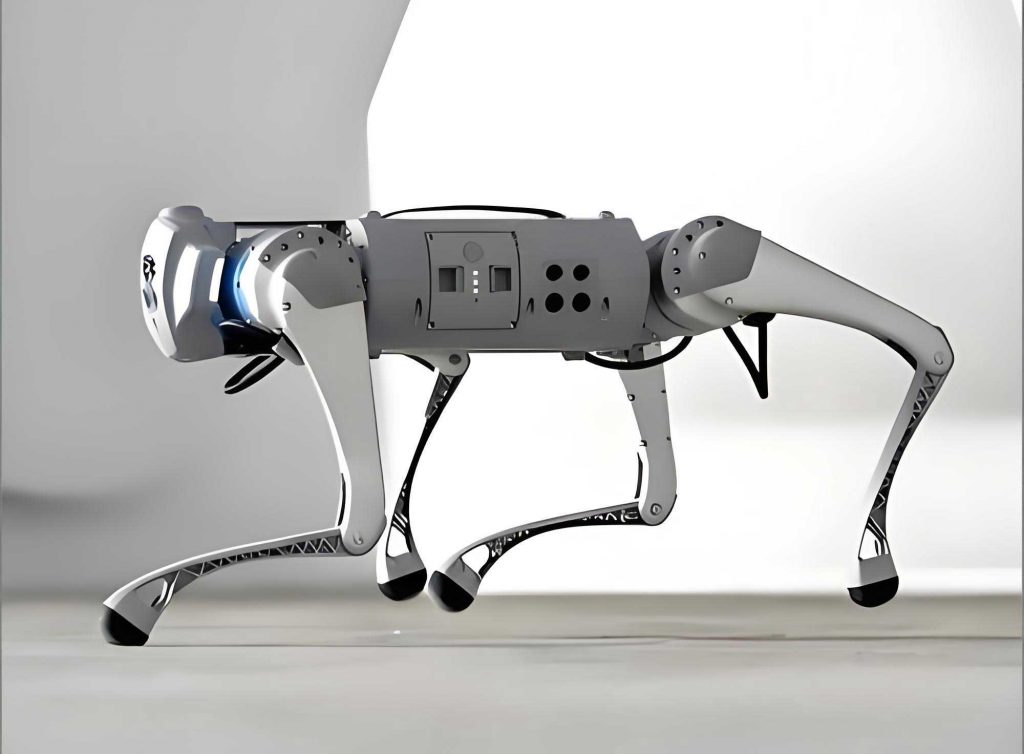
To establish a jumping motion model for the quadruped robot, we draw inspiration from biological analogs like cheetahs, which exhibit efficient jumping mechanics. We define a global coordinate system with the robot’s center of mass as the origin, where the X, Y, and Z axes correspond to the forward, lateral, and vertical directions, respectively. Using the Denavit-Hartenberg (D-H) parameter method, we systematically describe the motion parameters of each joint, including spinal, hip, and knee joints, and relate them to the foot-end position. This model captures the intricate relationships between joint movements and foot placement, essential for simulating jumping behaviors in a nuclear environment. The D-H parameters are summarized in Table 1, which outlines the link lengths, joint angles, and offsets for the quadruped robot structure.
| Joint | Link Length (m) | Joint Angle (rad) | Offset (m) | Twist Angle (rad) |
|---|---|---|---|---|
| Spinal | 0.15 | θ₁ | 0.05 | π/2 |
| Hip | 0.25 | θ₂ | 0.10 | 0 |
| Knee | 0.20 | θ₃ | 0.08 | 0 |
The dynamics analysis of the quadruped robot involves computing the drive angles for the hip and knee joints using inverse kinematics equations. For a two-segment leg structure, the angular displacements of the hip and knee joints are derived as follows. Let α₁ represent the hip joint angular displacement and α₂ represent the knee joint angular displacement. The formulas are given by:
$$ \alpha_1 = 2 \arctan\left( \frac{A – \frac{B}{2} + \sqrt{A^2 – P^2}}{B + P} \right) $$
and
$$ \alpha_2 = \arctan\left( \frac{m – N_1 \sin \alpha_2}{N_2} \right) – \alpha_1 $$
where A denotes the coordinate of the hip joint near the spine, B is the hip joint rotation point coordinate, P is the hip joint coordinate near the foot-end, m is the vertical displacement of the foot-end, and N₁ and N₂ represent the lengths of the thigh and shank, respectively. The swing amounts for the thigh and shank are then calculated using geometric relations:
$$ D = \alpha_1 + \frac{2\pi}{3} $$
$$ E = \alpha_2 – \frac{\pi}{3} $$
Here, D and E denote the swing amounts of the thigh and shank. The overall angular displacement for a single leg is formulated using the sine theorem:
$$ \alpha_i = -\arctan\left( \frac{B \sin\left( \alpha_1 + \frac{2\pi}{3} \right)}{A – B \cos\left( \alpha_1 + \frac{2\pi}{3} \right)} \right) $$
where α_i represents the total angular displacement of the leg. These equations enable precise control of the robot dog’s movements during jumping, accounting for the dynamic interactions between joints.
For trajectory planning of the jumping gait, we focus on ensuring smooth transitions during takeoff and landing to minimize impact forces. The foot-end interaction with the ground undergoes significant changes, necessitating a continuous velocity profile. We design the trajectory curve using a cubic polynomial to describe the displacement of the body’s center of mass:
$$ f = a_1 t + a_2 t^2 + a_3 t^3 $$
where f is the displacement curve of the body center of mass, and t is the time during the contact phase. During takeoff, the body’s center of mass acceleration transitions from 0 at time t to g at time t₁, leading to the foot-end trajectory function for takeoff and landing:
$$ h_1 = j_0 + \frac{g^{3/2}}{6 \sqrt{6 (j_1 – j_0)}} t_1^3 $$
Here, h₁ is the trajectory curve function for foot-end takeoff, and j₀ and j₁ are the vertical coordinates of the takeoff and landing points, respectively. The coefficients derived from these equations ensure a smooth foot-end trajectory, reducing structural shocks and enhancing the compliance of the quadruped robot. Table 2 summarizes the parameters used in trajectory planning, including time intervals and displacement values.
| Parameter | Symbol | Value | Unit |
|---|---|---|---|
| Takeoff Time | t₁ | 0.5 | s |
| Landing Time | t₂ | 1.0 | s |
| Vertical Displacement at Takeoff | j₀ | 0.0 | m |
| Vertical Displacement at Landing | j₁ | 0.3 | m |
| Gravitational Acceleration | g | 9.81 | m/s² |
After planning the jumping gait trajectory, we allocate the contact forces at the foot-end of the quadruped robot within the jumping motion model. Using model predictive control (MPC), we solve for the contact reaction forces by formulating it as an optimal control problem over a prediction horizon. The objective is to minimize a performance index that includes state errors, control inputs, and energy consumption:
$$ V_{\text{min}} = (D w_0 – w_1 + E \chi_1)^T \lambda_1 (D w_0 – w_1 + E \chi_1) + \chi_1^T \mu \epsilon_1 $$
In this equation, V represents the contact reaction force at the foot-end of the quadruped robot, w₁ and w₀ are the state quantities in the prediction horizon after takeoff and at rest, respectively, λ₁ is the state weight matrix during takeoff, χ₁ is the energy consumption weight matrix in the prediction horizon, ε₁ is the control quantity in the prediction horizon, and μ is a weighting coefficient. By computing the minimum contact reaction force that satisfies system dynamics, control input constraints, and state constraints, we achieve compliant force distribution. Since contact forces and reaction forces are equal in magnitude but opposite in direction, we directly obtain the foot-end contact force from sensor feedback, allowing adaptive adjustments based on environmental changes.
The robot dog continuously monitors environmental variations through sensors and feeds this data back to the control system. Our method dynamically adjusts the jumping gait trajectory and foot-end contact forces, ensuring smooth and stable motion for the quadruped robot with spinal joints. This approach effectively handles uncertainties and disturbances, such as uneven ground or radiation effects, common in nuclear power plants. The integration of MPC with force allocation enhances the robustness of the quadruped robot, making it suitable for autonomous operations in extreme conditions.
For simulation testing, we utilized the RobotBuilder dynamics simulation software platform, which incorporates the Dynamechs engine and OpenGL for realistic 3D visualization. We input the specific dimensions and mass distribution parameters of the nuclear power plant quadruped robot, as detailed in Table 3. These parameters are critical for accurately simulating the robot’s dynamic behavior during jumping.
| Component | Parameter | Value | Unit |
|---|---|---|---|
| Body | Mass | 25.0 | kg |
| Spinal Joint | Length | 0.5 | m |
| Hip Joint | Mass | 2.0 | kg |
| Knee Joint | Mass | 1.5 | kg |
| Thigh | Length | 0.3 | m |
| Shank | Length | 0.25 | m |
The simulation environment was configured with gravity acceleration and ground parameters to mimic nuclear plant conditions, as shown in Table 4. This setup ensures that the virtual world accurately reflects the physical properties affecting the robot dog’s motion.
| Parameter | Value | Unit |
|---|---|---|
| Gravity Acceleration | 9.81 | m/s² |
| Ground Friction Coefficient | 0.6 | – |
| Ground Stiffness | 1000 | N/m |
| Ground Damping | 50 | Ns/m |
We constructed a virtual nuclear power plant environment with obstacles and electrical infrastructure, and planned jumping gaits for the quadruped robot based on typical obstacle layouts. Our compliant control method was compared against cross-coupled control and virtual model-based approaches. The results, analyzed through angle parameters such as pitch and roll angles, demonstrated that our method maintained stable fluctuations within safe bounds, whereas the alternatives exhibited excessive deviations or irregular patterns. For instance, the cross-coupled control method often exceeded constraint ranges, while the virtual model approach showed unpredictable angle variations, indicating poor handling of spinal joint dynamics. In contrast, our approach ensured smooth and predictable motions, validating its effectiveness in managing complexities and disturbances for the robot dog.
Further analysis involved evaluating the performance metrics, such as energy consumption and stability margins, during jumping. We derived additional formulas to quantify the compliance, such as the cost function for the MPC optimization:
$$ J = \sum_{k=1}^{N} \left( \| w_k – w_{\text{ref}} \|^2_Q + \| \epsilon_k \|^2_R \right) $$
where J is the total cost, N is the prediction horizon, w_k is the state vector at step k, w_{\text{ref}} is the reference state, Q and R are weighting matrices, and ε_k is the control input. This formulation helps in minimizing deviations and ensuring efficient force distribution for the quadruped robot.
In conclusion, our compliant control method for the jumping gait of quadruped robots with spinal joint drive mechanisms significantly improves mobility and stability in nuclear power plant environments. By integrating precise modeling, dynamics analysis, trajectory planning, and force allocation via model predictive control, we address the challenges of uneven terrain, slippery surfaces, and radiation hazards. The simulation results confirm that our approach outperforms existing methods in handling dynamic uncertainties, providing a reliable foundation for autonomous robot dog operations. Future work will focus on real-world implementations and extensions to other gait types, further enhancing the adaptability of quadruped robots in extreme conditions.
The development of such advanced control strategies underscores the importance of continuous innovation in robotics for hazardous environments. As quadruped robots evolve, their ability to perform complex tasks like jumping over obstacles will become increasingly vital for safety and efficiency in nuclear facilities. Our method represents a step forward in this direction, leveraging mathematical rigor and practical simulations to achieve compliant and robust motion control for the robot dog.