
Humanoid robots, characterized by their human-like morphology and movement capabilities, represent a pivotal advancement in robotics, integrating disciplines such as mechanics, electrical engineering, materials science, and artificial intelligence. The development of humanoid robots has evolved from early prototypes like WABOT-1 to modern systems such as Boston Dynamics’ Atlas and Tesla’s Optimus, highlighting a trajectory toward enhanced mobility, intelligence, and functionality. A critical enabler of this progress is the adoption of composite materials, which offer superior properties like high strength-to-weight ratio, fatigue resistance, corrosion resistance, thermal stability, and structural design flexibility. These attributes address limitations of traditional materials, such as metals and polymers, in achieving lightweight, multifunctional, and adaptive designs for humanoid robots. This article explores the scientific challenges, application advancements, and future trends of composite materials in humanoid robots, emphasizing their role in lightweight design, sensing systems, and actuation mechanisms. By leveraging composites, humanoid robots can achieve improved performance in diverse environments, from industrial automation to extreme conditions, while fostering sustainability through green manufacturing.
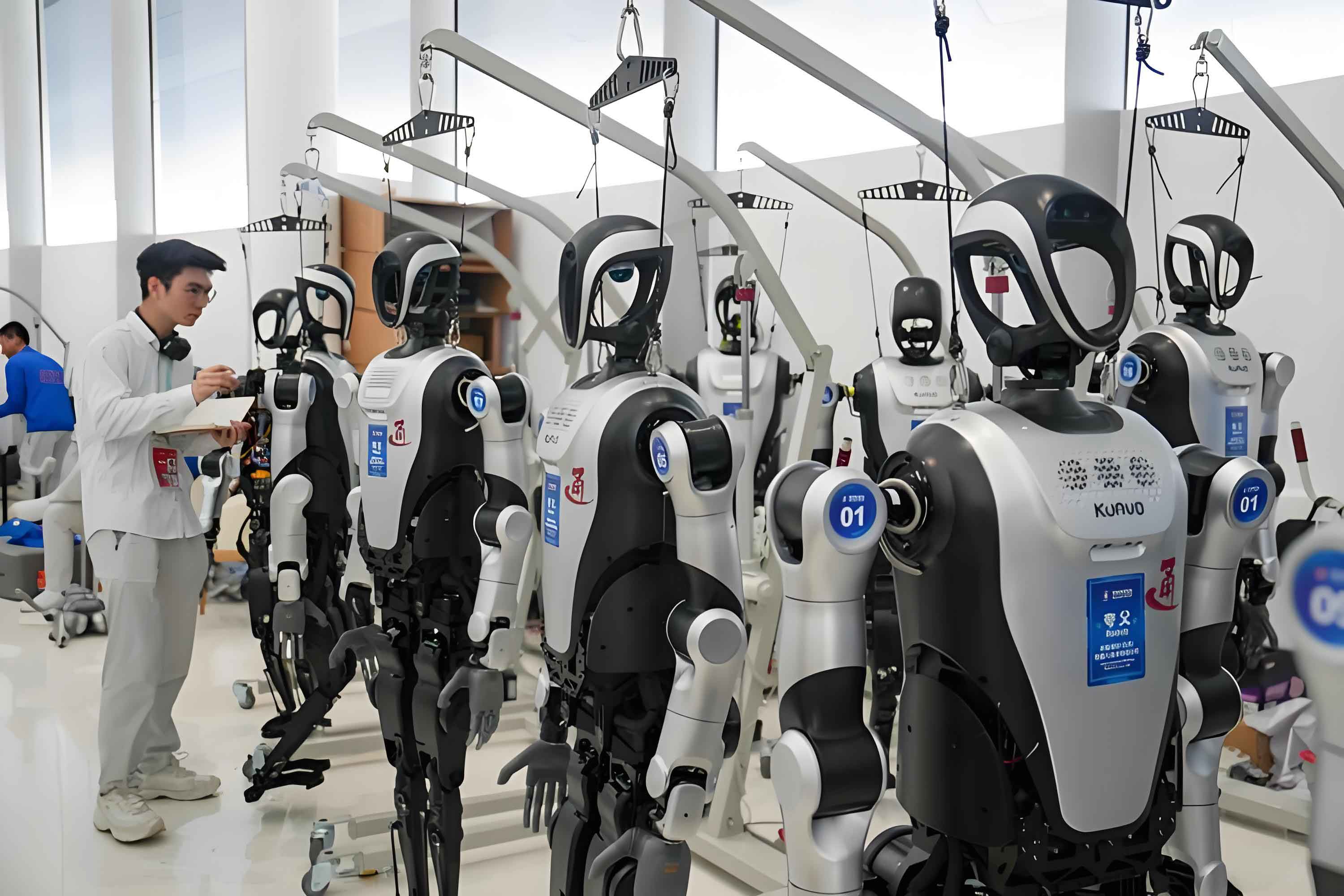
The integration of composite materials in humanoid robots addresses fundamental scientific issues, including lightweighting and efficiency, multifunctional integration and perception, functional material deployment in extreme environments, and green, low-cost manufacturing. For instance, the high specific strength and stiffness of composites enable significant weight reduction in structural components, such as frames and joints, enhancing the agility and energy efficiency of humanoid robots. Moreover, composites facilitate the embedding of sensors and actuators, enabling human-like tactile and thermal perception. In extreme scenarios, composites with tailored properties, such as thermal conductivity or electromagnetic shielding, expand the operational scope of humanoid robots. However, challenges persist in optimizing composite structures for dynamic loads, ensuring durability under cyclic stresses, and achieving cost-effective production. The following sections delve into these aspects, supported by empirical data, tables, and mathematical models to illustrate the transformative impact of composites on humanoid robots.
Scientific Challenges and Key Technologies
The deployment of composite materials in humanoid robots is governed by several scientific challenges. First, lightweighting and efficiency require composites to achieve high specific strength and stiffness, often expressed through the specific strength ($\sigma/\rho$) and specific modulus ($E/\rho$), where $\sigma$ is tensile strength, $E$ is Young’s modulus, and $\rho$ is density. For humanoid robots, minimizing mass while maintaining structural integrity is crucial for dynamic motion and battery life. Second, multifunctional integration involves embedding sensing, actuation, and energy harvesting capabilities within composite structures, enabling humanoid robots to perceive environments similarly to humans. This necessitates materials with piezoresistive, piezoelectric, or thermoelectric properties. Third, functional materials must withstand extreme conditions, such as high temperatures or radiation, which can be modeled using thermal stability equations like the Arrhenius equation for degradation: $$k = A e^{-E_a/(RT)},$$ where $k$ is the rate constant, $A$ is the pre-exponential factor, $E_a$ is activation energy, $R$ is the gas constant, and $T$ is temperature. Finally, green manufacturing focuses on sustainable composites, such as bio-based fibers, which reduce environmental impact but require optimization of life-cycle assessments.
| Material | Density (g/cm³) | Tensile Strength (MPa) | Young’s Modulus (GPa) | Specific Strength (MPa/(g/cm³)) | Specific Modulus (GPa/(g/cm³)) | Cost | Processing Difficulty |
|---|---|---|---|---|---|---|---|
| Steel (45#) | 7.85 | 600 | 210 | 76.4 | 26.8 | Low | Easy |
| Aluminum Alloy | 2.80 | 420 | 72 | 150.0 | 25.7 | Moderate | Easy |
| Titanium Alloy | 4.50 | 1000 | 117 | 222.2 | 26.0 | High | Difficult |
| Glass Fiber/Epoxy | 2.00 | 1245 | 48 | 622.5 | 24.0 | Moderate | Moderate |
| Aramid Fiber/Epoxy | 1.40 | 1373 | 78.4 | 980.7 | 56.0 | High | Difficult |
| Carbon Fiber (T300)/Epoxy | 1.60 | 1760 | 128 | 1100.0 | 80.0 | High | Difficult |
| Carbon Fiber (T700)/Epoxy | 1.60 | 2100 | 130 | 1312.5 | 81.3 | Very High | Very Difficult |
Key technologies for addressing these challenges include topology optimization for lightweight design, additive manufacturing for complex geometries, and multifunctional composite synthesis. For example, topology optimization algorithms minimize mass while satisfying stress constraints, often formulated as: $$\min_{\rho} \left( \int_{\Omega} \rho \, d\Omega \right) \quad \text{subject to} \quad \sigma \leq \sigma_{\text{allow}},$$ where $\rho$ is material density and $\sigma_{\text{allow}}$ is the allowable stress. Additive manufacturing enables the fabrication of intricate composite structures, such as lattice cores, which enhance energy absorption. Multifunctional composites integrate conductive fillers like carbon nanotubes (CNTs) or MXenes to achieve self-sensing capabilities, critical for humanoid robots operating in unstructured environments.
Advances in Lightweight Design and Structural Optimization
Lightweight design is paramount for humanoid robots to achieve high mobility, reduce energy consumption, and extend operational duration. Composite materials, particularly fiber-reinforced polymers (FRPs) like carbon fiber-reinforced polymers (CFRP), glass fiber-reinforced polymers (GFRP), and aramid fiber-reinforced polymers, offer exceptional specific strength and stiffness. For instance, replacing aluminum with CFRP in structural components can reduce weight by over 30%, as demonstrated in applications like robotic arms and hydraulic cylinders. The specific strength of CFRP can be expressed as: $$\text{Specific Strength} = \frac{\sigma}{\rho},$$ where values exceed 1000 MPa/(g/cm³) for advanced carbon fibers, compared to 222 MPa/(g/cm³) for titanium alloys.
Structural optimization techniques, such as topology optimization and genetic algorithms, further enhance lightweighting. In humanoid robots like ARMAR III, topology optimization of the thoracic structure reduced mass to 2.7 kg while maintaining high stiffness. Similarly, additive manufacturing of composite pelvis modules achieved 46% weight reduction. For hydraulic systems, composites enable lightweight actuators; for example, CFRP hydraulic cylinders in the HYDROÏD humanoid robot reduced weight by 28 kg, improving dynamic response. The optimization of such components often involves minimizing mass under pressure constraints, modeled as: $$\min \sum m_i \quad \text{subject to} \quad P_{\text{internal}} \leq P_{\text{max}},$$ where $m_i$ is the mass of element $i$ and $P_{\text{internal}}$ is the internal pressure.
Polyetheretherketone (PEEK) composites, reinforced with carbon fibers, are increasingly used in gears and bearings for humanoid robots due to their wear resistance and self-lubricating properties. In Tesla’s Optimus Gen-2, PEEK composites contributed to a 10 kg weight reduction and 30% increase in walking speed. The effectiveness of lightweight composites can be quantified through the bending stiffness equation for sandwich structures: $$D = \frac{E_f t_f h^2}{2(1-\nu^2)} + \frac{E_c t_c^3}{12(1-\nu_c^2)},$$ where $D$ is flexural rigidity, $E_f$ and $E_c$ are face and core moduli, $t_f$ and $t_c$ are thicknesses, $h$ is core height, and $\nu$ is Poisson’s ratio. This approach is vital for components like robotic limbs, where high stiffness-to-weight ratios are essential.
| Application | Material | Weight Reduction (%) | Stiffness Improvement (%) | Key Technology |
|---|---|---|---|---|
| Robotic Arm | CFRP | 30-40 | 25-35 | Topology Optimization |
| Hydraulic Cylinder | CFRP | 28-60 | 20-30 | Additive Manufacturing |
| Pelvis Module | Composite Lattice | 46 | 15 | 3D Printing |
| Gear Systems | PEEK-Carbon | 10-15 | 10-20 | Injection Molding |
Composite Sensing Systems for Humanoid Robots
Sensing systems are critical for humanoid robots to interact with environments and humans, requiring high sensitivity, multimodality, and durability. Composite materials enable the development of advanced sensors and electronic skins (e-skins) that mimic human perception. For instance, piezoelectric composites, such as polyvinylidene fluoride (PVDF) with ceramic fillers, convert mechanical stress into electrical signals, allowing for self-powered motion detection. The piezoelectric coefficient $d_{33}$ governs this effect: $$V = d_{33} \cdot \sigma \cdot t,$$ where $V$ is voltage, $\sigma$ is stress, and $t$ is thickness. In humanoid robots, such sensors are integrated into joints or knees to harvest energy from movement, powering other sensors and reducing external energy needs.
Flexible strain sensors based on composites like carbon black/polydimethylsiloxane (CB/PDMS) exhibit high gauge factors, enabling precise monitoring of finger bending or gait analysis. Similarly, triboelectric nanogenerators (TENGs) use composite layers to generate electricity from friction, facilitating self-driven tactile sensing. For example, a TENG sensor with PEEK and liquid metal detected object size and robot position with rapid response times. The triboelectric effect can be modeled as: $$Q = \sigma \cdot A \cdot \frac{d}{d_0},$$ where $Q$ is charge, $\sigma$ is surface charge density, $A$ is area, $d$ is separation distance, and $d_0$ is initial distance.
Multimodal sensing integrates pressure, temperature, and tactile perception into single composite systems. MXene-based composites, for instance, offer dual-mode detection with sensitivities up to 92.22 kPa⁻¹ for pressure and 0.05 K for temperature. Ionic liquid-carbon nanotube composites enable object recognition with 98.6% accuracy in humanoid hands. These systems often employ machine learning for real-time data processing, enhancing the autonomy of humanoid robots. The sensitivity $S$ of a piezoresistive sensor is defined as: $$S = \frac{\Delta R/R_0}{\Delta P},$$ where $\Delta R$ is resistance change, $R_0$ is initial resistance, and $\Delta P$ is pressure change. For humanoid robots, this allows adaptive grasping and environmental interaction.
Electronic skins represent a leap in robotic perception, providing stretchable, self-healing, and fire-resistant interfaces. Composites with silver nanowires or graphene enable e-skins that repair cuts within seconds and operate in extreme temperatures. For instance, a cellulose nanofiber-based e-skin sustained functionality at high temperatures, with a pressure sensitivity of 9.21 kPa⁻¹. In humanoid robots like iCub, e-skins on hands facilitate obstacle detection and gentle object manipulation. The capacitance $C$ of a stretchable sensor is given by: $$C = \frac{\varepsilon_r \varepsilon_0 A}{d},$$ where $\varepsilon_r$ is relative permittivity, $\varepsilon_0$ is vacuum permittivity, $A$ is area, and $d$ is separation. This formula underpins the design of capacitive e-skins for humanoid robots, ensuring accurate force mapping.
| Sensor Type | Material Composition | Sensitivity | Response Time (ms) | Application in Humanoid Robots |
|---|---|---|---|---|
| Piezoelectric | PVDF/BaTiO₃ | — | 50 | Energy Harvesting from Motion |
| Piezoresistive | CB/PDMS | 10.55 kPa⁻¹ | 46 | Strain Detection in Joints |
| Triboelectric | PEEK/Liquid Metal | — | 70 | Object Recognition and Avoidance |
| Thermal | Graphite/PDMS | 0.05 K | 100 | Temperature Sensing |
| Multimodal | MXene/Elastomer | 92.22 kPa⁻¹ | 11 | Tactile and Thermal Perception |
Composite Actuation Systems in Humanoid Robots
Actuation systems in humanoid robots, such as tendons and artificial muscles, benefit from composites that mimic biological mechanisms. Tendon-driven systems, using fibers like Dyneema or super-tough spider silk composites, transmit force from actuators to joints with high efficiency. The tensile strength of these tendons can be modeled as: $$\sigma_t = \frac{F}{A},$$ where $F$ is force and $A$ is cross-sectional area. For example, spider silk-carbon nanotube composites exhibit toughness twice that of natural silk, enabling durable and conductive tendons for humanoid hands. These materials allow for precise force transmission and self-sensing, simplifying robot design and enhancing grasping capabilities.
Artificial muscles, made from composites like twisted coiled polymers (TCPs) or shape memory alloys (SMAs), provide alternative actuation with high strain and energy density. TCP muscles, fabricated from silver-coated nylon, contract under electrical heating, enabling rapid movement in humanoid fingers or faces. The strain $\epsilon$ in TCP muscles is given by: $$\epsilon = \frac{\Delta L}{L_0},$$ where $\Delta L$ is length change and $L_0$ is original length. In humanoid robots, TCP muscles offer low-cost, lightweight actuation with strains up to 50%, though efficiency remains below 30%. Similarly, SMA composites embedded in soft matrices allow variable stiffness, adapting to different tasks. The phase transformation in SMAs follows the Clausius-Clapeyron relation: $$\frac{d\sigma}{dT} = -\frac{\Delta H}{T \epsilon_t},$$ where $\sigma$ is stress, $T$ is temperature, $\Delta H$ is enthalpy change, and $\epsilon_t$ is transformation strain.
Hybrid actuators combining ionic polymer-metal composites (IPMCs) with SMAs enable complex motions, such as grasping fragile objects. For instance, a humanoid hand with IPMC-SMA drives achieved multi-directional movement with minimal power consumption. The bending curvature $\kappa$ of an IPMC actuator can be expressed as: $$\kappa = \frac{M}{EI},$$ where $M$ is moment, $E$ is modulus, and $I$ is moment of inertia. These advancements highlight the potential of composites to create biomimetic actuation systems for humanoid robots, improving dexterity and interaction in real-world scenarios.
| Actuation Type | Material | Strain (%) | Stress (MPa) | Energy Efficiency (%) | Application |
|---|---|---|---|---|---|
| Tendon-Driven | Dyneema Fiber | 5-10 | 500-1000 | 70-80 | Joint Force Transmission |
| TCP Muscle | Silver-Nylon | 20-50 | 100-200 | 20-30 | Finger and Facial Movement |
| SMA Composite | NiTi/Elastomer | 4-8 | 200-500 | 5-10 | Variable Stiffness Joints |
| IPMC Hybrid | Nafion/Metal | 1-5 | 10-50 | 10-20 | Soft Gripping |
Future Trends in Composites for Humanoid Robots
The evolution of composite materials will drive future advancements in humanoid robots, focusing on ultra-light structures, impact resistance, thermal stability, intelligent deformation, stealth capabilities, and green manufacturing. Ultra-light structures, such as lattice and sandwich cores, minimize mass while maximizing stiffness. For example, CFRP honeycomb structures exhibit high buckling resistance, with critical buckling stress $\sigma_{cr}$ given by: $$\sigma_{cr} = \frac{\pi^2 E}{(L/r)^2},$$ where $L$ is length and $r$ is radius of gyration. These structures are ideal for limbs and frames in humanoid robots, reducing inertia and energy consumption.
Impact resistance is crucial for humanoid robots operating in dynamic environments. Composites with layered designs, such as ceramic-fiber hybrids, absorb energy through plastic deformation and crack deflection. The energy absorption $W$ can be calculated as: $$W = \int F \, dx,$$ where $F$ is force and $x$ is displacement. For low-velocity impacts, CFRP sandwich shells with foam enhancements improve damage tolerance, vital for falls or collisions.
Thermal stability enables humanoid robots to function in extreme temperatures. Composites with high thermal conductivity, like epoxy filled with boron nitride, dissipate heat from motors and electronics. The heat transfer rate $\dot{Q}$ follows Fourier’s law: $$\dot{Q} = -k A \frac{dT}{dx},$$ where $k$ is thermal conductivity, $A$ is area, and $dT/dx$ is temperature gradient. Smart thermal management systems using composites can maintain optimal operating conditions, expanding the scope of humanoid robots to harsh environments.
Intelligent deformation, inspired by origami and shape-memory composites, allows humanoid robots to adapt their morphology. For instance, foldable structures enable compact storage and rapid deployment, while variable stiffness materials facilitate grasping diverse objects. The curvature change in such systems can be modeled using geometric mechanics equations.
Stealth capabilities, achieved with carbon-based composites, reduce infrared signatures for military applications. The emissivity $\epsilon$ of these materials minimizes thermal detection, enhancing the covert operations of humanoid robots. Green manufacturing emphasizes bio-composites, such as hemp or flax fibers, which are renewable and biodegradable. The degradation rate can be optimized using surface treatments, balancing durability and environmental friendliness for sustainable humanoid robot production.
Conclusion
Composite materials are revolutionizing humanoid robots by enabling lightweight, multifunctional, and intelligent designs. Advances in lightweight structures, sensing systems, and actuation mechanisms have demonstrated significant improvements in performance, such as weight reduction, enhanced perception, and adaptive motion. Future trends point toward ultra-light composites, impact-resistant designs, thermal management, morphing structures, stealth features, and eco-friendly manufacturing. However, challenges remain in interface durability, self-regulation of artificial muscles, and scalability of multifunctional composites. By addressing these issues through continued research, composites will unlock new potentials for humanoid robots, making them more human-like and capable in diverse applications. The integration of composites with AI and other technologies will further propel the evolution of humanoid robots, paving the way for their widespread adoption in society.