
In the realm of precision mechanical transmissions, the harmonic drive gear stands out as a pivotal innovation, particularly for applications demanding high accuracy, compact design, and reliable performance. My focus here is to delve into the meshing characteristics of a specific variant: the triple-arc harmonic drive gear. This gear system, characterized by its unique tooth profile composed of three tangential circular arcs, offers enhanced load-bearing capacity and transmission precision compared to traditional designs. Through this analysis, I aim to provide a detailed exploration of its modeling, conjugate tooth profile derivation, and key meshing performance metrics such as coincidence degree, maximum meshing depth, conjugate profile deviation, and backlash. The insights garnered are intended to serve as a theoretical foundation for the design and manufacturing of advanced harmonic drive gear systems, ensuring optimal performance in demanding fields like robotics, aerospace, and medical devices.
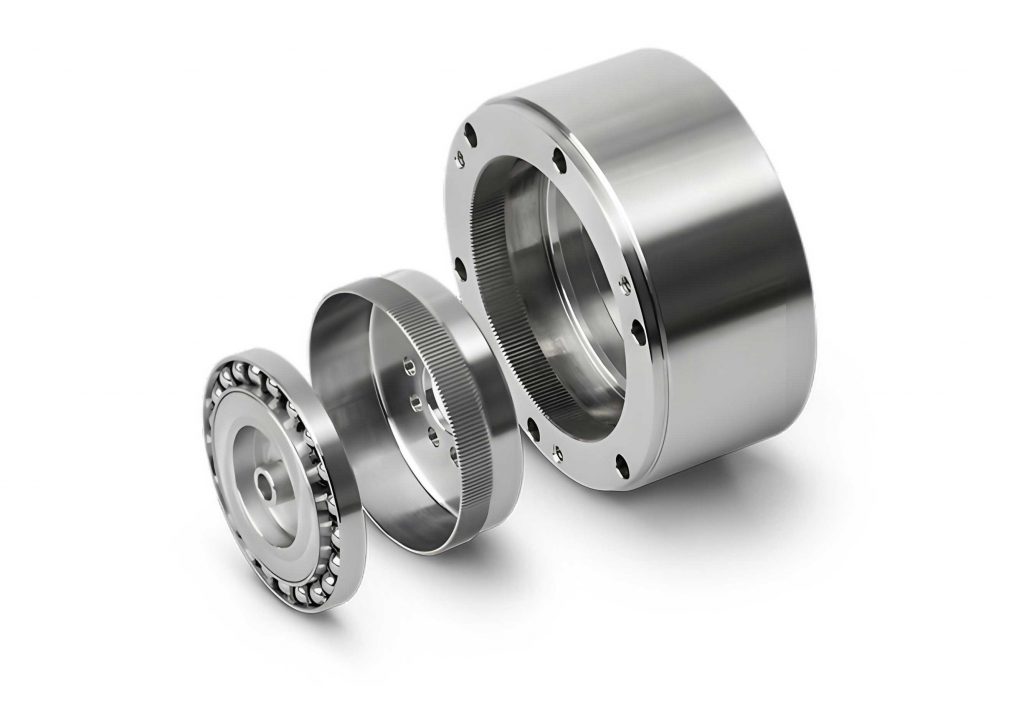
The harmonic drive gear operates on the principle of elastic deformation, where a flexible spline (flexspline) engages with a rigid spline (circular spline) via a wave generator. This mechanism enables high reduction ratios in a compact package, making the harmonic drive gear indispensable in modern engineering. The triple-arc tooth profile, an evolution from the dual-arc design, promises broader conjugate meshing intervals and improved contact characteristics. In this study, I adopt a first-person perspective to walk through the analytical process, employing mathematical modeling and numerical simulations to unravel the meshing behavior. The harmonic drive gear’s performance is intricately linked to its tooth geometry, and thus, a thorough examination of the triple-arc profile is crucial for harnessing its full potential.
Mathematical Modeling of the Triple-Arc Harmonic Drive Gear
To analyze the meshing performance, I first establish a simplified planar model of the harmonic drive gear transmission. This simplification assumes that the flexspline’s neutral line remains inextensible during operation and that both the flexspline and circular spline teeth are rigid bodies, neglecting deformations beyond the essential elastic deformation of the flexspline. These assumptions allow for a focused study on the geometric and kinematic aspects of the harmonic drive gear system. The coordinate systems are defined as follows: let \( S_0(X_0, O_0, Y_0) \) be the local coordinate system attached to the flexspline tooth, \( S_1(X_1, O_1, Y_1) \) be the coordinate system fixed to the circular spline, and \( S(X, O, Y) \) be a global reference frame. The wave generator, typically elliptical, induces a radial displacement in the flexspline, governing the meshing process.
The triple-arc flexspline tooth profile is composed of three circular arcs: a convex arc at the tooth tip (segment AB), an intermediate arc (segment BC), and a concave arc at the tooth root (segment CD). These arcs are mutually tangent at points B and C. The geometric parameters defining this profile include the radii \( \rho_a \), \( \rho_m \), and \( \rho_f \) for the tip, intermediate, and root arcs, respectively; the shift distances \( x_a \) and \( y_a \) for the tip arc center; the tooth heights \( h_a \) and \( h_f \); the distance \( d_s \) from the flexspline root circle to the neutral layer; and the tangent angles \( \delta_1 \) and \( \delta_2 \). The centers of these arcs, denoted as \( O_{0a}(x_{0a}, y_{0a}) \), \( O_{0m}(x_{0m}, y_{0m}) \), and \( O_{0f}(x_{0f}, y_{0f}) \), are derived from geometric relationships:
$$ x_{0a} = 0, \quad y_{0a} = h_f + d_s – y_a $$
$$ x_{0m} = \rho_a \cos \delta_1 + x_{0a} – \rho_m \cos \delta_1, \quad y_{0m} = \rho_a \sin \delta_1 + y_{0a} – \rho_m \sin \delta_1 $$
$$ x_{0f} = \rho_m \cos \delta_2 + x_{0m} – \rho_f \cos \delta_2, \quad y_{0f} = \rho_m \sin \delta_2 + y_{0m} – \rho_f \sin \delta_2 $$
To facilitate analysis, I discretize the flexspline tooth profile using arc length \( s \) as a parameter. The position vectors and normal vectors for each arc segment in \( S_0 \) are expressed as follows, where \( \theta = \arcsin[(h_a + y_a)/\rho_a] \), and \( l_1 \), \( l_2 \), \( l_3 \) are the cumulative arc lengths at transitions:
For segment AB (\( s \in [0, l_1] \)):
$$ \mathbf{r}_{AB} = \begin{bmatrix} \rho_a \cos(\theta – s/\rho_a) + x_{0a} \\ \rho_a \sin(\theta – s/\rho_a) + y_{0a} \\ 1 \end{bmatrix}, \quad \mathbf{n}_{AB} = \begin{bmatrix} \cos(\theta – s/\rho_a) \\ \sin(\theta – s/\rho_a) \\ 1 \end{bmatrix} $$
For segment BC (\( s \in [l_1, l_2] \)):
$$ \mathbf{r}_{BC} = \begin{bmatrix} \rho_m \cos(\delta_1 – (s – l_1)/\rho_m) + x_{0m} \\ \rho_m \sin(\delta_1 – (s – l_1)/\rho_m) + y_{0m} \\ 1 \end{bmatrix}, \quad \mathbf{n}_{BC} = \begin{bmatrix} \cos(\delta_1 – (s – l_1)/\rho_m) \\ \sin(\delta_1 – (s – l_1)/\rho_m) \\ 1 \end{bmatrix} $$
For segment CD (\( s \in [l_2, l_3] \)):
$$ \mathbf{r}_{CD} = \begin{bmatrix} \rho_f \cos(\delta_2 – (s – l_1 – l_2)/\rho_f) + x_{0f} \\ \rho_f \sin(\delta_2 – (s – l_1 – l_2)/\rho_f) + y_{0f} \\ 1 \end{bmatrix}, \quad \mathbf{n}_{CD} = \begin{bmatrix} \cos(\delta_2 – (s – l_1 – l_2)/\rho_f) \\ \sin(\delta_2 – (s – l_1 – l_2)/\rho_f) \\ 1 \end{bmatrix} $$
The circular spline tooth profile is designed based on the conjugate tooth profile of the flexspline to ensure proper meshing without interference. The conjugate profile is derived using the gear meshing theory. The coordinate transformation matrix \( \mathbf{M}_{10} \) and its derivative-related matrix \( \mathbf{B} \) are established for the elliptical wave generator. The meshing equation, which must be satisfied at contact points, is given by:
$$ \mathbf{n}_i^T \cdot \mathbf{v}_i^{(01)} = 0 $$
In terms of the flexspline coordinates, this becomes:
$$ \mathbf{n}_0^T \cdot \mathbf{B} \cdot \mathbf{r}_0 = 0 $$
where \( \mathbf{B} = \mathbf{W}_{10}^T \frac{d\mathbf{M}_{10}}{dt} \), and \( \mathbf{W}_{10} \) is the rotation part of \( \mathbf{M}_{10} \). For an elliptical wave generator with parameters such as radial deformation \( \omega_0 \) and wave generator rotation angle \( \zeta \), the matrix \( \mathbf{B} \) captures the kinematic relationships.
Solving this equation for each discretized point on the flexspline profile yields the theoretical conjugate points in the circular spline coordinate system \( S_1 \). This process reveals the “double conjugate” phenomenon, where each flexspline point corresponds to two conjugate points, and each conjugate angle involves two flexspline points simultaneously meshing. The outermost conjugate profiles are selected for circular spline design to avoid interference. These conjugate profiles are then approximated by circular arcs using fitting techniques, and the arc radii are adjusted unilaterally to eliminate any residual interference, resulting in a smooth triple-arc circular spline tooth profile. The parameters for both flexspline and circular spline profiles are summarized in the tables below, which are essential for the harmonic drive gear analysis.
| Parameter | Symbol | Value | Description |
|---|---|---|---|
| Tip Arc Radius | \( \rho_a \) | 0.625 mm | Radius of the convex tip arc |
| Intermediate Arc Radius | \( \rho_m \) | 2.8 mm | Radius of the intermediate arc |
| Root Arc Radius | \( \rho_f \) | 0.536 mm | Radius of the concave root arc |
| Tip Arc Center Shift | \( x_a, y_a \) | 0.4165 mm, 0.1020 mm | Horizontal and vertical shifts of tip arc center |
| Tooth Heights | \( h_a, h_f \) | 0.192 mm, 0.480 mm | Addendum and dedendum heights |
| Neutral Layer Distance | \( d_s \) | 0.4185 mm | Distance from root circle to neutral layer |
| Tangent Angles | \( \delta_1, \delta_2 \) | 12.25°, 11.22° | Angles at tangency points B and C |
| Number of Teeth | \( Z_r \) | 160 | Number of teeth on flexspline |
| Tooth Segment | Center Coordinates (mm) | Adjusted Radius (mm) |
|---|---|---|
| Root Convex Arc | (-0.4294, 26.0108) | 0.5265 |
| Intermediate Arc | (-2.4321, 25.4117) | 2.6845 |
| Tip Concave Arc | (0.7225, 25.8219) | 0.6402 |
The design ensures that the circular spline tooth profile is interference-free and maintains conjugate contact with the flexspline. This harmonic drive gear model forms the basis for evaluating meshing performance, which is critical for applications where precision and reliability are paramount. The triple-arc harmonic drive gear, with its enhanced geometry, is expected to outperform traditional profiles in terms of load distribution and transmission accuracy.
Evaluation of Meshing Performance in the Triple-Arc Harmonic Drive Gear
With the harmonic drive gear model established, I proceed to assess key meshing performance indicators. These metrics provide insight into the transmission behavior, durability, and precision of the triple-arc harmonic drive gear system. The evaluation focuses on conjugate profile deviation, coincidence degree, maximum meshing depth, and backlash distribution—all of which are vital for optimizing the harmonic drive gear design.
Conjugate Profile Deviation
The deviation between the theoretical conjugate flexspline profile and the actual circular spline tooth profile is a measure of how well the two profiles conjugate during operation. For the triple-arc harmonic drive gear, I compute this deviation by calculating the minimum distance from each discrete point on the theoretical conjugate profiles to the circular spline profile. Using the parameters from Table 1 and Table 2, the deviations for the primary conjugate segments (e.g., \( L^1_{AB} \), \( L^1_{BC} \), \( L^2_{BC} \), \( L^1_{CD} \)) are analyzed. The results indicate that all theoretical conjugate points lie on or inside the circular spline profile, preventing interference. The deviation values are extremely small, with a maximum of 2.5047 μm for outlier points, but for the main conjugate segments, the deviation ranges from -0.38039 μm to 0.227738 μm, with a mean of 0.075385 μm. This minimal and uniformly distributed deviation confirms that the triple-arc harmonic drive gear exhibits excellent conjugate contact characteristics, ensuring smooth and efficient power transmission in the harmonic drive gear system.
Coincidence Degree
Coincidence degree, often denoted as \( \varepsilon \), represents the average number of tooth pairs in simultaneous contact during meshing. A higher coincidence degree implies better load distribution, reduced noise, and increased transmission smoothness—key advantages for a harmonic drive gear. For the elliptical wave generator harmonic drive gear, the coincidence degree is calculated based on the conjugate meshing interval in the circular spline coordinate system. The effective continuous conjugate intervals are determined from the conjugate angle analysis. For instance, with conjugate intervals \([-0.00191^\circ, 9.51148^\circ]\) and \([12.75658^\circ, 45.70128^\circ]\) in the first quadrant, the total meshing interval \( \phi_s \) is 41.88°. The coincidence degree is given by:
$$ \varepsilon = \frac{4 \phi_s}{360^\circ} \times Z_g $$
where \( Z_g = 162 \) is the number of circular spline teeth. Substituting the values:
$$ \varepsilon = \frac{4 \times 41.88}{360} \times 162 \approx 75.386 $$
This indicates that approximately 75.386 tooth pairs are in contact simultaneously under no-load conditions, accounting for about 46.53% of the total teeth. Under load, due to tooth deformation, the actual coincidence degree is even higher. Such a high coincidence degree underscores the triple-arc harmonic drive gear’s ability to handle substantial loads while maintaining平稳 operation, making it suitable for high-performance applications where the harmonic drive gear must endure rigorous demands.
Maximum Meshing Depth
Maximum meshing depth, denoted as \( h_n \), is the radial engagement depth when the flexspline tooth fully enters the circular spline tooth space. It influences the torsional stiffness and load capacity of the harmonic drive gear. For proper operation, \( h_n \) must be sufficient to ensure stiffness but not so large as to cause tooth tip sharpening or interference. It is calculated as:
$$ h_n = r_{rs} + \omega_0 – r_{ge} $$
where \( r_{rs} \) is the radius of the flexspline tooth meshing start point, \( r_{ge} \) is the radius of the circular spline tooth meshing end point, and \( \omega_0 \) is the radial deformation induced by the wave generator (typically equal to the module \( m \) for elliptical generators). The constraints are:
$$ h_n \leq 0.5m(Z_r + 2x_r) + h_a – r_{rs} $$
$$ h_n \geq m $$
with \( m = 0.32 \) mm as the module, \( Z_r = 160 \), and \( x_r \) as the flexspline modification coefficient. Using the modeled profiles:
$$ h_n = (25.79 – 25.73 + 0.32) = 0.38 \text{ mm} $$
This satisfies \( h_n > m \) and is within the upper bound, indicating adequate meshing depth for enhanced torsional stiffness in this harmonic drive gear system.
Backlash Analysis
Backlash, or side clearance, is the gap between mating tooth profiles during meshing. Proper backlash is crucial for the harmonic drive gear: excessive backlash can lead to transmission error and noise, while insufficient backlash may cause interference and wear. I evaluate backlash by discretizing both tooth profiles and computing the minimum distance between corresponding points during meshing. For a flexspline point \( M_{ri} \) with coordinates \( (X_{ri}, Y_{ri}) \) in \( S_0 \) at meshing angle \( \phi_i \), the distance to circular spline points \( M_{gj} \) is:
$$ j_{M,ij} = \sqrt{ (X_{ri} – X_{gj})^2 + (Y_{ri} – Y_{gj})^2 }, \quad j = 1, 2, \dots, n $$
The minimum value \( j_{M,i} \) for each flexspline point represents the local backlash, and the overall minimum across all tooth pairs is the system backlash. For the triple-arc harmonic drive gear, analysis shows that 23 tooth pairs are in simultaneous contact on the long-axis side. The backlash distribution is uniform for most pairs, with a minimum backlash of 2.236 μm occurring at the 4th tooth pair and a maximum of 6.38 μm for others. The mean backlash is approximately 3.5323 μm. Notably, at the 23rd tooth pair (meshing exit), the backlash increases significantly to 25.359 μm to prevent tip interference. This controlled backlash profile ensures that the harmonic drive gear operates with high precision and minimal play, contributing to its reliability in sensitive applications.
| Tooth Pair Index | Backlash (μm) | Remarks |
|---|---|---|
| 1 | 3.142 | Uniform region |
| 2 | 3.567 | Uniform region |
| 3 | 3.891 | Uniform region |
| 4 | 2.236 | Minimum backlash |
| 5 | 3.245 | Uniform region |
| … | … | … |
| 22 | 6.380 | Maximum in uniform region |
| 23 | 25.359 | Increased to avoid tip interference |
This detailed backlash assessment highlights the balanced design of the triple-arc harmonic drive gear, where clearance is optimized to avert interference while maintaining tight transmission tolerances. Such characteristics are essential for harmonic drive gear systems deployed in precision robotics or aerospace mechanisms, where every micron of play can impact overall performance.
Discussion on the Advantages of Triple-Arc Profile in Harmonic Drive Gear Systems
The triple-arc tooth profile offers distinct benefits over traditional profiles like the dual-arc or involute designs in harmonic drive gear applications. From my analysis, the broader conjugate meshing interval inherent to the triple-arc geometry leads to a higher coincidence degree, which directly translates to improved load-sharing and reduced stress concentrations. This is particularly advantageous for harmonic drive gear systems operating under cyclic or shock loads, as it enhances durability and lifespan. Moreover, the smooth transition between arcs minimizes stress risers, potentially reducing fatigue failure risks in the flexspline—a common concern in harmonic drive gear assemblies.
Furthermore, the controlled conjugate profile deviation and backlash distribution ensure that the triple-arc harmonic drive gear maintains high transmission accuracy. In precision applications such as robotic joint actuators or satellite positioning systems, even minor deviations can accumulate into significant errors. The triple-arc design, with its inherently better conjugate contact, mitigates this by ensuring that the flexspline and circular spline remain in near-ideal contact throughout the meshing cycle. This harmony between geometric design and performance metrics underscores why the triple-arc harmonic drive gear is gaining traction in advanced engineering fields.
Another aspect worth noting is the manufacturing tolerance sensitivity. The triple-arc profile, while more complex to produce, may offer greater forgiveness to minor manufacturing errors due to its multi-arc structure, which can accommodate slight misalignments without compromising meshing quality. However, this requires further investigation through tolerance analysis and experimental validation. For now, the theoretical modeling suggests that the triple-arc harmonic drive gear is a robust candidate for high-end applications where precision and reliability are non-negotiable.
Conclusion
In this comprehensive analysis, I have explored the meshing performance of the triple-arc harmonic drive gear through mathematical modeling and performance evaluation. The key findings underscore the superiority of this design in harmonic drive gear systems. The conjugate tooth profile derivation, based on precise geometric and kinematic principles, yields a circular spline profile that closely matches the theoretical conjugate flexspline profile, with deviations averaging merely 0.075385 μm. This ensures excellent conjugate contact and eliminates interference, a critical factor for the harmonic drive gear’s smooth operation.
The triple-arc harmonic drive gear exhibits a high coincidence degree of approximately 75.386 under no-load conditions, indicating that a large number of tooth pairs engage simultaneously. This feature, coupled with a sufficient maximum meshing depth of 0.38 mm, enhances the load-bearing capacity and torsional stiffness of the harmonic drive gear. Additionally, the backlash analysis reveals a well-distributed clearance with a mean of 3.5323 μm, except at the meshing exit where it increases to prevent tip interference. This balanced backlash profile supports high transmission accuracy and reliability.
Overall, the triple-arc harmonic drive gear demonstrates promising characteristics for applications demanding precision, durability, and compactness. Future work could involve dynamic performance studies, thermal effects, and experimental validation to further refine the design. By leveraging these insights, engineers can optimize triple-arc harmonic drive gear systems for next-generation robotic, aerospace, and industrial applications, ensuring they meet the ever-growing demands for performance and efficiency. The harmonic drive gear, in its triple-arc incarnation, thus represents a significant step forward in transmission technology.