
The pursuit of high-performance motion transmission in applications such as aerospace robotics and precision instrumentation has consistently driven the advancement of harmonic drive gear technology. Renowned for their compact size, high single-stage reduction ratios, and exceptional positioning accuracy, harmonic drive gears represent a critical component in modern mechatronic systems. The core of their performance lies in the elastokinematic interaction between the flexspline, circular spline, and wave generator. Consequently, the design of the tooth profile, which governs this interaction, is paramount. While traditional design methodologies often focus on achieving conjugate motion or minimal backlash under no-load assembly conditions, the true test of a profile’s efficacy is its behavior under operational load. Load transmission induces non-uniform force distribution among the meshing tooth pairs, significantly influenced by the non-linear deformation of the flexspline. This complex interplay dictates critical performance metrics such as torsional stiffness, hysteresis, and positional accuracy under torque. Therefore, moving beyond static geometrical design to evaluate and understand the loaded meshing characteristics is essential for developing superior harmonic drive gear systems.
This article presents a holistic investigation, from the design of a triple-circular-arc spatial tooth profile to the finite element analysis of its loaded performance, with a specific focus on elucidating the relationship between output torsional stiffness and meshing characteristics. The primary objective is to establish a measurable link between the observable torsional stiffness hysteresis and the otherwise immeasurable internal state of tooth engagement, such as the number of load-sharing teeth. First, a triple-circular-arc profile for the flexspline is constructed. Recognizing that the flexspline cup deforms into a conical shape under the wave generator’s influence, a spatial tooth profile is developed. This is achieved by applying strategic radial modifications to the basic profile across several axial cross-sections, aiming to minimize the dispersion of the outer envelope generated by the profile’s meshing motion. Subsequently, the conjugate circular spline profile is designed using the envelope method based on this optimized outer envelope. A high-fidelity three-dimensional Finite Element Analysis (FEA) model incorporating the spatial-profile flexspline, planar-profile circular spline, and a simplified wave generator is established. By applying progressively increasing and reversing torques to the flexspline flange while fixing the circular spline, the load transmission behavior is simulated. The analysis of meshing force distribution and the resulting torque-torsion hysteresis curves reveals a strong correlation between the system’s torsional stiffness and the number of teeth actively participating in load sharing. This finding suggests that the easily measurable torsional stiffness hysteresis curve serves as a valuable diagnostic tool, allowing for the estimation of internal meshing conditions and providing a quantitative basis for evaluating and refining tooth profile designs for enhanced load-capacity and predictable performance in harmonic drive gear applications.
Fundamental Geometry and Kinematics of Harmonic Gear Meshing
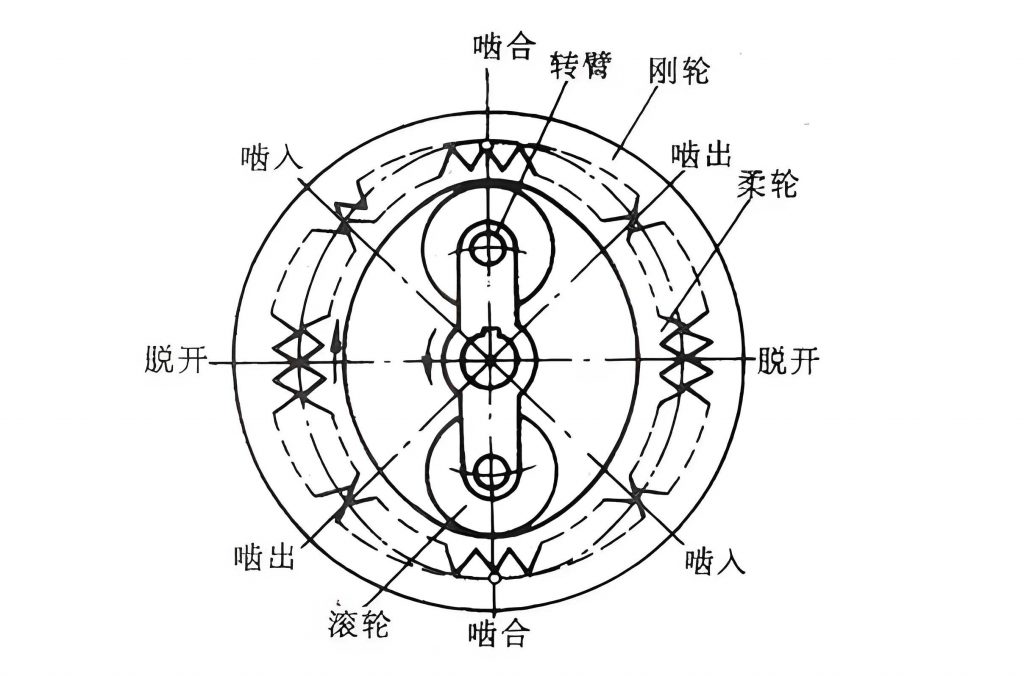
The operational principle of a harmonic drive gear hinges on the controlled elastic deformation of the flexspline, typically a thin-walled cup, by an elliptical wave generator. This deformation creates two diametrically opposite zones of major engagement with the rigid circular spline. The kinematics of a point on the flexspline relative to the circular spline forms the foundation for tooth profile design. Consider an elliptical wave generator acting on the flexspline’s neutral circle of initial radius $$r_m$$. A coordinate system {O, $$X_W$$, $$Y_W$$} is fixed to the wave generator, with its origin at the rotation center and the $$X_W$$-axis aligned with the generator’s major axis. A coordinate system {$$O_f$$, $$X_f$$, $$Y_f$$} is attached to a flexspline tooth, with $$O_f$$ on the neutral surface and the $$X_f$$-axis along the tooth’s symmetry line. The circular spline tooth coordinate system is {O, $$X_C$$, $$Y_C$$}, where the $$X_C$$-axis aligns with the gear space symmetry line.
Let $$\phi$$ and $$\phi_1$$ represent the angular positions of the flexspline tooth base point $$O_f$$ relative to the $$X_W$$-axis before and after deformation, respectively. Assuming the neutral surface length remains constant, their relationship is governed by the integral:
$$\phi = \frac{1}{r_m} \int_{0}^{\phi_1} \sqrt{\rho^2 + \rho’^2} d\phi_1$$
where $$\rho(\phi_1)$$ is the radial distance of the deformed neutral surface. The wave generator’s angular position relative to the circular spline space symmetry line is:
$$\phi_W = \frac{z_1}{z_2} \phi$$
Here, $$z_2$$ and $$z_1$$ are the number of teeth on the circular spline and flexspline, respectively. Consequently, the angle between the radial vector to point $$O_f$$ and the $$X_C$$-axis is:
$$\theta = \phi_1 – \phi_W = \phi_1 – \frac{z_1}{z_2} \phi$$
The rotation of the flexspline tooth profile normal due to deformation is:
$$\theta_{uz} = -\arctan(\rho’ / \rho)$$
Thus, the total angle between the flexspline tooth symmetry line ($$X_f$$) and the circular spline space symmetry line ($$X_C$$) is:
$$\Phi = \theta_{uz} + \theta$$
The coordinates of point $$O_f$$ in the circular spline coordinate system are therefore:
$$
\begin{cases}
x_C^{O_f} = \rho \sin\theta \\[6pt]
y_C^{O_f} = \rho \cos\theta
\end{cases}
$$
By evaluating these equations for $$\phi_1$$ varying within a meshing quadrant (e.g., 0 to $$\pi/2$$), the complete meshing motion trajectory of the flexspline tooth relative to the circular spline is defined. This trajectory is essential for both conjugate profile generation and the calculation of the functional or loaded backlash, which is the minimum circumferential distance between opposing tooth profiles within the potential contact zone and is a key indicator of meshing quality and load distribution.
Design of Triple-Circular-Arc Tooth Profiles
Flexspline Profile Definition and Parameters
The triple-circular-arc profile offers greater flexibility in controlling pressure angle and curvature distribution compared to simpler profiles, leading to potentially improved stress and load-sharing characteristics. The flexspline profile, as conceptually illustrated, consists of four smoothly connected circular arcs: the addendum arc (radius $$R_1$$), the main or middle arc (radius $$R_2$$), the dedendum arc (radius $$R_3$$), and the root fillet (radius $$R_4$$). Key profile dimensions include the addendum height $$h_a$$, dedendum height $$h_f$$, and the distances $$h_{la}$$ and $$h_{lf}$$ defining the vertical span of the middle arc. The point where the profile intersects the pitch circle is a critical reference. For the case study presented here, a flexspline with 100 teeth and a module of 0.506603 mm was designed. The detailed parameters are summarized in the table below.
| Symbol | Value (mm) | Description |
|---|---|---|
| $$z_1$$ | 100 | Number of teeth |
| $$m$$ | 0.506603 | Module |
| $$h_a$$ | 0.2837 | Addendum height |
| $$h_f$$ | 0.3192 | Dedendum height |
| $$h_{la}$$ | 0.2324 | Middle arc top height |
| $$h_{lf}$$ | 0.0016 | Middle arc bottom height |
| $$R_1$$ | 0.1317 | Addendum arc radius |
| $$R_2$$ | 1.3679 | Middle arc radius |
| $$R_3$$ | 2.4318 | Dedendum arc radius |
| $$R_4$$ | 0.3040 | Root fillet radius |
| $$S$$ | 0.5659 | Circular tooth thickness on pitch circle |
Wave Generator and Flexspline Deformation Model
An elliptical cam wave generator is employed, producing a radial deformation $$w_0$$ of 0.402 mm on the flexspline neutral surface of radius $$r_m = 24.7737$$ mm. The contour of the deformed neutral surface is given by the ellipse equation:
$$\rho(\phi) = \frac{ab}{\sqrt{a^2 \sin^2 \phi + b^2 \cos^2 \phi}}$$
where $$a$$ and $$b$$ are the semi-major and semi-minor axes, respectively, calculated as:
$$a = r_m + w_0$$
$$b = \frac{12r_m – 7a + 4\sqrt{a(3r_m – 2a)}}{9}$$
For the given parameters, $$a = 24.9425$$ mm and $$b = 24.1352$$ mm. The radial displacement at any angle $$\phi$$ is $$u_0(\phi) = \rho(\phi) – r_m$$.
However, the deformation of a cup-shaped flexspline is not uniform along its axis; it exhibits a conical taper due to boundary constraints at the diaphragm or cup bottom. Under the assumption of a straight generatrix for the deformed cup wall, the radial position at an axial coordinate $$z$$ (measured from the cup bottom) can be approximated by a linear interpolation:
$$\rho(\phi, z) = [\rho(\phi) – r_m] (z / z_0) + r_m \quad \text{for} \quad 0 < z < l$$
where $$z_0$$ is the axial distance from the cup bottom to the designed main cross-section of the tooth ring, and $$l$$ is the total axial length of the cylindrical shell.
Spatial Tooth Profile Generation via Radial Modification
To ensure optimal engagement of the tapered flexspline with a planar circular spline profile, the basic flexspline tooth profile must be modified axially to create a spatial (three-dimensional) tooth surface. This is achieved by introducing a controlled radial offset (modification) to the profile at different axial cross-sections. Seven cross-sections (ZS1 to ZS7) were defined along the flexspline cup’s tooth ring. The primary design criterion was to minimize the overlap or dispersion of the outer envelopes generated by the meshing motion of the profile at each section. By iteratively adjusting the radial modification value at each section, the collective set of envelopes was made to converge as closely as possible to that of a designated primary section (e.g., the fourth section). The resulting axial positions and corresponding optimal radial modification amounts are listed below.
| Section | Axial Position, $$Z_{Si}$$ (mm from cup bottom) | Radial Modification, $$H_{Si}$$ (µm) |
|---|---|---|
| ZS1 | 25.300 | +76.82 |
| ZS2 | 23.678 | +46.55 |
| ZS3 | 22.057 | +17.27 |
| ZS4 | 20.435 | -8.00 |
| ZS5 | 19.223 | +1.81 |
| ZS6 | 18.012 | +13.62 |
| ZS7 | 16.800 | +30.40 |
Circular Spline Profile Design via the Envelope Method
The conjugate circular spline profile is designed as the envelope of the family of flexspline profile positions during meshing. For this study, a triple-circular-arc profile was also adopted for the circular spline. The design process using the envelope method ensures continuous conjugation within the intended meshing zone. The main geometric parameters for the circular spline, designed for 102 teeth to provide the necessary tooth difference, are as follows.
| Symbol | Value (mm) | Description |
|---|---|---|
| $$z_2$$ | 102 | Number of teeth |
| $$r_{a2}$$ | 25.5000 | Tip circle radius |
| $$r_{f2}$$ | 26.1122 | Root circle radius |
| $$R_5$$ | 0.6145 | Addendum arc radius |
| $$R_6$$ | 1.8705 | Middle arc radius |
| $$R_7$$ | 0.7979 | Dedendum arc radius |
| $$R_8$$ | 0.3000 | Tip fillet radius |
| $$\theta_{ST}$$ | 6.359° | Middle arc center angle |
Finite Element Simulation Model for Load Performance Analysis
To evaluate the loaded transmission performance of the designed harmonic drive gear, a detailed nonlinear finite element model was developed. The goal was to simulate the static torque-torsion behavior and internal stress/force distribution accurately.
Geometric Modeling and Meshing
The model comprised three key components: the spatial-profile cup flexspline, the planar-profile circular spline, and a simplified wave generator representation. The flexspline model was generated parametrically. Based on the seven cross-sectional profiles defined with their specific radial modifications, the spatial tooth surface was created in the FEA preprocessor using axial lofting operations. The cup body was modeled as a continuous structure with the tooth ring. High-order 3D solid elements (e.g., SOLID186 in ANSYS) were used for both the flexspline and circular spline to capture bending and contact deformations accurately. Mapped and swept meshing techniques were employed in the tooth regions to ensure mesh quality and computational efficiency. The circular spline was simplified to an internal gear ring with a planar tooth profile extruded from the designed 2D contour. Given its high stiffness relative to the flexspline, it was modeled as a rigid body in some simulations or with a high modulus material in others. The wave generator’s primary function is to induce and maintain the elliptical deformation. For static load analysis, it was modeled as a rigid elliptical shell (using SHELL63 elements) with a narrow width, representing the outer race of the wave bearing.
Contact Definitions, Boundary Conditions, and Loading
Surface-to-surface contact pairs were established to model all critical interactions. The contact between the circular spline teeth and the flexspline teeth was defined with the circular spline surface as the target and the flexspline surface as the contact body, using appropriate contact elements (e.g., CONTA174). A friction coefficient was included to model tangential forces. Another contact pair was defined between the outer surface of the simplified wave generator and the inner cylindrical surface of the flexspline cup to maintain the assembly deformation. For the boundary conditions, all degrees of freedom on the outer cylindrical surface of the circular spline were constrained, simulating its fixation in a housing. The wave generator was fixed in space. The nodes on the outer rim of the flexspline’s cup bottom flange were coupled in all degrees of freedom except for rotation about the gear axis. A MASS21 element was created at the center and coupled to these flange nodes. The load torque was then applied directly to this mass element, effectively applying a pure torque to the flexspline output flange. This setup mirrors the standard torsional stiffness test, where the input (wave generator) is fixed, and torque is applied to the output (flexspline).
Simulation Results and Analysis
No-Load Backlash Distribution
Initially, the model was solved for the no-load assembly state with the wave generator imposing the elliptical deformation on the flexspline. The deformed positions of the flexspline tooth profiles at the front, middle, and rear sections were extracted. The circumferential backlash—the shortest distance between non-contacting conjugate flanks—was calculated along the meshing zone. The results showed that the spatial profile design successfully aligned the backlash distribution across the tooth width. In the central, primary load-bearing section, the backlash remained within a tight band of approximately 4 µm over a significant portion of the meshing arc (from about 3.6° to 33° from the major axis in the engaging region). This uniform and minimal no-load backlash is a desirable starting condition, promoting simultaneous multi-tooth contact as soon as a small load is applied and contributing to a more uniform load distribution.
Meshing Force Distribution Under Increasing Load
To simulate the transition from no-load to full load, a series of static analyses was performed with incrementally increasing torque applied to the flexspline flange. The rated load torque (RLT) for this size of harmonic drive gear was defined as 25 N·m. The evolution of the meshing force distribution on one side of the major axis (the engaging side) was investigated at various load levels: 3%, 10%, 20%, 50%, and 100% of RLT. At a very low load (3% RLT), only a small number of teeth in the region immediately adjacent to the major axis (approximately from 3.6° to 10.8°) carried detectable force. As the load increased to 10% RLT, the active engagement zone expanded rapidly to cover about 40° of arc. Notably, further increases in load did not significantly expand this arc length; instead, the force magnitude on the already-engaged teeth increased. This behavior confirms the efficacy of the profile design in achieving a wide zone of near-simultaneous contact. The force distribution within the engaged zone (from ~3.6° to ~39.6°) was relatively uniform, especially at lower loads, which is optimal for minimizing stress concentrations and maximizing the load capacity of the harmonic drive gear.
Torsional Stiffness Hysteresis Curve
The complete torsional stiffness characteristic, including hysteresis due to friction and non-linear deflections, was simulated by following a standard testing protocol. A multi-step simulation was run, applying torque in the following sequence: 1) Load from 0 to +100% RLT, 2) Unload from +100% RLT back to 0, 3) Load from 0 to -100% RLT (reverse direction), 4) Unload from -100% RLT back to 0, and finally 5) Reload from 0 to +100% RLT. This cycle produces a hysteresis loop. The resulting torque versus angular displacement (torsion) curve is plotted. The curve exhibits a distinct non-linear “toe” region at very low torques, followed by a predominantly linear region at medium to high loads. The slope of this curve at any point defines the instantaneous torsional stiffness, $$K$$:
$$K = \frac{\Delta T}{\Delta \theta}$$
where $$\Delta T$$ is the increment in load torque and $$\Delta \theta$$ is the corresponding increment in angular displacement at the output flange. The non-linear toe region corresponds to the initial seating of teeth and the gradual taking up of backlash across multiple teeth. The transition to linear behavior indicates that the effective number of load-sharing teeth and the dominant deformation modes have stabilized.
Discussion: Relating Torsional Stiffness to Meshing Characteristics
The most significant insight from this study is the strong correlation revealed between the macro-scale torsional stiffness and the micro-scale meshing state within the harmonic drive gear. By post-processing the FEA results at each load step, the number of tooth pairs carrying substantial load (e.g., force above a minimal threshold) was extracted. When this number of meshing teeth is plotted against the calculated torsional stiffness $$K$$, a clear, positive correlation emerges. The stiffness increases sharply in the initial low-torque phase (0-20% RLT), which is precisely when the number of active teeth is rapidly increasing as backlash is taken up across the designed engagement zone. Once the load is sufficient to fully seat all teeth within the optimized contact arc (beyond approximately 20% RLT), the number of meshing teeth plateaus. Correspondingly, the torsional stiffness also stabilizes, resulting in the linear portion of the hysteresis curve.
This relationship has profound practical implications for the design and evaluation of harmonic drive gears. Internal meshing characteristics, such as the precise number of load-sharing teeth and the uniformity of force distribution, are extremely difficult to measure in a physical prototype or monitor during operation. However, the torsional stiffness hysteresis curve is a standard, relatively straightforward measurement. The findings here indicate that the shape of this curve, particularly the extent and curvature of the initial non-linear zone, encodes valuable information about the internal meshing quality. A rapid transition to high, linear stiffness suggests a design that achieves multi-tooth contact quickly under low load, which is desirable for high positional stiffness and accuracy. Conversely, a prolonged, highly non-linear toe region might indicate insufficient simultaneous contact or excessive backlash. Therefore, by analyzing the measurable torsional stiffness, engineers can make informed inferences about the immeasurable internal load-sharing behavior of their harmonic drive gear design, providing a powerful tool for performance validation and design refinement.
Conclusion
This work has presented an integrated methodology for the design and performance evaluation of a harmonic drive gear utilizing a triple-circular-arc spatial tooth profile. The process began with the kinematic foundation of harmonic gear meshing and proceeded to the detailed design of a flexspline profile, which was then strategically modified in the axial direction to create a spatial tooth surface compensating for the flexspline’s conical deformation. The conjugate circular spline profile was generated using the envelope method. A high-fidelity nonlinear finite element model was successfully developed to simulate the loaded behavior of this designed system under static torque.
The simulation results provided detailed insights into the no-load backlash distribution, the evolution of meshing force distribution with increasing load, and the complete torsional stiffness hysteresis characteristic. The key finding is the establishment of a direct, positive correlation between the system’s output torsional stiffness and the number of teeth actively engaged in load sharing. The initial non-linear region of the hysteresis curve corresponds to the phase where an increasing number of teeth sequentially come into contact and take up load. Once the designed multi-tooth contact zone is fully engaged, the stiffness becomes largely linear.
This correlation is of great practical significance. It suggests that the easily measurable torsional stiffness hysteresis curve, a standard performance metric for harmonic drive gears, can serve as a diagnostic indicator for the internal meshing state. By analyzing the characteristics of this curve, particularly the transition from non-linear to linear behavior, designers and engineers can infer the effectiveness of their tooth profile design in achieving desirable multi-tooth contact under load. A design that promotes rapid, wide-zone contact will exhibit a shorter non-linear toe region and a higher overall stiffness, leading to improved load capacity, reduced elastic hysteresis error, and enhanced positional accuracy for the harmonic drive gear system. This approach bridges the gap between complex internal gear geometry and measurable system-level performance, offering a valuable pathway for the design optimization and validation of high-performance harmonic drive transmissions.