
The planetary roller screw mechanism (PRSM) represents a highly efficient form of power transmission, converting rotary motion into precise linear displacement. Its superior load capacity, stiffness, and compact design make it indispensable in demanding applications such as aerospace actuators, machine tools, and robotics. The core of its functionality lies in the multi-point contact established between the threads of the screw, the planetary rollers, and the nut. However, the assumption of perfect alignment between these components is rarely true in practice. Manufacturing tolerances, assembly errors, and operational deflections inevitably induce skew or tilt in the rollers relative to the screw and nut axes. This deviation critically disrupts the ideal uniform load sharing among the numerous engaged thread pairs.
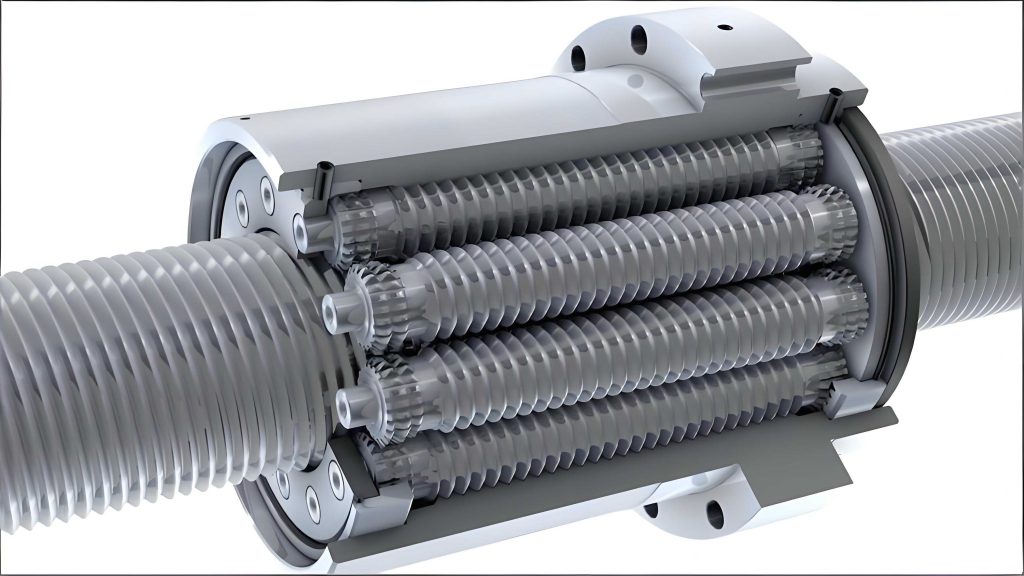
This misalignment can lead to a phenomenon known as thread “disengagement” or “mesh-apart,” where certain thread pairs lose contact entirely while others become severely overloaded. This localized overloading is a primary cause of premature failure, often manifesting as pitting, spalling, or even catastrophic crushing on one side of the roller threads, as illustrated in operational failures. Existing static load distribution models for the planetary roller screw mechanism predominantly rely on the ideal geometric assumption of perfectly parallel axes for the screw, rollers, and nut. These models are insufficient for predicting the highly non-uniform and potentially dangerous load patterns induced by roller skew. This paper, therefore, develops a refined analytical method to calculate the precise load distribution within a planetary roller screw mechanism, explicitly accounting for roller angular deviation and the consequential state changes between contact and disengagement of individual thread pairs.
Geometric Modeling of Roller Skew
To quantify the skew of a roller within the planetary roller screw assembly, we establish a coordinate framework. Let O-XYZ be the global coordinate system, with the Z-axis aligned with the nominal screw axis. For an individual roller, we define a roller-fixed coordinate system \(o_q-x_qy_qz_q\), where the \(z_q\)-axis coincides with the roller’s nominal axis. The instantaneous position and orientation of this roller system relative to a local frame \(o_{Pq}-x_{Pq}y_{Pq}z_{Pq}\) (where \(x_{Pq}\) ideally passes through \(z_q\)) are described by deviation angles and an offset vector.
The roller can experience angular deviations \(\phi_q\) and \(\psi_q\), representing rotations about the \(x_q\) and \(y_q\) axes, respectively. Additionally, a small offset vector \(^q\boldsymbol{\varepsilon}\) accounts for any radial displacement. The transformation from the skewed roller coordinates to the local frame is given by the homogeneous transformation matrix:
$$ ^{q}\mathbf{T} = \begin{bmatrix} ^{q}\mathbf{H} & ^{q}\mathbf{p} + ^{q}\boldsymbol{\varepsilon} \\ \mathbf{0} & 1 \end{bmatrix} $$
where \(^{q}\mathbf{p}\) is the ideal position vector of the roller origin, and \(^{q}\mathbf{H}\) is the rotation matrix encapsulating the skew angles \(\phi_q\), \(\psi_q\), and the roller’s phase angle \(\Phi_q\):
$$ ^{q}\mathbf{H} = \begin{bmatrix}
\cos\psi_q & \sin\psi_q \sin\phi_q & \sin\psi_q \cos\phi_q \\
0 & \cos\phi_q & -\sin\phi_q \\
-\sin\psi_q & \cos\psi_q \sin\phi_q & \cos\psi_q \cos\phi_q
\end{bmatrix} $$
Utilizing the general meshing equations for the planetary roller screw mechanism under misaligned conditions, we can solve for the contact point coordinates and, most importantly, the axial clearance \(c\) for each potential thread engagement between the nut and roller (\(c_{Nq,m}\)) and between the screw and roller (\(c_{Sq,m}\)). A positive clearance indicates a gap, while zero or negative clearance indicates contact or interference. The fundamental clearance vector for the mechanism, considering all \(n_T\) threads on a roller, is constructed as:
$$\boldsymbol{\varepsilon}_{NSq} = [\varepsilon_{Nq,1} … \varepsilon_{Nq,n_T} \; \varepsilon_{Sq,1} … \varepsilon_{Sq,n_T}]^T$$
where \(\varepsilon_{Nq,m} = \min(c_{Nq,m}) + \min(c_{Sq,m}) – \min(c_{Sq,m})\) and \(\varepsilon_{Sq,m} = c_{Sq,m} – \min(c_{Sq,m})\). This vector is pivotal for determining the initial contact state of each thread pair before load application.
Load Distribution Calculation Methodology
Generalized Finite Element Discretization with Skew
We model the planetary roller screw mechanism using a generalized finite element approach. The screw, nut, and roller bodies are discretized into a series of linear axial spring elements representing their base stiffness. The thread-to-thread contacts are modeled using nonlinear gap-contact elements. Rigid links connect these contact elements to the corresponding nodes on the body spring elements. This discretization allows us to assemble the system’s equilibrium equations.
The relationship between the elemental deformation vector \(\boldsymbol{\delta}\) and the nodal displacement vector \(\mathbf{u}\) is governed by the compatibility conditions, which include the initial gap vector \(\boldsymbol{\varepsilon}_{NSq}\):
$$\boldsymbol{\delta} = \mathbf{A} \cdot \mathbf{u} – \begin{bmatrix} \mathbf{0} \\ \boldsymbol{\varepsilon}_{NSq} \end{bmatrix}$$
Here, \(\mathbf{A}\) is the connectivity or compatibility matrix. The equilibrium condition requires that the internal forces balance the external load vector \(\mathbf{F}\) (primarily the nut axial load \(F_N\)). The elemental force vector \(\mathbf{F}_e\) is related to deformation via the stiffness matrix \(\mathbf{K}\):
$$\mathbf{F}_e = \mathbf{K} (\boldsymbol{\delta}) = \mathbf{K} \left( \mathbf{A} \cdot \mathbf{u} – \begin{bmatrix} \mathbf{0} \\ \boldsymbol{\varepsilon}_{NSq} \end{bmatrix} \right)$$
The system equilibrium equation in its standard form is:
$$\mathbf{A}^T \mathbf{F}_e = \mathbf{F} \quad \Rightarrow \quad \mathbf{A}^T \mathbf{K} \left( \mathbf{A} \cdot \mathbf{u} – \begin{bmatrix} \mathbf{0} \\ \boldsymbol{\varepsilon}_{NSq} \end{bmatrix} \right) = \mathbf{F}$$
The stiffness matrix \(\mathbf{K}\) is block-diagonal, containing the stiffness of the screw (\(k_{S,i}\)), nut (\(k_{N,i}\)), and roller (\(k_{q,i}\)) spring elements, as well as the contact stiffnesses for the nut-roller (\(k_{eqn,m}\)) and screw-roller (\(k_{eqs,m}\)) pairs. The contact stiffness for a given thread pair is highly nonlinear, depending on the contact force \(F_m\) itself, according to Hertzian theory:
$$k_{eqn,m} = \frac{16}{9} \frac{E_{Nq}^{2/3} R_{Nq,m}^{1/3}}{\cos\lambda_{Nq,m} \cos\beta_{Nq,m}} \left( \frac{1}{\chi_{Nq,m}} \right)^{1/3} F_{Nq,m}^{1/3}$$
A similar expression holds for \(k_{eqs,m}\). Critically, if a thread pair is disengaged (not in contact), its contact force \(F_m = 0\), and by the above formulation, its contact stiffness becomes zero. This changes the structure of the global stiffness matrix.
Multi-Load Step Algorithm Accounting for Disengagement
The central challenge is that the contact state (engaged or disengaged) of each thread pair is not known a priori for a given external load and roller skew; it is part of the solution. A direct solution of the nonlinear equilibrium equation is not feasible. Therefore, we employ an incremental, multi-load step solution algorithm that progressively applies the nut load while updating the contact state.
Algorithm Overview:
- Initialization: Calculate the initial gap vector \(\boldsymbol{\varepsilon}_{NSq}^{(0)}\) from the unloaded geometry with roller skew. Set initial contact forces to zero. Divide the total nut load \(F_N\) into \(n_L\) small increments \(\Delta F\).
- Load Step Loop: For each load increment \(l = 1\) to \(n_L\):
- Use the contact state from the previous step (\(l-1\)) as the initial guess.
- Construct the modified global stiffness matrix \(\mathbf{K}’\) and compatibility matrix \(\mathbf{A}’\) by removing rows and columns corresponding to disengaged contact elements (where stiffness is zero).
- Solve the linearized equilibrium equation for this step:
$$\mathbf{A}’^T \mathbf{K}’ \left( \mathbf{A}’ \cdot \mathbf{u}^{(l)} – \begin{bmatrix} \mathbf{0} \\ \boldsymbol{\varepsilon}_{eff}^{(l-1)} \end{bmatrix} \right) = \mathbf{F}^{(l)}$$
where \(\mathbf{F}^{(l)}\) is the applied load vector at step \(l\), and \(\boldsymbol{\varepsilon}_{eff}^{(l-1)}\) is the effective gap vector updated from the previous step. - Calculate the new contact forces and the nodal approach vector \(\boldsymbol{\sigma}^{(l)}\).
- Update Contact State: The effective gap for the next iteration is updated as:
$$\varepsilon_{eff, k}^{(l)} = \begin{cases}
\varepsilon_{eff, k}^{(l-1)} – \sigma_k^{(l)}, & \text{if } \varepsilon_{eff, k}^{(l-1)} – \sigma_k^{(l)} > 0 \\
0, & \text{if } \varepsilon_{eff, k}^{(l-1)} – \sigma_k^{(l)} \leq 0
\end{cases}$$
A gap closing to zero indicates the thread pair has come into contact. A pair remains disengaged if its effective gap is positive. - Check if the set of engaged contacts has changed from the initial guess for this load step. If yes, update the matrices \(\mathbf{K}’\) and \(\mathbf{A}’\) with the new contact set and re-solve (inner iteration) until the contact state stabilizes.
- Completion: After applying all load increments, the final contact forces \(F_{Nq,m}\) and \(F_{Sq,m}\) represent the load distribution on the nut-side and screw-side threads of the roller, fully accounting for the roller skew and any resulting disengagement.
This algorithm robustly handles the nonlinearity arising from both the Hertzian contact and the changing system topology due to thread disengagement in the skewed planetary roller screw mechanism.
Model Validation and Case Study Analysis
The proposed method was validated against a detailed 3D nonlinear finite element analysis (FEA) model for a single-roller planetary roller screw mechanism segment. Parameters for the validation case are summarized below:
| Parameter | Value |
|---|---|
| Screw/Nut/Roller Nominal Radius | 9.75 mm / 16.25 mm / 3.25 mm |
| Thread Flank Angle | 45° |
| Lead | 2 mm |
| Number of Threads on Roller (\(n_T\)) | 15 |
| Young’s Modulus / Poisson’s Ratio | 209 GPa / 0.29 |
| Nut Axial Load (\(F_N\)) | 1000 N |
Two scenarios were analyzed: an ideal aligned case (\(\phi_q = \psi_q = 0’\)) and a skewed case (\(\phi_q = 0′, \psi_q = -0.8’\)). The comparison of load distribution results is shown in the figure below. For the ideal case, the analytical model matches the FEA results exceptionally well, with a maximum error of only 4.4%. The load distribution shows a smooth gradient due to the boundary conditions (nut load on one end, screw fixed on the other).
For the skewed case, the load distribution pattern is drastically different and reversed. The analytical model successfully captures this complex pattern predicted by FEA, with a maximum error of 15.3%. The discrepancy is attributed to simplifications in the analytical model, such as neglecting shear and bending deformations of the thread teeth and approximating the continuous helix with discrete springs. The FEA contour plots confirmed the reversal of high-stress regions corresponding to the calculated load reversal. This validates the capability of the proposed method to accurately model the effects of roller skew in a planetary roller screw mechanism.
Influence of Roller Skew on Load Distribution
Using a more extensive planetary roller screw mechanism model (\(r_S=21mm, r_N=35mm, r_q=7mm, n_T=23, F_N=2000N\)), we systematically analyzed the influence of skew angles \(\phi_q\) and \(\psi_q\) within a realistic range of ±1.0 arc-minute.
Skew in the \(y_{Pq}o_{Pq}z_{Pq}\) Plane (\(\psi_q = 0\))
Varying \(\phi_q\) simulates the roller tilting in a vertical plane. The load distribution results are summarized conceptually below:
| Skew Angle \(\phi_q\) | Effect on Nut-side Load | Effect on Screw-side Load | Overall Trend |
|---|---|---|---|
| \(\phi_q > 0\) (e.g., 0.5′, 1.0′) | Increases on rear threads (m~12-23). | Increases on front threads (m~1-11). | Maximum force increases with \(|\phi_q|\). Pattern: Low-to-High (Nut), High-to-Low (Screw). |
| \(\phi_q = 0\) | Baseline, smooth gradient. | Baseline, smooth gradient. | Ideal reference state. |
| \(\phi_q < 0\) (e.g., -0.5′, -1.0′) | Increases on front threads (m~1-11). | Increases on rear threads (m~12-23). | Maximum force is non-monotonic; \(\phi_q = -1.0’\) can sometimes improve uniformity compared to \(\phi_q=0\). |
The analysis reveals that a negative skew angle \(\phi_q\) can, in specific configurations, surprisingly lead to a more uniform load distribution than the perfectly aligned case, suggesting a potential passive compensation effect.
Skew in the \(x_{Pq}o_{Pq}z_{Pq}\) Plane (\(\phi_q = 0\))
Varying \(\psi_q\) simulates the roller tilting in a horizontal plane. The effects are more severe and sensitive:
| Skew Angle \(\psi_q\) | Effect on Nut-side Load | Effect on Screw-side Load | Critical Observation |
|---|---|---|---|
| \(\psi_q > 0\) (e.g., 0.5′, 1.0′) | Sharp increase on rear threads. | Sharp increase on front threads. | Severe load imbalance. Pattern reversal from baseline. |
| \(\psi_q = 0\) | Baseline. | Baseline. | Ideal reference state. |
| \(\psi_q < 0\) (e.g., -0.5′, -1.0′) | Sharp increase on front threads. | Sharp increase on rear threads. | Severe load imbalance. Pattern reversal from baseline. |
The key finding is the extreme sensitivity to \(\psi_q\). For \(|\psi_q| > 1.0’\), clear thread disengagement occurs: several thread pairs carry zero load, while the active pairs experience forces up to three times greater than in the ideal aligned state. This dramatically increases the risk of localized fatigue and failure in the planetary roller screw mechanism.
Combined Skew in Both Planes
When both \(\phi_q\) and \(\psi_q\) are non-zero, the load distribution is predominantly governed by the angle \(\psi_q\). The angle \(\phi_q\) acts as a modifying factor. For instance, with a fixed negative \(\psi_q\), a concurrent negative \(\phi_q\) can amplify the load on the front threads, while a positive \(\phi_q\) can partially counteract it. This interplay highlights the complexity of error effects in a real planetary roller screw assembly.
Conclusion
This paper has presented a robust and validated analytical methodology for calculating the load distribution in a planetary roller screw mechanism, explicitly considering the critical effects of roller angular skew and thread disengagement. The proposed generalized finite element model, coupled with a multi-load step incremental solution algorithm, successfully resolves the nonlinear problem of changing contact topology. The major conclusions are:
- Model Efficacy: The method accurately predicts the complex, non-uniform load patterns induced by roller skew, showing strong agreement with detailed finite element analysis while being computationally efficient.
- Sensitivity to Skew Plane: Load distribution is highly sensitive to the skew angle \(\psi_q\) (rotation in the plane containing the roller and screw axes). Even small values (\(>1.0’\)) can cause thread disengagement and spike the maximum thread contact force by a factor of three, posing a severe reliability risk.
- Potential for Compensation: The skew angle \(\phi_q\) (rotation in the perpendicular plane) has a more moderate effect. Interestingly, specific negative values of \(\phi_q\) can, in some configurations, lead to a more uniform load distribution than the nominally aligned state, suggesting a passive error compensation mechanism.
- Design and Assembly Implication: The findings underscore the paramount importance of controlling assembly tolerances and minimizing moments that induce skew, particularly around the axis corresponding to \(\psi_q\). This analysis provides a essential tool for assessing the sensitivity of a planetary roller screw mechanism design to geometric imperfections, guiding tolerance specification, and predicting service life under real-world non-ideal conditions.
Future work will extend this model to a full multi-roller planetary roller screw system to study load sharing among rollers under system-level errors and thermal gradients.