
In the pursuit of precision and efficiency within modern industrial automation, the transmission system acts as a critical component. Among various solutions, the Rotary Vector Reducer has emerged as a pivotal technology, finding extensive application in industrial robotics, high-precision CNC machine tools, medical equipment, and aerospace systems. My research focuses on the intricate design and behavioral simulation of a specific model of this sophisticated reducer. The rotary vector reducer represents a significant evolution from traditional planetary and cycloidal drives, synthesizing their advantages into a compact, high-ratio, and highly efficient transmission unit. The core of its operation lies in a two-stage reduction mechanism, which will be the focal point of my modeling and analysis.
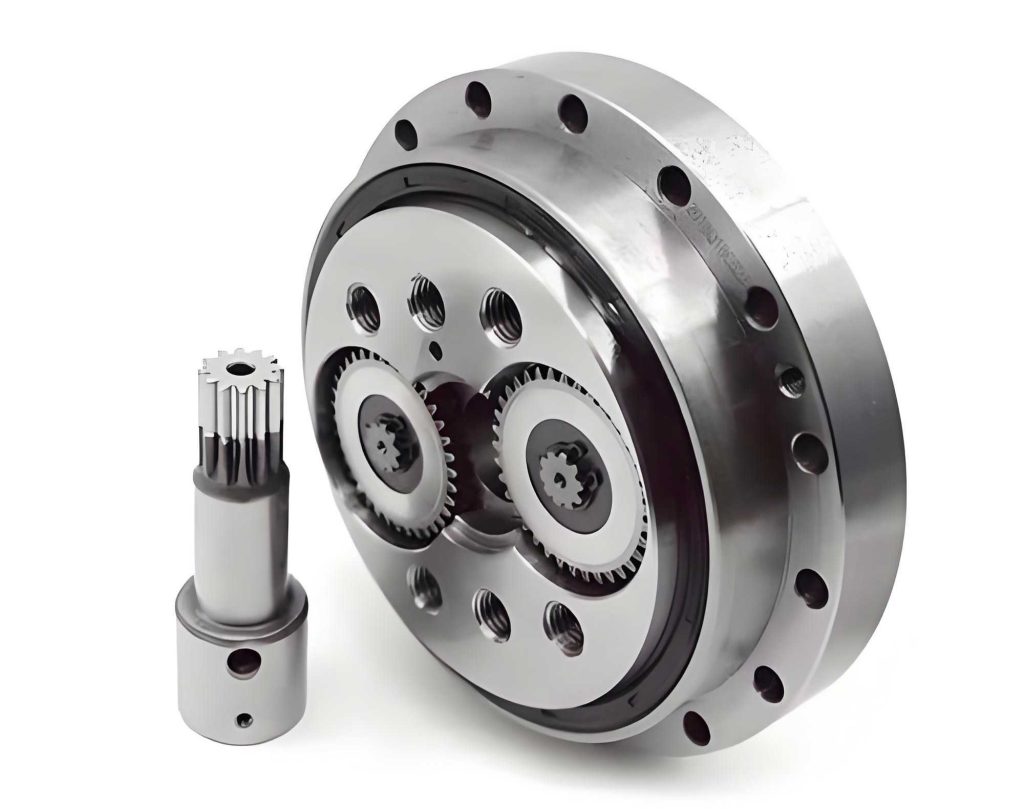
The fundamental architecture of a rotary vector reducer is a hybrid system. The first stage is a conventional involute planetary gear train, which provides an initial speed reduction. The second stage, and the more distinctive one, is a cycloidal pin-wheel planetary drive, responsible for the primary high-ratio reduction. This combination grants the rotary vector reducer its renowned characteristics: exceptional torsional stiffness, high precision, compact footprint, and smooth operation with minimal backlash. The overall transmission ratio is the product of the ratios from these two stages. In the studied model, the target is a high reduction ratio suitable for precision servo applications.
The operational principle is fascinating. Motive power is introduced via the sun gear (central gear). This rotation is transmitted to multiple planetary gears, achieving the first-stage reduction. These planetary gears are mounted on crankshafts. In the second stage, these crankshafts drive cycloidal discs (or摆线轮). The eccentric motion of the crankshafts causes the cycloidal discs to undergo a compound planetary motion. Through meshing with a ring of stationary pin gears housed in the shell, this motion is converted. When the shell is fixed, the slow rotation is output through the planet carrier (or crankshaft support), completing the two-stage reduction process. Understanding this kinematic chain is essential for accurate virtual modeling.
To embark on the virtual prototyping journey, I first established the foundational technical specifications for the rotary vector reducer model. The design goals included an input power of 0.5 kW and an input speed of 3,000 rpm. A Panasonic servo motor system (model MHMD082G1 with MCDHT3520 driver) was selected as the prime mover, providing a rated torque of 2.4 N·m at the specified speed. The total target transmission ratio was set at 120, decomposed into a first-stage planetary ratio of 3 and a second-stage cycloidal ratio of 40. The detailed parameters for gear geometry and cycloidal drive are consolidated in the table below.
| Primary Parameter | Value | Secondary Parameter | Value |
|---|---|---|---|
| Total Transmission Ratio (i) | 120 | Pin Center Circle Diameter (dp) / mm | 104 |
| Module (m) / mm | 1.5 | Eccentricity (a) / mm | 1 |
| Pressure Angle (α) / ° | 20 | Pin Diameter (drp) / mm | 4 |
| Sun Gear Teeth (z1) | 9 | Cycloidal Disc Addendum Diameter (dag) / mm | 102 |
| Planetary Gear Teeth (z2) | 27 | Cycloidal Disc Dedendum Diameter (dfg) / mm | 98 |
| Cycloidal Disc Teeth (z4) | 39 | Cycloidal Disc Height (h) / mm | 2 |
| Number of Pins (z5) | 40 | Cycloidal Disc Width (B) / mm | 10 |
| Pin Radius (rrp) / mm | 2 | Pin Diameter Coefficient (k2) | 2.04 |
The most critical and geometrically complex component within the rotary vector reducer is undoubtedly the cycloidal disc. Its tooth profile is not an involute but a cycloidal curve, derived from the trochoidal generation process. A well-established mathematical model describes this profile. The parametric equations for the tooth flank, considering a shortened epitrochoid (to allow for rolling contact with the pins), are given by:
$$ x = \left[ r_p \sin\varphi – \frac{k_1 r_p}{z_5} \sin(z_5 \cdot \varphi) \right] + \frac{r_{rp}}{\sqrt{1 + k_1^2 – 2k_1 \cos(z_4 \cdot \varphi)}} \left[ -\sin\varphi + k_1 \sin(z_5 \cdot \varphi) \right] $$
$$ y = \left[ r_p \cos\varphi – \frac{k_1 r_p}{z_5} \cos(z_5 \cdot \varphi) \right] – \frac{r_{rp}}{\sqrt{1 + k_1^2 – 2k_1 \cos(z_4 \cdot \varphi)}} \left[ \cos\varphi – k_1 \cos(z_5 \cdot \varphi) \right] $$
Where:
• $r_p$ is the radius of the pin center circle.
• $\varphi$ is the generating roll angle.
• $k_1$ is the shortened amplitude coefficient (or trochoid ratio).
• $z_4$ and $z_5$ are the number of cycloidal disc teeth and pins, respectively.
• $r_{rp}$ is the radius of the pin.
Leveraging the powerful parametric modeling capabilities of Siemens NX (UG), I implemented these equations directly to create a precise and controllable model of the cycloidal disc. This approach ensures the geometric fidelity of the most critical interacting surface in the rotary vector reducer. Within the NX “Expression” dialog, I defined a series of parameters and the final curve equations, as shown in the following setup table.
| Parameter Expression | Description |
|---|---|
| a = 1 | Eccentricity |
| al = 360*t*z4 | Meshing phase angle (t is NX internal variable 0→1) |
| f = 1/sqrt(1+k1*k1-2*k1*cos(al)) | Intermediate function Φ(al) |
| i_cyc = z5 / z4 | Cycloidal stage transmission ratio |
| k1 = 0.76923 | Shortened amplitude coefficient |
| rp = 52 | Pin circle radius |
| rrp = 2 | Pin radius |
| xt = (rp – rrp*f)*cos((1-i_cyc)*al) – (a – k1*rrp*f)*cos(i_cyc*al) | X-coordinate of cycloidal profile |
| yt = (rp – rrp*f)*sin((1-i_cyc)*al) + (a – k1*rrp*f)*sin(i_cyc*al) | Y-coordinate of cycloidal profile |
| z4 = 39 | Number of cycloidal disc teeth |
| z5 = 40 | Number of pins |
Using the “Law Curve” tool with the “By Equation” method, these expressions generated the precise two-dimensional tooth profile. This sketch was then extruded to create the solid three-dimensional model of the cycloidal disc. Similar parametric and feature-based modeling techniques were employed for all other components of the rotary vector reducer, including the sun gear, planetary gears, crankshafts, housing (shell), pin gears, and various bearings. Strategic simplifications, such as omitting non-functional fillets and chamfers, were made to reduce computational complexity during subsequent simulations without compromising the kinematic integrity of the rotary vector reducer model.
The next critical phase was the virtual assembly. Based on the kinematic relationships and physical interfaces defined in the rotary vector reducer’s design, I applied appropriate mating constraints in NX Assembly. This process digitally builds the complete system, ensuring all parts fit together correctly. A crucial step here is interference detection. I performed both static and dynamic interference checks. The static check validates the assemblability and clearances in a nominal state, while the dynamic check simulates the range of motion to identify any collisions throughout the operating cycle. This virtual prototyping step is invaluable, as it identifies potential design conflicts early, saving significant time and cost compared to physical prototyping. The final assembled virtual prototype of the rotary vector reducer provided a fully defined digital twin for dynamic analysis.
With a verified virtual assembly, the focus shifted to motion simulation within the NX Motion module. The objective was to animate the rotary vector reducer and extract kinematic data for analysis. I created a new dynamic simulation and manually defined all necessary links and joints for greater control over the model. The process was broken down by the two stages of the rotary vector reducer.
First-Stage (Planetary Gear Train) Simulation Setup:
1. Links: The sun gear shaft, each planetary gear with its corresponding crankshaft section, and the needle rollers on the crankshaft eccentrics were defined as separate links. The needle rollers required individual links because they rotate relative to the crankshaft eccentric.
2. Joints: Revolute joints were applied to the sun gear link (defining its axis of rotation). Each planetary gear assembly was connected to the ground (housing) via a revolute joint. Crucially, the needle roller links were connected to their corresponding crankshaft eccentric surfaces using a “Point on Curve” joint type. This accurately models the rolling contact between the needle roller and the cycloidal disc’s inner bore in the subsequent stage.
Second-Stage (Cycloidal Drive) Simulation Setup:
1. Links: The two cycloidal discs and the main housing/shell (which contains the fixed pins) were defined as links.
2. Joints: The cycloidal discs were connected to the needle roller links (from the first stage) using “Point on Curve” joints, capturing the drive from the eccentric crankshafts. The housing/shell was assigned a fixed joint. Each pin gear, modeled as a cylinder, was connected to the housing using a “Point on Curve” joint, constraining it to remain fixed within its bore while allowing the cycloidal disc to roll over it.
To simulate the startup transient of the rotary vector reducer, a motion driver was applied to the sun gear’s revolute joint. I used the STEP function to define a smooth acceleration from standstill to the full operating speed over one second. The angular velocity driver function was defined as:
$$ \omega(t) = 18000 \times \text{STEP}(time, 0, 0, 1, 1) \quad \text{[deg/s]} $$
This corresponds to the sun gear accelerating from 0 to 18,000 deg/s (or 3,000 RPM) linearly over 1 second. The solver was then executed to simulate the dynamics of the complete rotary vector reducer system under this prescribed motion.
The motion simulation generated extensive data. While velocity profiles confirm the expected reduction ratio, acceleration plots provide deeper insight into the dynamic smoothness, vibration, and force transmission characteristics of the rotary vector reducer. Analyzing the angular acceleration of key components during the startup reveals distinct behavioral phases.
The acceleration profiles for the sun gear, planetary gears, and the housing shell show remarkably similar oscillatory trends, which is expected due to their direct kinematic coupling through the gear meshes. The startup transient can be segmented into three regimes:
- Initial Impulse (0-0.3s): A sharp acceleration peak occurs at the instant of startup, followed by a rapid decay and irregular oscillations as the system components overcome inertia and take up mechanical backlash.
- Settling Phase (0.3-0.6s): The acceleration settles into a more stable, periodic oscillation resembling a sinusoidal pattern. This indicates the system is transitioning to steady-state operation.
- Near-Steady State Oscillation (0.6-1.0s): The amplitude of acceleration oscillations increases again but stabilizes within a bounded, periodic range. The housing, being the massive outer structure, exhibits lower absolute acceleration values than the central gears, signifying that the compact design of the rotary vector reducer effectively contains vibrations.
The acceleration of the cycloidal disc is the most dramatic. The plot shows significant impulsive spikes corresponding to the engagement of each cycloidal tooth with a pin gear. This is the characteristic impact of the cycloidal-pin meshing action. Following each spike, the acceleration rapidly drops. The pattern is highly periodic, with a period related to the tooth engagement frequency. Given the cycloidal disc’s role—it is driven eccentrically and simultaneously meshes with multiple pins—it experiences the most complex motion and highest dynamic loading. Despite the impulsive spikes, the overall response remains periodic and bounded, indicating stable operation of the rotary vector reducer.
The comprehensive virtual prototyping and simulation exercise for this rotary vector reducer yielded significant insights. The parametric modeling of the cycloidal disc using its exact mathematical equations ensured high geometric accuracy, forming a reliable foundation for analysis. The detailed virtual assembly and interference checking process validated the mechanical design and fit before any physical part was manufactured. The motion simulation, with careful definition of links and joints to represent the two-stage kinematics, successfully captured the dynamic behavior of the rotary vector reducer.
The analysis of acceleration data, particularly, is valuable. It confirms that the rotary vector reducer operates with periodic vibrations within a small, predictable amplitude. The structure effectively dampens vibrations from the high-speed stage, leading to smooth output characteristics. The observed cycloidal disc impacts are inherent to its design but remain controlled. This entire digital engineering workflow—from parametric design to dynamic simulation—provides a powerful platform for subsequent advanced analyses of the rotary vector reducer. It lays the essential groundwork for future investigations into areas such as detailed stress and fatigue analysis, thermal performance, advanced noise and vibration (NVH) prediction, startup torque characterization, and even fault diagnosis studies. By leveraging this virtual model, the development cycle of high-performance rotary vector reducers can be significantly accelerated and optimized.