
As a high-precision mechanical transmission component, the Planetary Roller Screw (PRS) has garnered significant attention in fields such as aerospace actuation, robotics, and advanced machine tools due to its exceptional load capacity, high stiffness, and compact size. Its core function is the conversion between rotary and linear motion through the meshing of threaded surfaces between a central screw, multiple circumferentially arranged planetary rollers, and an outer nut. The contact characteristics at these helical interfaces fundamentally determine the mechanism’s transmission accuracy, load distribution, efficiency, and fatigue life. Traditional contact analysis often treats the screw, rollers, and nut as rigid bodies. However, under operational axial loads, these components inevitably undergo elastic deformation—including thread tooth bending, shear, and contact deformation—which perturbs the ideal meshing geometry and alters the actual contact point locations on the helical flanks. This paper presents a comprehensive analytical model to investigate the contact characteristics of the planetary roller screw, explicitly accounting for the elastic deformations of all threaded members and the consequent load distribution among the engaged thread teeth.
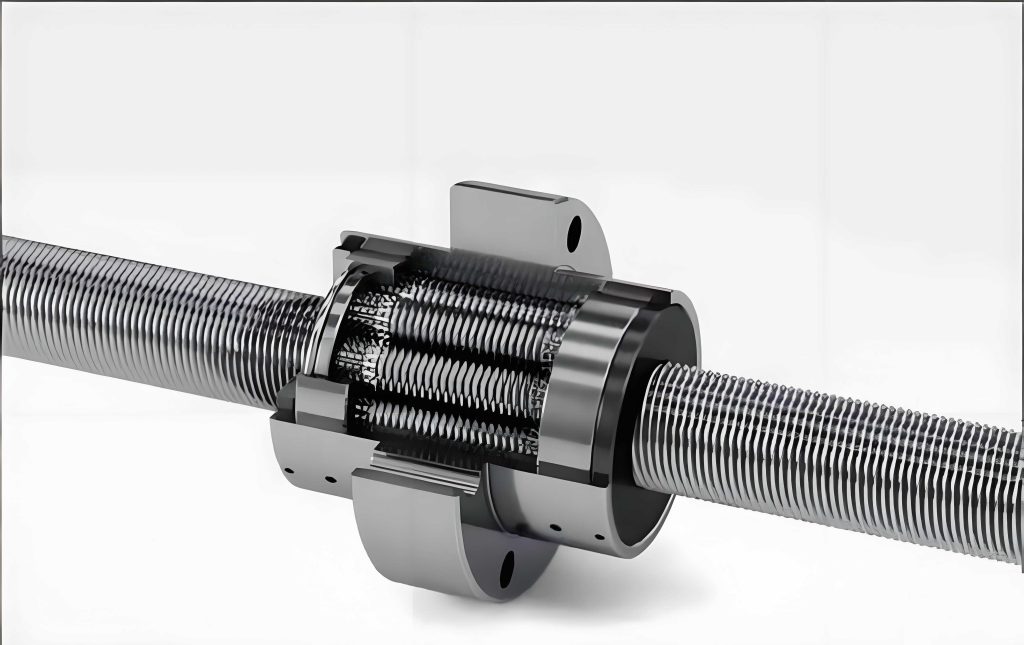
The elastic deformation in a loaded planetary roller screw can be categorized into three primary types: 1) axial compression/extension of the screw, roller, and nut shafts; 2) bending and shear deformation of the individual thread teeth under load; and 3) local Hertzian contact deformation at the mating thread interfaces. For contact point analysis, the deformation of the thread teeth and the contact zones are the most critical, as they directly alter the local geometry of the engaging helical surfaces. When a normal contact force $$F_n$$ acts at a point on the thread flank, it can be resolved into axial ($$F_a$$), tangential ($$F_t$$), and radial ($$F_r$$) components relative to the thread’s axis.
The radial component induces a radial expansion or contraction of the threaded part. For external threads (screw, roller), modeled as solid cylinders with a diameter equal to the thread major diameter $$d_a$$, the radial displacement $$\delta^r_i$$ is:
$$\delta^r_i = \frac{d_{a,i} \cdot F_{r,i} \cdot \tan \beta_i}{p \cdot E} (1 – \mu^2) \quad \text{for } i = S, R$$
For the internal nut threads, modeled as a hollow cylinder with major diameter $$D_{Na}$$ and minor diameter $$d_{N0}$$, the radial displacement is:
$$\delta^r_N = \left( \frac{D_{Na}^2 + d_{N0}^2}{D_{Na}^2 – d_{N0}^2} + \mu \right) \frac{d_{N0} \cdot F_{r,N} \cdot \tan \beta_N}{2p \cdot E}$$
Here, $$p$$ is the pitch, $$E$$ is Young’s modulus, $$\mu$$ is Poisson’s ratio, and $$\beta$$ is the thread profile angle.
The axial deformation of a thread tooth $$\delta^a_i$$ due to the axial force component $$F_a$$ is a sum of deformations from bending ($$\delta^1$$), shear ($$\delta^2$$), tooth root tilting ($$\delta^3$$), and root shear ($$\delta^4$$). The general expressions are:
$$\delta^a_i = \delta^1_i + \delta^2_i + \delta^3_i + \delta^4_i$$
The individual components for a trapezoidal thread profile with parameters a (tooth root width), b (tooth thickness), and c (tooth crest width) are given by:
$$\delta^1_i = \frac{4F_{a,i}(1-\mu^2)}{E} \left[ \frac{1}{2} – \frac{b_i}{a_i} + \left( \frac{b_i}{a_i} \right)^2 \ln \left(1 + \frac{a_i}{b_i}\right) \right] \frac{1}{\tan \beta_i}$$
$$\delta^2_i = \frac{6F_{a,i}(1+\mu)}{5E \tan \beta_i} \ln \left( \frac{a_i}{b_i} \right)$$
$$\delta^3_i = \frac{12F_{a,i} c_i (1-\mu^2)}{\pi E a_i^2} \left( b_i – \frac{c_i}{2} \right) \tan \beta_i$$
$$\delta^4_i = \frac{2F_{a,i}(1-\mu^2)}{\pi E} \left[ \left(1 – \frac{p}{a_i}\right) \ln \left( \frac{p-a_i}{p} \right) + \frac{1}{2} \left( \frac{p}{a_i} \right)^2 \ln \left( \frac{p^2}{p^2 – a_i^2} \right) \right]$$
These deformations are crucial for determining the load distribution in a planetary roller screw assembly.
The normal contact deformation $$\delta^n$$ at the point contact between two helical surfaces is calculated based on Hertzian theory. For a contact pair (e.g., screw-roller or nut-roller), the deformation is:
$$\delta^n = \frac{3}{2} \left( \frac{2}{\pi m} \right)^{2/3} \frac{F_n^{2/3}}{(\sum \rho)^{1/3}} \left( \frac{1}{E’} \right)^{2/3} K(e)$$
Here, $$\sum \rho$$ is the sum of principal curvatures at the contact point, $$E’$$ is the equivalent elastic modulus, $$K(e)$$ is the complete elliptic integral of the first kind, and $$m$$ is a parameter related to the curvature difference function $$F(\rho)$$. The axial and radial components of this contact deformation are found by projecting it along the respective directions:
$$\delta^{a,R} = \delta^n \cos \beta_n \cos \lambda_R$$
$$\delta^{r,R} = \delta^n \sin \beta_n$$
where $$\beta_n$$ is the normal pressure angle and $$\lambda_R$$ is the roller’s lead angle.
To model the contact, a coordinate system is established. Let $$O-XYZ$$ be the global frame fixed to the screw head, with the Z-axis aligned with the screw/nut axis. A local moving frame $$O_{pRj}-x_{pRj}y_{pRj}z_{pRj}$$ rotates with the cage, its $$x_{pRj}$$-axis pointing to the j-th roller’s center. Component frames $$o_i-x_iy_iz_i$$ (i=S, R, N) are attached to the screw, roller, and nut, respectively. The transformation matrix from a component frame to the global frame incorporates the phase angles and assembly offsets.
The equation of a helical surface for each component in its local frame, accounting for radial deformation $$\delta^r$$, is derived. For the screw’s lower flank ($$\zeta = -1$$):
$$\mathbf{r}_S(u_S, \theta_S) = \begin{bmatrix}
(r_S + \delta^r_S + u_S) \cos(\theta_S + \theta^0_S) \\
(r_S + \delta^r_S + u_S) \sin(\theta_S + \theta^0_S) \\
\frac{l_S}{2\pi}\theta_S – \left( \frac{b_S}{2} + \delta^a_S \right) \tan \beta_S
\end{bmatrix}$$
For the nut’s upper flank ($$\zeta = 1$$):
$$\mathbf{r}_N(u_N, \theta_N) = \begin{bmatrix}
(r_N + \delta^r_N + u_N) \cos(\theta_N + \theta^0_N) \\
(r_N + \delta^r_N + u_N) \sin(\theta_N + \theta^0_N) \\
\frac{l_N}{2\pi}\theta_N + \left( \frac{b_N}{2} + \delta^a_N \right) \tan \beta_N
\end{bmatrix}$$
For the roller with a circular arc profile of radius $$r_{cR}$$, the surface equation is:
$$\mathbf{r}_R(u_R, \theta_R) = \begin{bmatrix}
(r_R + \delta^r_R + u_R) \cos(\theta_R + \theta^0_R) \\
(r_R + \delta^r_R + u_R) \sin(\theta_R + \theta^0_R) \\
\frac{l_R}{2\pi}\theta_R + \zeta \sqrt{r_{cR}^2 – (u_R – u_{cR})^2} + w_{cR}
\end{bmatrix}$$
In these equations, $$r_i$$ is the pitch radius, $$l_i$$ is the lead, $$u_i$$ is the radial surface coordinate, and $$\theta_i$$ is the angular surface coordinate.
The condition for two surfaces $$\Sigma_U$$ and $$\Sigma_B$$ to be in tangency at a contact point involves both position vector coincidence and surface normal collinearity in a common coordinate frame (e.g., the local moving frame):
$$\mathbf{r}_B^{pR}(u_B, \theta_B) + \mathbf{l}_{BU}^{pR} = \mathbf{r}_U^{pR}(u_U, \theta_U)$$
$$\mathbf{n}_B^{pR}(u_B, \theta_B) = \xi_{BU} \cdot \mathbf{n}_U^{pR}(u_U, \theta_U)$$
Here, $$\mathbf{l}_{BU}^{pR}$$ is a displacement vector accounting for initial axial clearance.
Applying this tangency condition to the screw-roller and nut-roller pairs yields systems of equations that define the contact point parameters. For the screw-roller pair (screw lower flank $$\Sigma_{SB}$$ and roller upper flank $$\Sigma_{RU}$$), the contact equations in terms of contact radii ($$r_{SR}, r_{RSc}$$) and contact angles ($$\phi_{SR}, \phi_{RSc}$$) from the local x-axis are:
$$
\begin{aligned}
&r_{SR} \cos \phi_{SR} + r_{RSc} \cos \phi_{RSc} = r_S + r_R \\
&r_{SR} \sin \phi_{SR} = r_{RSc} \sin \phi_{RSc} \\
&-\tan \lambda_{SR} \sin \phi_{SR} + \tan \beta_S \cos \phi_{SR} = -\tan \lambda_{RSc} \sin \phi_{RSc} – \tan \beta_{RSc} \cos \phi_{RSc} \\
&\tan \beta_S \sin \phi_{SR} + \tan \lambda_{SR} \cos \phi_{SR} = -\tan \beta_{RSc} \sin \phi_{RSc} + \tan \lambda_{RSc} \cos \phi_{RSc}
\end{aligned}
$$
Similarly, for the nut-roller pair (nut upper flank $$\Sigma_{NU}$$ and roller lower flank $$\Sigma_{RB}$$):
$$
\begin{aligned}
&r_{NR} \cos \phi_{NR} – r_{RNc} \cos \phi_{RNc} = r_S + r_R \\
&r_{NR} \sin \phi_{NR} = r_{RNc} \sin \phi_{RNc} \\
&-\tan \lambda_{NR} \sin \phi_{NR} + \tan \beta_N \cos \phi_{NR} = -\tan \lambda_{RNc} \sin \phi_{RNc} + \tan \beta_{RNc} \cos \phi_{RNc} \\
&\tan \beta_N \sin \phi_{NR} + \tan \lambda_{NR} \cos \phi_{NR} = \tan \beta_{RNc} \sin \phi_{RNc} + \tan \lambda_{RNc} \cos \phi_{RNc}
\end{aligned}
$$
The leads $$\lambda$$ at the contact point are functions of the instantaneous contact radius: $$\tan \lambda = l / (2\pi r)$$.
The load distribution among the numerous engaged thread teeth is non-uniform due to elastic deflections. Considering a “thread loop” consisting of two adjacent teeth on the nut and the roller, and the intervening shaft sections, a compatibility equation can be written. The total axial deformation of the nut side of the loop must equal that of the roller side:
$$p_N + \sum \delta_{Nq} = p_R + \sum \delta_{Rq}$$
where $$\sum \delta_{Nq}$$ and $$\sum \delta_{Rq}$$ include axial deformations from shaft segments, thread teeth bending, and contact points for the q-th loop. This leads to a system of linear equations relating the axial loads on successive teeth, $$F_{NR,k}$$ and $$F_{SR,k}$$, which can be solved given the total axial load and component stiffnesses. The stiffness of a thread tooth in axial direction $$K^a$$ and the axial contact stiffness $$K^{a,R}$$ are derived from the deformation formulas presented earlier.
The following table presents key geometrical parameters for a sample planetary roller screw used for analysis and model validation.
| Parameter | Screw (S) | Roller (R) | Nut (N) |
|---|---|---|---|
| Pitch Radius $$r_i$$ (mm) | 12 | 4 | 20 |
| Major Diameter (mm) | 24.65 | 8.8 | 39.26 |
| Minor Diameter (mm) | 22.5 | 6.95 | 41.05 |
| Pitch $$p$$ (mm) | 2 | 2 | 2 |
| Number of Starts $$n_i$$ | 5 | 1 | 5 |
| Lead $$l_i$$ (mm) | 10 | 2 | 10 |
| Lead Angle $$\lambda_i$$ (°) | 7.55 | 4.55 | 4.55 |
| Profile Angle $$\beta_i$$ (°) | 45 | 45 | 45 |
| Roller Arc Radius $$r_{cR}$$ (mm) | — | 4.956 | — |
| Number of Rollers $$n_{roller}$$ | 10 | ||
| Number of Roller Threads $$z$$ | 20 | ||
First, the proposed elastic model is validated against a classical rigid-body model for contact point calculation. Under a small average load per roller thread (250 N), the results show close agreement, with maximum deviation in contact radius below 1.4%. However, under a significantly larger load (2500 N), the deviation becomes substantial, especially for the nut contact radius, which changes by over 13%. This confirms that elastic deformation cannot be neglected in the contact analysis of a heavily loaded planetary roller screw. The table below summarizes a comparison of key contact position parameters.
| Parameter | Rigid Model | Elastic Model (250N avg.) | Elastic Model (2500N avg.) |
|---|---|---|---|
| Screw Contact Radius $$r_{SR}$$ (mm) | 12.0552 | 12.0340 | 11.9192 |
| Screw Contact Angle $$\phi_{SR}$$ (°) | 2.9959 | 3.0015 | 3.0281 |
| Roller Contact Radius (S-side) $$r_{RSc}$$ (mm) | 4.0111 | 4.0111 | 4.0115 |
| Roller Contact Angle (S-side) $$\phi_{RSc}$$ (°) | 9.0374 | 9.0271 | 8.9791 |
| Nut Contact Radius $$r_{NR}$$ (mm) | 20.0000 | 19.7259 | 17.2586 |
| Nut Contact Angle $$\phi_{NR}$$ (°) | 0 | 0.0020 | 0.0113 |
The load distribution calculated for a planetary roller screw under a total axial load shows a characteristic pattern. The load on screw-roller teeth is higher at the ends of the engagement zone and lower in the middle, while the nut-roller teeth exhibit a more uniform distribution. This asymmetry is due to differences in the axial stiffness of the screw and nut shafts and the bending stiffness of their respective thread teeth.
The influence of this load distribution on the contact point location for each individual meshing pair is significant. For the screw-roller side, as the load on a specific tooth decreases, the screw contact radius $$r_{SR}$$ increases and the roller contact radius $$r_{RSc}$$ slightly decreases. Simultaneously, the contact angles $$\phi_{SR}$$ and $$\phi_{RSc}$$ become more negative and less positive, respectively. This means the projected contact point moves away from the line connecting the screw and roller centers and shifts towards the direction of the roller’s pitch radius and the screw’s major diameter.
For the nut-roller side, the trend is different. As the load on a nut-roller tooth increases, the nut contact radius $$r_{NR}$$ decreases substantially, while the roller contact radius $$r_{RNc}$$ increases very slightly. Both contact angles $$\phi_{NR}$$ and $$\phi_{RNc}$$ increase from near zero to small positive values. This indicates that the contact point moves away from the theoretical tangent point of the pitch circles and travels along the roller’s pitch circle, deviating from the line connecting the nut and roller centers. The contact point on the planetary roller screw’s nut side is never at the pitch circle tangent point under load; it is always displaced along the roller’s pitch circle.
In conclusion, the contact characteristics in a planetary roller screw are profoundly influenced by the elastic deformations of its components. A model that incorporates thread tooth bending, shear, radial expansion, and Hertzian contact deformation is essential for accurately predicting the true contact point locations on the helical flanks. The proposed methodology, which couples deformation analysis with load distribution calculation and meshing geometry, reveals that the contact points are not fixed but vary with the load carried by each engaged thread tooth. On the screw-roller side, contact shifts towards the screw’s major diameter. On the nut-roller side, contact travels along the roller’s pitch circle. These insights are fundamental for optimizing the design of the planetary roller screw to improve load distribution, minimize stress concentrations, and enhance its overall transmission performance and durability. Understanding these detailed contact mechanics is key to advancing the reliability and capability of systems employing planetary roller screw actuators.