
In the field of robotics, the development of a dexterous robotic hand that mimics human hand functionality has been a long-standing goal. Such hands are crucial for applications ranging from industrial teleoperation to medical prosthetics. However, achieving precise control over both posture and grasping force in real-time remains a challenge. Traditional methods often rely on separate systems for posture and force control, leading to disjointed operation. In this study, I propose an integrated approach where a data glove controls joint angles for posture, while electromyography (EMG) signals from forearm muscles are used to predict and control grasping force. This method aims to enhance the realism and effectiveness of virtual reality simulations for dexterous robotic hand training and control.
The core of this work involves building a virtual reality model of a dexterous robotic hand and implementing a force prediction algorithm based on neural networks. The virtual model allows for interactive simulation of grasping tasks, providing a platform for testing control algorithms without physical hardware. By leveraging EMG signals, which are natural indicators of muscle activation, I aim to create a more intuitive and responsive control system. This approach can be applied to intelligent prosthetic limbs, rehabilitation training for stroke patients, and remote operation of robots in hazardous environments. Throughout this article, the term “dexterous robotic hand” will be emphasized to highlight the focus on multi-fingered, anthropomorphic hands capable of complex manipulations.
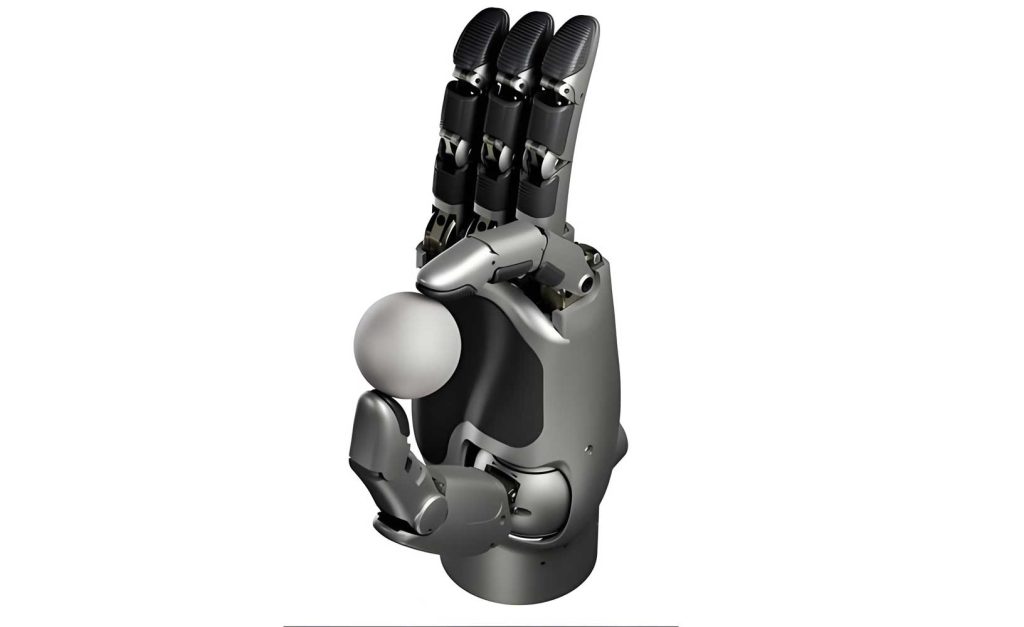
To begin, I developed a virtual model of a dexterous robotic hand using a combination of SolidWorks for mechanical design and MATLAB’s SimMechanics for dynamic simulation. The dexterous robotic hand model consists of multiple fingers, each with several joints to replicate human hand kinematics. The conversion from SolidWorks to SimMechanics was achieved through an XML file import process, which automatically generates corresponding SimMechanics blocks for bodies, joints, constraints, and actuators. SimMechanics enables forward dynamics, inverse dynamics, and kinematic analyses, simplifying the mathematical modeling and providing realistic simulations. Additionally, I used Simulink 3D Animation to create a visual representation of the dexterous robotic hand in a virtual environment. This tool employs VRML (Virtual Reality Modeling Language) to define the hand’s geometry and link it to the SimMechanics model, allowing for real-time interaction and feedback. The mapping between the data glove’s joint angles and the virtual dexterous robotic hand’s joints is critical for accurate posture control.
The posture control system relies on a data glove equipped with sensors that measure finger joint angles. The data glove communicates via Bluetooth, sending angle data to the MATLAB model through UDP protocols. To ensure smooth and stable control, I implemented a debouncing algorithm that updates the dexterous robotic hand’s posture only when joint angle changes exceed a threshold of 5 degrees. This reduces jitter caused by natural hand tremors. The mapping between human hand joints and the dexterous robotic hand joints is linear, expressed as:
$$ y = K \cdot (x – a) $$
where \( x \) is the raw sensor output, \( a \) is an offset value, \( K \) is a gain coefficient, and \( y \) is the input to the virtual joint. For simplicity, I focused on flexion and extension for most fingers, while the thumb, which plays a vital role in grasping, was modeled with composite motions including flexion, extension, abduction, adduction, and opposition. This mapping ensures that the dexterous robotic hand accurately replicates human hand gestures in virtual reality.
For force control, I utilized surface EMG signals from the forearm’s flexor pollicis longus muscle, which is primarily responsible for thumb movement. The EMG signals were captured using sensors and preprocessed to extract features relevant to force prediction. The preprocessing involved normalization to scale the data between 0 and 1, using the min-max normalization formula:
$$ x^* = \frac{x – \min}{\max – \min} $$
where \( x \) is the raw EMG value, \( \min \) and \( \max \) are the minimum and maximum values in the dataset, and \( x^* \) is the normalized value. This step ensures faster convergence during neural network training. The force prediction model is based on a backpropagation (BP) neural network, which is well-suited for nonlinear approximation tasks like EMG-to-force mapping. The network architecture includes an input layer, one hidden layer with 10 neurons, and an output layer with a single neuron representing the predicted thumb fingertip force. The hidden layer uses a sigmoid activation function:
$$ f(x) = \frac{1}{1 + e^{-x}} $$
The training process involves minimizing the error between predicted and actual forces using the mean absolute error (MAE) as a metric. The network was trained with the BFGS quasi-Newton method, implemented via MATLAB’s neural network toolbox. The overall system integrates posture control from the data glove and force prediction from EMG, creating a cohesive control scheme for the dexterous robotic hand in virtual reality.
To validate the approach, I conducted experiments with multiple participants performing various grasping tasks. The experimental setup included the data glove, EMG sensors, and force sensors attached to objects. Participants were asked to grasp different objects, such as a card and a cup, using distinct grasp types: palm contact, fingertip contact, and lateral pinch. These grasp types were chosen to represent common manipulations in daily activities. For each grasp, I recorded joint angles from the data glove, EMG signals from the forearm, and actual thumb fingertip force from force sensors. The data was split into training and testing sets to evaluate the BP neural network’s prediction accuracy. The goal was to assess whether the dexterous robotic hand could be controlled seamlessly in virtual reality, with accurate force prediction across continuous gesture changes.
The results demonstrated that the EMG-based force prediction model achieved high accuracy. The table below summarizes the prediction accuracy for different grasp actions, expressed as a percentage of correct predictions relative to actual force measurements:
| Grasp Action | Prediction Accuracy (%) | Mean Absolute Error (MAE) |
|---|---|---|
| Power Grasp | 88.9 | 0.12 |
| Two-Finger Pinch | 87.8 | 0.15 |
| Three-Finger Pinch | 89.8 | 0.11 |
| Lateral Pinch | 88.2 | 0.14 |
As shown, the average accuracy across all actions was approximately 88.7%, with a maximum variation of only 2%. This indicates that the prediction model is robust and not significantly affected by changes in hand posture. The dexterous robotic hand responded effectively in virtual reality, with the object’s color changing based on contact status (e.g., white for no contact, yellow for single-finger contact, green for multi-finger contact), providing visual feedback during simulation. The force prediction signal appeared slightly earlier than the actual force due to the physiological delay between EMG activation and muscle contraction, which is acceptable for real-time control.
To further analyze the system’s performance, I examined the relationship between EMG signals and force output. The normalized EMG amplitude showed a strong correlation with thumb force, as illustrated by the following equation derived from linear regression analysis:
$$ F_{\text{pred}} = \alpha \cdot \text{EMG}_{\text{norm}} + \beta $$
where \( F_{\text{pred}} \) is the predicted force, \( \text{EMG}_{\text{norm}} \) is the normalized EMG signal, and \( \alpha \) and \( \beta \) are coefficients determined during training. This linear relationship underpins the neural network’s ability to generalize across different grasp types. Additionally, I evaluated the impact of hidden layer size on prediction accuracy. The table below compares MAE values for varying numbers of hidden neurons:
| Number of Hidden Neurons | MAE (Training) | MAE (Testing) |
|---|---|---|
| 5 | 0.18 | 0.22 |
| 10 | 0.10 | 0.12 |
| 15 | 0.09 | 0.13 |
| 20 | 0.08 | 0.14 |
Choosing 10 hidden neurons provided an optimal balance between model complexity and generalization, avoiding overfitting while maintaining low error. This configuration was used for all subsequent experiments with the dexterous robotic hand. The virtual simulation also allowed for testing different object geometries and stiffness levels, enhancing the adaptability of the control algorithm. For instance, when grasping a soft virtual object, the force prediction model adjusted dynamically to prevent excessive deformation, mimicking real-world compliant control.
The integration of posture and force control in a single virtual reality framework offers several advantages. First, it enables more natural interaction with the dexterous robotic hand, as users can rely on intuitive hand movements and muscle signals. Second, the system can be used for training purposes, such as rehabilitation exercises where patients need to regain fine motor skills. By practicing with the virtual dexterous robotic hand, users can improve their coordination and strength without physical risks. Third, in teleoperation scenarios, the combined control scheme allows operators to manipulate remote dexterous robotic hands with high precision, essential for tasks in space, underwater, or hazardous environments. The use of EMG signals for force control reduces the cognitive load compared to traditional joystick or keyboard interfaces.
However, there are limitations to this study. The EMG signals can be noisy and subject to variability due to skin impedance, electrode placement, and individual physiological differences. While normalization and filtering mitigate some issues, further signal processing techniques like wavelet transforms or independent component analysis could improve robustness. Additionally, the current model focuses only on thumb force prediction; extending it to multiple fingers would enhance the dexterous robotic hand’s overall capability. Future work will involve incorporating force sensors on all fingertips and using multi-channel EMG signals to predict forces for each finger independently. The virtual reality environment could also be expanded to include haptic feedback, providing tactile sensations to the user during grasping.
In terms of mathematical modeling, the dynamics of the dexterous robotic hand can be described using Lagrangian mechanics. For a finger with \( n \) joints, the equations of motion are:
$$ M(q)\ddot{q} + C(q, \dot{q})\dot{q} + G(q) = \tau $$
where \( q \) is the vector of joint angles, \( M(q) \) is the inertia matrix, \( C(q, \dot{q}) \) accounts for Coriolis and centrifugal forces, \( G(q) \) represents gravitational forces, and \( \tau \) is the torque input. In the virtual simulation, these equations are solved in real-time by SimMechanics, ensuring physically accurate motion. The control law for the dexterous robotic hand combines posture tracking and force regulation:
$$ \tau = J^T F_{\text{desired}} + K_p (q_d – q) + K_d (\dot{q}_d – \dot{q}) $$
where \( J \) is the Jacobian matrix mapping joint space to task space, \( F_{\text{desired}} \) is the desired fingertip force from the EMG predictor, \( q_d \) and \( \dot{q}_d \) are desired joint angles and velocities from the data glove, and \( K_p \) and \( K_d \) are proportional and derivative gains. This hybrid control strategy ensures that the dexterous robotic hand follows human gestures while applying appropriate forces based on muscle activity.
To illustrate the experimental procedure, I designed a protocol where participants performed repetitive grasping cycles. Each cycle included approaching, grasping, holding, and releasing an object. The EMG signals were sampled at 1000 Hz, and the force data was synchronized with the virtual simulation. The following table outlines the key parameters used in the experiments:
| Parameter | Value | Description |
|---|---|---|
| EMG Sampling Rate | 1000 Hz | Frequency of EMG signal acquisition |
| Data Glove Update Rate | 30 Hz | Frequency of joint angle updates |
| Neural Network Training Epochs | 500 | Number of iterations for BP network training |
| Force Sensor Range | 0-10 N | Measurement range for thumb fingertip force |
| Debouncing Threshold | 5 degrees | Minimum joint angle change for posture update |
The virtual dexterous robotic hand successfully simulated various grasp types, with real-time visual feedback enhancing user immersion. For example, during a power grasp, all fingers made contact with the object, triggering a color change to green. The force prediction model allowed the dexterous robotic hand to adjust grip strength based on EMG signals, preventing slippage or excessive force. This capability is crucial for applications like prosthetic hands, where users need to handle fragile objects without breaking them. The dexterous robotic hand’s performance was consistent across different participants, indicating the generalizability of the control algorithm.
In conclusion, this study presents a comprehensive control algorithm for a dexterous robotic hand in virtual reality, integrating posture control via data glove and force prediction via EMG signals. The use of a BP neural network enabled accurate thumb force prediction with an average accuracy of 88.7%, demonstrating minimal sensitivity to changes in hand posture. The virtual simulation platform, built with SimMechanics and Simulink 3D Animation, provides a flexible environment for testing and training. The dexterous robotic hand’s ability to mimic human gestures and apply appropriate forces makes it suitable for prosthetics, rehabilitation, and teleoperation. Future enhancements will focus on multi-finger force prediction, improved signal processing, and haptic integration. Overall, this work contributes to advancing the control of dexterous robotic hands, bringing us closer to seamless human-robot interaction in virtual and real-world settings.
The mathematical formulations and experimental results underscore the effectiveness of the proposed approach. By repeatedly emphasizing the dexterous robotic hand throughout this article, I highlight its central role in the research. The integration of virtual reality with biomimetic control opens new avenues for developing intelligent robotic systems that can assist humans in diverse tasks. As technology evolves, the dexterous robotic hand will continue to be a key component in robotics, pushing the boundaries of what is possible in automation and human augmentation.