
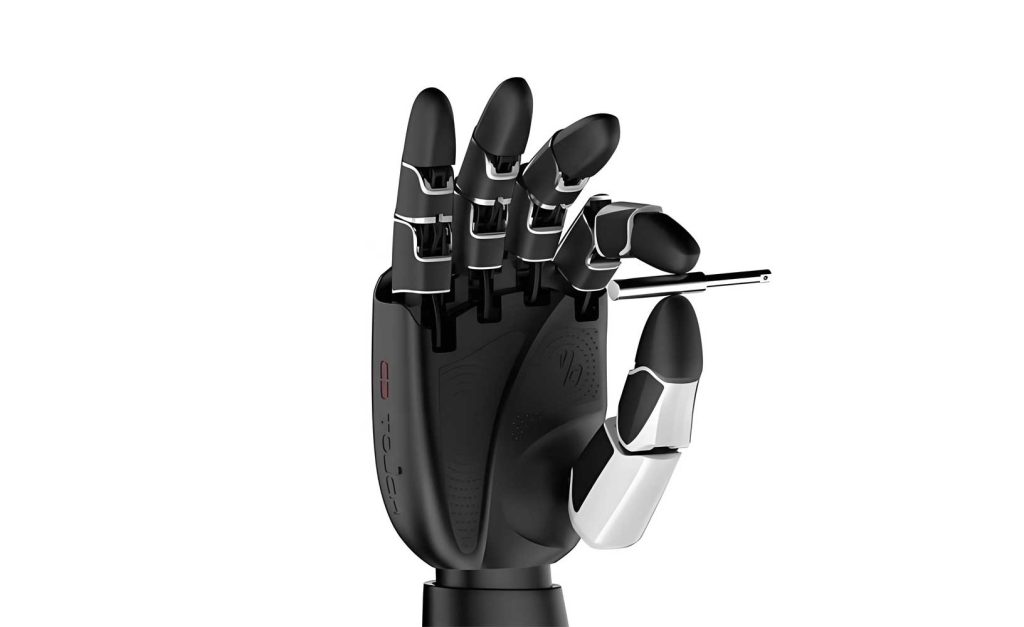
The realization of a multifingered, multisensory dexterous robotic hand that rivals the human hand in size, dexterity, and precision is a pinnacle challenge in robotics. Such systems are envisioned for deployment in hazardous environments—space, deep-sea, or nuclear facilities—where they must execute complex, human-like manipulation tasks. This demands not only a mechanical form factor akin to the human hand but also a sophisticated control system capable of high-speed computation, precise actuator control, and seamless integration of numerous sensors. A critical sub-problem within this domain is the coordinated control of differentially driven joints, common in compact finger designs, where the motion fidelity of one joint depends entirely on the synchronized operation of two actuators. This article details the development of a high-performance, multi-level control system for an anthropomorphic dexterous robotic hand and presents a novel cross-coupled synchronous controller specifically designed for its base joints, eliminating the need for an explicit dynamic model and significantly enhancing positional accuracy.
Architectural Challenges and Hierarchical Control Solution
Modern dexterous robotic hand designs are densely packed mechatronic systems. Each finger, essentially a small robot, incorporates multiple motors, gearboxes, and a suite of sensors (position, force/torque, temperature, tactile). The control system must acquire and process all sensor data, execute coordinated trajectory planning for up to 15-20 degrees of freedom, and generate precise actuator commands in real-time, typically within a millisecond-scale cycle. Traditional designs often house drivers and controllers in the palm or forearm, using tendons for transmission. This introduces unwanted elasticity and friction, hindering precise position control. The alternative—embedding the drive and control electronics within the finger itself—is constrained by severe spatial limitations.
To overcome these challenges, we architected a multi-level control system based on Digital Signal Processors (DSP) and Field-Programmable Gate Arrays (FPGA). This hierarchy efficiently distributes computational load and enables the unprecedented integration required for a compact dexterous robotic hand. The architecture is stratified as follows:
- High-Level Control (Task Planning & Coordination): Executed by a powerful floating-point DSP, this layer handles task decomposition, multi-finger coordination, and complex manipulation algorithms. It communicates setpoints and commands to the lower levels.
- Communication Layer: Managed by an FPGA in the palm, this layer acts as a high-speed data router, distributing sensor streams from the fingers upward and routing control commands from the high-level processor downward to the appropriate finger modules.
- Low-Level Finger Control (Drive & Sensing): This is the core innovation. Each finger module contains its own DSP and FPGA. The finger DSP is responsible for sensor signal acquisition (via ADCs, SPI), basic processing, and communication with its local FPGA. The finger FPGA performs critical tasks: it calibrates raw sensor data into usable physical values (joint position, velocity, torque), implements the high-frequency motor commutation and current control loops for brushless DC motors, and manages local communication. This decentralization places intelligence and drive power directly at the point of action.
The synergy between DSP and FPGA is key. The DSP offers flexibility and ease of implementing complex algorithms, while the FPGA provides deterministic, parallel processing for time-critical tasks like motor control and sensor interfacing. By digitizing sensor signals at the source, analog noise over long cables is eliminated. This layered, modular approach allowed us to develop a five-fingered dexterous robotic hand, the DLR/HIT II, where the entire drive, control, and sensor system for each finger is integrated within the finger’s structure, achieving a size and mobility profile comparable to a human hand.
Dynamics of the Finger and the Base Joint Problem
The kinematic structure of each finger in our dexterous robotic hand features three independent degrees of freedom (DoF). The distal and medial joints are relatively straightforward, often using tendons or direct drives. The greatest complexity lies in the base joint, which provides adduction/abduction and flexion/extension. To save space and share load, a differential mechanism employing four bevel gears is used. Two motors (M1, M2) drive the system. Their coordinated motion determines the joint’s output:
- Pure Flexion/Extension: Both motors rotate in the same direction at the same speed.
- Pure Adduction/Abduction: Both motors rotate at the same speed but in opposite directions.
Any desired combined motion is a superposition of these two modes. The relationship between motor space and joint space for the base joint is linear. Let $\theta_{m1}, \theta_{m2}$ be motor positions and $\theta_{j1}, \theta_{j2}$ be joint positions (e.g., flexion and abduction). The transformation is given by:
$$
\begin{bmatrix}
\theta_{j1} \\
\theta_{j2}
\end{bmatrix}
=
\mathbf{C}_{mj}
\begin{bmatrix}
\theta_{m1} \\
\theta_{m2}
\end{bmatrix}, \quad \text{where } \mathbf{C}_{mj} = \frac{1}{2}
\begin{bmatrix}
1 & 1 \\
1 & -1
\end{bmatrix}
$$
The dynamics of an n-DoF robotic finger can be described in joint space by the Lagrangian formulation:
$$
\mathbf{D}(\boldsymbol{\theta}_j) \ddot{\boldsymbol{\theta}}_j + \mathbf{C}(\boldsymbol{\theta}_j, \dot{\boldsymbol{\theta}}_j) \dot{\boldsymbol{\theta}}_j + \mathbf{g}(\boldsymbol{\theta}_j) + \mathbf{f}_j(\dot{\boldsymbol{\theta}}_j) = \boldsymbol{\tau}_j
$$
where $\mathbf{D}$ is the inertia matrix, $\mathbf{C}$ represents Coriolis and centrifugal forces, $\mathbf{g}$ is gravity, $\mathbf{f}_j$ is joint friction, and $\boldsymbol{\tau}_j$ is the joint torque vector. For the base joint, the joint torque is produced by the two motors through the differential’s inverse transformation. The motor torque $\boldsymbol{\tau}_m$ relates to joint torque $\boldsymbol{\tau}_j$ as:
$$
\boldsymbol{\tau}_m = \mathbf{N} \mathbf{C}_{mj}^T \boldsymbol{\tau}_j
$$
where $\mathbf{N}$ is a diagonal matrix of gear ratios. Combining this with the motor’s own dynamics ($\mathbf{J}_m \ddot{\boldsymbol{\theta}}_m + \mathbf{B}_m \dot{\boldsymbol{\theta}}_m + \mathbf{f}_m$), we get the complete driven system dynamics in motor coordinates:
$$
\boldsymbol{\tau}_{cmd} = \mathbf{J}_m \ddot{\boldsymbol{\theta}}_m + \mathbf{B}_m \dot{\boldsymbol{\theta}}_m + \mathbf{f}_m + \mathbf{N}\mathbf{C}_{mj}^T \left[ \mathbf{D}(\boldsymbol{\theta}_j) \ddot{\boldsymbol{\theta}}_j + \mathbf{C}(\boldsymbol{\theta}_j, \dot{\boldsymbol{\theta}}_j) \dot{\boldsymbol{\theta}}_j + \mathbf{g}(\boldsymbol{\theta}_j) + \mathbf{f}_j(\dot{\boldsymbol{\theta}}_j) \right]
$$
This equation reveals a highly nonlinear, coupled, multi-input system. Crucially, the fidelity of the base joint’s motion ($\theta_{j1}, \theta_{j2}$) depends entirely on the precise and synchronized motion of the two motors. In conventional independent joint control (e.g., two separate PD loops), each motor’s controller only reacts to its own tracking error. If one motor is slightly slower due to a load disturbance or friction, it creates not only a positional error in its own channel but also induces a parasitic error in the other joint dimension due to the coupling in $\mathbf{C}_{mj}$. This lack of coordination degrades the overall accuracy of the dexterous robotic hand during precise manipulation.
Cross-Coupled Synchronous Controller Design
To enforce synchronization between the two motors driving the base joint of the dexterous robotic hand, we designed a cross-coupled controller. The core idea is to feed back not only each motor’s individual tracking error but also an error that directly measures their deviation from the desired synchronized state. This allows each controller to react to the other motor’s performance, promoting cooperative behavior.
Let $\theta^d_{m1}, \theta^d_{m2}$ be desired motor trajectories and $\theta_{m1}, \theta_{m2}$ be actual positions. The individual tracking errors are $e_{1} = \theta^d_{m1} – \theta_{m1}$ and $e_{2} = \theta^d_{m2} – \theta_{m2}$. For a desired synchronization relationship $s_1 \theta^d_{m1} = s_2 \theta^d_{m2}$ (with $s_1, s_2$ as coupling coefficients defined by the task), we define the synchronization errors:
$$
\varepsilon_1 = s_1 e_{1} – s_2 e_{2}, \quad \varepsilon_2 = s_2 e_{2} – s_1 e_{1} = -\varepsilon_1
$$
Perfect synchronization is achieved when $\varepsilon_1 = \varepsilon_2 = 0$. We then construct a combined error signal for each motor that incorporates both its tracking error and its contribution to the synchronization error. For a two-motor system, we define a coupled error $e_{c,i}$:
$$
e_{c,i} = s_i e_{i} + \beta \int \Delta \varepsilon_i \, dt
$$
where $\Delta \varepsilon_1 = \varepsilon_1 – \varepsilon_2 = 2\varepsilon_1$ and $\Delta \varepsilon_2 = \varepsilon_2 – \varepsilon_1 = 2\varepsilon_2$ for the two-motor case. The term $\beta$ is a positive gain. The derivative of this coupled error is:
$$
\dot{e}_{c,i} = s_i \dot{e}_{i} + \dot{s}_i e_{i} + \beta \Delta \varepsilon_i
$$
We now define a virtual reference velocity $v_{r,i}$:
$$
v_{r,i} = s_i \dot{\theta}^d_{mi} + \dot{s}_i e_{i} + \beta \Delta \varepsilon_i + k e_{c,i}
$$
where $k$ is a positive constant. A sliding surface-like variable $r_i$ is defined as the difference between this reference and the actual scaled velocity:
$$
r_i = v_{r,i} – s_i \dot{\theta}_{mi} = \dot{e}_{c,i} + k e_{c,i}
$$
The control objective is to drive $r_i$ to zero, which ensures both $e_{c,i}$ and $\dot{e}_{c,i}$ vanish, implying perfect tracking and synchronization. To achieve this without relying on the precise and complex dynamic model from Eq. (6), we propose the following robust control law for the commanded torque to motor $i$:
$$
\tau_{cmd,i} = K_{c,i} s_i^{-1} v_{r,i} + K_{m,i} s_i^{-1} \dot{v}_{r,i} + K_{r,i} s_i^{-1} r_i + s_i^{-1} K_{\varepsilon} \Delta \varepsilon_i + U_{sat,i} \tanh(\alpha_i e_{i})
$$
where:
- $K_{c,i} v_{r,i}$ and $K_{m,i} \dot{v}_{r,i}$ are feedforward terms for velocity and acceleration, providing the nominal effort needed for the desired motion.
- $K_{r,i} r_i$ is the main feedback term driving the combined error to zero.
- $K_{\varepsilon} \Delta \varepsilon_i$ is a direct feedback on the synchronization error, strengthening the cooperative response.
- $U_{sat,i} \tanh(\alpha_i e_{i})$ is a smooth robust nonlinear compensator. $U_{sat,i}$ is chosen to be slightly larger than the estimated maximum static friction (different values for positive/negative velocity), and $\alpha_i$ shapes the hyperbolic tangent function. This term efficiently compensates for static friction and other bounded model uncertainties without introducing chatter.
This controller for the dexterous robotic hand base joint is model-independent in the sense that it does not require explicit values for $\mathbf{D}$, $\mathbf{C}$, or $\mathbf{g}$. The gains $K_{c,i}, K_{m,i}, K_{r,i}, K_{\varepsilon}, \beta, k$ are tuned for performance and stability.
Experimental Validation and Results
The performance of the control system and the proposed synchronous controller was validated on a single finger module of the dexterous robotic hand. The base joint motors were commanded to follow a synchronized trajectory: moving from $(0^\circ, 0^\circ)$ to $(50^\circ, 10^\circ)$ at a speed of $(120^\circ/s, 24^\circ/s)$ and back, following a smooth polynomial profile. We compared three controllers:
- Independent PD with Friction Compensation (PD+): A standard, non-coordinated baseline.
- Trajectory Tracking Control (TTC): A more advanced, model-independent tracking controller similar to the proposed one but without explicit synchronization terms ($\beta=0, K_{\varepsilon}=0$).
- Proposed Cross-Coupled Synchronous Control (CCSC): The full controller described above.
The following table summarizes the key performance metrics in the motor space, specifically the maximum absolute synchronization error $|\varepsilon_1|_{max}$ during the motion. As the theory predicts, the PD+ controller shows the largest sync error.
| Control Method | Max Sync Error $|\varepsilon_1|_{max}$ (deg) | Description |
|---|---|---|
| PD+ | 1.85 | Independent control, high coupling-induced error. |
| TTC | 1.12 | Better tracking, but no explicit sync, so error persists. |
| CCSC (Proposed) | 0.48 | Explicit sync feedback minimizes coordination error. |
The ultimate goal is accurate joint motion. The next table shows the root-mean-square (RMS) tracking error for the two base joint angles ($\theta_{j1}$, $\theta_{j2}$) calculated over the entire trajectory. The superior synchronization of the CCSC directly translates into superior joint tracking accuracy.
| Control Method | RMS Error $\theta_{j1}$ (deg) | RMS Error $\theta_{j2}$ (deg) |
|---|---|---|
| PD+ | 0.92 | 0.89 |
| TTC | 0.61 | 0.58 |
| CCSC (Proposed) | 0.31 | 0.28 |
The parameter $\beta$ plays a critical role in the CCSC’s performance. It controls the weight of the integrated synchronization error in the coupled error signal. The effect of varying $\beta$ (while keeping $K_{\varepsilon}$ constant for stability) is analyzed below. An optimal range exists; too small a value weakens synchronization, while too large a value can lead to overshoot and oscillation.
| Gain $\beta$ | Max Sync Error (deg) | Joint RMS Error (deg) | Remarks |
|---|---|---|---|
| 0.1 | 0.82 | 0.52 | Weak synchronization. |
| 0.4 | 0.48 | 0.31 | Optimal performance. |
| 0.8 | 0.45 | 0.35 | Slight oscillation in error signal. |
| 1.5 | 0.60 | 0.50 | Visible oscillation, degraded performance. |
The experimental data conclusively demonstrates the effectiveness of the proposed framework. The DSP&FPGA-based control system successfully meets the real-time computational and integration demands of the dexterous robotic hand. Furthermore, the cross-coupled synchronous controller significantly outperforms conventional non-synchronizing strategies. By explicitly minimizing the synchronization error between the two drive motors of the differential base joint, it reduces the parasitic coupling errors and achieves a remarkable improvement in the absolute positional accuracy of the joint. This enhanced precision at the fundamental joint level is a critical enabler for the fine manipulation capabilities expected of a truly advanced dexterous robotic hand.