
The pursuit of creating robotic manipulators that emulate the versatility and adaptability of the human hand has been a long-standing goal in robotics. Traditional rigid robotic hands, while powerful, often lack the inherent compliance and safety for unstructured human-centric environments. The emergence of soft robotics has presented a promising avenue, offering excellent compliance, high power-to-weight ratios, and safe human-robot interaction. However, standalone soft actuators frequently suffer from low structural stiffness, susceptibility to lateral buckling under load, and challenges in achieving precise force and position control. To bridge this gap, this work focuses on the design and implementation of a hybrid, flexible dexterous robotic hand that combines soft actuators with strategic reinforcement. The core of this study lies in the development of a sophisticated force/position hybrid control system for this dexterous robotic hand, supported by comprehensive kinematic modeling, simulation-based controller tuning, and experimental validation of its mechanical and control performance.
The conceptual design of the presented flexible dexterous robotic hand is based on a modular finger architecture. Each finger is independently actuated and consists of two primary types of soft joints: bending joints and lateral swing joints. This configuration grants each finger multiple degrees of freedom, enabling complex motions such as enveloping and precision grasps, which are essential for a truly dexterous robotic hand. The bending joints are responsible for the primary flexion/extension motion, mimicking the metacarpophalangeal (MCP) and proximal interphalangeal (PIP) joints. The lateral swing joint provides abduction/adduction capability, increasing the workspace and enabling adaptive grip on irregularly shaped objects. The actuators are pneumatically driven, with internal chambers that expand under pressure, causing asymmetric elongation and resulting in bending. To address the inherent low stiffness and lateral instability, the soft silicone structure is mechanically constrained using methods like embedded fibers or external limiting layers, creating a semi-soft, tendon-reinforced composite structure.
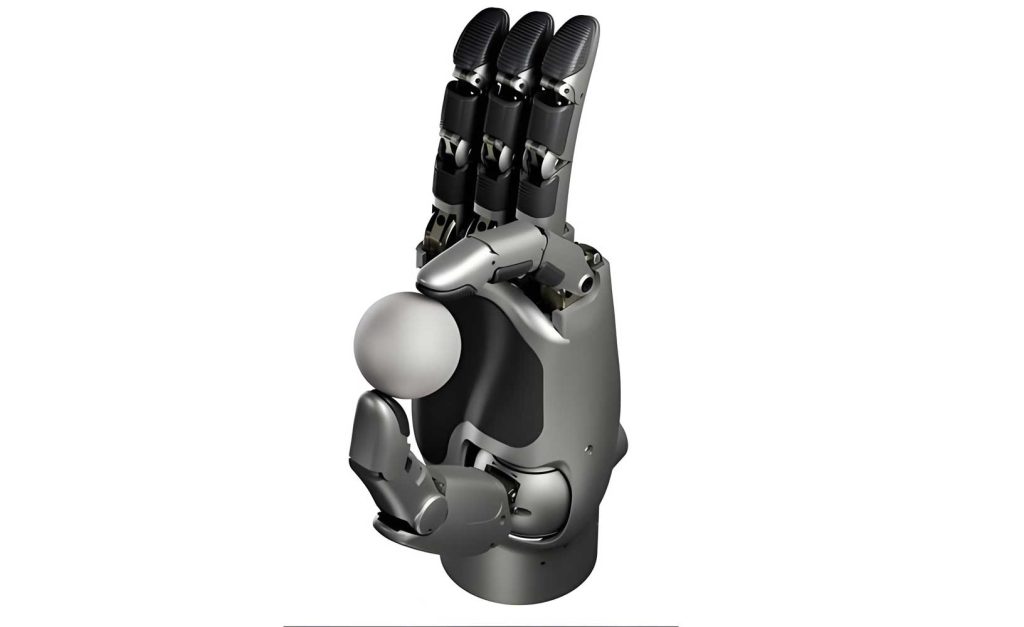
The foundation for controlling this flexible dexterous robotic hand is an accurate kinematic model. Given the continuum nature and variable length of the soft actuators, traditional Denavit-Hartenberg (D-H) parameters are not directly applicable. A piecewise constant curvature approximation is often used, but for higher accuracy in our specific multi-chamber design, a customized geometrical model is derived. The actuator is divided into segments: fixed base sections, active bending sections, and connecting sections. Assuming uniform pressure distribution and equal bending curvature in each active chamber, the relationship between input pressure (or chamber elongation) and the resulting bending angle is established. Let \( \theta \) be the bending angle of a single active chamber segment. The elongation \( \Delta l \) of the chamber on the extended side is related to the bending angle and the neutral axis radius \( r \) by:
$$ \Delta l = h \cdot \theta $$
where \( h \) is the distance from the neutral axis to the chamber wall. By sequentially calculating the transformation of each segment, the pose of the fingertip relative to the finger base can be derived. For a bending joint with multiple chambers, the overall transformation from the base frame \(\{S_0\}\) to the fingertip frame \(\{S_{11}\}\) is given by the homogeneous transformation matrix \( \mathbf{T}_{0}^{11} \), which is a function of the aggregate bending angle \( \Theta = n \cdot \theta \), where \( n \) is the number of effective chamber segments, and the geometric parameters \( l_{b1}, l_{b3}, r \):
$$
\mathbf{T}_{0}^{11} = \prod_{i=1}^{n} \mathbf{T}_{i-1}^{i}(\theta, l_{b1}, l_{b3}, r) \\
\mathbf{p}_{fingertip}^{0} = \begin{bmatrix}
x_0 + l_{b1}(1+\cos(n\theta)) + l_{conn}\cos(\theta/2) + l_{b3}(\cos(3\theta/2)+\cos(5\theta/2)+…) + r\sin(n\theta) \\
y_0 \\
z_0 + l_{conn}\sin(\theta/2) – l_{b3}(\sin(3\theta/2)+\sin(5\theta/2)+…) – l_{b1}\sin(n\theta) + r\cos(n\theta) – r
\end{bmatrix}
$$
Similarly, for the lateral swing joint with a swing angle \( \alpha \), the endpoint position \( \mathbf{p}_{swing}^{0} \) is derived from its own set of geometric parameters. The full forward kinematics of the entire dexterous robotic hand is then obtained by combining the transformations of the swing joint and the subsequent bending joints in series.
Effective control of a dexterous robotic hand requires an intelligent grasp strategy. Rather than relying solely on object geometry, a more robust approach integrates perception with task context. We propose a strategy where a vision system (e.g., a camera) captures the target object. This image is processed by a pre-trained neural network for object recognition. The recognized object is then mapped to a intended task (e.g., “drinking from a bottle,” “writing with a pen”). This task context dictates the appropriate grasp mode:
| Object Class | Inferred Task | Recommended Grasp Mode |
|---|---|---|
| Bottle, Cup | Lift and Tilt | Power Grasp (Enveloping) |
| Pen, Screwdriver | Precise Manipulation | Precision Grasp (Fingertip) |
| Ball, Apple | Hold and Carry | Spherical Grasp |
| Credit Card, Key | Pick and Place | Lateral Pinch |
This task-oriented strategy allows the dexterous robotic hand to select a functionally appropriate grip, enhancing success rates in real-world scenarios.
The core contribution of this work is the design of a hybrid force/position control system for the dexterous robotic hand. The control mode switches based on contact state. During the free-motion phase (pre-contact), the system operates in position control mode to guide the finger to a desired location. Upon detecting contact via a fingertip tactile sensor, the system seamlessly switches to force control mode to regulate the interaction force and prevent object damage or excessive squeezing. The block diagram of the control system is implemented as follows:
- High-Level Planner: Generates the desired fingertip trajectory (position setpoint \( \mathbf{x}_d \)) and the desired contact force setpoint \( F_d \).
- Mode Switch: Determines the active control mode based on the measured contact force \( F_{sens} \). A threshold \( F_{thresh} \) triggers the switch from position to force control.
$$ \text{Mode} = \begin{cases}
\text{Position Control}, & \text{if } F_{sens} < F_{thresh} \\
\text{Force Control}, & \text{if } F_{sens} \ge F_{thresh}
\end{cases} $$ - PID Controllers: Two separate PID controllers are used.
- Position PID: Takes the position error \( e_x = x_d – x_{sens} \) (from an inertial measurement unit or encoder) and computes a control signal.
- Force PID: Takes the force error \( e_F = F_d – F_{sens} \) and computes a control signal.
The output from the active PID controller is a demanded pressure \( P_{cmd} \).
- Pressure Dynamics & Actuation: The demanded pressure is compared with the actual chamber pressure \( P_{sens} \). This error \( e_P = P_{cmd} – P_{sens} \) is fed to a low-level PID controller that drives an electro-pneumatic proportional valve. The valve adjusts the airflow to achieve the target pressure in the soft actuator, thereby producing motion or force.
The overall control law for the inner pressure loop can be expressed as:
$$ u(t) = K_{p,P} e_P(t) + K_{i,P} \int_0^t e_P(\tau) d\tau + K_{d,P} \frac{de_P(t)}{dt} $$
where \( u(t) \) is the valve command signal (e.g., voltage), and \( K_{p,P}, K_{i,P}, K_{d,P} \) are the PID gains for the pressure controller.
To optimize the control parameters and validate system performance before physical implementation, a detailed simulation model was built in Simulink. The plant model incorporates the kinematic equations, the pressure-flow dynamics of the pneumatic system, and the passive elasticity of the soft material. Sensor noise (modeled as Gaussian white noise at 1000 Hz) was added to the feedback signals to simulate real-world conditions. A comparison between a simple low-pass filter and a Kalman filter was conducted for state estimation. The Kalman filter demonstrated superior performance, effectively suppressing noise without introducing significant phase lag, which is critical for the stability of the dexterous robotic hand control.
Systematic tuning of the high-level position and force PID controllers was performed via simulation. The performance was evaluated based on rise time, settling time, overshoot, and steady-state error to a step input and a sinusoidal tracking command.
Position Controller Tuning: The goal was to track a desired angular trajectory. After extensive simulation, the optimal parameters were found.
| Parameter | Value | Effect |
|---|---|---|
| Proportional Gain (\(K_{p,x}\)) | 7.5 | Provides strong responsive action. Values >7.5 caused instability. |
| Integral Gain (\(K_{i,x}\)) | 10000 | Eliminates steady-state tracking error for slow signals. |
| Derivative Gain (\(K_{d,x}\)) | 0 | Any positive value introduced high-frequency oscillations. |
The closed-loop transfer function for the tuned position control system showed stable and accurate tracking performance.
Force Controller Tuning: The goal was to regulate contact force to a desired setpoint. The tuning process yielded a different set of optimal parameters, reflecting the different dynamics of the force interaction loop.
| Parameter | Value | Effect |
|---|---|---|
| Proportional Gain (\(K_{p,F}\)) | 3.0 | Ensures quick force response without excessive overshoot. |
| Integral Gain (\(K_{i,F}\)) | 500 | Rejects constant disturbances and achieves zero steady-state force error. |
| Derivative Gain (\(K_{d,F}\)) | 0.01 | Adds slight damping to reduce oscillation upon contact. |
The force control loop demonstrated a critically damped response to a step change in desired force, which is ideal for stable grasping with the dexterous robotic hand.
To validate the theoretical models and the control system’s assumptions, a series of experiments were conducted on individual joint modules of the dexterous robotic hand. The experimental setup consisted of the soft finger joint, an electro-pneumatic proportional valve (ITV0030, SMC), a pressure sensor (ISE30A, SMC), a 6-axis IMU (MPU6050) for angle measurement, and a thin-film force sensor at the fingertip. A Raspberry Pi 3B+ served as the real-time controller.
Bending Joint Characterization: The relationship between input gauge pressure (\(P\)) and the resultant bending angle (\(\theta\)) was measured. The experimental data was plotted against the theoretical kinematic model derived earlier.
$$ \theta_{model} = f(P, E, h, l_{b1}, l_{b3}, r) $$
where \(E\) represents the effective modulus of the composite soft material. The results showed strong agreement in trend. At low pressures (<5 kPa), minor discrepancies were observed due to material hysteresis and the low stiffness of the joint. At higher pressures, the model accurately predicted the behavior until large angles (>60°), where material hyperelasticity and internal stress stiffening caused the experimental curve to deviate, showing less angular increase per unit pressure compared to the linearized model.
The force exertion capability was also tested by pressing the fingertip against a load cell at various fixed joint angles and pressures. The contact force \(F_c\) was found to be a function of both input pressure \(P\) and the joint’s angular deflection \(\theta\):
$$ F_c = g(P, \theta) $$
The data revealed that for a constant input pressure, the normal contact force at the fingertip decreases as the joint bends further. This is because the moment arm for force generation changes with configuration, and more of the actuator’s energy is spent on maintaining the deflected shape against internal elasticity. This insight is crucial for grasp planning with the dexterous robotic hand: to maximize grip force, objects should be grasped with the fingers in a less-curled configuration.
Lateral Swing Joint Characterization: A similar procedure was applied to the swing joint to map pressure \(P\) to swing angle \(\alpha\). The experimental data fit closely with the theoretical swing model, confirming its predictability. At 15 kPa, a swing angle of approximately 32° was achieved, matching the model’s prediction within a 10% error margin, which validates the kinematic foundation used for the overall dexterous robotic hand control.
Finally, the integrated force/position control system was tested on a single finger of the assembled dexterous robotic hand. The finger was commanded to move to a predetermined position (triggering position control) and then to squeeze a force sensor (triggering force control). The step response of the force control loop was recorded and compared to the simulation. The experimental rise time and settling time were within 15% of the simulated values, demonstrating that the simulation-tuned PID parameters (\(K_p=3, K_i=500, K_d=0.01\)) were effective in the real system. The system successfully maintained stable contact forces, proving the viability of the proposed hybrid control architecture for the flexible dexterous robotic hand.
In conclusion, this work presented a holistic approach to developing a controllable flexible dexterous robotic hand. The key outcomes are: 1) The design of a hybrid soft-rigid finger module with enhanced stiffness and multiple degrees of freedom. 2) The derivation of customized kinematic models (pose equations) for both bending and swing joints, which were experimentally validated. 3) The proposal of a task-oriented grasp strategy for intelligent object manipulation. 4) The design and simulation of a hybrid force/position control system, with optimized PID parameters determined to be \(K_{p,x}=7.5, K_{i,x}=10000, K_{d,x}=0\) for position control and \(K_{p,F}=3.0, K_{i,F}=500, K_{d,F}=0.01\) for force control. 5) Experimental characterization of the joint mechanics and validation of the control performance. The results confirm that the proposed system meets practical requirements for force and position regulation, marking a significant step towards robust and adaptable dexterous robotic hands for interactive and delicate tasks.