
As AI human robot technology rapidly advances, humanoid robots are increasingly deployed across diverse scenarios, presenting complex safety risks and challenges in criminal liability attribution. In this article, I explore the multifaceted nature of these issues, drawing on theoretical frameworks and practical considerations to propose a comprehensive approach. The integration of AI human robot systems into society necessitates a reevaluation of traditional legal principles, particularly in criminal law, where questions of responsibility become blurred in the face of autonomous decision-making.
Humanoid robots, as embodied AI, possess unique characteristics that distinguish them from other robotic forms. Their anthropomorphic design, advanced sensory capabilities, and learning algorithms enable them to interact with humans in ways that mimic social behaviors. This blurring of lines between machine and human raises fundamental questions about liability when these AI human robot entities cause harm. For instance, consider a scenario where an AI human robot in a healthcare setting makes an erroneous decision leading to patient injury—who is to blame? The developer, the user, or the robot itself? This exemplifies the “diffusion of criminal liability” phenomenon, where multiple actors may be involved, and causation is difficult to trace.
To systematically address these challenges, I begin by outlining the key application domains of AI human robot systems and their associated risks. The following table summarizes major scenarios and the primary criminal liability issues they entail:
| Application Scenario | Safety Risks | Criminal Liability Challenges |
|---|---|---|
| Healthcare and Elderly Care | Physical injury, privacy breaches | Determining negligence among developers, users, and autonomous decisions |
| Military and Law Enforcement | Unlawful use of force, proportionality issues | Attributing responsibility for violations of international humanitarian law |
| Domestic and Service Industries | Data security threats, emotional manipulation | Balancing product liability with user misconduct in AI human robot interactions |
| Social and Entertainment Fields | Ethical dilemmas, such as in sexual robotics | Evaluating obscenity laws and consent in AI human robot contexts |
In theoretical discussions, four primary models of criminal liability for AI human robot incidents have emerged: agency liability, negligence liability, strict liability, and independent liability. Each has its merits and drawbacks, which can be expressed through a comparative formula. Let $$ L $$ represent the level of liability, and $$ F $$ denote the fairness of attribution. For agency liability, where humans are held responsible for robot actions, we have $$ L_{\text{agency}} = f(\text{control}, \text{intent}) $$, meaning liability depends on the degree of human control and intent. Negligence liability, based on foreseeable risks, can be modeled as $$ L_{\text{negligence}} = P(\text{harm}) \times D(\text{duty}) $$, where $$ P(\text{harm}) $$ is the probability of harm and $$ D(\text{duty}) $$ is the breach of duty of care. Strict liability, which imposes responsibility without fault, is often criticized for its potential injustice, as $$ L_{\text{strict}} = \text{constant} $$ regardless of culpability. Independent liability, assigning responsibility directly to the AI human robot, introduces $$ L_{\text{independent}} = g(\text{autonomy}, \text{capability}) $$, where autonomy and cognitive capability are key factors.
Among these, strict liability is largely incompatible with modern criminal law principles that emphasize mens rea, or guilty mind. However, the other models can be integrated into a scenario-based criminal liability system. In current AI human robot development stages, traditional criminal law doctrines can handle most cases, but they require adaptation. For example, the concept of “permissible risk” must be recalibrated for AI contexts. We can define permissible risk $$ R_p $$ as: $$ R_p = \frac{B}{C} \times S $$, where $$ B $$ is the benefit derived from AI human robot deployment, $$ C $$ is the potential cost of harm, and $$ S $$ represents societal acceptance factors. If $$ R_p > 1 $$, the risk may be deemed acceptable, shielding developers from liability under certain conditions.
Similarly, the principle of reliance, which traditionally applies to human interactions, must be extended to AI human robot systems. In a scenario where a human relies on an AI human robot for decision-making, the reliance can be quantified as $$ \text{Reliance} = T \times A $$, where $$ T $$ is the trustworthiness of the system based on its design and performance history, and $$ A $$ is the appropriateness of the context. If reliance is justified, it may negate liability for resulting harms. For instance, if an AI human robot in an industrial setting follows standardized protocols and a human worker relies on its actions, any accident might not attribute fault to the worker.
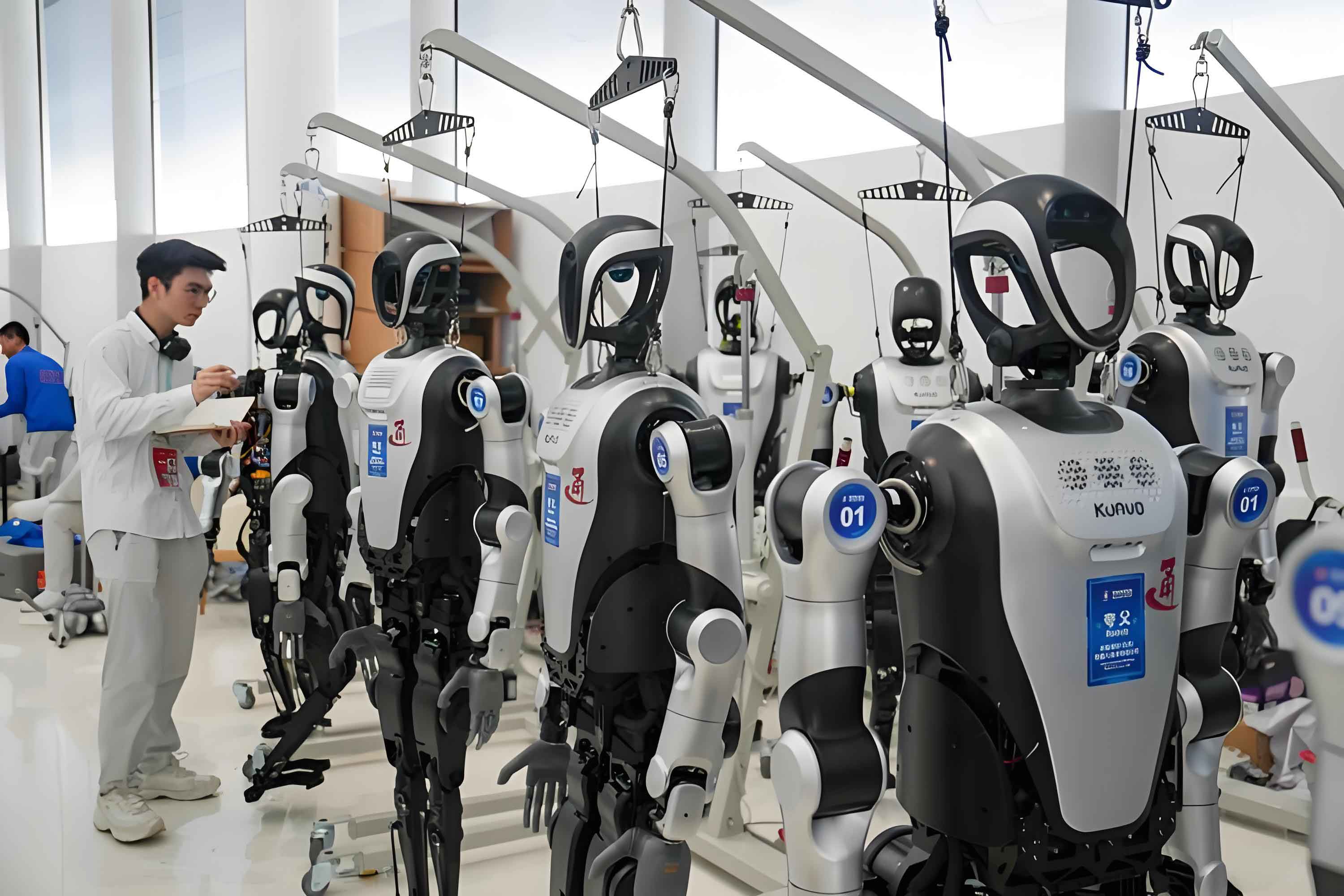
Looking forward, the possibility of recognizing AI human robots as independent liability subjects cannot be dismissed. From a functionalist perspective, if an AI human robot demonstrates advanced autonomy and learning capabilities, it could be treated similarly to legal persons like corporations. The criteria for such status can be summarized in the formula: $$ E_{\text{liability}} = \sum_{i=1}^{n} (A_i \times C_i) $$, where $$ E_{\text{liability}} $$ is the eligibility for independent liability, $$ A_i $$ represents autonomy indicators (e.g., decision-making without human intervention), and $$ C_i $$ denotes cognitive abilities (e.g., understanding norms). If $$ E_{\text{liability}} $$ exceeds a threshold, the AI human robot might bear criminal responsibility, with penalties such as algorithmic resets or functional restrictions serving as “punishments.”
Moreover, an open criminal liability system for AI human robot governance must harmonize with other legal domains and ethical standards. For example, in military applications, international humanitarian law principles like distinction and proportionality must be embedded in AI human robot programming to avoid criminal liability for war crimes. In data privacy contexts, adherence to regulations like the GDPR can influence whether a breach leads to criminal charges. The table below illustrates how cross-disciplinary integration can inform liability assessments:
| Legal Domain | Relevant Principles | Impact on AI Human Robot Liability |
|---|---|---|
| International Humanitarian Law | Distinction, Proportionality | If violated, developers or users may face charges for aiding in crimes |
| Data Protection Law | Minimization, Transparency | Breaches could lead to criminal liability under cybersecurity statutes |
| Robot Ethics | Autonomy, Non-maleficence | Ethical lapses may inform mens rea in negligence cases |
Ethical considerations, particularly in sensitive areas like AI human robot use in sexual contexts, further complicate criminal liability. For instance, the production of child-like AI human robots raises questions about virtual exploitation and whether it constitutes a criminal act under obscenity laws. A functional approach might evaluate harm through the formula $$ H = I \times M $$, where $$ H $$ is the harm caused, $$ I $$ is the impact on societal values, and $$ M $$ is the moral reprehensibility. If $$ H $$ surpasses a legal threshold, criminalization could be justified, reflecting a balance between innovation and protection.
In conclusion, the criminal liability framework for AI human robot systems must be dynamic and context-dependent. By integrating traditional doctrines with novel adaptations like permissible risk and reliance principles, and by remaining open to functionalist interpretations of independent liability, we can address the evolving challenges. As AI human robot technology continues to permeate society, ongoing dialogue between law, ethics, and technology will be essential to ensure just and effective governance. This approach not only mitigates risks but also fosters responsible innovation in the AI human robot landscape.