
The relentless advancement of modern technology and mechanical processing has propelled the planetary roller screw into the spotlight as a superior alternative to traditional ball screws in demanding applications. This sophisticated power transmission device, characterized by its exceptional precision, rigidity, efficiency, and load-bearing capacity, is finding widespread adoption in fields such as aerospace, military, and notably, the automotive industry. The core function of a planetary roller screw, akin to a ball screw, is to convert rotary motion into precise linear motion. However, its unique multi-threaded, multi-contact design endows it with unparalleled performance advantages under high-load, high-reliability conditions, making it a component of immense research value and broad development prospects. This work focuses on the design and analysis of a planetary roller screw for the specific purpose of retrofitting a commercial heavy-truck steering gear, providing practical insights for the development of next-generation Electric Power Steering (EPS) systems.
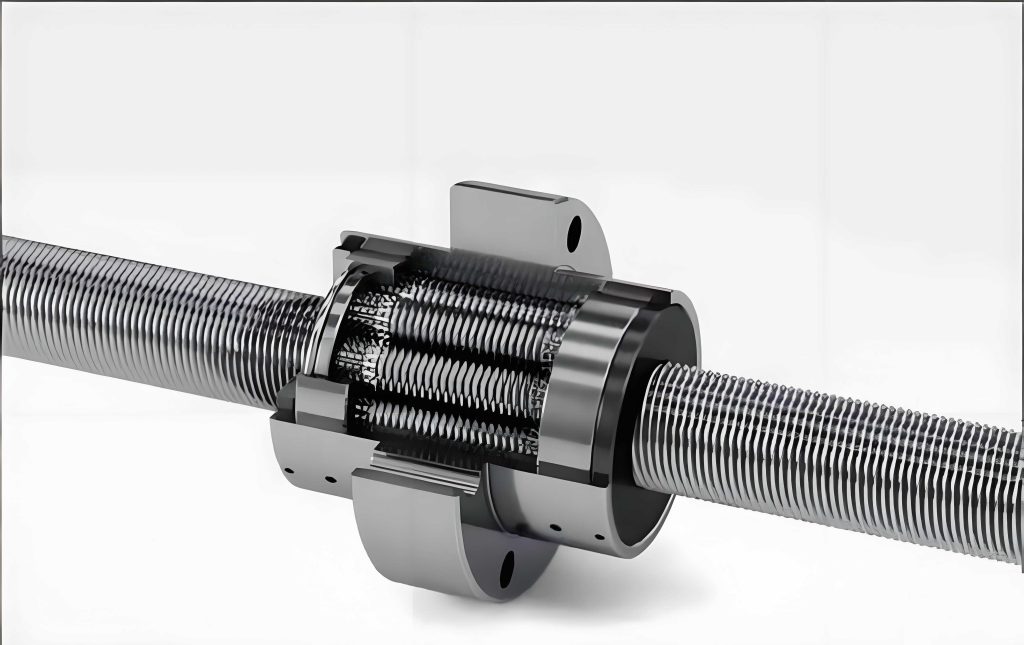
The fundamental operating principle of a planetary roller screw revolves around a clever planetary arrangement. The system primarily consists of a central screw, a surrounding nut, and several threaded rollers distributed circumferentially between them, often held by a retainer or cage. An internal gear ring, typically integrated into the nut, meshes with gear teeth on the ends of the rollers. When the screw rotates, the threaded engagement drives the rollers to rotate. The gear meshing at the roller ends constrains their orbital path, forcing them to undergo a pure rolling motion within the thread flanks of both the screw and the nut. This rolling action, as opposed to the sliding or point-contact in other screws, is key to its high efficiency and load capacity, ultimately causing the nut to translate axially along the screw. A critical kinematic analysis establishes the relationship between the rotational speeds of the components. Let $\omega_S$, $\omega_R$, and $\omega_N$ represent the angular velocities of the screw, roller, and nut, respectively. For a common configuration where the nut is prevented from rotating ($\omega_N = 0$), the kinematics are governed by the thread leads and pitch diameters. Defining $L_S$, $L_R$, and $L_N$ as the lead of the screw, roller, and nut threads, and with $d_S$, $d_R$, and $d_N$ as their pitch diameters, fundamental relationships can be derived. For a standard design where the roller threads are single-start and the screw/nut threads are multi-start with matched leads, the transmission ratio is given by:
$$ V = \frac{L_S}{\pi \cdot d_R} \cdot (1 + \frac{d_R}{d_S}) $$
where $V$ is the linear velocity of the nut per unit rotational speed of the screw. The geometric constraint for proper assembly is:
$$ d_N = d_S + 2d_R $$
The design process for a planetary roller screw targeting a specific application, such as retrofitting the ZF 8098 heavy-truck steering gear, is a meticulous exercise in balancing spatial constraints, performance requirements, and manufacturability.
| Parameter | Specification / Constraint |
|---|---|
| Target Application | ZF 8098 Heavy-Duty Steering Gear Retrofit |
| Available Installation Space | Defined by existing steering gear housing |
| Nominal Screw Diameter ($d_S$) | 30 mm |
| Required Lead ($L_{PRS}$) | 10 mm |
| Minimum Transmission Efficiency | ≥ 70% |
| Maximum Input Speed | ≥ 120 rpm |
| Maximum Output Torque (Steering Gear) | 7388 Nm |
With the lead and nominal screw diameter defined, the next step is the detailed design of the threaded components. The selection of the number of screw thread starts ($n_S$) is crucial as it directly defines the thread pitch ($p$) for a given lead: $p = L_{PRS} / n_S$. Common choices for $n_S$ are 5 or 6 to ensure load distribution and manufacturability. Choosing $n_S = 5$ results in a pitch $p = 2$ mm. The nut lead $L_N$ is typically matched to the screw lead. The pitch diameter of the nut $d_N$ is derived from the geometric constraint $d_N = d_S + 2d_R$, where $d_R$ is the roller pitch diameter. The roller is usually designed with a single-start thread ($n_R=1$). A key relationship linking the number of screw starts to the diameters is often expressed as $n_S \approx d_S / d_R + 2$, which helps in initially sizing the roller. For a screw with $d_S=30$ mm and $n_S=5$, the approximate roller pitch diameter $d_R$ becomes 10 mm, making $d_N = 50$ mm. The axial length of the nut is determined by the required stroke and the geometry of the steering gear’s rack piston, leading to a design length of 174 mm. Accordingly, the roller length is set to 168 mm to fit within the nut, with portions allocated for the threaded section and the end gears.
The thread profile is a critical design choice that dramatically affects contact mechanics, load distribution, and wear. While standard trapezoidal threads can be used, a modified profile is often preferred to avoid detrimental point contact. A common and effective approach is to use a gothic arch or circular profile with a 90° included angle for the roller threads, which mates with appropriately shaped flanks on the screw and nut. This promotes favorable line contact, enhancing load distribution, axial stiffness, and efficiency. The contact condition can be analyzed by considering the radius of curvature. For a roller with a circular thread profile of radius $\rho_R$, the contact with a flat or conforming screw/nut flank can be modeled using Hertzian contact theory. The semi-contact width $a$ for a cylinder-on-plane configuration under axial load $F_a$ per contact is approximately:
$$ a = \sqrt{ \frac{4 F_a}{\pi l} \cdot \frac{1-\nu^2}{E} \cdot \rho_{eff} } $$
where $l$ is the contact length, $\nu$ is Poisson’s ratio, $E$ is the elastic modulus, and $\rho_{eff}$ is the effective radius of curvature ($1/\rho_{eff} = 1/\rho_R \pm 1/\rho_{S,N}$). The “+” sign is used for conforming contact. Material selection is driven by the high contact stresses, cyclical loading, and need for wear resistance. High-carbon chromium bearing steel, such as GCr15 (AISI 52100 equivalent), hardened to 58-62 HRC, is an excellent choice for all three primary components (screw, nut, rollers) due to its high fatigue strength and wear resistance.
| Component | Lead, $L$ (mm) | Pitch, $p$ (mm) | # of Starts, $n$ | Pitch Diameter, $d$ (mm) | Length (mm) | Thread Profile |
|---|---|---|---|---|---|---|
| Screw | 10 | 2 | 5 | 30 | Defined by stroke | Concave (mating) |
| Nut | 10 | 2 | 5 | 50 | 174 | Concave (mating) |
| Roller | 2* | 2 | 1 | 10 | 168 (136 threaded) | Circular (90° angle) |
*Roller lead is defined relative to its own rotation and is typically single-start.
The planetary gear system at the roller ends is essential for synchronizing roller motion and preventing relative slip. The gear design is derived from the pitch diameters of the nut (acting as the internal ring gear) and the rollers (acting as planets). The gear module $m$ is chosen based on size and strength requirements. Using the pitch diameters as a guide ($d_N=50$ mm, $d_R=10$ mm) and selecting a fine module $m=0.5$ mm, the number of teeth can be calculated: $z_N = d_N / m = 100$ and $z_R = d_R / m = 20$. Standard pressure angles ($\alpha = 20°$) are used. To avoid undercut on the roller gears with low tooth counts and to optimize the mesh, profile shift (modification) is applied. An equal and negative shift for both meshing gears is a common strategy to strengthen the tooth roots. Selecting a shift coefficient of $x_R = -0.2$ for the roller and an equal $x_N = -0.2$ for the internal nut gear ensures a proper, strong mesh. The center distance $a$ for the gear mesh must satisfy the assembly condition for the planetary train, which is inherently met by the geometric constraint $d_N = d_S + 2d_R$ when the gear module is consistent.
$$ a = m \cdot \frac{z_N – z_R}{2} = 0.5 \cdot \frac{100 – 20}{2} = 20 \text{ mm} $$
This matches the radial difference: $(d_N – d_R)/2 = (50-10)/2 = 20$ mm. The contact ratio $\epsilon_{\alpha}$ for this internal-external mesh should be checked to ensure smooth, continuous power transmission:
$$ \epsilon_{\alpha} = \frac{ \sqrt{z_R^2 – (z_{R}\cos\alpha)^2} – z_R \sin\alpha + \sqrt{z_N^2 – (z_{N}\cos\alpha)^2} – z_N \sin\alpha }{2\pi \cos\alpha} $$
(Note: Signs differ for internal gears; this is a simplified representation).
| Parameter | Nut (Internal Gear) | Roller (Planet Gear) |
|---|---|---|
| Number of Teeth, $z$ | 100 | 20 |
| Module, $m$ (mm) | 0.5 | |
| Pressure Angle, $\alpha$ | 20° | |
| Profile Shift Coefficient, $x$ | -0.2 | -0.2 |
| Addendum Coefficient, $h_a^*$ | 1.0 | |
| Dedendum/Clearance Coefficient, $c^*$ | 0.35 | |
A three-dimensional model integrating all these parameters is essential for visualization, assembly checking, and subsequent simulation. Modern CAD software like SolidWorks enables the creation of precise models of the screw, nut, rollers, and cage, which can then be virtually assembled to verify clearances and kinematic function.
To validate the structural integrity of the designed planetary roller screw under operational loads, finite element analysis (FEA) is indispensable. However, modeling the complete assembly with all threaded contacts is computationally prohibitive. A rational simplification is required. Given that the primary load transfer occurs through the thread flanks and the load is distributed among multiple rollers and their many contact points, a localized model representing the worst-case contact condition can yield insightful results. A highly effective simplification is to model a single, representative thread contact pair as a hemisphere (representing the roller thread crest) pressing against a flat or conforming surface (representing the screw or nut thread flank). This captures the essence of the Hertzian contact stress state. The material properties for GCr15 steel are assigned: Young’s Modulus $E = 210$ GPa, Poisson’s Ratio $\nu = 0.278$, and density $\rho = 7850$ kg/m³.
The operational load is derived from the steering gear’s maximum output torque. Assuming this torque $T_{max} = 7388$ Nm is reacted by a sector gear (e.g., with a reference diameter $d_{sector} = 120$ mm), the resulting axial force $F_{axial}$ on the steering rack and consequently on the planetary roller screw nut is:
$$ F_{axial} = \frac{2 \cdot T_{max}}{d_{sector}} = \frac{2 \cdot 7388}{0.12} \approx 123,000 \text{ N} $$
If the designed planetary roller screw employs $N_r = 8$ rollers, the axial load per roller is $F_{roller} = F_{axial} / N_r = 15,375$ N. Furthermore, if each roller has $N_c = 82$ active thread turns in contact, the load per individual contact point is $F_{contact} = F_{roller} / N_c \approx 187.5$ N. This force $F_{contact}$ is applied to the simplified hemisphere-on-plane model. Appropriate constraints are applied to the flat surface to represent the supporting structure. A fine mesh is generated, particularly in the contact region, to ensure accurate stress resolution.
| Parameter | Value | Description |
|---|---|---|
| Model Type | Simplified Hemisphere-on-Plane | Represents single thread contact |
| Material | GCr15 Steel | $E=210$ GPa, $\nu=0.278$ |
| Max. Axial Force ($F_{axial}$) | 123,000 N | From 7388 Nm output torque |
| Number of Rollers ($N_r$) | 8 | Design choice |
| Contacts per Roller ($N_c$) | 82 | Based on engaged length |
| Load per Contact ($F_{contact}$) | 187.5 N | $F_{axial} / (N_r \cdot N_c)$ |
The solution from the static structural analysis reveals the stress and deformation fields. The maximum von Mises stress is found to be concentrated in a small subsurface region at the center of the contact patch, as predicted by Hertzian theory. For the given parameters, the peak stress value $\sigma_{max} \approx 78.8$ MPa. This must be compared to the yield strength of hardened GCr15, which is typically above 1500 MPa, and its allowable contact fatigue stress. The calculated contact stress is well within safe limits, indicating the design can handle the specified load. The maximum elastic strain $\epsilon_{max}$ is on the order of $3.94 \times 10^{-4}$, located at the contact interface surface. The low stress and strain values confirm the robustness of the planetary roller screw design for this application. Nevertheless, in real-world conditions involving millions of cycles, impact loads, and environmental factors, the contact zones remain the most critical areas. To enhance durability and lifespan, surface hardening treatments like nitriding or specialized coatings can be applied specifically to the thread flanks of the screw, nut, and rollers to increase surface hardness, improve wear resistance, and raise the fatigue limit.
The successful implementation of a planetary roller screw in a harsh environment like a heavy-truck steering system depends on more than just mechanical design. Manufacturing quality is paramount. Processes must minimize inclusions and control oxygen content in the steel to prevent fatigue initiation sites. Advanced machining techniques, such as precision grinding or cold roll-forming for the threads, are necessary to achieve the required profile accuracy and surface finish while inducing beneficial compressive residual stresses. Furthermore, the integration into an EPS system requires a tailored control strategy. The assist characteristic curve—mapping steering wheel torque to assist motor torque—must be designed to leverage the high bandwidth and precision of the planetary roller screw, possibly using a hybrid curve that combines linear, progressive, and saturation regions to optimize driver feel across all vehicle speeds and loading conditions.
In conclusion, the planetary roller screw presents a compelling solution for high-performance linear actuation. Through detailed kinematic analysis, parameter design tailored to spatial and load constraints (demonstrated for a ZF 8098 steering gear retrofit), and finite element verification, its feasibility for demanding applications is rigorously established. The analysis confirms that the highest stresses and strains are localized at the thread contact interfaces between the rollers and the screw/nut, guiding targeted material enhancement strategies. The inherent advantages of the planetary roller screw—exceptional rigidity, high load capacity, and reliable precision—make it a prime candidate for revolutionizing actuation in heavy-duty electric power steering systems and other mission-critical mechanical domains. The design methodology and analytical approach outlined provide a foundational framework for engineers developing advanced transmission systems.