
The relentless pursuit of precision, compactness, and reliability in modern mechanical systems has established the harmonic drive gear as a cornerstone technology in fields ranging from industrial robotics and aerospace to semiconductor manufacturing and medical devices. My exploration into this domain stems from a critical observation: while the fundamental advantages of harmonic drive gears are well-documented, significant gaps persist in their practical evaluation, particularly concerning the dynamic measurement of transmission stiffness and the accurate prediction of operational lifespan. Traditional methods often rely on static or simplified dynamic tests, which fail to capture the complex, real-world behavior of these components under varying loads and motion profiles. This limitation directly impacts the reliability and longevity predictions for systems employing harmonic drive gears. Therefore, my focus has been on developing a comprehensive design philosophy coupled with an advanced, high-precision detection methodology. This integrated approach aims not only to refine the design parameters of the harmonic drive gear itself but also to establish a robust framework for its in-situ performance characterization and life-cycle assessment.
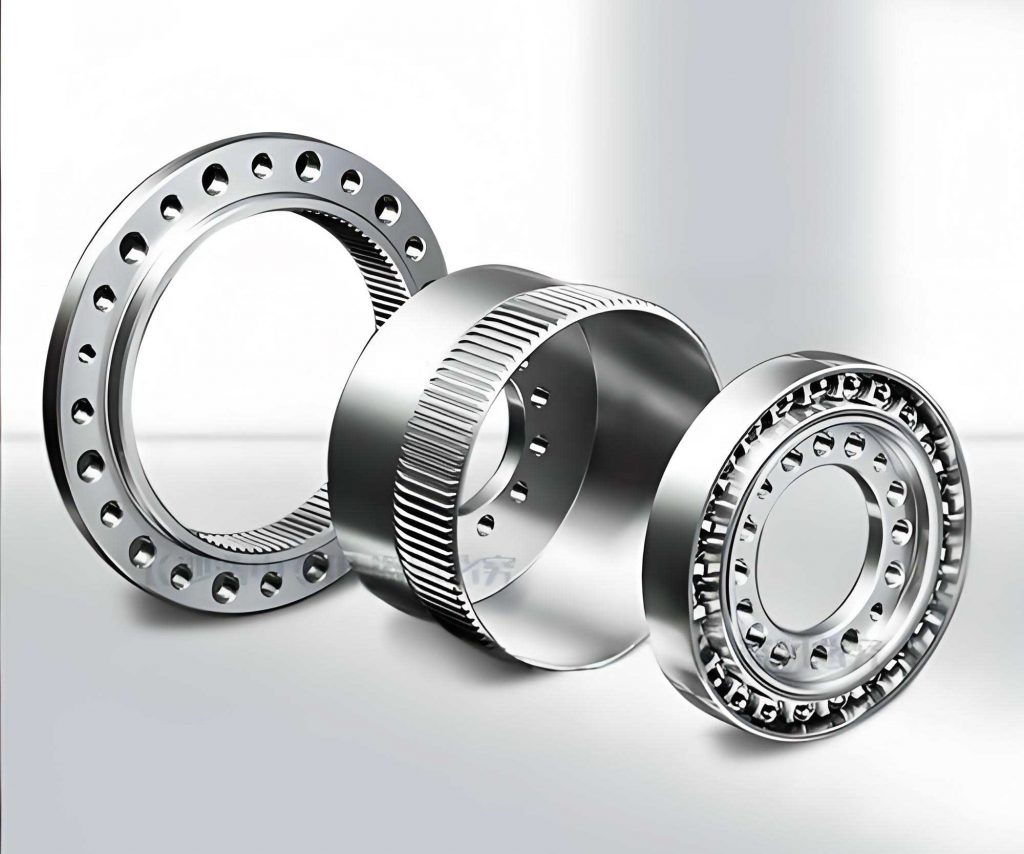
The operational principle of the harmonic drive gear is a masterpiece of elastic kinematics. At its core are three primary components: a rigid Circular Spline (CS), a flexible Flexspline (FS), and an elliptical or cam-shaped Wave Generator (WG). The wave generator, typically incorporating a thin-walled bearing, is inserted into the flexspline, deforming its initially circular rim into an elliptical shape. This controlled deformation causes the teeth of the flexspline to engage with those of the circular spline at two diametrically opposite regions along the major axis of the ellipse. As the wave generator rotates, the elliptical deformation pattern rotates with it. The key to the high reduction ratio lies in the slight difference in the number of teeth between the flexspline and the circular spline. For every full rotation of the wave generator, the flexspline rotates backward (or forward, depending on the configuration) by a number of teeth equal to this difference. The gear reduction ratio, $i$, is given by:
$$ i = \frac{N_{cs}}{N_{cs} – N_{fs}} $$
where $N_{cs}$ is the number of teeth on the circular spline and $N_{fs}$ is the number of teeth on the flexspline. This mechanism provides exceptional advantages, including high torque capacity, zero-backlash operation (in precision designs), coaxial input/output shafts, and remarkably compact dimensions.
Integrated Design of Harmonic Drive System and Evaluation Platform
My design approach transcends the isolated component to encompass the entire system and its evaluation ecosystem. The proposed framework is modular, integrating the physical harmonic drive gear assembly with a suite of real-time detection and analytical modules. The system’s architecture is designed for continuous, automated, and accurate testing, eliminating the need for bulky, dedicated test rigs that often constrain measurement conditions. A central Master Control module orchestrates the entire process, receiving streaming data from three primary sensor arrays. These include a Noise Detection Module equipped with high-sensitivity acoustic sensors, a Load Detection Module using precision torque and force transducers, and a critical Stiffness Detection Module employing advanced displacement and angle sensors. All captured data is streamed to a dedicated Data Storage unit. This repository feeds two core analytical engines: a Transmission Ratio Calculation module that continuously verifies kinematic performance, and a Lifespan Prediction module that employs degradation models based on the acquired dynamic data. Finally, a comprehensive Display Module presents all parameters—noise spectra, load curves, dynamic stiffness, calculated ratios, and remaining life estimates—in an actionable format for engineers and technicians.
| Module | Primary Function | Key Sensors/Inputs | Output |
|---|---|---|---|
| Noise Detection | Acquire acoustic emission data during operation | Acoustic Emission (AE) sensors, Microphones | Noise spectrum, S(f) |
| Load Detection | Measure input/output torque and axial/radial forces | Torque transducers, Load cells | Torque (τ), Force (F) |
| Stiffness Detection | Measure dynamic angular displacement under load | High-resolution encoders, Laser triangulation sensors | Angular deflection (Δθ) |
| Master Control | Coordinate testing sequence, data acquisition, and module communication | System clock, User-defined test profiles | Control signals, Synchronized data streams |
| Lifespan Prediction | Analyze degradation trends from all sensor data | Historical stiffness, noise, and load data | Remaining Useful Life (RUL) estimate |
Advanced Noise Spectrum Analysis for Condition Monitoring
In the context of a harmonic drive gear, acoustic emissions are not merely unwanted sound; they are a rich source of information regarding its internal state. Meshing imperfections, developing wear in the flexspline or wave generator bearing, lubrication breakdown, and mounting misalignments all generate distinctive acoustic signatures. My method moves beyond simple sound pressure level measurement to perform a detailed spectral analysis and model fitting. The core assumption is that the noise power spectral density, $S(f)$, can be modeled as a sum of inverse power laws of frequency, which is effective for characterizing the broadband noise often associated with mechanical degradation:
$$ S(f) = \sum_{\beta=0}^{4} a_{\beta} f^{-\beta} $$
Here, $f$ is frequency, and $a_{\beta}$ are the noise reference coefficients to be determined. These coefficients encapsulate the physical noise generation mechanisms within the harmonic drive gear. To estimate them accurately from discrete measurements $S_i$ at frequencies $f_i$, the problem is cast in matrix form. Selecting $N \geq 5$ frequency points to ensure a well-posed system, we define:
$$ \mathbf{F} =
\begin{bmatrix}
1 & f_1^{-1} & f_1^{-2} & f_1^{-3} & f_1^{-4} \\
1 & f_2^{-1} & f_2^{-2} & f_2^{-3} & f_2^{-4} \\
\vdots & \vdots & \vdots & \vdots & \vdots \\
1 & f_N^{-1} & f_N^{-2} & f_N^{-3} & f_N^{-4}
\end{bmatrix},
\quad
\mathbf{A} =
\begin{bmatrix}
a_0 \\
a_1 \\
a_2 \\
a_3 \\
a_4
\end{bmatrix},
\quad
\mathbf{S} =
\begin{bmatrix}
S_1 \\
S_2 \\
\vdots \\
S_N
\end{bmatrix} $$
The initial estimate $\mathbf{A}^{(0)}$ is obtained via the least-squares solution: $\mathbf{A}^{(0)} = (\mathbf{F}^T\mathbf{F})^{-1}\mathbf{F}^T \mathbf{S}$. An iterative refinement process using a regularized system of equations is then employed to minimize error and account for measurement noise. The correction $\Delta^{(l)}$ at iteration $l$ is solved from:
$$ (\mathbf{J}^{(l)T}\mathbf{J}^{(l)} + \lambda \mathbf{I})\Delta^{(l)} = \mathbf{J}^{(l)T}(\mathbf{S} – \hat{\mathbf{S}}^{(l)}) $$
where $\mathbf{J}^{(l)}$ is the Jacobian matrix of the model with respect to parameters $a_{\beta}$ at the current iterate, $\lambda$ is a regularization parameter, $\mathbf{I}$ is the identity matrix, and $\hat{\mathbf{S}}^{(l)}$ is the model’s spectral estimate. The parameters are updated: $\mathbf{A}^{(l+1)} = \mathbf{A}^{(l)} + \Delta^{(l)}$. This process yields a robust set of coefficients $a_{\beta}$ that serve as a unique fingerprint for the harmonic drive gear’s condition. Trend analysis of these coefficients over time provides an early warning for incipient faults.
Dynamic Stiffness Characterization Through Kinematic Data
Transmission stiffness is arguably the most critical dynamic property of a harmonic drive gear, directly influencing positioning accuracy, bandwidth, and resonance characteristics of the driven system. My proposed method represents a paradigm shift from static or quasi-static measurements to a fully dynamic, model-based identification technique that can be performed during normal operation or with a simple test setup. The procedure is as follows:
- Excitation and Data Acquisition: The joint or system containing the harmonic drive gear is subjected to a controlled sinusoidal or multi-tonal motion profile via its servo motor. Using only standard feedback devices—the motor encoder (input side) and an output-side encoder—the input angle $\theta_{in}(t)$ and output angle $\theta_{out}(t)$ are recorded. The relative angular displacement, $\phi(t)$, is computed:
$$ \phi(t) = \theta_{in}(t) – \theta_{out}(t) $$ - Kinematic Derivation: Numerical differentiation (with appropriate filtering) is applied to obtain angular velocities $\omega_{in}(t)$ and $\omega_{out}(t)$, and subsequently the output angular acceleration $\alpha_{out}(t)$.
- Torque Estimation: The output inertial torque $\tau_{out}(t)$ is estimated by multiplying the filtered output angular acceleration by the known inertia $J_{out}$ of the load attached to the harmonic drive gear’s output:
$$ \tau_{out}(t) \approx J_{out} \cdot \alpha_{out}(t) $$
This elegant approach allows for torque estimation without a direct torque sensor on the output. - Dynamic Model Identification: The relationship between $\phi(t)$ and $\tau_{out}(t)$ is nonlinear, encompassing stiffness, hysteresis, friction, and backlash. A parameterized dynamic model is posited. A common effective model for the harmonic drive gear’s resistive torque $\tau_{hd}$ is:
$$ \tau_{hd}(\phi, \dot{\phi}) = K \phi + B \dot{\phi} + F_c \cdot \text{sgn}(\dot{\phi}) + F_v \dot{\phi} + \tau_h(\phi) $$
where $K$ is the nonlinear stiffness, $B$ is a damping coefficient, $F_c$ is Coulomb friction, $F_v$ is viscous friction, and $\tau_h$ represents a hysteresis function (e.g., modeled by a Bouc-Wen or Preisach model). During motion, $\tau_{hd} \approx \tau_{out}$. - Parameter Identification & Stiffness Mapping: Using the collected time-series data $\{\phi(t), \dot{\phi}(t), \tau_{out}(t)\}$, the model parameters are identified via a least-squares or recursive estimation algorithm. The identified stiffness function $K(\phi)$, which may itself be a polynomial or look-up table, represents the dynamic transmission stiffness of the harmonic drive gear. The quality of the dynamic stiffness map for a harmonic drive gear is paramount for predicting its behavior under complex operational loads.
| Method | Principle | Advantages | Limitations |
|---|---|---|---|
| Static / Quasi-Static | Apply step torque, measure steady-state deflection. | Simple setup, clear interpretation. | Misses dynamic effects, hysteresis losses; slow. |
| Frequency Response | Apply sinusoidal torque, measure amplitude/phase lag. | Characterizes frequency-dependent behavior. | Requires expensive shakers; complex analysis. |
| Proposed Dynamic Identification | Use kinematic data and inertia to estimate torque; identify model. | In-situ capability; captures nonlinear dynamics; cost-effective. | Requires accurate load inertia knowledge; sensitive to measurement noise. |
Material Science and Geometric Optimization in Design
The performance envelope of a harmonic drive gear is fundamentally dictated by the material and geometry of its flexspline. This thin-walled, cyclically deforming component must exhibit an exceptional combination of high fatigue strength, good toughness, and consistent elastic properties. My design methodology places immense emphasis on this element. Advanced alloys, such as high-strength managing steels (e.g., 18Ni300) or specialized precipitation-hardening stainless steels, are selected for their high endurance limits. Furthermore, surface engineering techniques like shot peening or deep rolling are integral to the design specification, as they induce beneficial compressive residual stresses in the critical tooth root and fillet regions of the flexspline, dramatically extending the fatigue life of the harmonic drive gear.
Geometric optimization is performed using Finite Element Analysis (FEA) to map stress and strain distributions under load. Key design variables include:
- Flexspline Cup Geometry: Wall thickness profile, diaphragm shape, and back-cone angle.
- Tooth Profile: Modifications to the standard involute to optimize stress distribution and contact pattern between the flexspline and circular spline.
- Wave Generator Profile: The contour of the cam or the elliptical bearing raceway, which controls the deformation path of the flexspline.
The optimization objective is a multi-variable function $F_{obj}$ to be minimized:
$$ F_{obj} = w_1 \cdot \sigma_{max} + w_2 \cdot \delta_{max} + w_3 \cdot V $$
where $\sigma_{max}$ is the maximum von Mises stress, $\delta_{max}$ is the maximum deformation, $V$ is the volume (mass), and $w_i$ are weighting factors prioritizing strength, stiffness, and lightweighting, respectively. The result is a harmonically optimized flexspline that delivers the required torque and life while minimizing weight and strain energy.
Lifespan Prediction Model Integrating Multi-Physics Data
Accurate Remaining Useful Life (RUL) prediction transforms the harmonic drive gear from a maintenance-based component into a prognostics and health management (PHM) asset. My model integrates the multi-dimensional data streams from the detection modules. The core degradation driver is often fatigue in the flexspline, accelerated by factors reflected in the sensor data. A general prognostic model can be formulated as:
$$ \frac{dD(t)}{dt} = G(\boldsymbol{\Theta}(t), \mathbf{S}(t)) $$
where $D(t)$ is a damage index (0 for new, 1 for failure), $\boldsymbol{\Theta}(t)$ represents the operational parameters (torque, speed, cycles), and $\mathbf{S}(t)$ represents the condition indicators (stiffness drop $-\Delta K$, noise coefficient trend $\Delta a_{\beta}$, temperature increase). The function $G$ is learned from historical run-to-failure data or physics-based failure models. For example, a model incorporating dynamic stiffness loss and load might be:
$$ \frac{dD}{dN} = C \cdot \left( \frac{\tau_{amp}}{\tau_{ult} \cdot (1 – \gamma \cdot \Delta K)} \right)^m $$
where $N$ is the number of cycles, $C$ and $m$ are material constants, $\tau_{amp}$ is the torque amplitude, $\tau_{ult}$ is the ultimate torque strength, $\Delta K$ is the percentage loss of initial stiffness, and $\gamma$ is a scaling factor. By continuously updating $D(t)$ with real-time $\tau_{amp}(t)$ and $\Delta K(t)$ from the detection system, a continuously evolving RUL estimate is generated: $RUL(t) = \frac{1-D(t)}{dD/dt}$.
Applications and Future Trajectories
The implications of this integrated design-and-evaluation framework are profound. In space robotics, where reliability is paramount and repair is impossible, the ability to continuously monitor the stiffness and acoustic signature of a harmonic drive gear in a joint actuator allows for mission adaptation and fault anticipation. In high-speed pick-and-place robots, the dynamic stiffness map enables feedforward compensation controllers that can cancel torsional vibrations, pushing the limits of speed and accuracy. The future development of the harmonic drive gear is inextricably linked with such intelligent monitoring. Research trajectories include the integration of fiber Bragg grating (FBG) sensors directly into the flexspline material for direct strain field measurement, the use of machine learning algorithms to identify more complex patterns in the noise and vibration data for finer fault classification, and the development of self-lubricating or magnetically levitated wave generators to eliminate mechanical wear entirely.
In conclusion, the harmonic drive gear remains a pivotal technology for precision motion. The synergy of advanced materials, optimized geometry, and—most critically—a sophisticated, model-based evaluation system that leverages noise, kinematics, and load data for dynamic stiffness identification and prognostics, marks a significant evolution. This holistic approach moves us from a paradigm of periodic maintenance based on time or cycles, to one of condition-based and predictive maintenance grounded in the actual physical state of the component. It ensures that every harmonic drive gear can be trusted not just for its designed performance, but for its verifiable and predictable performance throughout its entire service life, thereby enhancing the reliability, efficiency, and intelligence of the broader mechanical systems it empowers.