
In the field of robotics, the development of a dexterous robotic hand that mimics the human hand’s biological structure has been a long-standing goal due to its high dexterity, versatility, and adaptability in performing various grasping and manipulation tasks. As a researcher focused on robotic manipulation, I have explored multiple design paradigms for dexterous robotic hands, including mechanical hinge structures, biomimetic joints, and tendon-driven configurations. However, many existing designs rely on complex mechanical transmissions and control methods, which often compromise flexibility and adaptability. In this work, I propose a novel design for a dexterous robotic hand that integrates tendon winding reduction with tendon transmission, utilizing a special rope-winding method to achieve finger abduction/adduction and coupled motions. This approach aims to achieve a biomimetic, compact, and lightweight dexterous robotic hand with human-like agility and grasping force. Throughout this article, I will detail the design, analysis, and testing of this dexterous robotic hand, emphasizing key aspects such as kinematics, statics, and practical grasping capabilities.
The human hand serves as an ideal model for robotic hands due to its exceptional functionality. My design philosophy revolves around replicating key features of the human hand, including size similarity, joint structure, and motion characteristics. The dexterous robotic hand I developed comprises five fingers, each with three joints and three independently controllable degrees of freedom (DOFs). Specifically, the metacarpophalangeal (MCP) joint has two DOFs: flexion/extension and abduction/adduction. The abduction/adduction joint angle ranges from -20° to 20°, while the flexion/extension joint angles range from 0° to 90°. This configuration enables the dexterous robotic hand to perform a wide array of gestures and grasping actions, similar to a human hand. The overall dimensions are comparable to an adult human hand, ensuring practical applicability in tasks requiring fine manipulation.
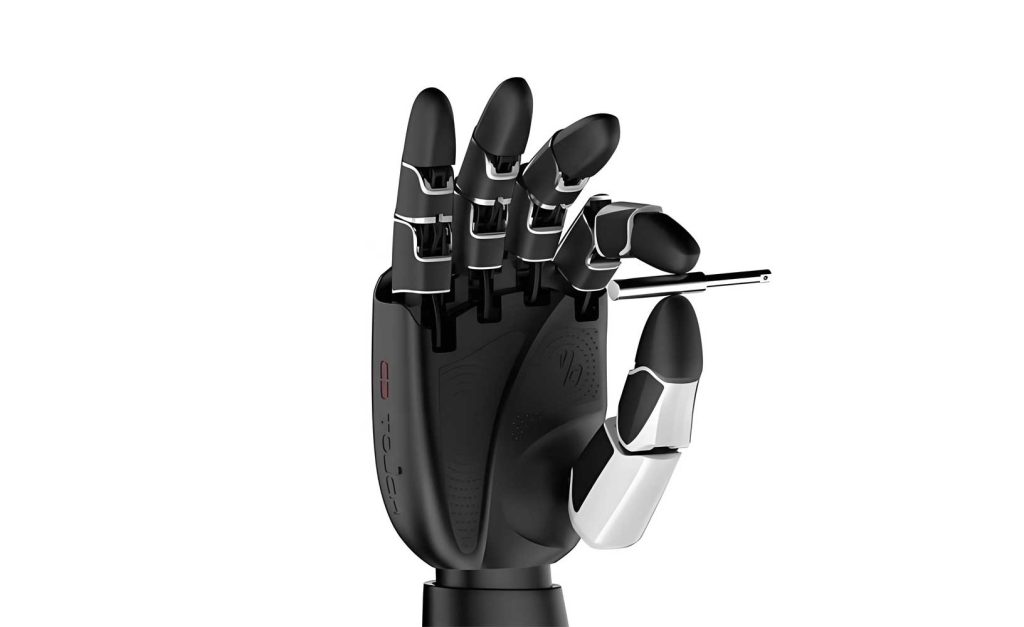
To achieve a modular and maintainable design, I adopted a modular approach where each finger of the dexterous robotic hand has an identical structure but varying lengths. Each finger consists of four parts: the fingertip, middle phalanx, proximal phalanx, and finger base. The distal interphalangeal (DIP) and proximal interphalangeal (PIP) joints are designed to exhibit coupled motion, mimicking the human hand’s oblique ligaments. I implemented a special tendon-routing method to realize this coupling. As shown in the design schematics, tendons are routed through pulleys and binding points to synchronize joint movements. For instance, when the tendon for the PIP joint is actuated, it causes the DIP joint to rotate proportionally, adhering to the human-like coupling ratio where the DIP joint angle is approximately two-thirds of the PIP joint angle. This coupling enhances the dexterous robotic hand’s ability to conform to object surfaces during grasping.
The driving mechanism for this dexterous robotic hand is based on the twisting wire actuator principle, which exploits the shortening effect of flexible tendons during twisting. This approach, known as wound rope drive, offers high reduction ratios, compactness, and compliance. Each tendon is connected to a micro DC motor at one end and to the finger joints at the other end. By twisting the tendon via motor rotation, linear contraction is achieved, pulling the joints to produce motion. This method eliminates the need for bulky gearboxes or linkages, contributing to the lightweight nature of the dexterous robotic hand. The drive module is integrated into the palm, with tendons routed through dedicated channels to minimize interference and space usage. For abduction/adduction motions, I designed a unique tendon-routing system where tendons pass through a winding shaft and are attached to both sides of the abduction mechanism. Motor rotation in opposite directions tightens one side while loosening the other, enabling rapid side-to-side finger movements with minimal space consumption. This design is particularly beneficial for the dexterous robotic hand’s adaptability in complex grasping scenarios.
The control system for the dexterous robotic hand is built around an STM32 microcontroller as the main control unit. It manages 15 micro DC motors, each equipped with Hall sensors for position feedback. Motor drivers communicate with the microcontroller via CAN bus, enabling precise control of motor speed, current, and angle. I developed a graphical user interface (GUI) using QT for上位机 control, allowing users to set motor parameters, monitor finger positions, and execute grasping commands through serial communication. The software facilitates real-time adjustment and data logging, essential for experimental validation. This integrated control system ensures that the dexterous robotic hand can perform coordinated movements and respond dynamically to environmental changes.
To analyze the performance of the dexterous robotic hand, I conducted a comprehensive kinematic study. The wound rope drive kinematics relate motor rotation to tendon contraction and joint angles. For a tendon with initial length segments S1 and S2, diameter r, and distance D from the output point to the tendon axis, the contraction length ΔL as a function of motor angle ε is given by:
$$ \Delta L = \sqrt{S_2^2 – D^2} – \sqrt{(S_1 + S_2 – \sqrt{(2D + r\varepsilon)^2 + S_1^2})^2 – D^2} $$
This contraction translates to joint rotation θ through a geometric constant c: ΔL = θc. For abduction/adduction, the relationship between motor angle ε1 and joint angle θ1 involves the winding shaft radius R, tendon radius r, base length T, and spiral angle β:
$$ \theta_1 = \frac{\pi}{180} \varepsilon_1 \cdot \frac{R + r}{T \sin \beta} $$
For finger kinematics, I used the Denavit-Hartenberg (D-H) method to model each finger as a serial chain. The D-H parameters for a typical finger are summarized in Table 1.
| Joint i | θ_i (°) | d_i (mm) | a_i (mm) | α_i (°) |
|---|---|---|---|---|
| 1 | θ_1 | 0 | a_1 = 0 | 90 |
| 2 | θ_2 | 0 | a_2 | 0 |
| 3 | θ_3 | 0 | a_3 | 0 |
| 4 | θ_4 | 0 | a_4 | 0 |
The homogeneous transformation matrices are derived as follows:
$$ ^{i-1}_i T = \begin{bmatrix}
\cos \theta_i & -\sin \theta_i \cos \alpha_i & \sin \theta_i \sin \alpha_i & a_i \cos \theta_i \\
\sin \theta_i & \cos \theta_i \cos \alpha_i & -\cos \theta_i \sin \alpha_i & a_i \sin \theta_i \\
0 & \sin \alpha_i & \cos \alpha_i & d_i \\
0 & 0 & 0 & 1
\end{bmatrix} $$
The forward kinematics for the fingertip position relative to the base frame are:
$$ ^0X_4 = (a_4 C_{234} + a_3 C_{23} + a_2 C_2) C_1 $$
$$ ^0Y_4 = (a_4 C_{234} + a_3 C_{23} + a_2 C_2) S_1 $$
$$ ^0Z_4 = a_4 S_{234} + a_3 S_{23} + a_2 S_2 $$
where S_i = sin θ_i, C_i = cos θ_i, S_{ij} = sin(θ_i + θ_j), C_{ij} = cos(θ_i + θ_j), and so on. The inverse kinematics solve for joint angles given fingertip coordinates. For example, θ_1 is computed as:
$$ \theta_1 = \tan^{-1}\left( \frac{^0Y_4}{^0X_4} \right) $$
with constraints -20° ≤ θ_1 ≤ 20°. The coupled angles θ_3 and θ_4 are derived numerically from geometric relations, and θ_2 is obtained via trigonometric equations. These kinematic models enable precise control of the dexterous robotic hand’s finger positions.
The workspace of the dexterous robotic hand’s finger, representing all reachable points by the fingertip, was analyzed using MATLAB’s Robotics Toolbox. By sampling 30,000 random joint angles within allowable ranges, I generated a point cloud visualization. The workspace exhibits a broad spatial volume, facilitating grasping of objects with varied shapes and sizes. This extensive reach is crucial for the dexterous robotic hand’s versatility in real-world applications.
Static analysis focuses on the relationship between joint torques and fingertip forces during grasping. Assuming quasi-static conditions and point contacts, the Jacobian matrix J maps joint velocities to fingertip velocities. For flexion/extension motions, the Jacobian is derived as:
$$ J = \begin{bmatrix}
-(a_4 S_{234} + a_3 S_{23} + a_2 S_2) & -(a_4 S_{234} + a_3 S_{23}) & -a_4 S_{234} \\
a_4 C_{234} + a_3 C_{23} + a_2 C_2 & a_4 C_{234} + a_3 C_{23} & a_4 C_{234} \\
0 & -\frac{RR_1}{k} & 1
\end{bmatrix} $$
where RR_1 is the DIP joint radius and k is a coupling constant. The joint torques τ are related to fingertip forces F by τ = J^T F. For instance, the torques at joints 2 and 3 are:
$$ \tau_2 = [-a_4 \sin(\theta_2 + \theta_3 + \theta_4) – a_3 \sin(\theta_2 + \theta_3) – a_2 \sin \theta_2] f_x + [a_4 \cos(\theta_2 + \theta_3 + \theta_4) + a_3 \cos(\theta_2 + \theta_3) + a_2 \cos \theta_2] f_z $$
$$ \tau_3 = [-a_4 \sin(\theta_2 + \theta_3 + \theta_4) – a_3 \sin(\theta_2 + \theta_3)] f_x + [a_4 \cos(\theta_2 + \theta_3 + \theta_4) + a_3 \cos(\theta_2 + \theta_3)] f_z $$
where f_x and f_z are contact force components. This analysis helps in sizing actuators and ensuring sufficient grasping force for the dexterous robotic hand.
To validate the design, I conducted grasping experiments with various objects. The dexterous robotic hand successfully performed both pinch and enveloping grasps, demonstrating its adaptability. In pinch grasps, the thumb and index finger cooperated to pick up small items like a 40-mm diameter ball and a 66×37×15 mm box. The abduction capability of the fingers enhanced precision in handling such objects. For enveloping grasps, the hand conformed to larger items like a 75-mm diameter orange, an irregular stapler, and a 60–65 mm diameter water bottle. The tendon-driven compliance and joint coupling allowed the fingers to wrap around objects securely, mimicking human-like grasping behavior. These tests confirm that the dexterous robotic hand achieves stable and reliable grasping across a range of shapes and sizes, highlighting its potential for practical use in robotics.
In terms of technical specifications, the dexterous robotic hand incorporates multiple design innovations. Table 2 summarizes key parameters of the finger joints and drive system.
| Parameter | Value | Description |
|---|---|---|
| Number of Fingers | 5 | Modular design with identical structure |
| DOFs per Finger | 3 | Flexion/extension and abduction/adduction |
| Joint Angle Ranges | θ_1: -20° to 20°, θ_2, θ_3, θ_4: 0° to 90° | Based on human hand kinematics |
| Drive Mechanism | Wound rope actuator | Utilizes tendon twisting for contraction |
| Actuators | 15 micro DC motors | Integrated with Hall sensors |
| Control Unit | STM32 microcontroller | Manages motor commands and feedback |
| Communication | CAN bus and serial interface | For motor drivers and上位机 software |
The wound rope drive offers several advantages for the dexterous robotic hand. Its high reduction ratio allows the use of small, low-torque motors while generating substantial fingertip forces. The elasticity of tendons introduces passive compliance, reducing impact forces and enhancing object manipulation safety. Moreover, the compact layout of tendons within the finger structures minimizes overall weight and complexity. Compared to traditional linkage-based designs, this tendon-driven approach improves the dexterous robotic hand’s adaptability and simplifies maintenance.
From a control perspective, the dexterous robotic hand’s kinematics enable both position and force control strategies. The forward kinematics equations provide real-time fingertip position estimation based on motor encoder readings. Inverse kinematics algorithms allow planning of joint trajectories for desired grasping postures. Additionally, the static model facilitates force control by regulating motor currents to achieve specific contact forces. I implemented a proportional-integral-derivative (PID) controller for each motor, tuned to achieve smooth and accurate joint movements. The上位机 software provides a platform for testing different control algorithms, further enhancing the dexterous robotic hand’s performance.
In development, I faced challenges such as tendon wear and friction management. To address these, I selected high-strength, low-friction synthetic fibers for tendons and incorporated lubricated sheaths at routing points. The winding shaft design for abduction/adduction includes polished surfaces to minimize friction losses. These considerations ensure durability and consistent performance of the dexterous robotic hand over extended use.
The dexterous robotic hand’s workspace analysis reveals its capability to handle objects within a broad spatial envelope. Using the forward kinematics equations, I computed the reachable points for a representative finger. The results show that the fingertip can access regions spanning approximately 80 mm in the X-direction, 80 mm in the Y-direction, and 80 mm in the Z-direction relative to the base. This workspace is sufficient for common grasping tasks, such as picking up cups, tools, or electronic devices. The inclusion of abduction/adduction DOFs expands the workspace laterally, enabling the dexterous robotic hand to grasp objects from various orientations.
For future improvements, I plan to integrate tactile sensors on the fingertips of the dexterous robotic hand to provide haptic feedback. This would enable more sophisticated manipulation tasks, such as object recognition and slip detection. Additionally, machine learning algorithms could be employed to optimize grasping strategies based on sensor data. The modular design allows for easy upgrades, such as replacing tendons with more durable materials or adding extra DOFs for enhanced dexterity.
In conclusion, the dexterous robotic hand presented in this work demonstrates a significant advancement in biomimetic robotic manipulation. By leveraging tendon-driven actuation and innovative routing techniques, I achieved a compact, lightweight, and highly adaptable design. The kinematic and static analyses provide a foundation for precise control, while grasping experiments validate its practical utility. This dexterous robotic hand holds promise for applications in industrial robotics, prosthetic devices, and humanoid robots, where human-like dexterity is essential. Ongoing research will focus on enhancing sensory integration and autonomous control, further pushing the boundaries of what a dexterous robotic hand can accomplish.
Throughout this article, I have emphasized the importance of the dexterous robotic hand in modern robotics. The design principles discussed here—such as modularity, tendon-driven actuation, and biomimetic coupling—can inspire future developments in the field. As robotics continues to evolve, the dexterous robotic hand will play a crucial role in bridging the gap between human and machine capabilities, enabling more natural and efficient interactions with the physical world.