
The field of robotics has expanded dramatically, driven in part by the demands of intelligent manufacturing. The robotic hand, serving as the end-effector and the sole direct point of interaction with the environment, has evolved significantly. Its development has progressed from simple grippers to modern, anthropomorphic, multi-fingered, multi-joint dexterous robotic hand systems equipped with sensing capabilities. Key aspects of this evolution include the design of finger dexterity, such as overall size, number of joints, selection of actuation and transmission methods, and integration of sensor systems. Multi-fingered dexterous robotic hands, characterized by their high degrees of freedom, multiple fingers, and perceptual functions, are well-suited to meet these advanced requirements. A core function of such a hand is to achieve human-like grasping, making the study of grasp force planning a critical element in the control of multi-fingered manipulation and coordination.
A common challenge in traditional dexterous robotic hand design is the inherent conflict between pursuing high dexterity and managing resulting large dimensions and structural complexity. To address this, our work focuses on the design of a compact, fully actuated three-fingered dexterous robotic hand with high flexibility. This involves detailed analysis of the drive train, transmission mechanisms, and assembly. We performed motor selection for the joints, established dynamic and static models, created a detailed 3D model, and conducted dynamic simulations to validate the structural design and motor selection. Furthermore, based on the designed structure, we applied a straightforward yet effective method for contact force planning to solve for feasible grasping forces, verifying their realizability under the constraints of available joint torques.
Structural Design of the Three-Fingered Dexterous Robotic Hand
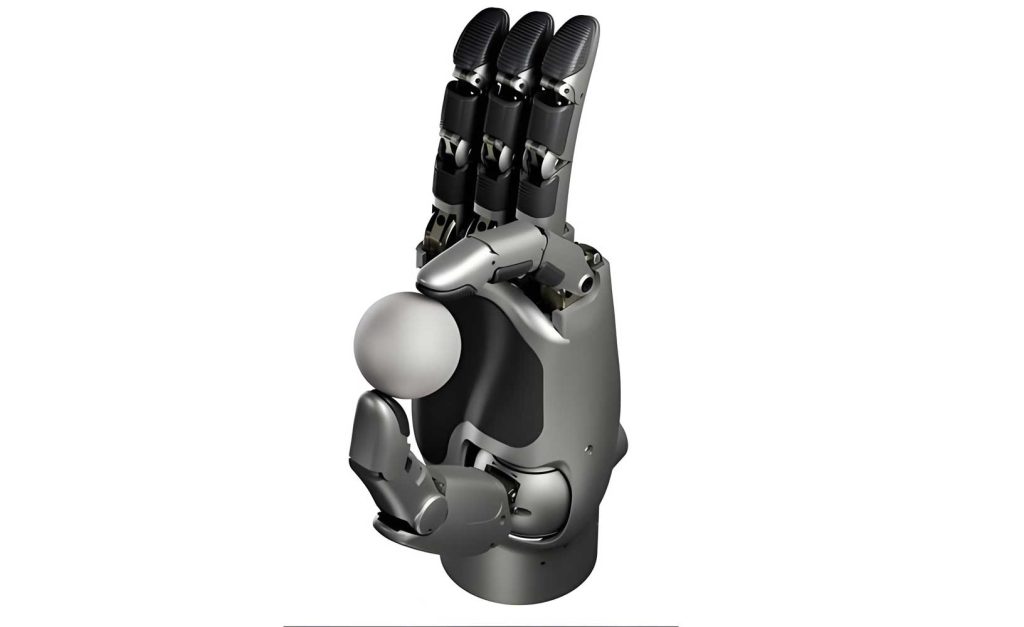
Based on common robotic grasping postures, we designed a small, highly flexible, fully actuated three-fingered dexterous robotic hand. All joints in the hand are revolute. The chosen actuators are compact and powerful Maxon DC servo motors paired with matching gearheads. The key structural features of this dexterous robotic hand are as follows:
- The overall mechanism is simple, compact, and lightweight. The fingers primarily consist of joint housings, motors, gearheads, and motor mounts, with a tightly managed clearance of only 4mm, contributing to a compact and light joint structure.
- The hand possesses a total of eight degrees of freedom, offering high dexterity. Through the coordinated motion of its three fingers, it can perform most common grasping functions, including power grasps, precision pinches, and enveloping grasps.
- The use of DC servo motors and bevel gear transmission ensures reliable motion transfer, high control precision, small size, and a high level of integration.
Following the overall design scheme, we detailed the hand’s structure. The dexterous robotic hand comprises three fingers, a palm, and a base. The two outer fingers are driven by DC servo motors on the base to perform abduction/adduction (side-sway) motions. Finger flexion is achieved via internal drive motors within the joints. The middle finger’s proximal joint length is 55mm, and the distal joint length is 35mm.
The base motors control the side-sway rotation of the two outer fingers. By rotating to appropriate angles and cooperating with the middle finger, common actions such as grasping, holding, pinching, and enveloping can be executed, allowing the dexterous robotic hand to adapt well to objects of various shapes. The use of a worm gear set in the base joint not only redirects the motion axis but also provides speed reduction for the drive motor. The flexion of the distal joint is driven by a motor housed within the middle finger’s proximal joint, transmitting motion via bevel gears. The motor and gearhead are fixed inside the joint by a motor mount, and its output shaft is axially secured by a sleeve and a set screw. The palm, fixedly connected to the middle finger base, serves a dual purpose: it assists in object envelopment and acts as a mechanical limit, while also maintaining balance and stability for the bases of the other two fingers. The entire mechanism is compact, small in size, and highly flexible.
| Feature | Specification |
|---|---|
| Number of Fingers | 3 |
| Total Degrees of Freedom | 8 |
| Actuation Type | Fully Actuated (DC Servo Motors) |
| Proximal Joint Length | 55 mm |
| Distal Joint Length | 35 mm |
| Key Transmission Elements | Worm Gears (Base), Bevel Gears (Finger) |
| Motor Type | Maxon DC Servo with Gearhead |
Dynamic Modeling and Simulation of the Dexterous Robotic Hand
Establishment of the Dynamic Equations
Several methods exist for dynamic analysis, including the Lagrange method, Newton-Euler method, and Gauss’s principle. The Lagrange method, which does not require consideration of internal forces between components and offers a clear formulation with explicit physical meaning, was employed for our analysis of the dexterous robotic hand.
The Lagrange dynamic equation model is given by:
$$ \frac{d}{dt}\left(\frac{\partial L}{\partial \dot{q}_i}\right) – \frac{\partial L}{\partial q_i} = F_i $$
where the Lagrangian function $L = K – P$, $K$ is the kinetic energy of the finger, $P$ is the potential energy, $q_i$ are the joint variables, and $F_i$ are the joint driving torques.
Based on the structural characteristics of the three-fingered hand, a single finger is simplified and modeled as a planar two-link mechanism. The system’s total kinetic and potential energies are derived as follows:
$$ K = K_1 + K_2 = \frac{1}{6}m_1 l_1^2 \dot{A}^2 + \frac{1}{6}m_2 l_2^2 \dot{B}^2 + \frac{1}{2}m_2 l_1^2 \dot{A}^2 + \frac{1}{2}m_1 l_1 l_2 c_2 \dot{A}^2 + \frac{1}{3}m_2 l_2^2 \dot{B}^2 + \frac{1}{2}m_1 l_1 l_2 c_2 \dot{A}\dot{B} $$
$$ P = \frac{1}{2}m_1 g l_1 s_1 + m_2 g \left( l_1 s_1 + \frac{1}{2} l_2 s_{12} \right) $$
where $m_1, m_2$ are the link masses, $l_1, l_2$ are the link lengths, $A$ and $B$ are the joint angles, $c_2 = \cos(B)$, $s_1 = \sin(A)$, $s_{12} = \sin(A+B)$, and $g$ is gravity.
Applying the Lagrange equation (1), the joint driving torques $T_1$ and $T_2$ (corresponding to $F_i$) are obtained:
$$
\begin{aligned}
T_1 &= \left( \frac{1}{3}m_1 l_1^2 + m_2 l_1^2 + \frac{1}{3}m_2 l_2^2 + m_2 l_1 l_2 c_2 \right) \ddot{A} – \frac{1}{2}m_2 l_1 l_2 s_2 \dot{B}^2 \\
&\quad + \left( \frac{1}{3}m_2 l_2^2 + \frac{1}{2}m_2 l_1 l_2 c_2 \right) \ddot{B} – (m_2 l_1 l_2 s_2) \dot{A}\dot{B} \\
&\quad + \left( \frac{1}{2}m_1 + m_2 \right) g l_1 c_1 + \frac{1}{2} m_2 g l_2 c_{12}
\end{aligned}
$$
$$
T_2 = \left( \frac{1}{3}m_2 l_2^2 + \frac{1}{2}m_2 l_1 l_2 c_2 \right) \ddot{A} + \frac{1}{3}m_2 l_2^2 \ddot{B} + \frac{1}{2}m_2 l_1 l_2 s_2 \dot{A}^2 + \frac{1}{2} m_2 g l_2 c_{12}
$$
where $s_2 = \sin(B)$, $c_1 = \cos(A)$, $c_{12} = \cos(A+B)$. These dynamic equations incorporate simplifications: the finger links are modeled as uniform rods, joint friction is neglected, and links are treated as rigid bodies. Consequently, the joint driving torques depend solely on the joint motion profiles.
Dynamic Simulation and Validation using ADAMS
To avoid complexity in the ADAMS simulation environment due to numerous parts and mating relationships, the 3D model of the dexterous robotic hand was simplified appropriately. The simplified virtual prototype was constructed in ADAMS by defining material properties, adding revolute joints at appropriate locations, and applying fixed constraints where needed. Motion drives, defined using ADAMS step functions, were applied to the revolute joints to prescribe their motion profiles. Simulation yielded performance curves for joint velocity, displacement, and driving torque. Since the flexion joints of the three fingers are identical, the same drive functions were applied, resulting in identical velocity, displacement, and acceleration profiles for corresponding joints.
The simulation results showed that the finger joint velocity and displacement curves changed smoothly and steadily over a 3-second period, with no violent vibrations or sudden jumps, indicating the reasonableness of the mechanical design for the dexterous robotic hand. The joint torque curves were also obtained from the simulation.
To validate the theoretical dynamic model, a set of discrete time points was selected, and the corresponding theoretical torque values were calculated using the derived equations in MATLAB. These were compared against the torque data extracted from the ADAMS simulation, as shown in the comparison plot. The deviation between the theoretical analysis data and the simulation data is minimal and falls within a reasonable range. This consistency verifies the correctness of the theoretical calculation and the rationality of the simulation analysis, providing a reliable reference for motor selection and control system design of the dexterous robotic hand.
| Time (s) | Theoretical Torque (mNm) | ADAMS Simulated Torque (mNm) | Absolute Error (mNm) |
|---|---|---|---|
| 0.5 | 4.21 | 4.35 | 0.14 |
| 1.0 | -1.88 | -2.01 | 0.13 |
| 1.5 | -8.97 | -9.12 | 0.15 |
| 2.0 | 6.54 | 6.40 | 0.14 |
| 2.5 | 11.23 | 11.08 | 0.15 |
Static Analysis of the Dexterous Robotic Hand
When the dexterous robotic hand is in contact with an external object, a static analysis is necessary to determine the relationship between the fingertip contact forces and the joint driving torques, which is essential for reliable grasping. Under static conditions, according to the principle of virtual work, the relationship between the joint driving torque vector $\boldsymbol{\tau}$ and the fingertip contact force vector $\mathbf{F}_P$ is given by $\boldsymbol{\tau} = \mathbf{J}^T \mathbf{F}_P$, where $\mathbf{J}$ is the Jacobian matrix. Avoiding singular configurations, the relationship to compute the contact force from the joint torques for a two-link finger model is:
$$ \mathbf{F}_P = \begin{bmatrix} F_{PX} \\ F_{PY} \end{bmatrix} = (\mathbf{J}^T)^{-1} \begin{bmatrix} \tau_1 \\ \tau_2 \end{bmatrix} $$
where the inverse transpose of the Jacobian for the planar model is:
$$ (\mathbf{J}^T)^{-1} = \frac{1}{l_1 l_2 s_2} \begin{bmatrix} l_2 c_{12} & -l_1 c_1 – l_2 c_{12} \\ l_2 s_{12} & -l_1 s_1 – l_2 s_{12} \end{bmatrix} $$
From Equation (5), it is evident that the fingertip contact force $\mathbf{F}_P$ depends on both the joint driving torques and the joint angles. Considering the designed dexterous robotic hand structure and its grasping performance, the operational joint angle ranges are defined as $A \in [-30^\circ, 0]$ and $B \in [30^\circ, 60^\circ]$. Given a fixed set of joint driving torques (determined by motor selection), the magnitude of the contact force $\|\mathbf{F}_P\|$ is determined by the joint angles. Conversely, specifying a required contact force range informs the necessary motor torque specifications.
Contact Force Planning and Calculation for the Multi-Fingered Grasp
When a multi-fingered dexterous robotic hand grasps or manipulates an object, each finger must apply an appropriate force. This force must be sufficient to ensure a stable grasp but not so large as to cause deformation or damage to the object. The problem of finding a set of feasible contact forces is known as grasp force planning.
We employ a method that utilizes Lagrange multipliers to obtain an initial set of grasping forces that satisfy the nonlinear friction cone constraints. This initial solution is then optimized by introducing a stability margin coefficient to yield a final set of robust, optimal contact forces. This method explicitly considers the constraints imposed by the available joint driving torques of the dexterous robotic hand, ensuring the computed forces are physically realizable.
Considering the general case of frictional point contact, the contact force for the $i$-th finger can be represented as $\mathbf{F}_{Pi} = (F_{Pix}, F_{Piy}, F_{Piz})^T$ in the local contact coordinate frame. The relationship between all finger contact forces, stacked into a vector $\mathbf{F}_p$, and the net wrench $\mathbf{F}_0$ applied to the object is linear, defined by the grasp matrix $\mathbf{G} \in \mathbb{R}^{6 \times 3m}$ (where $m$ is the number of contact points):
$$ \mathbf{G} \mathbf{F}_p = -\mathbf{F}_0 $$
For a stable, force-closure grasp, the contact forces must satisfy the equilibrium equation (6), the friction cone constraints, and the unilateral (non-adhesive) force constraint. The friction cone and unilateral constraints for each contact $i$ are:
$$ \sqrt{F_{ix}^2 + F_{iy}^2} \le \mu_i F_{iz}, \quad F_{iz} \ge 0 $$
The general solution to the compatibility equation (6) is:
$$ \mathbf{F}_p = \mathbf{F}_M + \mathbf{F}_N = -\mathbf{G}^+ \mathbf{F}_0 + (\mathbf{I} – \mathbf{G}^+ \mathbf{G}) \mathbf{v} $$
where $\mathbf{F}_M$ is the particular solution that balances the external object wrench (the manipulation force), $\mathbf{F}_N$ is the homogeneous solution representing the internal grasping forces crucial for stability, $\mathbf{G}^+$ is the Moore-Penrose pseudo-inverse of $\mathbf{G}$, $\mathbf{I}$ is the identity matrix, and $\mathbf{v}$ is an arbitrary vector of appropriate dimension. By modulating $\mathbf{v}$, we can adjust the internal forces to obtain contact forces that satisfy all constraints while optimizing a desired objective, such as minimizing the sum of normal forces. We construct the initial force set as:
$$ \mathbf{F}_p = -\mathbf{G}^+ \mathbf{F}_0 + (\mathbf{I} – \mathbf{G}^+ \mathbf{G}) \boldsymbol{\alpha} $$
Here, $\boldsymbol{\alpha}$ is a coefficient vector that scales the internal forces. By dynamically adjusting $\boldsymbol{\alpha}$ through iterative scaling ($\boldsymbol{\alpha}^{k+1} = \beta \boldsymbol{\alpha}^{k}$ with $\beta > 1$), an initial set of contact forces satisfying the friction cone constraints can be efficiently found. The elements of $\boldsymbol{\alpha}$ essentially act as weighting factors for the normal force components at each contact.
To demonstrate this planning method for our dexterous robotic hand, we consider the task of grasping a sphere of diameter 60mm. For grasp stability, the three fingertip contact points A, B, and C are placed uniformly on a great circle of the sphere. The coefficient of friction at each contact is $\mu = 0.3$. The external wrench $\mathbf{F}_0$ is set to $[0.15, 0.173, 0.3, 0, 0, 0]^T$ (forces in N, moments in Nmm). With an initial coefficient vector $\boldsymbol{\alpha}_0 = 0.3 \mathbf{1}$ and scaling factor $\beta=1.2$, the algorithm converges to an initial feasible grasp force set $\mathbf{F}_p^0$.
Verification confirms that $\mathbf{G}\mathbf{F}_p^0 + \mathbf{F}_0 \approx \mathbf{0}$ and each force lies within its friction cone ($\sqrt{F_{ix}^2+F_{iy}^2} – \mu F_{iz} < 0$). However, these initial forces are often near the friction cone boundary, offering minimal robustness against disturbances. To enhance stability, we introduce a stability margin coefficient $\lambda > 1$ (here, $\lambda=1.2$) to tighten the friction cone constraint during optimization:
$$ \sqrt{F_{ix}^2 + F_{iy}^2} \le \frac{\mu_i}{\lambda} F_{iz} $$
Re-solving the optimization problem with this modified constraint yields the final, optimized contact forces:
$$
\begin{aligned}
\mathbf{F}_{P1} &= [-0.025,\ 0.1,\ 0.59]^T \text{ N} \\
\mathbf{F}_{P2} &= [0.075,\ 0.1,\ 0.54]^T \text{ N} \\
\mathbf{F}_{P3} &= [-0.05,\ 0.1,\ 0.46]^T \text{ N}
\end{aligned}
$$
Compared to the initial forces, the optimized set features increased normal force components ($F_{iz}$), thereby increasing the grasp’s stability margin and its ability to resist external disturbances. Crucially, a static analysis using Equation (5) confirms that these optimized contact forces are achievable within the operable joint angle ranges of the dexterous robotic hand and its available joint driving torques, validating the physical realizability of the planned grasp.
Conclusion
This work presented the comprehensive design and analysis of a novel three-fingered dexterous robotic hand. We began with the mechanical design, focusing on a compact and highly flexible fully-actuated architecture, including configuration, component layout, and part selection, culminating in a detailed 3D model. A dynamic mathematical model for a single finger was established using the Lagrange method. Numerical analysis of the dynamic equations in MATLAB produced theoretical joint torque curves. Concurrently, a virtual prototype of the dexterous robotic hand was built in ADAMS for simulation, yielding joint torque, velocity, and displacement curves. The smooth nature of these curves demonstrated the合理性 of the structural design. The close agreement between the theoretical and simulated torque curves validated the correctness of the dynamic analysis.
Furthermore, we addressed the critical problem of grasp force planning. A method based on Lagrange multipliers was implemented to efficiently compute an initial set of feasible contact forces satisfying frictional constraints. This initial solution was then optimized by incorporating a stability margin coefficient to produce a robust set of grasping forces. The entire process accounted for the constraints imposed by the dexterous robotic hand‘s joint actuators, ensuring the planned forces are not only optimal for stability but also physically realizable by the hardware. This integrated approach, combining innovative mechanical design with rigorous modeling and practical force planning, contributes a valuable reference for the development and control of future dexterous robotic hand systems.