
In the field of robotics, the development of advanced end-effectors is crucial for enhancing automation in industrial and service applications. Traditional robotic grippers often lack the adaptability and dexterity required for complex tasks, such as handling objects of varying shapes and sizes in flexible manufacturing environments. As a researcher focused on robotic manipulation, I have explored innovative designs to address these limitations. This paper presents the design and analysis of a novel dexterous robotic hand based on parallel finger mechanisms, aiming to combine high load-bearing capacity with enhanced dexterity. The dexterous robotic hand features three identical parallel fingers arranged in a triangular configuration, enabling versatile grasping modes. Through kinematic modeling, workspace optimization, and experimental validation, this work demonstrates the potential of such dexterous robotic hands in industrial settings.
The inspiration for this dexterous robotic hand stems from the need for robust and adaptable grippers in modern automation. Existing dexterous robotic hands, such as tendon-driven or muscle-actuated designs, often sacrifice strength for flexibility, limiting their use in heavy-duty applications. Conversely, parallel mechanisms offer high stiffness and precision, making them ideal for tasks requiring force exertion. In this study, I propose a dexterous robotic hand that leverages parallel structures to achieve both dexterity and load capacity. The fingers are designed as 2-UU-UPU parallel mechanisms, providing three degrees of freedom per finger: two translational motions and one rotational motion. This configuration allows the dexterous robotic hand to perform conformal grasping, adapting to objects with irregular geometries.
To begin, let me describe the structural design of the dexterous robotic hand. The hand comprises a palm and three modular fingers, each constructed as a two-link system. The first link is a 2-UU-UPU parallel mechanism, consisting of a static platform, a moving platform, one UPU limb, and two UU limbs, all connected via universal joints. The second link is a rigid body attached perpendicularly to the moving platform. Actuation is achieved through three motors per finger: one for linear motion along the UPU limb and two for rotational motions in the UU limbs. This fully driven approach enhances the precision and payload capacity of the dexterous robotic hand. The fingers are arranged with two parallel fingers on one side and a third finger on the opposite side, forming an isosceles triangle for balanced force distribution. Key design parameters are summarized in Table 1.
| Parameter | Symbol | Value (mm) |
|---|---|---|
| Base link length | l1 | 40 |
| Platform width | l2 | 40 |
| Limb length | l3 | 200 |
| Finger link length | l4 | 200 |
| Palm dimensions | L1, L2, L3 | 120 |
Kinematic analysis is essential for understanding the motion capabilities of the dexterous robotic hand. Using screw theory, the degrees of freedom (DOF) for each finger are derived. The moving platform has three DOF: translations along the X and Y axes and rotation about the X axis. The inverse kinematics solution relates the fingertip position and orientation to the joint inputs. Let the fingertip position in the base frame be denoted as $$ \mathbf{o} = (o_x, o_y, o_z) $$, and the rotation angle about X be $$ \alpha $$. The transformation matrix is $$ \mathbf{R}_X(\alpha) $$, and the position of point P on the moving platform is given by:
$$ \mathbf{p} = (l_3 \sin \theta_2, l_3 \cos \theta_2 \sin \theta_1, l_3 \cos \theta_2 \cos \theta_1)^T $$
From the geometric constraints, we obtain the following equations:
$$ o_x = l_3 \sin \theta_2 $$
$$ o_y – l_4 \sin \alpha = l_3 \cos \theta_2 \sin \theta_1 $$
$$ o_z – l_4 \cos \alpha = l_3 \cos \theta_2 \cos \theta_1 $$
Solving these yields the joint angles $$ \theta_1 $$ and $$ \theta_2 $$, and the linear displacement $$ d $$ is derived from the distance between points A1 and B1:
$$ | \mathbf{a}_1 – \mathbf{b}_1 | = d^2 $$
For cooperative manipulation, the kinematics of all three fingers are analyzed in a global palm coordinate system. The fingertip positions for the thumb, index, and middle fingers are expressed relative to the palm, allowing the calculation of joint inputs for grasping arbitrary objects. The velocity Jacobian matrix is derived to map the fingertip velocities to joint velocities. Let $$ \dot{\mathbf{x}} = (\dot{o}_x, \dot{o}_y, \dot{\alpha})^T $$ be the output velocity vector and $$ \dot{\mathbf{p}} = (\dot{\theta}_1, \dot{\theta}_2, \dot{d})^T $$ be the input velocity vector. The Jacobian matrix $$ \mathbf{J} $$ satisfies:
$$ \mathbf{J} \dot{\mathbf{x}} = \dot{\mathbf{p}} $$
where $$ \mathbf{J} = -\mathbf{A}^{-1} \mathbf{B} $$, with matrices $$ \mathbf{A} $$ and $$ \mathbf{B} $$ constructed from partial derivatives of the kinematic equations. This analysis ensures smooth motion control of the dexterous robotic hand.
Workspace analysis is conducted to evaluate the reachable areas of the dexterous robotic hand. Using the inverse kinematics and parameter ranges (e.g., joint limits: $$ -\frac{4\pi}{9} \leq \theta_i \leq \frac{4\pi}{9} $$, linear actuator range: 100 mm to 300 mm), the single-finger workspace is plotted via numerical search methods. The collaborative workspace for all three fingers is also determined, enabling the dexterous robotic hand to grasp objects up to 350 mm in diameter and 400 mm in height, such as cylinders and spheres. The workspace is visualized as a 3D volume, confirming the dexterous robotic hand’s ability to handle a variety of industrial objects.
Singularity analysis is performed to avoid configurations where the dexterous robotic hand loses controllability. The Jacobian matrix is examined for determinants approaching zero. The inverse kinematic singularity occurs when $$ \det(\mathbf{B}) = 0 $$, but this lies outside the joint limits. The forward kinematic singularity is assessed using the condition number $$ \kappa_A $$ of matrix $$ \mathbf{A} $$. The reciprocal $$ 1/\kappa_A $$ indicates proximity to singularity; values near zero suggest problematic poses. For instance, at $$ \alpha = -72^\circ $$, a singularity is detected, so trajectory planning avoids such orientations. This ensures reliable operation of the dexterous robotic hand.
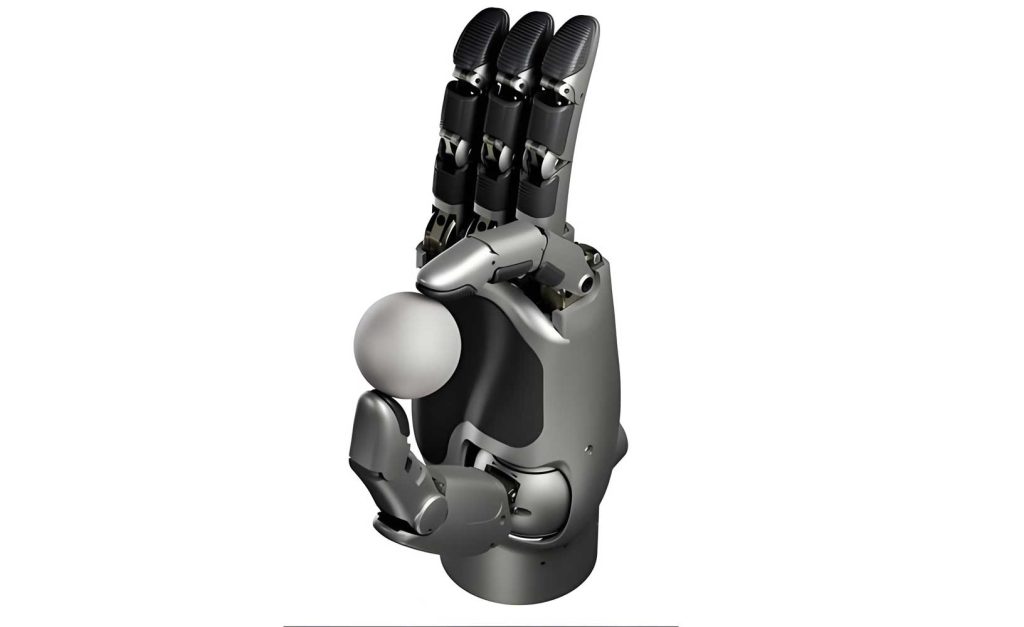
Grasping analysis is crucial for evaluating the dexterous robotic hand’s performance. Two primary grasping modes are considered: precision grasping and power grasping. Precision grasping involves fingertip contact for delicate manipulation, while power grasping uses finger links and the palm for stable holding. The dexterous robotic hand can switch between internal and external precision grasps, as well as enveloping and parallel power grasps. For force closure analysis, the contact forces are modeled with friction (coefficient $$ \mu = 0.6 $$). When grasping a cylindrical object, the system is simplified to a planar two-finger model due to symmetry. The equilibrium equations for forces and moments are:
$$ \sum_{i=0}^{4} F_i \mu = G $$
$$ \tau_T = F_1 d_0 + d_2 F_2 \cos \alpha_T + F_2 d_3 $$
$$ \tau_{IM} = F_3 d_0 + d_2 F_4 \cos \alpha_{IM} + F_4 d_3 $$
where $$ G $$ is the object weight, $$ F_i $$ are contact forces, and $$ \tau $$ are joint torques. Optimization minimizes the total driving torque $$ \min \tau(\mathbf{x}) = \tau_T + \tau_{IM} + \tau_1 + \tau_2 $$. For a 45 steel cylinder (density 7850 kg/m³) with radius 30 mm and height 200 mm, the optimal contact forces are $$ F_0 = 12.19 \, \text{N} $$, $$ F_1 = F_3 = 20 \, \text{N} $$, $$ F_2 = F_4 = 10.15 \, \text{N} $$, yielding a maximum payload of 4.43 kg. This demonstrates the superior load capacity of this dexterous robotic hand compared to traditional designs, as summarized in Table 2.
| Dexterous Robotic Hand Type | Actuation Method | Max Payload (kg) | Key Features |
|---|---|---|---|
| Proposed Parallel Hand | Motor-driven | 4.43 | High stiffness, adaptive grasping |
| Tendon-driven Hand | Artificial muscles | 1.0 | Lightweight, compliant |
| Gear-linkage Hand | Motor-driven | 3.0 | Precise, complex control |
To validate the design, virtual prototyping is performed using ADAMS software. The dexterous robotic hand model is simulated for grasping tasks, with joint inputs derived from inverse kinematics. The motion trajectories confirm the accuracy of kinematic equations, as shown in Figure 1 for joint angle comparisons. Contact forces during grasping are monitored; for instance, when lifting a cylinder, the finger link forces stabilize around 2.5 N for index and middle fingers and 5 N for the thumb, aligning with theoretical predictions. These simulations verify the dexterous robotic hand’s ability to perform stable grasps without slippage.
Experimental validation involves a physical prototype of the dexterous robotic hand. The mechanical parts are 3D-printed for lightweight construction, and Dynamixel AX-12A servo motors (torque 15 N·m) are used for actuation. Control is implemented via MATLAB, sending commands to adjust finger poses. The dexterous robotic hand successfully demonstrates multiple grasping modes, as shown in Figure 2, including external precision grasps for small objects and enveloping power grasps for larger cylinders. The adaptive nature of the dexterous robotic hand allows it to conform to objects of varying shapes, such as spheres and irregular tools, meeting flexible production requirements.
Further analysis includes dynamics modeling to assess the dexterous robotic hand’s response under dynamic loads. The equations of motion are derived using the Lagrangian approach. Let $$ \mathbf{q} $$ be the joint coordinate vector, $$ \mathbf{M}(\mathbf{q}) $$ the inertia matrix, $$ \mathbf{C}(\mathbf{q}, \dot{\mathbf{q}}) $$ the Coriolis matrix, and $$ \mathbf{G}(\mathbf{q}) $$ the gravity vector. The dynamics equation is:
$$ \mathbf{M}(\mathbf{q}) \ddot{\mathbf{q}} + \mathbf{C}(\mathbf{q}, \dot{\mathbf{q}}) \dot{\mathbf{q}} + \mathbf{G}(\mathbf{q}) = \boldsymbol{\tau} $$
where $$ \boldsymbol{\tau} $$ is the torque input. Simulation results indicate that the dexterous robotic hand can handle payloads up to 5 kg with moderate accelerations, ensuring stability during rapid operations. This highlights the robustness of the parallel mechanism in the dexterous robotic hand.
Control strategies for the dexterous robotic hand are also explored. A PID controller is designed for each joint to track desired trajectories. The control law for joint i is:
$$ \tau_i = K_p e_i + K_i \int e_i \, dt + K_d \dot{e}_i $$
where $$ e_i $$ is the position error. Experiments show that the dexterous robotic hand achieves position errors below 0.5 mm, suitable for precision tasks. Additionally, impedance control is implemented to adjust stiffness during interaction, enhancing the dexterous robotic hand’s adaptability in unstructured environments.
In terms of applications, this dexterous robotic hand is ideal for industrial automation, such as assembly lines where objects vary in size and material. Its high load capacity allows it to handle metal parts, while its dexterity enables delicate operations like inserting components. The dexterous robotic hand can also be integrated into service robots for assistive tasks, such as fetching items in hospitals or homes. Future work may focus on enhancing the dexterous robotic hand with sensory feedback, such as tactile sensors, to improve grasping reliability.
To summarize, the development of this dexterous robotic hand addresses key challenges in robotic manipulation. The use of parallel finger mechanisms provides a unique combination of strength and flexibility, making the dexterous robotic hand suitable for diverse industrial scenarios. Through comprehensive kinematic, workspace, and grasping analyses, the design is optimized for performance. Experimental results confirm that the dexterous robotic hand can achieve conformal grasping with a payload exceeding 4 kg, outperforming many existing designs. As robotics continues to evolve, dexterous robotic hands like this will play a pivotal role in advancing automation capabilities.
In conclusion, this paper has presented a detailed study on a novel dexterous robotic hand. The design leverages parallel structures to enhance load-bearing capacity while maintaining dexterity. Key contributions include the kinematic modeling, singularity avoidance, and experimental validation of the dexterous robotic hand. The ability to switch between grasping modes allows the dexterous robotic hand to adapt to various objects, fulfilling requirements for flexible industrial production. I believe that further refinements, such as weight reduction and advanced control, will expand the applications of this dexterous robotic hand. Ultimately, the integration of such dexterous robotic hands into robotic systems will drive innovation in automation and robotics research.