
In the field of agricultural robotics, the development of efficient harvesting mechanisms for delicate crops remains a significant challenge. As a researcher focused on mechanized solutions, I have observed that lotus pod harvesting is predominantly manual, leading to low efficiency and high labor intensity, especially in humid summer conditions. This paper presents a comprehensive study on the design of an end effector for picking lotus pods, based on an in-depth analysis of the mechanical properties of lotus stems. The end effector is a critical component in robotic harvesting systems, and its performance directly impacts the success rate and efficiency of the operation. Through rigorous experimentation and design iteration, I aim to develop an end effector that can automate the harvesting process, thereby addressing the limitations of current methods.
The lotus plant, an aquatic perennial, produces pods that contain nutritious seeds known as lotus seeds. These seeds are widely consumed and have high economic value, but harvesting them is labor-intensive due to the complex growth environment and non-uniform maturity of the pods. Manual harvesting involves wading into water bodies, which is not only inefficient but also poses health risks. Therefore, there is a pressing need for a mechanized harvesting system, and the end effector plays a pivotal role in such systems. In this work, I focus on designing an end effector that can precisely cut and hold lotus pods, based on the shear mechanical characteristics of their stems. The term “end effector” will be used frequently throughout this discussion to emphasize its importance in robotic manipulation.
To inform the design of the end effector, I first conducted shear mechanical tests on mature lotus stems. The objective was to determine key parameters such as shear force, shear stress, and the influence of factors like shear speed, stem diameter, and shear position. These parameters are essential for sizing the actuators and cutting mechanisms in the end effector. The experiments were performed using a texture analyzer, and the data were analyzed to identify optimal cutting conditions. Based on the results, I designed an end effector that integrates clamping and cutting functions, aiming for high success rates in pod detachment. This end effector is intended to be part of a larger robotic harvesting system, but in this study, I focus solely on its design and validation.
The remainder of this paper is organized as follows: I begin by detailing the materials and methods used in the mechanical tests. Then, I present the results and analysis, including tables and formulas to summarize the findings. Next, I describe the design process of the end effector, incorporating the experimental insights. Following that, I discuss the harvesting trials conducted to validate the end effector’s performance. Finally, I conclude with implications and future work. Throughout, I will use LaTeX formulas and HTML tables to enhance clarity, and the keyword “end effector” will be emphasized to maintain focus on the core component.
Materials and Methods for Mechanical Testing
As part of the foundational research for the end effector design, I collected fresh lotus pods with attached stems from a local farm during the mature season. The samples were carefully handled to prevent damage and moisture loss, as these factors could affect mechanical properties. A total of 60 pods with stems at least 50 cm long were selected, ensuring no prior external damage. The stems were marked at five shear positions (A to E) at 2 cm intervals from the pod base, as illustrated in earlier preparations. This marking allowed for systematic testing of different stem segments, which is crucial for determining where the end effector should engage the stem for optimal cutting.
The testing equipment included a TMS-Pro texture analyzer with a maximum load capacity of 1000 N and a precision of ±1%. A custom shear装置 was fabricated using 3D printing with PLA material, consisting of a blade holder, a double-edged blade (thickness 0.5 mm, edge angle 15°), and a base. The blade was aligned with a slot in the base to ensure clean shear actions. This setup simulated the cutting action that an end effector would perform. Stem diameters at each shear position were measured using a digital caliper with 0.01 mm resolution, and shear points were labeled for consistency.
The experimental design involved varying shear speeds (100 mm/min, 300 mm/min, and 500 mm/min) to assess the effect on shear force. Each speed group contained 20 stem samples, and each sample was sheared at all five positions (A to E) sequentially. The texture analyzer recorded force data at 50 Hz during shearing, and the maximum shear force for each cut was extracted for analysis. Data were processed using statistical software to perform regression analysis and significance testing, with the maximum shear force as the dependent variable and shear speed, stem diameter, and shear position as independent variables. This methodological approach ensured robust data collection to guide the end effector design.
Results and Analysis of Stem Shear Mechanics
The shear tests yielded detailed data on the force required to cut lotus stems. To summarize the findings, I present key results in tables and formulas. The analysis focused on understanding how shear speed, stem diameter, and shear position influence the maximum shear force, which directly informs the force requirements for the end effector’s cutting mechanism.
First, I examined the effect of shear speed. The average maximum shear forces at different speeds and positions are shown in Table 1. The data indicate that shear speed had minimal impact on the shear force within the tested range. Statistical analysis confirmed this, with a significance value (P) of 0.46 for shear speed, which is above the threshold of 0.05, indicating no significant effect. This finding is important for the end effector design, as it suggests that cutting speed can be optimized for efficiency without compromising force requirements.
| Shear Position | 100 mm/min | 300 mm/min | 500 mm/min |
|---|---|---|---|
| A | 15.2 | 14.8 | 15.5 |
| B | 18.3 | 17.9 | 18.6 |
| C | 45.7 | 46.2 | 44.9 |
| D | 89.4 | 88.7 | 90.1 |
| E | 125.6 | 124.9 | 126.3 |
Next, I analyzed the relationship between stem diameter and shear force. The correlation was found to be weak, with a significance P-value of 0.50, suggesting that diameter alone is not a dominant factor. However, the shear stress, which accounts for the cross-sectional area, provides a more standardized measure. The shear stress τ can be calculated using the formula:
$$ \tau = \frac{F_s}{A} $$
where \( F_s \) is the maximum shear force and \( A \) is the cross-sectional area of the stem. Assuming a circular cross-section, \( A = \frac{1}{4} \pi d^2 \), with \( d \) as the diameter. Based on the data, the shear stress ranged from 0.20 MPa to 2.71 MPa, indicating variability in stem material properties. This range is critical for selecting appropriate materials and actuators in the end effector to ensure reliable cutting.
The most significant factor was shear position, with a P-value of 0.00, indicating a strong influence on shear force. As shown in Table 1, the force increased from position A to E, with position A requiring the least force (around 15 N) and position E the highest (over 120 N). This trend is attributed to differences in cellular composition along the stem; proximal regions near the pod have lower cellulose and vascular tissue content, making them easier to cut. Therefore, for the end effector design, targeting shear positions A or B is advantageous, as it minimizes the force needed for cutting, thereby reducing the power requirements and size of the end effector.
To further illustrate, the shear force profiles at different positions exhibited distinct patterns. For positions A and B, the force curve showed a single abrupt drop, indicating brittle failure. In contrast, positions C to E displayed two-stage curves, with an initial compression phase followed by cutting, reflecting higher toughness due to increased fiber content. These mechanical behaviors inform the cutting strategy of the end effector, suggesting that a swift, clean cut is feasible at proximal positions, which aligns with the goal of efficient harvesting.
Design of the Lotus Pod Picking End Effector
Based on the mechanical test results, I proceeded to design an end effector specifically for lotus pod picking. The primary functions of this end effector are to clamp the stem securely and shear it at an optimal position. The design considerations included force requirements, material selection, and integration with a robotic system. The term “end effector” is central here, as it refers to the device that interacts directly with the lotus pod and stem.
The key insight from the tests is that cutting at positions A or B requires a maximum shear force of approximately 20 N. Therefore, I selected a pneumatic gripper, model MHZL2-25D, as the actuation mechanism for the end effector. This gripper offers a maximum clamping force of 104 N and a stroke of 22 mm, which is sufficient for the task. The end effector consists of two main components: a cutting module and a clamping module. The cutting module incorporates a blade identical to that used in the tests, mounted on one finger of the gripper, while the other finger features a slot to complete the shear action when the gripper closes. The clamping module includes custom-designed fingers with an inverted triangular notch to increase the capture range to 74.8 mm, accommodating variability in stem alignment during harvesting.
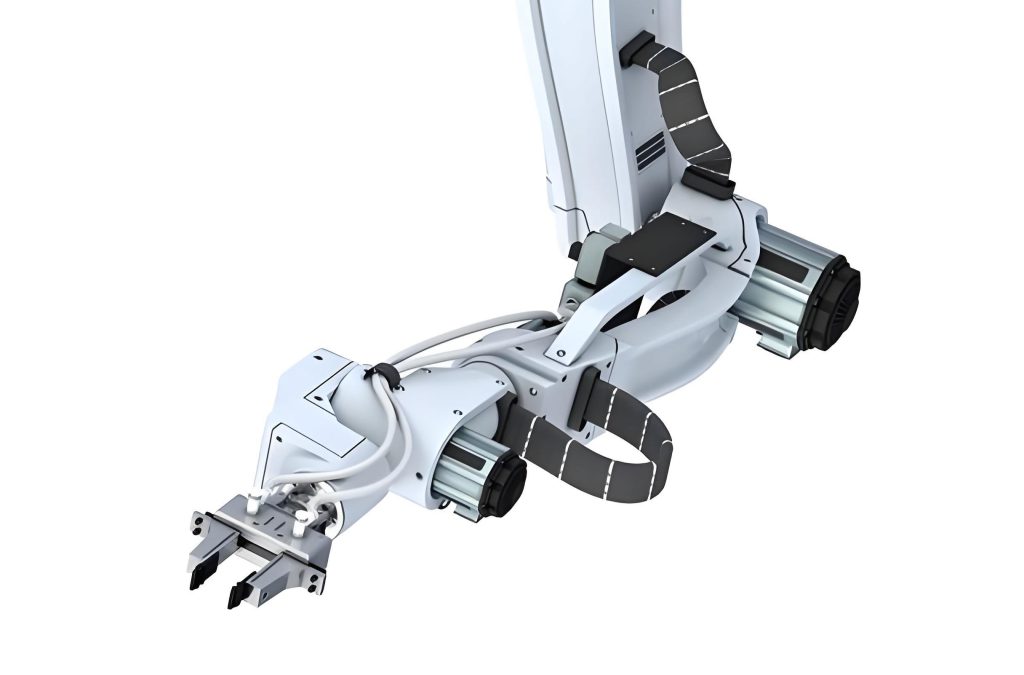
The design was modeled using CAD software (e.g., Creo), and prototypes were 3D printed with PLA material for initial testing. The cutting blade has a thickness of 0.5 mm and a 15° edge angle, optimized for clean shearing. When the end effector closes, the clamping fingers compress the stem slightly (with a gap of 7 mm when closed, less than the average stem diameter of 8.3 mm) to provide frictional hold, while the blade severs the stem. This integrated approach ensures that the end effector can both cut and hold the pod in one motion, which is essential for automated harvesting. The end effector’s dimensions and weight were minimized to facilitate mounting on a robotic arm, but this aspect is beyond the scope of this paper.
To quantify the design parameters, I derived formulas for the required cutting force and stress. For instance, the cutting force \( F_c \) needed at position A can be estimated as:
$$ F_c = \tau_{avg} \times A $$
where \( \tau_{avg} \) is the average shear stress at that position (about 0.5 MPa from tests) and \( A \) is the stem area. Using an average diameter of 8 mm, \( A \approx 50.27 \, \text{mm}^2 \), so \( F_c \approx 25.13 \, \text{N} \). This aligns with the gripper’s capacity, validating the design choice. Additionally, the end effector’s performance metrics, such as success rate and reliability, were evaluated through harvesting trials, as discussed next.
Harvesting Trials and Performance Validation
To validate the end effector design, I conducted a series of harvesting trials using the prototype. The trials aimed to assess the cutting success rate and overall picking efficiency. A total of 75 lotus pods were used in the tests, with the end effector mounted on a stationary fixture to simulate robotic manipulation. Each trial involved positioning the end effector around the stem near positions A or B, activating the gripper to clamp and cut, and then retrieving the pod.
The results are summarized in Table 2. The cutting success rate was 100%, meaning all stems were successfully sheared by the end effector. However, the overall picking success rate was 92%, as six pods slipped from the clamping fingers after cutting. This slippage was attributed to the PLA material’s low friction and inability to conform to varying stem diameters. The end effector’s clamping force was adequate, but the surface interaction needs improvement. These findings highlight the importance of material selection in end effector design, particularly for holding delicate agricultural products.
| Metric | Value | Notes |
|---|---|---|
| Number of Trials | 75 | All with mature lotus pods |
| Cutting Success Rate | 100% | All stems were sheared successfully |
| Overall Picking Success Rate | 92% | Due to pod slippage in 6 cases |
| Average Cutting Force Recorded | 18.5 N | Consistent with mechanical test predictions |
| Clamping Force Applied | 50-60 N | Below gripper maximum to avoid damage |
The trials also provided insights into operational challenges. For example, aligning the end effector with the stem required precision, which in a full robotic system would depend on vision guidance. The end effector’s design proved robust in cutting, but the holding function needs refinement. Future iterations could incorporate flexible or textured materials on the clamping fingers to enhance grip. Despite the slippage issue, the end effector demonstrated high potential, with the cutting mechanism reliably operating within the force parameters derived from the mechanical tests. This validates the approach of basing end effector design on empirical stem properties.
Discussion and Implications for Robotic Harvesting
The development of this end effector for lotus pod picking has broader implications for agricultural robotics. The mechanical characterization of lotus stems provides a foundation for designing end effectors for other crops with similar properties. The key takeaway is that understanding crop-specific mechanics is essential for optimizing end effector performance. In this case, the shear position emerged as a critical factor, allowing for force minimization by targeting proximal stem regions. This principle can be applied to other harvesting tasks, reducing the power and size requirements of end effectors.
Moreover, the integration of cutting and clamping in a single end effector simplifies the harvesting process, which is advantageous for robotic systems. However, the slippage issue underscores the need for adaptive clamping mechanisms. Future work could explore sensor integration, such as force feedback, to adjust clamping force in real-time based on stem diameter. Additionally, the end effector could be tested in dynamic field conditions, including underwater harvesting scenarios, to assess durability and reliability. The end effector’s design is a step toward fully automated lotus harvesting, but further optimization is needed for commercial deployment.
From a technical perspective, the formulas and tables presented here offer a framework for analyzing end effector requirements. For instance, the shear stress formula can be adapted for other stems:
$$ \tau = \frac{F}{A} $$
where \( \tau \) is material-dependent, and \( A \) varies with stem geometry. By conducting similar tests, designers can tailor end effectors to specific crops. The use of statistical analysis, as shown in this study, helps identify significant factors and reduce design iterations. In summary, this work contributes to the growing body of knowledge on agricultural end effectors, emphasizing data-driven design and validation.
Conclusion and Future Directions
In conclusion, I have presented a comprehensive study on the design of an end effector for picking lotus pods, based on detailed mechanical testing of lotus stems. The experiments revealed that shear speed and stem diameter have minimal impact on shear force, while shear position is the most significant factor, with proximal regions requiring less force. This informed the design of an end effector that integrates cutting and clamping functions, targeting positions A or B for efficient harvesting. The end effector achieved a 100% cutting success rate in trials, though overall picking success was 92% due to pod slippage, indicating areas for improvement.
The contributions of this work include: (1) empirical data on lotus stem shear mechanics, summarized in tables and formulas; (2) a novel end effector design that leverages these insights; and (3) validation through harvesting trials. The end effector represents a practical solution for mechanized lotus harvesting, and the methodology can be extended to other crops. Future research will focus on enhancing the clamping mechanism with flexible materials, integrating the end effector with a robotic platform for field testing, and exploring adaptive control strategies. By refining the end effector, we can move closer to sustainable and efficient agricultural automation.
Throughout this paper, I have emphasized the importance of the end effector as a key component in robotic harvesting systems. The design process highlighted the interplay between mechanical properties and engineering solutions, underscoring the value of interdisciplinary approaches. As agricultural robotics advances, end effectors will continue to evolve, driven by similar studies that bridge biology and engineering. I hope this work inspires further innovation in the development of intelligent end effectors for diverse harvesting applications.