
The pursuit of a universal end-effector capable of emulating the dexterity and adaptability of the human hand remains a central challenge in robotics. While traditional parallel grippers excel in structured environments, their limited degrees of freedom (DoFs) and fixed grasp postures render them inadequate for the diverse and uncertain tasks found in unstructured service and industrial settings, such as logistics, home assistance, and light assembly. A true dexterous robotic hand must therefore balance high functionality—encompassing flexibility, sufficient force, and sensing—with practical considerations like manufacturability, maintainability, and cost. This work presents the design, modeling, and experimental validation of a novel dexterous robotic hand architecture that addresses this balance through a synergy of modular finger design and a reconfigurable palm.
The core philosophy is to achieve requisite dexterity without unnecessary mechanical complexity. Our dexterous robotic hand features three identical, modular fingers mounted on a palm capable of reconfiguring their spatial arrangement. Each modular finger possesses two actively driven joints, providing a total of seven active DoFs (six finger joints and one reconfiguration DoF). Both finger joints utilize a linkage-driven transmission, a choice that offers significant advantages in robustness, high force transmission, and ease of assembly compared to tendon-driven systems. The reconfigurable palm allows the hand to morph between several fundamental grasp archetypes—power, precision, and lateral—optimizing its grasp strategy for a wide variety of object shapes and sizes. This paper details the requirement analysis, mechanical design, kinematic and static modeling, and comprehensive grasping experiments that demonstrate the hand’s capabilities.
1. Requirement Analysis and Design Specifications
Defining the specifications for a practical dexterous robotic hand requires a careful analysis of target applications. The key design drivers are identified as follows.
1.1 Flexibility and Controllability
A fundamental trade-off exists between fully-actuated and underactuated hands. Fully-actuated designs offer independent control of each joint, enabling precise fingertip positioning and a wider range of in-hand manipulation gestures. However, they often suffer from high complexity, weight, and control difficulty due to the large number of actuators and sensors. Underactuated hands, using fewer actuators than joints, are simpler and can adapt passively to object shape, but they sacrifice direct control over joint trajectories and may struggle with specific precision tasks.
Our design adopts a middle path: a fully-actuated modular finger with two joints instead of the three found in a human finger. This reduces the per-finger actuator count, simplifying control and mechanics, while retaining two controllable DoFs for dexterous positioning. The actuation method is selected as electric motor drives, specifically integrated linear servos, for their precision, reliability, and ease of integration with embedded controllers and force sensors.
1.2 Payload and Force Capability
The hand must be capable of handling everyday objects and light tools. An analysis of common items—from food containers and bottles to small power tools—suggests a target payload capacity of approximately 5 kg is sufficient for a broad range of service tasks. Furthermore, to effectively utilize commercial collaborative robot arms (cobots) with payloads typically between 5-10 kg, the hand’s own weight must be minimized. A target weight below 2 kg and a fingertip force exceeding 20 N are set to ensure strong and stable grasps without over-burdening the host manipulator. The linkage transmission is explicitly chosen for its ability to provide high force at the fingertip from a relatively small motor.
1.3 Ease of Assembly and Maintenance (Modularity)
For deployment in real-world environments, serviceability is critical. A modular design, where the finger and palm are self-contained units, dramatically simplifies maintenance. If a finger is damaged, it can be replaced as a single unit without disassembling the entire hand. Similarly, the palm module can be swapped. This approach also enhances design scalability; the same modular finger can be used to construct two, three, four, or five-fingered hands based on task requirements. Linkage mechanisms are inherently easier to assemble and align compared to complex multi-tendon routing systems, further supporting this design goal.
1.4 Reconfigurability and System Integration
A fixed palm layout limits the grasp types a hand can perform. A reconfigurable palm, which can change the relative position of the fingers, greatly expands the hand’s functional workspace and enables it to assume optimal configurations for different objects. After evaluating several reconfiguration schemes—including finger abduction/adduction and translational sliding—a scheme where two fingers rotate symmetrically about an axis in the palm was selected. This design, illustrated conceptually below, allows the two fingers to sweep through a 180° arc, enabling transitions between key grasp postures with a single actuator.
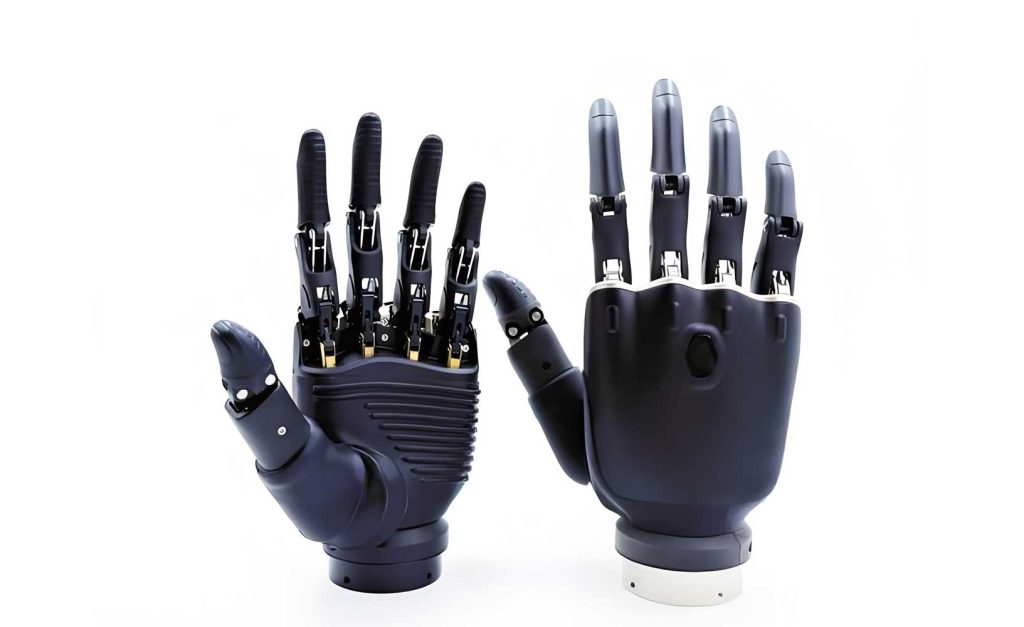
The final integrated dexterous robotic hand must also be easily attachable to standard robot flanges. By housing all actuators within the hand’s structure, a simple interface plate can be used for mounting, ensuring compatibility with a wide range of commercial robotic arms.
These requirements are consolidated into the target specifications for our dexterous robotic hand, as shown in Table 1.
| Parameter | Target Value |
|---|---|
| Number of Fingers | 3 |
| Total Active Degrees of Freedom | 7 (6 finger joints + 1 palm joint) |
| Fingertip Force | > 20 N |
| Maximum Payload | 5 kg |
| Hand Weight | < 2.0 kg |
| Finger Length | ~100 mm |
| Key Features | Modular design, linkage-driven joints, reconfigurable palm, integrated force sensing, serial communication interface. |
2. Mechanical Design of the Modular, Reconfigurable Dexterous Robotic Hand
The proposed dexterous robotic hand is realized through the detailed design of two core subsystems: the modular finger and the reconfigurable palm.
2.1 Modular Finger Design
Each modular finger is a self-contained two-DoF manipulator. The kinematic structure consists of a proximal link (attached to the palm), a medial link, and a distal link (fingertip). The two joints are the Metacarpophalangeal (MCP) joint (joint 1, between palm and proximal link) and the Proximal Interphalangeal (PIP) joint (joint 2, between proximal and medial links). The Distal Interphalangeal (DIP) joint is fixed, a common simplification that retains significant dexterity while reducing complexity.
The actuation system is the key innovation. Two miniature linear servo actuators are housed vertically within the finger’s base and proximal link. Their linear motion is converted into rotary joint motion via two independent four-bar linkage systems.
- MCP Joint Actuation: The first linear actuator’s motion is transmitted through a set of links forming a slider-crank mechanism, which drives the rotation of the proximal link about the MCP axis.
- PIP Joint Actuation: The second linear actuator drives a four-bar linkage embedded within the finger. The coupler of this linkage is connected to the medial link, causing it to rotate relative to the proximal link about the PIP axis.
The kinematic diagram and force flow are modeled below. The relationship between the linear actuator displacement $d_i$ and the corresponding joint angle $q_i$ is governed by the geometry of the four-bar linkage. For the PIP joint, the vector loop equation can be written as:
$$ \vec{L_1} + \vec{L_2} – \vec{L_3} – \vec{L_4(d)} = 0 $$
where $L_1$ is the ground link (part of the finger structure), $L_2$ is the input link connected to the actuator output, $L_3$ is the coupler link driving the finger link, and $L_4$ is the variable-length link representing the actuator’s extension. Solving this equation yields the nonlinear function $q_2 = f(d_2)$.
The static force relationship is crucial for evaluating fingertip force. Assuming negligible friction and inertial forces, the principle of virtual work can be applied. The force $F_{act}$ exerted by the linear actuator is related to the torque $\tau_j$ at joint $j$ by the Jacobian of the linkage transmission:
$$ \tau_j = J_{linkage}^T(q_j) \cdot F_{act} $$
The fingertip force $F_{tip}$ is then related to the joint torques via the hand Jacobian $J_{hand}(q)$:
$$ F_{tip} = (J_{hand}^{-T}(q)) \cdot \tau $$
where $\tau = [\tau_1, \tau_2]^T$. Combining these, the overall force transmission from actuator to fingertip can be modeled. This linkage design typically provides a mechanical advantage greater than 1 at most configurations, enabling high fingertip forces from compact actuators.
A distinctive feature is the adjustable workspace via two selectable attachment points on the medial link for the PIP joint linkage. This changes the effective link lengths in the four-bar mechanism, altering the maximum flexion angle of the PIP joint. In the “small workspace” configuration, the finger is optimized for enveloping large objects. In the “large workspace” configuration, the finger can curl more tightly, suitable for grasping smaller items. This adjustment is performed manually but provides valuable adaptability. The distal fingertip is also designed as a replaceable cap, allowing for different surface textures (e.g., soft silicone for high friction) or shapes.
2.2 Reconfigurable Palm Design
The palm serves as the structural core and the reconfiguration mechanism. It houses the three modular finger bases. One finger is fixed in a central position. The other two fingers are mounted on a common rotating platform, or “finger base,” which is driven by a rotary servo motor through a gear train. This allows the two fingers to rotate symmetrically in opposite directions, spanning a 180° arc relative to the fixed finger.
This single-DoF reconfiguration enables three primary grasp postures, which form the basis for most grasping strategies:
- Uniform (Triangular) Grasp: The two movable fingers are positioned at approximately 120° from the fixed finger, forming an equilateral triangle. This posture is ideal for spherical and rounded objects, providing stable, enveloping force closure.
- Opposition (Lateral) Grasp: The movable fingers rotate to a position directly opposite the fixed finger, forming a parallel-jaw-like or three-point pinch configuration. This is optimal for cylindrical objects (like bottles), tools, or flat items (like books), maximizing contact area and pinch force.
- Unilateral (Precision) Grasp: The movable fingers are rotated to be adjacent to the fixed finger, creating a three-fingered precision pinch cluster. This mimics a human fingertip grasp for small or delicate objects and can be used for tool tips.
The transformation between these postures is defined by the reconfiguration angle $\alpha$. The forward kinematics of the entire dexterous robotic hand must therefore account for both the finger joint angles $\mathbf{q}_f$ and the palm reconfiguration angle $\alpha$. The pose of fingertip $i$ in the world frame is given by:
$$ \mathbf{x}_{tip,i} = f_{palm}(\alpha) \cdot f_{finger,i}(\mathbf{q}_{f,i}) $$
where $f_{palm}$ defines the base frame transformation for finger $i$ based on $\alpha$, and $f_{finger,i}$ is the forward kinematics of the modular finger from its base.
All electronic control boards for the seven actuators (six linear servos and one rotary servo) are integrated within the palm structure. Communication with an external robot controller is achieved via a single serial bus (e.g., UART or RS-485), greatly simplifying wiring and integration. The final assembled dexterous robotic hand is a compact, self-contained unit ready for mounting on a robotic arm.
3. Mathematical Modeling and Analysis
To quantitatively assess the performance of the dexterous robotic hand, key mathematical models are developed.
3.1 Workspace Analysis
The collective workspace of the three fingertips determines the size and shape of objects the hand can potentially grasp. The workspace $W_i$ of a single modular finger (in its local base frame) is a 2D planar region defined by the limits of its two joint angles: $q_{1}^{min} \leq q_1 \leq q_{1}^{max}$, $q_{2}^{min} \leq q_2 \leq q_{2}^{max}$. This region can be approximated by sweeping the fingertip position through all joint angle combinations:
$$ W_i = \{ \mathbf{p}_{tip}(q_1, q_2) \, | \, q_1 \in [q_{1}^{min}, q_{1}^{max}], \, q_2 \in [q_{2}^{min}, q_{2}^{max}] \} $$
where $\mathbf{p}_{tip}(q_1, q_2) = [L_1\cos(q_1) + L_2\cos(q_1+q_2), \, L_1\sin(q_1) + L_2\sin(q_1+q_2)]^T$ for link lengths $L_1$ (proximal) and $L_2$ (medial).
The global workspace $W_{hand}(\alpha)$ is the union of the workspaces of all three fingers after being transformed by the palm reconfiguration:
$$ W_{hand}(\alpha) = \bigcup_{i=1}^{3} \, T_i(\alpha) \, W_i $$
where $T_i(\alpha)$ is the rigid transformation for finger $i$’s base. By evaluating $W_{hand}(\alpha)$ for key values of $\alpha$ (corresponding to the three primary postures), we can visualize how reconfiguration adapts the hand’s reachable volume to different object geometries.
3.2 Grasp Stability and Force Closure
A fundamental measure of a grasp’s quality is force closure — the ability of the hand to apply wrenches (forces and torques) in any direction on the object through contact forces. For a three-fingered hand with friction point contacts, a necessary condition for force closure is that the contact points do not lie on a common line. Our reconfigurable palm is designed specifically to avoid this condition for a wide range of objects.
We can analyze a simplified 2D grasp. The grasp map $G$ relates the contact forces $f_c$ at the three fingertips to the net wrench $w$ on the object:
$$ w = G f_c $$
For force closure in the plane, the convex hull of the primitive contact wrenches must contain the origin in its interior. The reconfigurable postures ensure that for typical object shapes (sphere, cylinder, prism), the contact normals can be arranged to span the wrench space. The uniform grasp posture naturally provides three contact points around an object, whose normals are not concurrent, satisfying planar force closure for rounded objects.
3.3 Fingertip Force Estimation
As derived in Section 2.1, the maximum static fingertip force is a function of the actuator force and the mechanical advantage of the linkage transmission. The actuator force $F_{act}$ is known from motor specifications (e.g., stall force). The transmission ratio $r_t(q)$ at a given joint angle is the derivative of the actuator displacement with respect to the joint angle:
$$ r_t(q) = \frac{\partial d}{\partial q} $$
The joint torque is $\tau = r_t(q) \cdot F_{act}$. Finally, the maximum sustainable fingertip force in a direction is limited by the weakest joint torque divided by the corresponding moment arm from that joint to the contact point. For a given grasp, we can compute the maximum applicable grasping force $F_g$ by solving:
$$ J_{hand}^T(\mathbf{q}) \, \mathbf{f}_{tip} \leq \boldsymbol{\tau}_{max}(\mathbf{q}) $$
where $\boldsymbol{\tau}_{max}$ is the vector of maximum joint torques (from actuator limits and transmission ratios) and $\mathbf{f}_{tip}$ is the set of fingertip forces. This model allows us to predict that the designed dexterous robotic hand will meet the >20 N fingertip force target.
| Robotic Hand Model | Actuation Method | Key Features | Reported Fingertip Force | Weight |
|---|---|---|---|---|
| BarrettHand | Tendon / Underactuated | Adaptive grasp, spread motion | ~15 N (at tip) | ~1.2 kg |
| Robotiq 3-Finger Adaptive | Linkage / Underactuated | Self-adaptive, multiple modes | 15-60 N (adaptive) | ~2.3 kg |
| Schunk SDH | Tendon / Fully-actuated | 7 DoFs, tactile sensing | N/A | ~1.95 kg |
| Proposed Hand | Linkage / Fully-actuated Fingers + Reconfigurable Palm | Modular, reconfigurable posture, adjustable workspace | Target >20 N (Modeled ~25 N) | < 2.0 kg |
4. System Integration and Experimental Validation
A physical prototype of the modular, reconfigurable dexterous robotic hand was constructed based on the designs described. The system integration and experimental procedures are outlined here.
4.1 Control System Architecture
The hand is controlled via a hierarchical architecture. A high-level planner (e.g., running on a ROS-based system) decides the grasp type and generates target joint angles or fingertip positions. These commands are sent via a serial communication protocol to two embedded motor driver boards inside the palm: one dedicated to the three modular fingers (six linear servos) and one for the palm reconfiguration servo. The linear servos have integrated potentiometers for joint position feedback and can also provide a proxy for force sensing through current draw. This allows for basic position-force hybrid control strategies.
4.2 Performance Metrics Measurement
The prototype was tested to verify key specifications:
- Weight: The final assembly weighed 1.55 kg, meeting the <2 kg target.
- Fingertip Force: Measured using a digital force gauge. The finger was commanded to push against the gauge at various joint configurations. An average maximum force of 25 N was recorded, exceeding the initial target.
- Payload: The hand successfully lifted and held a 5 kg dumbbell in both opposition and unilateral grasp postures, confirming the payload capacity.
| Metric | Measured Value |
|---|---|
| Total Weight | 1.55 kg |
| Average Max Fingertip Force | 25 N |
| Maximum Verified Payload (Stable Hold) | 5.0 kg |
| Reconfiguration Range (per movable finger) | 0° to 180° |
| Communication Latency (command to motion start) | < 50 ms |
4.3 Comprehensive Grasping Experiments
To validate the dexterity and adaptability of the hand, grasping experiments were conducted with a set of 18 common objects, inspired by benchmark sets like the YCB Object Set. The objects were chosen to vary in size, shape, weight, and material stiffness. For each object, the most appropriate of the three primary grasp postures was selected manually.
The experiments were highly successful, demonstrating the utility of the reconfigurable palm:
- Uniform Grasp Posture: Effectively grasped spherical and rounded objects like tennis balls, apples, and oranges. The three-point, evenly distributed contact provided stable enveloping grasps.
- Opposition Grasp Posture: Excellently suited for cylindrical objects (water bottles, cans), tool handles (screwdriver), and flat objects (notebook, card). This posture maximized the contact area along the object’s axis.
- Unilateral Grasp Posture: Successfully picked up smaller items like a pack of gum, a marker, and facilitated precision tasks like holding a thin card. It also allowed for a “power pinch” on small, heavy objects.
The results can be summarized by the grasp success rate $S$ for each posture category, defined as:
$$ S = \frac{N_{successful}}{N_{total}} \times 100\% $$
For the tested objects assigned to each category, success rates were above 90%, with failures primarily due to extremely small or very large/slippery objects at the limit of the hand’s kinematic or friction constraints.
The modular finger’s adjustable workspace feature was also tested. For a large apple, the “small workspace” setting provided a more secure, cradling grasp. For a smaller lime, the “large workspace” setting allowed the fingers to curl more completely around it.
5. Discussion and Conclusion
This work presented the complete design cycle—from requirements to experimentation—of a novel modular, reconfigurable three-fingered dexterous robotic hand. The core contribution is a practical design philosophy that balances dexterity with simplicity, achieved through two key innovations: 1) a linkage-driven, two-DoF modular finger that is powerful, compact, and easily replicable, and 2) a single-DoF reconfigurable palm that significantly expands the hand’s functional versatility by enabling distinct grasp archetypes.
The mathematical models provided a foundation for understanding the hand’s workspace, force capabilities, and grasp stability. The experimental validation on the physical prototype confirmed that the design meets its target specifications: 1.55 kg weight, 25 N fingertip force, 5 kg payload capacity, and most importantly, demonstrated robust and adaptable grasping across a wide range of everyday objects by leveraging its reconfigurable nature.
Compared to existing three-fingered hands (Table 2), this design offers a unique combination of full active control of the finger joints (for precision) with the adaptability of a reconfigurable palm, all within a lightweight and modular package. The use of linkage transmission throughout enhances durability and ease of maintenance, addressing practical concerns for real-world deployment.
Future work will focus on several enhancements. Integrating more advanced tactile sensors directly into the fingertip modules would enable finer force control and object perception. Developing autonomous algorithms to select the optimal palm configuration and finger motions based on object pose and shape from a vision system is a critical next step for full autonomy. Furthermore, exploring the integration of a fourth modular finger or a dedicated opposable thumb module could unlock even greater dexterity for complex in-hand manipulation tasks. Nevertheless, the current prototype stands as a compelling proof-of-concept that a thoughtfully designed, modular, and reconfigurable dexterous robotic hand can provide a powerful and practical solution for flexible manipulation in unstructured environments.