
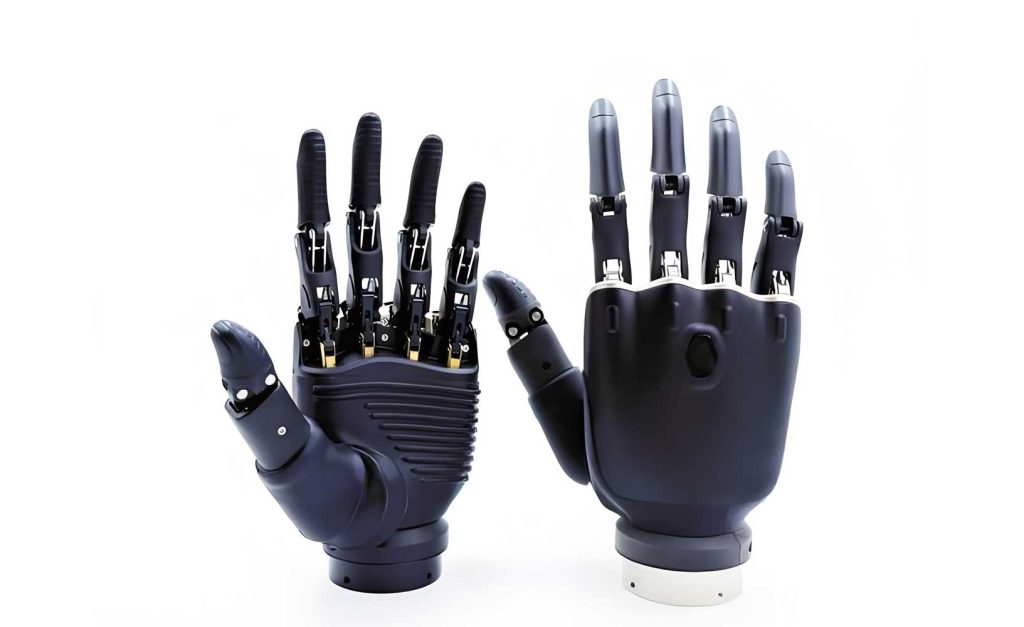
In the field of robotics, end-effectors are critical components for task execution. Traditional industrial robotic end-effectors are often customized based on specific geometric features of target objects, leading to limited functionality, high specialization, and poor adaptability. When faced with diverse tasks, these end-effectors require replacement, which reduces system versatility, increases costs, and necessitates tedious reprogramming. This hinders rapid reconfiguration of production lines and limits applications in non-industrial domains. With the continuous evolution of robotics, higher technical demands are placed on end-effectors in terms of safety, convenience, flexibility, and intelligence. In this context, the dexterous robotic hand emerges as a novel end-effector, boasting multi-degree-of-freedom structures, excellent adaptability, and diverse grasping modes. It can flexibly handle objects of varying geometries, making it suitable for complex grasping tasks in multi-scenario environments, thus offering broad application prospects.
Since the 1970s, researchers worldwide have conducted extensive studies on the design and drive control of dexterous robotic hands, developing typical examples such as the Okada hand, Stanford/JPL hand, and Utah/MIT hand. However, traditional dexterous robotic hand designs often employ fixed palms, with optimization focused solely on the fingers. Fixed palms limit the dexterity of the robotic hand. To overcome this, designs like the UB hand, Robotnaut hand, DLR-I hand, and HIT/DLR-II hand divide the palm into two parts, enabling relative motion between fingers and palm, significantly enhancing grasping stability and dexterity. Another solution involves mounting fingers on a rigid axis at the palm center, as seen in the Barrett hand and the four-fingered robotic hand designed by Higashimori et al. Dai et al. introduced a metamorphic palm-based multi-fingered dexterous robotic hand using metamorphic mechanism principles, offering a larger workspace and higher dexterity, opening new avenues for dexterous robotic hand design.
Given the importance of deformable palms in grasping, researchers have explored this area. Capsj-Morales et al. experimentally verified the impact of palm deformation on finger opposition and object support during grasping. Zhang Yongde et al. optimized the structural forms of multi-fingered dexterous robotic hands, proposing optimal configurations. Liu Jinyue et al. addressed uncontrollable joint rotation in underactuated dexterous robotic hands by proposing a novel single-tendon underactuated dexterous robotic hand design with lockable joints. Liu et al. presented a dynamic origami transformation approach, providing fresh insights for dexterous robotic hand design. Wang Hairong et al. studied thumb dexterity in humanoid dexterous robotic hands, proposing a global measurement method for multi-fingered manipulation dexterity. Jin et al. designed a parallel mechanism-inspired multimodal dexterous robotic hand with high task adaptability and a variable number of degrees of freedom during grasping operations. Wei et al. designed a metamorphic five-bar dexterous robotic hand, analyzing the impact of planar five-bar link distribution on workspace and providing link proportion relationships for maximizing workspace. Gong Junshan et al. designed a multifunctional dexterous robotic hand based on parallel finger structures, demonstrating ideal workspace and good adaptability through prototype experiments. Yang Yang et al. analyzed finger dexterity, proposing design criteria for multi-fingered dexterous robotic hands with optimal dexterity. Lu et al. introduced an underactuated reconfigurable dexterous robotic hand capable of adapting to various objects and performing precise in-hand manipulations, along with a passive idler adjustment system. Tian et al. designed a reconfigurable parallel mechanism with a threefold-symmetric Bricard linkage as the moving platform, determining feasible configurations for branch structures and validating through prototype experiments. Jiang Li et al. proposed a novel multi-fingered hand position/torque control strategy with good tracking performance, ensuring stability during object grasping transitions. Meng et al. designed a dexterous robotic hand based on multi-link mechanisms, successfully executing precise pinch and enveloping grasps.
In summary, current research on metamorphic dexterous robotic hands primarily focuses on palm structure design, with less attention paid to the role of palm posture and finger angles during grasping. However, in complex environments involving objects of different shapes, factors such as palm posture, finger angles, and grasping angles significantly impact grasping success rates. We propose a novel multimodal metamorphic dexterous robotic hand aimed at addressing the grasping needs of various object morphologies through flexible structures and precise control.
To meet the grasping requirements of complex environments and diverse objects, a deformable palm can effectively enhance the dexterity and workspace of the dexterous robotic hand. Therefore, we employ a deployable mechanism for palm design. To reduce the control system’s burden during palm deployment, the internal degrees of freedom of the deployable mechanism should be minimized. Hence, we select the threefold-symmetric Bricard linkage as the metamorphic palm for the dexterous robotic hand. For a closed-loop mechanism composed of several links, according to the Denavit-Hartenberg standard model, the necessary and sufficient condition for motion is that the product of transformation matrices for each link equals the identity matrix:
$$ [T_{n1}] \ldots [T_{34}][T_{23}][T_{12}] = [I] $$
The structural diagram of the threefold-symmetric Bricard linkage is shown in the image above. Its geometric parameters satisfy:
| Parameter | Value |
|---|---|
| a12, a23, a34, a45, a56, a61 | L |
| α1, α3, α5 | ω |
| α2, α4, α6 | 2π – ω |
| β1, β3, β5 | β |
| γ1, γ3, γ5 | γ |
Based on the Denavit-Hartenberg matrix method and geometric parameters, the motion coordination equation for the threefold-symmetric Bricard linkage is derived:
$$ \cos^2 \omega + \sin^2 \omega (\cos \beta + \cos \gamma) + (1 + \cos^2 \omega) \cos \beta \cos \gamma – 2 \cos \omega \sin \beta \sin \gamma = 0 $$
We plot the corresponding curves of β and γ for different ω values. When ω takes different values, the threefold-symmetric Bricard linkage exhibits different motion characteristics. To ensure continuous motion of the palm, avoid interference between links, and maximize the palm’s workspace, we select ω = 2π/3. The curve of the motion coordination equation for this case is monotonic. To prevent the mechanism from reaching bifurcation points with motion uncertainty, we restrict β ∈ (0, π) and γ ∈ (2π/3, π). Within this interval, for any β, there is a unique γ corresponding. We choose β as the input parameter for the Bricard palm.
After selecting the parameters, we illustrate the kinematic diagram. The Bricard linkage is a single-loop six-bar mechanism with six axes intersecting at two points, using β as the driving parameter. To enable the palm to adjust grasping postures and meet multi-task demands in complex environments, we use the metamorphic palm as the moving platform, equipped with three branches connected to a base. The base achieves reconfigurability via links and sliders. The overall structure of our multimodal metamorphic dexterous robotic hand is depicted in the image. This design replaces the traditional rigid platform with a threefold-symmetric Bricard palm, allowing palm posture transformation and size adjustment. The Bricard linkage connects to branches via Hooke joints. Each branch is a planar five-bar mechanism capable of planar movement and rotation. Branches connect to motor mounts via two driving links, with motor mounts installed on sliders movable on the base. Compared to planar two-bar mechanisms, five-bar mechanisms allow all drive motors to be housed within the motor mounts, offering better stability and higher transmission efficiency. The base connects to three branches via two arc sliders and one lead screw slide. Links connect the slide and sliders, so controlling the lead screw slide movement drives sliders along arc rails, enabling different branch configurations for various motion modes, thus achieving reconfigurability.
To compute the degrees of freedom (DOF) of the dexterous robotic hand, we first determine the DOF of the Bricard linkage. We use screw theory to calculate redundant constraints. The linear dependency of the motion screw system is independent of the coordinate system, so we compute the motion screws in the moving coordinate system. For the threefold-symmetric Bricard linkage in a general configuration, let Mi be the center of the revolute joint connecting the palm to the branch, and Ni be the center of the revolute joint connecting the moving platform to the finger. Links are denoted as MjNj (j=1,2,3). Due to high symmetry, △M1M2M3 and △N1N2N3 are equilateral triangles with parallel planes. Establish a moving coordinate system {Om}: Om-xmymzm at the center of △M1M2M3, with xm along OmM1, zm perpendicular to the plane of △M1M2M3, and ym determined by the right-hand rule. Point G is the center of △N1N2N3, with OmG perpendicular to both triangles.
Let the link length be L, rotation angles at Mi and Ni be β and γ, respectively. Define OmM1 = OmM2 = OmM3 = L1, GN1 = GN2 = GN3 = L2, and OmG = L3. L1, L2, L3 can be expressed via L, β, γ. Motion screws at Bricard joints are denoted Si (i = M1, M2, M3, N1, N2, N3), with unit vectors si = (xsi, ysi, zsi)^T for screw direction and position vectors ri = (xi, yi, zi)^T for location. In {Om}, unit vectors si are:
$$ s_{M1} = \frac{N_2M_1 \times M_1N_3}{\|N_2M_1 \times M_1N_3\|} = \left( \sqrt{3}L_2L_3, 0, 3L_1L_2 – \sqrt{3}L_2^2/2 \right) / m_1 $$
$$ s_{M2} = \frac{N_3M_2 \times M_2N_1}{\|N_3M_2 \times M_2N_1\|} = \left( -\sqrt{3}L_2L_3/2, \sqrt{3}L_2L_3/2, 3L_1L_2 – \sqrt{3}L_2^2/2 \right) / m_1 $$
$$ s_{M3} = \frac{N_1M_3 \times M_3N_2}{\|N_1M_3 \times M_3N_2\|} = \left( -\sqrt{3}L_2L_3/2, -\sqrt{3}L_2L_3/2, 3L_1L_2 – \sqrt{3}L_2^2/2 \right) / m_1 $$
$$ s_{N1} = \frac{M_2N_1 \times N_1M_3}{\|M_2N_1 \times N_1M_3\|} = \left( \sqrt{3}L_1L_3, 0, 3L_1L_2 – \sqrt{3}L_1^2/2 \right) / m_2 $$
$$ s_{N2} = \frac{M_3N_2 \times N_2M_1}{\|M_3N_2 \times N_2M_1\|} = \left( -\sqrt{3}L_1L_3/2, \sqrt{3}L_1L_3/2, 3L_1L_2 – \sqrt{3}L_1^2/2 \right) / m_2 $$
$$ s_{N3} = \frac{M_1N_3 \times N_3M_2}{\|M_1N_3 \times N_3M_2\|} = \left( -\sqrt{3}L_1L_3/2, -\sqrt{3}L_1L_3/2, 3L_1L_2 – \sqrt{3}L_1^2/2 \right) / m_2 $$
where \( m_1 = \sqrt{3L_1^2L_2^2 + 3L_2^2L_3^2 – 3L_1L_2^3 + 3L_2^4/4} \) and \( m_2 = \sqrt{3L_1^2L_2^2 + 3L_1^2L_3^2 – 3L_1^3L_2 + 3L_1^4/4} \). Position vectors ri are:
$$ r_{M1} = (L_1, 0, 0), \quad r_{M2} = (-L_1/2, \sqrt{3}L_1/2, 0), \quad r_{M3} = (-L_1/2, -\sqrt{3}L_1/2, 0) $$
$$ r_{N1} = (-L_2, 0, L_3), \quad r_{N2} = (L_2/2, -\sqrt{3}L_2/2, L_3), \quad r_{N3} = (L_2/2, \sqrt{3}L_2/2, L_3) $$
The motion screws in {Om} are \( S_i = [s_i \quad s_{0i}]^T = [s_i \quad r_i \times s_i]^T \). Substituting si and ri, we obtain the motion screw system. The rank of this system is 5, indicating one redundant constraint for the Bricard linkage. Ignoring the reconfigurable DOF of the base, the overall DOF of the dexterous robotic hand with the Bricard platform is calculated using the DOF formula:
$$ M = \sum_{\beta=1}^{g} f_\beta + d(n – g – 1) + v – \xi = 4 $$
where \( f_\beta \) is the DOF at the β-th joint, d is the motion dimension, n is the number of basic links, and g is the number of single-DOF kinematic pairs. The threefold-symmetric Bricard linkage has 1 DOF, and the three branches impart 3 DOFs to the Bricard platform, with specific forms determined by base configuration.
By moving base sliders, the dexterous robotic hand achieves different configurations, resulting in three working modes based on relative positions of arc sliders and lead screw slider: parallel mode, vertical mode, and regular mode. Denote the branch connected to the lead screw slider as Branch 1, and those connected to arc sliders as Branches 2 and 3. When the driving slider is at the limit position near the base center, Branch 1’s rotation axis is parallel to those of Branches 2 and 3 (parallel mode). When the driving slider is at the limit position away from the base center, Branch 1’s rotation axis is perpendicular to those of Branches 2 and 3 (vertical mode). When the lead screw slider is at non-limit positions, axes are neither parallel nor perpendicular (regular mode). These modes enable the dexterous robotic hand to adapt to various tasks.
Generally, robotic hands perform two types of grasping operations: enveloping grasps and precision grips. For enveloping grasps, the hand wraps around the object, with the object pressed against the palm. The Bricard platform can adjust size as needed. Our dexterous robotic hand demonstrates enveloping grasps on spherical objects of different shapes. For flat or large objects, a larger Bricard palm can be used, providing substantial contact area for effective grasping. For spherical or regularly shaped medium-sized objects, the palm can be reduced for better contact. For objects with sharp corners or slender shapes, the palm can adjust to a triangular pyramid or fully contracted configuration to adapt to small objects.
For precision grips, there are two subtypes: external precision grips and internal precision grips. Internal precision grips are suitable for shell-like objects with sensitive surfaces or objects with large external sizes but suitable internal holes. For precision grips, palm structure can also be adjusted based on object shape and size, with palm size and orientation providing better pinching angles for fingers, thus improving grasping performance.
The motion of the dexterous robotic hand can be represented by an 8-dimensional generalized coordinate vector (x, y, z, ψ, θ, φ, α, β), where p = (x, y, z)^T denotes the position of the moving coordinate system origin Om relative to the fixed frame, Q represents orientation via Euler angles ψ (yaw), θ (pitch), and φ (roll). The rotation matrix Q is:
$$ Q = R_z(\phi) R_y(\theta) R_x(\psi) = \begin{bmatrix} \cos\phi\cos\theta & \cos\phi\sin\theta\sin\psi – \sin\phi\cos\psi & \cos\phi\sin\theta\cos\psi + \sin\phi\sin\psi \\ \sin\phi\cos\theta & \sin\phi\sin\theta\sin\psi + \cos\phi\cos\psi & \sin\phi\sin\theta\cos\psi – \cos\phi\sin\psi \\ -\sin\theta & \cos\theta\sin\psi & \cos\theta\cos\psi \end{bmatrix} $$
Parameter α is the rotation angle of the arc rail, affecting the working mode. Parameter β is the rotation angle of the Bricard link. Inverse kinematics involves solving relationships between palm and branches, determining branch positions via rail angle, and computing drive angles based on Hooke joint positions. We establish moving coordinate systems on sliders. For Branch 1, the position vector U1 = (x1, 0, z1) is derived. E1’s position is E1 = (l0 + l4 sin θ11, 0, lA + l4 cos θ11). From geometry:
$$ \| U1 – E1 \| = \sqrt{(l_3/2)^2 + l_5^2} $$
Let tan(θ11/2) = t11. Substituting U1 and E1, using trigonometric identities, we solve:
$$ t_{11} = \frac{m_{11} \pm \sqrt{m_{11}^2 – 4m_{12}m_{13}}}{2m_{13}} $$
where m11, m12, m13 are functions of x1 and z1. Thus, the inverse solution is θ11 = 2 arctan t11. To solve θ12, we use:
$$ \| D1 – C1 \| = l_2 $$
where C1 = (l0 + lAB + l1 sin θ12, 0, lB + l1 cos θ12), D1 = E1 + (l3 cos φ, 0, l3 sin φ), with φ1 and φ2 defined. This yields:
$$ t_{12} = \frac{m_{21} \pm \sqrt{m_{21}^2 – 4m_{22}m_{23}}}{2m_{23}} $$
where m21, m22, m23 are functions of x1 and z1, so θ12 = 2 arctan t12. Branches 2 and 3 are solved similarly.
Forward kinematics involves determining position vector p, rotation matrix Q, and Bricard rotation angle β given link angles. From inputs, Hooke joint positions Uj are found: Uj = ObAj + AjEj + EjUj. Considering geometry, we establish a coordinate system {Ou} parallel to the moving frame. The side length of equilateral triangle △U1U2U3 formed by Uj is lu = \|U1 – U2\|. Planes of △U1U2U3 and △M1M2M3 are parallel. From Uj positions, the pose of {Ou} relative to {Ob} is:
$$ p_u = \frac{1}{3}(U_1 + U_2 + U_3), \quad R_u = \left[ \frac{O_uU_1}{\|O_uU_1\|} \quad \frac{U_1U_2 \times U_1U_3}{\|U_1U_2 \times U_1U_3\|} \times \frac{O_uU_1}{\|O_uU_1\|} \quad \frac{U_1U_2 \times U_1U_3}{\|U_1U_2 \times U_1U_3\|} \right] $$
Via coordinate transformation: Uj^Ou = p_Om^Ou + R_Om^Ou (M_j^Om + c s_i^Om). Combining equations, we derive:
$$ l_u = 2L \cos(\gamma/2) + c \sqrt{3 – 4\cos^2(\gamma/2) – 4\cos^2(\beta/2) + 4\cos(\gamma/2)\cos(\beta/2)} / \sin(\beta/2) $$
Forward kinematics is a nonlinear system solvable numerically by coupling with the motion coordination equation.
Workspace analysis reveals input-output relationships and application performance. Using inverse kinematics, we compute drive angles and check if they fall within reasonable ranges to determine reachable workspace. We assign values to structural parameters:
| Parameter (Unit) | Value | Parameter (Unit) | Value |
|---|---|---|---|
| lA (mm) | 30 | l5 (mm) | 150 |
| lB (mm) | 40 | l6 (mm) | 50 |
| lAB (mm) | 50 | S (mm) | 42.9 |
| l1 (mm) | 50 | L (mm) | 120 |
| l2 (mm) | 180 | r (mm) | 130 |
| l3 (mm) | 34 | β (rad) | (0, π) |
| l4 (mm) | 200 | γ (rad) | (2π/3, π) |
Considering application scenarios, we impose constraints: the angle between l5 and l6 should exceed π/2 to avoid excessive rotation at Hooke joints Uj; drive angles θj1 ∈ (-π/2, π/2) and θj2 ∈ (-π, π). Constraints are:
$$ \overrightarrow{MD_jE_j} \cdot \overrightarrow{U_jM_j} \geq 0, \quad \theta_{j1} \in (-\pi/2, \pi/2), \quad \theta_{j2} \in (-\pi, \pi) $$
We employ a general discrete boundary search algorithm based on inverse kinematics and geometric constraints. Steps include defining a search region larger than the actual workspace, setting structural parameters and boundary conditions, discretizing the workspace with step size, computing analytical solutions for drives, recording points satisfying constraints, and iterating through all points to obtain the workspace.
Via MATLAB simulation, we analyze the workspace of the Bricard linkage. For β = 5π/6 and β = π/6, the workspace of the parallel dexterous robotic hand with Bricard platform is visualized. In vertical mode, when β = 5π/6, the moving platform’s workspace is much larger than for β = π/6, as the Bricard linkage contracts, allowing branches to move over a larger range. As β decreases, movement along x and z axes changes little, but rotation about y decreases significantly. In parallel mode, when the platform is far from limit positions along z, it has a larger rotation range, with symmetric rotation about x. Near limit positions, rotational capability drops greatly. In regular mode (α = π/3), workspace improves notably compared to vertical mode, with the dexterous robotic hand palm having a broad motion range.
In conclusion, we design a novel multimodal parallel metamorphic dexterous robotic hand. Key contributions include: designing a new dexterous robotic hand configuration capable of performing various grasping tasks through multiple motion modes;深入研究了该机构的自由度,并分析了在不同运动模式下其手掌内操作的表现;实现了对不同物体的包络抓取和精确夹持操作,展示了灵巧手在多种工作模式下的适应性;建立了灵巧手的运动学模型,并对机构的正运动学和逆运动学进行了分析;通过MATLAB仿真进一步验证了灵巧手在多模态下的工作空间和性能表现,并基于仿真结果对不同模态下的机构进行了系统分析。We innovatively use a metamorphic palm as the moving platform, designing the dexterous robotic hand configuration to enable not only palm shape deformation but also posture adjustment. This allows the metamorphic dexterous robotic hand to grasp more complex objects and adapt to more diverse environments, offering new insights for metamorphic dexterous robotic hand design. The emphasis on palm posture’s crucial role in grasping adds significant research value to the field of dexterous robotic hand development.