
In recent years, the development of quadruped robots has gained significant attention due to their potential to navigate complex terrains with high adaptability. As a researcher in robotics, I have focused on enhancing the mobility and stability of these systems by incorporating bio-inspired features. This article presents a comprehensive study on the leg configuration and foot motion space estimation of a quadruped robot, specifically emphasizing the role of waist characteristics. The primary goal is to improve the robot dog’s performance in unstructured environments, such as rough terrain, by optimizing its structural parameters and motion planning. Through virtual prototyping, genetic algorithms, kinematic analysis, and Monte Carlo simulations, I have derived optimal leg proportions, waist dimensions, and workspace boundaries, laying a foundation for advanced gait planning in quadruped robots.
The inspiration for this work stems from the remarkable agility of quadruped animals, like cats, which exhibit flexible waist movements that contribute to their stability and adaptability. By mimicking these biological traits, I designed a quadruped robot with three degrees of freedom per leg, including dedicated waist joints for pitch and roll motions. This design aims to replicate the dynamic behaviors observed in nature, enabling the robot dog to handle sudden impacts and uneven surfaces more effectively. In this article, I will detail the methodologies used for leg and waist optimization, the kinematic modeling process, and the estimation of the foot-end workspace, all of which are critical for the development of high-performance quadruped robots.
Introduction to Quadruped Robot Design
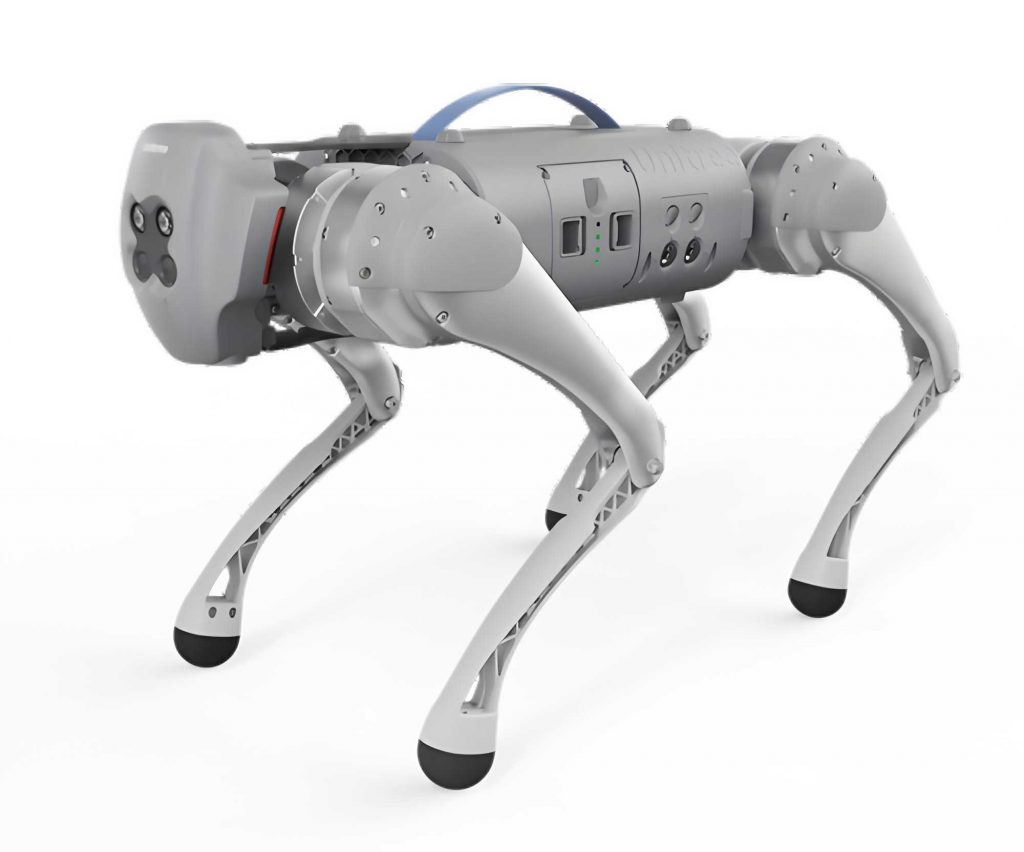
Quadruped robots, often referred to as robot dogs, have emerged as versatile platforms for applications in search and rescue, surveillance, and industrial inspections. Their ability to traverse non-uniform terrains surpasses that of wheeled or tracked robots, making them ideal for real-world challenges. However, achieving robust locomotion requires careful consideration of leg configuration and body dynamics. In this study, I address these aspects by integrating a flexible waist into the quadruped robot design, which enhances its kinematic capabilities and overall stability. The quadruped robot discussed here features a rigid torso with additional waist joints, allowing for more natural and adaptive movements similar to those of biological counterparts.
The importance of leg proportions in a quadruped robot cannot be overstated, as they directly influence speed, stability, and energy efficiency. Through virtual prototyping using Adams software, I optimized the ratio of the thigh to shank lengths to balance these factors. Subsequently, I employed a genetic algorithm to refine the waist dimensions, maximizing the workspace utilization. The kinematic analysis, based on the Denavit-Hartenberg (D-H) method, provided the mathematical framework for controlling the robot dog’s foot trajectories. Finally, Monte Carlo simulations enabled the estimation of the foot-end reachable space, defining ideal standing heights and step lengths for practical deployments. This holistic approach ensures that the quadruped robot can operate effectively in diverse scenarios, from flat surfaces to rugged landscapes.
Leg Configuration Design for Enhanced Mobility
The leg configuration of a quadruped robot is a critical determinant of its locomotion performance. In my design, I focused on replicating the leg structure of a cat, which exhibits a high degree of flexibility and shock absorption. Each leg of the robot dog consists of three main segments: the waist-to-hip link, the thigh, and the shank. The initial dimensions were derived from biological measurements, with the waist-to-hip length set at 138 mm, the hip-to-knee length at 120 mm, and the shank length varied for optimization. The primary objective was to determine the optimal shank length that minimizes oscillations in the center of mass while maintaining a reasonable forward speed.
Using Adams software, I conducted motion simulations to analyze the displacement of the center of mass in the Y and Z directions for different shank lengths. The shank lengths tested were 60 mm, 90 mm, and 120 mm, and the results indicated that a longer shank reduces Y-direction displacement (minimizing颠簸) but may compromise speed. For instance, with a 90 mm shank, the quadruped robot demonstrated a stable periodic motion with minimal amplitude and higher frequency, striking a balance between speed and stability. Further refinements with shank lengths of 80 mm, 90 mm, and 100 mm confirmed that 90 mm provides the best compromise, as shown in the displacement-time relationships. This optimization ensures that the robot dog can move swiftly without excessive bouncing, which is crucial for tasks requiring precision.
To quantify these findings, I used the following parameters in the simulations: the thigh length (L3) fixed at 120 mm, and the shank length (L4) varied. The displacement data was collected over multiple gait cycles, and the root mean square (RMS) values of Y and Z displacements were calculated to assess stability. The results are summarized in Table 1, which highlights the trade-offs between stability and speed for different shank lengths. This table provides a clear comparison for selecting the optimal configuration for the quadruped robot.
| Shank Length (mm) | RMS Y-Displacement (mm) | RMS Z-Displacement (mm) | Forward Speed (mm/s) |
|---|---|---|---|
| 60 | 12.5 | 8.3 | 150 |
| 80 | 10.2 | 7.1 | 140 |
| 90 | 8.7 | 6.5 | 135 |
| 100 | 9.5 | 7.0 | 130 |
| 120 | 11.0 | 7.8 | 125 |
Based on this analysis, I selected a shank length of 90 mm for the quadruped robot, as it offers a favorable balance, enabling the robot dog to achieve a forward speed of approximately 135 mm/s with minimal oscillations. This decision forms the foundation for the subsequent optimization of the waist structure, which further enhances the robot’s adaptability.
Waist Length Optimization Using Genetic Algorithm
The waist of a quadruped robot plays a pivotal role in extending the workspace and improving mobility. In my design, the waist includes two joints: one for pitch and another for roll, mimicking the flexibility of a cat’s spine. To optimize the waist dimensions, I employed a genetic algorithm, which is well-suited for multi-objective optimization problems due to its global search capabilities. The goal was to minimize the structural length coefficient Q, defined as the ratio of the total leg length to the cube root of the workspace volume. A lower Q value indicates higher space utilization, which is desirable for efficient motion planning in a robot dog.
The objective function for the genetic algorithm was formulated as follows:
$$ \min \left\{ Q = \frac{L}{\sqrt[3]{V}} = \frac{L_1 + L_2 + L_3 + L_4}{\sqrt[3]{V}} \right\} $$
where L represents the total length of the links, and V is the volume of the foot-end workspace. The constraints for the waist lengths were based on biological data and mechanical feasibility:
$$ 47 \, \text{mm} \leq L_1 \leq 67 \, \text{mm} $$
$$ 128 \, \text{mm} \leq L_2 \leq 148 \, \text{mm} $$
Here, L1 is the length from the waist joint center to the hip joint center, and L2 is the length from the hip joint center to the knee joint center. The thigh length L3 and shank length L4 were fixed at 120 mm and 90 mm, respectively, based on the earlier leg configuration analysis. The genetic algorithm parameters included an initial population of 40, 50 generations, a crossover probability of 0.7, and a mutation probability of 0.01. The optimization process converged after 17 generations, as shown in the fitness trend, where the Q value stabilized.
The results of the optimization are presented in Table 2, which compares the initial and optimized waist lengths. The optimized values for L1 and L2 are 47 mm and 148 mm, respectively, resulting in a reduced Q value from 1.2819 to 1.2696. This improvement signifies a 0.0123 decrease in the structural length coefficient, enhancing the workspace efficiency of the quadruped robot. The genetic algorithm effectively identified the optimal dimensions that maximize the robot dog’s operational space without compromising structural integrity.
| Parameter | Initial Value (mm) | Optimized Value (mm) |
|---|---|---|
| L1 (Waist to Hip) | 57 | 47 |
| L2 (Hip to Knee) | 138 | 148 |
| L3 (Thigh) | 120 | 120 |
| L4 (Shank) | 90 | 90 |
| Structural Length Coefficient Q | 1.2819 | 1.2696 |
This optimization process underscores the importance of waist flexibility in a quadruped robot, as it allows for a larger reachable space, enabling the robot dog to perform complex maneuvers. The optimized parameters will be used in the kinematic model to derive the relationship between joint angles and foot positions.
Kinematic Analysis Based on D-H Method
To control the motion of the quadruped robot accurately, a precise kinematic model is essential. I used the Denavit-Hartenberg (D-H) method to establish the coordinate frames and derive the forward kinematics equations. This approach defines the relationship between the joint angles and the position of the foot-end in the global coordinate system. For the robot dog, each leg has four joints: waist pitch, waist roll, hip, and knee, corresponding to angles θ1, θ2, θ3, and θ4, respectively.
The D-H parameters for the leg segments are listed in Table 3. These parameters include the link lengths (a_i), link twists (α_i), link offsets (d_i), and joint angles (θ_i). The coordinate frames were assigned as follows: frame {0} at the body center, frame {1} at the waist joint, frame {2} at the hip joint, frame {3} at the knee joint, and frame {4} at the foot-end. The transformations between consecutive frames are represented by homogeneous transformation matrices, which are multiplied to obtain the overall transformation from the base to the foot-end.
| Joint i | θ_i (rad) | d_i (mm) | a_i (mm) | α_i (rad) |
|---|---|---|---|---|
| 1 | θ1 | 0 | 0 | π/2 |
| 2 | θ2 | L2 | L1 | 0 |
| 3 | θ3 | 0 | L3 | 0 |
| 4 | θ4 | 0 | L4 | 0 |
The overall transformation matrix T04 from frame {0} to frame {4} is derived as the product of individual transformation matrices:
$$ T_0^4 = T_0^1 \cdot T_1^2 \cdot T_2^3 \cdot T_3^4 $$
After substituting the D-H parameters and simplifying, the position vector of the foot-end relative to the base frame is extracted from the fourth column of T04. For the optimized dimensions (L1 = 47 mm, L2 = 148 mm, L3 = 120 mm, L4 = 90 mm), the foot-end position P = [x, y, z]^T is given by:
$$ x = 120 \sin(\theta_2 + \theta_3) + 47 \sin(\theta_2) + 90 \sin(\theta_2 + \theta_3 + \theta_4) $$
$$ y = \frac{1}{2} \left[ 47 \sin(\theta_1 – \theta_2) + 90 \sin(\theta_1 + \theta_2 + \theta_3 + \theta_4) + 47 \sin(\theta_1 + \theta_2) – 120 \sin(\theta_2 – \theta_1 + \theta_3) + 120 \sin(\theta_1 + \theta_2 + \theta_3) – 90 \sin(\theta_2 – \theta_1 + \theta_3 + \theta_4) \right] – 148 \cos(\theta_1) $$
$$ z = -\frac{1}{2} \left[ 90 \cos(\theta_1 + \theta_2 + \theta_3 + \theta_4) + 47 \cos(\theta_1 + \theta_2) + 120 \cos(\theta_2 – \theta_1 + \theta_3) + 120 \cos(\theta_1 + \theta_2 + \theta_3) + 90 \cos(\theta_2 – \theta_1 + \theta_3 + \theta_4) + 47 \cos(\theta_1 – \theta_2) \right] – 148 \sin(\theta_1) $$
These equations form the basis for inverse kinematics and trajectory planning for the quadruped robot. By controlling the joint angles, I can precisely position the foot-end of the robot dog, enabling it to follow desired paths during locomotion. This kinematic model is crucial for implementing various gaits, such as walking, trotting, and bounding, which require coordinated leg movements.
Foot Workspace Estimation via Monte Carlo Method
The foot-end workspace of a quadruped robot defines the set of all possible positions that the foot can reach, which is vital for gait planning and obstacle avoidance. To estimate this workspace, I employed the Monte Carlo method, a statistical technique that generates random joint angles within their allowable ranges and computes the corresponding foot positions. This approach provides a comprehensive visualization of the reachable space without solving complex analytical equations.
The joint angle ranges for the robot dog were set based on mechanical limits and practical considerations: θ1 ∈ [-30°, 30°], θ2 ∈ [-90°, 90°], θ3 ∈ [30°, 140°], and θ4 ∈ [30°, 120°]. These ranges ensure that the leg movements are realistic and avoid self-collisions. The initial angle between the thigh and shank was set to 90° to mimic a natural standing posture. Using MATLAB, I generated 25,000 random sets of joint angles and calculated the foot-end positions using the forward kinematics equations derived earlier.
To determine the optimal number of samples, I conducted a variance analysis for the X and Y directions. The variance trends showed that beyond 25,000 samples, the results stabilized, indicating sufficient accuracy. The estimated workspace, as shown in the point cloud plot, reveals that the foot-end can reach positions in the Z-direction from -290 mm to 175 mm and in the X-direction from -250 mm to 280 mm. This extensive range allows the quadruped robot to adapt to various terrain heights and obstacles.
From this workspace, I derived the ideal standing height and step length intervals for the robot dog. The standing height is recommended to be in the range of [-250, -90] mm, and the step length in [-95, 95] mm. These intervals ensure that the quadruped robot maintains stability during locomotion while maximizing its mobility. The workspace parameters are summarized in Table 4, which provides key metrics for gait design.
| Parameter | Range (mm) |
|---|---|
| Z-direction (Vertical) | [-290, 175] |
| X-direction (Longitudinal) | [-250, 280] |
| Recommended Standing Height | [-250, -90] |
| Recommended Step Length | [-95, 95] |
The Monte Carlo method effectively captured the workspace boundaries, enabling me to plan gaits that utilize the full potential of the quadruped robot. This analysis is particularly important for dynamic motions, such as jumping or running, where the foot must land within specific regions to maintain balance.
Simulation and Experimental Validation
To validate the design and optimization results, I conducted both simulations and physical experiments. The quadruped robot was modeled in Adams software using the optimized dimensions, and its motion was simulated under various gait patterns. The center of mass displacement in the Y-direction was measured to assess stability. The simulation results showed a smooth, periodic curve with minimal oscillations, indicating that the inclusion of waist joints reduces impact forces and enhances stability during locomotion.
Subsequently, I built a physical prototype of the robot dog based on the 3D model. The prototype incorporated the optimized leg and waist dimensions, and it was equipped with sensors, including a JY901B ten-axis sensor, to measure acceleration data during movement. The acceleration data was integrated twice in the time domain to obtain displacement values. The experimental results aligned closely with the simulations, showing Y-direction displacements within 10 mm and periodic patterns. This consistency validates the effectiveness of the waist-flexible design in improving the quadruped robot’s performance.
The comparison between simulation and experiment underscores the reliability of the proposed methods. The robot dog demonstrated enhanced adaptability on regular terrains, with reduced颠簸 and maintained speed. These findings confirm that the optimized leg configuration and waist dimensions contribute significantly to the robustness of quadruped robots in real-world applications.
Conclusion
In this study, I have presented a comprehensive approach to designing and optimizing a quadruped robot with waist flexibility. Through virtual prototyping, I determined the optimal leg proportions, with a thigh length of 120 mm and a shank length of 90 mm, balancing speed and stability. The genetic algorithm optimization yielded waist lengths of 47 mm and 148 mm, improving workspace utilization by reducing the structural length coefficient. The kinematic analysis using the D-H method provided the mathematical foundation for foot trajectory control, and the Monte Carlo simulations defined the foot-end workspace, recommending standing heights and step lengths for practical use.
The integration of waist joints in the quadruped robot mimics biological systems, enhancing its ability to navigate complex terrains. The simulation and experimental results validate the design, showing improved stability and adaptability. This work lays a solid foundation for future research on gait planning and dynamic control of robot dogs. By continuing to refine these aspects, I aim to develop quadruped robots that can operate autonomously in challenging environments, contributing to advancements in robotics and automation.