
The mechanization and intelligent automation of agricultural harvesting represent a critical frontier in addressing labor shortages and enhancing productivity, particularly in complex terrains like the hilly regions predominant in citrus cultivation. Among the various subsystems of an agricultural robot, the end effector—the device that interacts directly with the crop—is paramount. Its performance dictates not only the success rate of detachment but also the preservation of fruit quality, directly impacting economic value. This work focuses on the comprehensive design, simulation, and preliminary experimental validation of a novel adsorption-based end effector specifically engineered for the non-destructive harvesting of citrus fruit. The primary objective is to achieve efficient, reliable, and gentle fruit detachment, separating the fruit from the stem (peduncle) without inflicting compression, abrasion, or拉扯 damage to the delicate peel.
The design process for such a specialized end effector must be fundamentally grounded in the biophysical properties of the target fruit. Therefore, prior to any mechanical conceptualization, an experimental study was conducted to characterize key geometric and mechanical parameters of a representative citrus variety. A sample of 100 fruits was randomly selected to establish statistical baselines. The average mass was found to be 88 grams. The mean transverse diameter (the widest point) was 53 mm, and the mean longitudinal diameter (stem to blossom end) was 45 mm. These dimensional parameters are crucial for defining the spatial envelope of the cutting mechanism within the end effector to ensure the fruit can be properly positioned and enclosed. Furthermore, the average diameter of the fruit stem was measured to be 2.1 mm, informing the specifications for the cutting blades.
Beyond geometry, the mechanical forces involved in harvest are critical. Two key force thresholds were experimentally determined. First, the tensile force required to detach the fruit from the stem by simple pulling was measured. This “pull-off” force, which represents a failure mode to be avoided by the design, ranged from a minimum of 21.9 N to a maximum of 46.2 N. Consequently, any grasping or吸附 force applied by the end effector to hold the fruit must be carefully controlled to remain significantly below the minimum pull-off force of 21.9 N to prevent premature detachment or damage during the positioning and cutting phase. Second, the shear force required to cleanly cut through the stem was quantified using a purpose-built cutting test apparatus. The results, summarized in Table 1 below, indicated a maximum cutting resistance of 79.2 N for stems within the observed diameter range. This value is essential for sizing the actuator responsible for the cutting motion.
| Stem Diameter Range (mm) | Average Cutting Resistance (N) | Maximum Recorded Resistance (N) |
|---|---|---|
| 1.9 – 2.1 | ~58.4 | 75.3 |
| 2.2 – 2.5 | ~63.3 | 72.5 |
| 2.6 – 3.0 | ~68.9 | 79.2 |
Guided by these empirical requirements, a three-module吸附 end effector was conceived. The overarching operating sequence is as follows: The end effector, mounted on a robotic arm, is guided to a target fruit identified by a vision system. A soft suction cup extends, makes contact, and gently吸附s the fruit, holding it securely in place. A integrated cutting mechanism then closes around the stem and severs it. Finally, the suction is released, allowing the harvested fruit to drop into a collection channel. The three core modules are:
- Adsorption Module: This module is responsible for the gentle, compliant prehension of the fruit. It consists of a pneumatic cylinder that provides a linear extension/retraction motion, at the end of which a soft, bellows-type suction cup is mounted. The suction is generated by a vacuum ejector. The critical design parameter here is the suction cup diameter, which must generate sufficient holding force without exceeding the fruit’s pull-off strength. The theoretical吸附 force (W) of a suction cup under vacuum is given by:
$$ W = \frac{\pi}{4} D^2 \cdot P \cdot n \cdot \eta $$
Where \(D\) is the effective cup diameter, \(P\) is the pressure differential (vacuum level), \(n\) is the number of cups (here, n=1), and \(\eta\) is a safety factor accounting for surface roughness and porosity. Setting the required吸附 force \(W\) to a safe value below 21.9 N (e.g., 15 N), with a typical vacuum pressure \(P\) of -50 kPa and a safety factor \(\eta\) of 0.5 for a porous fruit surface, the minimum diameter can be calculated:
$$ D = \sqrt{\frac{4W}{\pi P \eta}} = \sqrt{\frac{4 \times 15}{\pi \times 50 \times 10^3 \times 0.5}} \approx 0.039 \, \text{m} = 39 \, \text{mm} $$
A standard 50 mm diameter soft suction cup was selected to provide a robust margin of safety and accommodate size variability. - Cutting Module: This module performs the severing action. To ensure a clean, scissor-like shear cut, a parallel four-bar linkage mechanism was designed. This mechanism translates the linear motion of a second pneumatic cylinder into the symmetric, parallel closing motion of two cutting blades. One blade acts as the cutter, moving past a fixed anvil or counter-blade. The design ensures the blades move in a straight line relative to the stem, minimizing bending and tearing. The force requirement for the cutting cylinder is derived from the maximum stem cutting resistance \(F_{cut}\) of 79.2 N and the linkage geometry. At the moment of cutting, the mechanical advantage of the linkage must be considered. If the force transmitted to each blade is \(F_{blade}\), and the linkage angle θ affects the required cylinder force \(F_{cyl}\), a simplified static analysis yields:
$$ F_{cyl} \approx 2 \cdot F_{blade} \cdot \frac{1}{\tan(\theta)} $$
For a conservative estimate with \(\theta \approx 60^\circ\) and \(F_{blade} \geq F_{cut}\), the required cylinder force exceeds 150 N. A pneumatic cylinder with a 0.5 MPa pressure rating providing 150.8 N of force was therefore selected. - Transfer Chute: This is a passive funnel or channel structure positioned below the cutting zone. Once the stem is cut and suction is released, the fruit falls freely into this chute, which guides it gently away from the work area into a collection bin, preventing it from dropping and impacting the ground or other fruits.
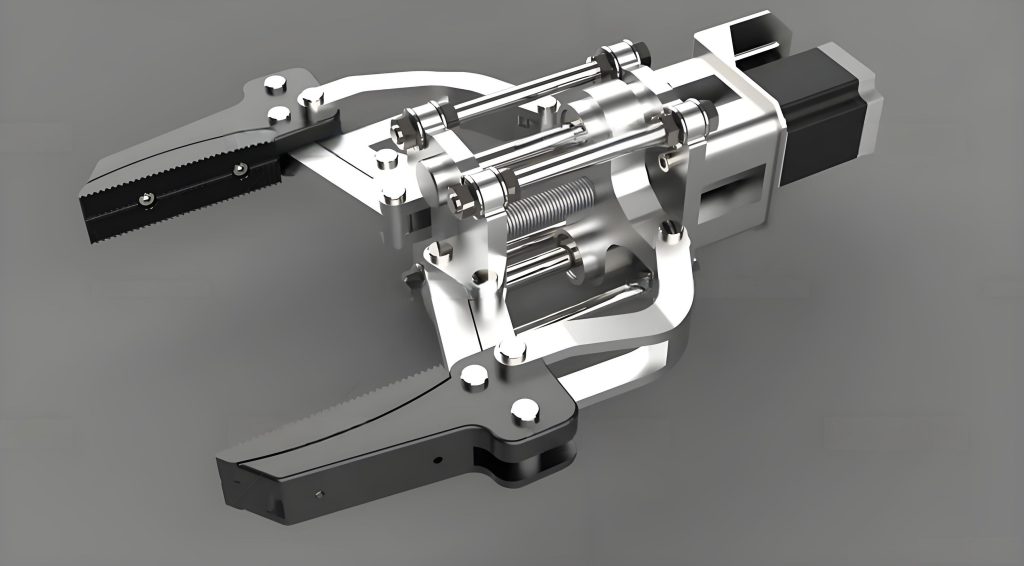
The integration of these modules results in a compact end effector assembly. The structural frame, designed to house the cylinders, linkages, and suction assembly, is intended to be lightweight yet rigid. To validate the kinematic performance and structural integrity of the proposed end effector design before physical prototyping, a detailed simulation analysis was undertaken.
First, a kinematic simulation was performed using a multibody dynamics software (e.g., ADAMS). The 3D CAD model of the cutting mechanism was imported, and appropriate joints (revolute and prismatic) were applied to the linkages and cylinder. The piston of the cutting cylinder was given a prescribed motion profile. The simulation output focused on the trajectory, velocity, and acceleration of the cutting blade. The results confirmed a symmetric, parallel closing path for the blade assembly. The displacement curve showed a smooth translation of approximately 70 mm in the primary cutting direction. More importantly, the velocity and acceleration profiles, as shown in the derived plots below, were continuous and free of sharp discontinuities or impulsive spikes. The maximum simulated velocity remained below 0.5 m/s, and accelerations were within reasonable limits. This smooth motion profile is critical for reducing inertial vibrations in the end effector and ensuring stable, predictable cutting action, which contributes to the goal of non-destructive harvesting.
Second, a Finite Element Analysis (FEA) was conducted to evaluate the structural strength of key components, particularly those intended for fabrication via 3D printing using Polylactic Acid (PLA) filament. PLA is favored for prototyping due to its ease of use and low cost, but its mechanical properties are inferior to metals. The most critically loaded parts, such as the blade holder, linkage arms, and main connector brackets, were analyzed. A static structural simulation was set up where the calculated maximum cutting force of 80 N was applied to the cutting blade holder. The material properties for PLA used in the simulation are listed in Table 2.
| Property | Value |
|---|---|
| Density (ρ) | 1.24 g/cm³ |
| Young’s Modulus (E) | 3.5 GPa |
| Poisson’s Ratio (ν) | 0.35 |
| Tensile Yield Strength (σ_y) | 55 MPa |
The FEA results produced von Mises stress distribution plots. The maximum stress (\( \sigma_{max} \)) observed in any PLA component was approximately 28 MPa, located at a connection pin hole in a linkage arm. Applying a standard safety factor (\( n \)) of 2 for prototype components, the allowable stress is:
$$ \sigma_{allowable} = \frac{\sigma_y}{n} = \frac{55 \, \text{MPa}}{2} = 27.5 \, \text{MPa} $$
Since \( \sigma_{max} \) (28 MPa) was very close to but slightly above \( \sigma_{allowable} \), the design was deemed acceptable for a proof-of-concept prototype under controlled conditions, though it indicated a marginal area that could be reinforced in future iterations. The corresponding maximum deformation was on the order of 0.1 mm, which is negligible for the intended kinematic function. These simulation results provided confidence that the 3D-printed end effector could withstand the operational loads.
Following the simulation phase, a functional prototype of the adsorption-based end effector was fabricated. All structural components (frame, linkages, blade holders) were 3D printed using PLA. The pneumatic cylinders (for extension and cutting), solenoid valves, vacuum ejector, and soft suction cup were commercial off-the-shelf components. The system was integrated with a pneumatic control circuit comprising an air compressor, filters, regulators, and electronically actuated valves to sequence the operations: 1) Extend adsorption module, 2) Activate vacuum, 3) Retract adsorption module to pull fruit into cutting position, 4) Activate cutting cylinder, 5) Release vacuum, 6) Retract cutting cylinder.
A bench-top test was performed to evaluate the prototype’s core functionality. The end effector was fixed to a test stand, and citrus fruits with stems were presented manually. The control sequence was initiated via a manual switch. Qualitative and observational results from these preliminary tests were positive. The soft suction cup successfully吸附ed and held fruits securely without visible deformation or damage to the peel. The cutting mechanism activated reliably, cleanly shearing through stems of various diameters. The entire cycle, from吸附 to release, was completed in under 3 seconds. Critically, the fruit experienced no significant拉扯 force, as it was fully supported by吸附 during the cutting action. The successful severance confirmed that the force output from the selected pneumatic cylinder was adequate. The fruit then dropped cleanly into the collection chute. This prototype validation demonstrated the feasibility of the adsorption-based approach for non-destructive detachment. The end effector exhibited the primary required attributes: gentle prehension, reliable cutting, and no post-cut crushing or abrasion.
In conclusion, this work presents the full-cycle development of a specialized吸附 end effector for robotic citrus harvesting, from biophysical requirement analysis through to functional prototyping. The design was driven by empirical data on fruit geometry and stem mechanics, ensuring the end effector is tailored to its specific task. Kinematic and structural simulations validated the soundness of the mechanical design and material choice for prototyping. The fabricated end effector prototype successfully demonstrated the core principle of using吸附 for non-destructive fruit restraint coupled with a mechanical cutter for stem severance. This approach effectively decouples the fruit-holding function from the cutting function, eliminating the need for complex grippers that must apply compressive force. Future work will focus on integrating this end effector with a robotic manipulator and vision system for fully autonomous in-orchard testing, optimizing the cycle time, and conducting quantitative studies on harvest success rate and fruit damage assessment compared to manual methods. The modular and simulation-informed design methodology showcased here provides a robust framework for developing effective end effector solutions for other delicate horticultural crops.