
The development of end-effectors that mimic the versatility and adaptability of the human hand remains a paramount challenge in robotics. A true dexterous robotic hand must be capable of conforming to a vast array of object geometries and executing precise manipulation tasks, serving as a universal tool for humanoid robots, space exploration, prosthetic limbs, and industrial automation. However, replicating the human hand’s complexity within a compact, efficient, and robust mechanical package presents significant engineering hurdles. The primary constraints include limited space for actuators, the need for a high number of degrees of freedom (DoFs), and the requirement for substantial yet controllable grasp forces. Traditional actuation methods, such as geared motors placed directly at the joints, lead to bulky, heavy fingers with poor power-to-weight ratios. Remote actuation via tendons offers a promising solution, allowing motors to be housed in the forearm or palm, thereby reducing the inertial load on the fingers and increasing their speed and agility. This article presents the design philosophy, detailed mechanical implementation, and novel control strategies of the TUST dexterous robotic hand, which successfully achieves highly underactuated control of 21 DoFs across the entire hand using a single motor, enabled by an innovative tendon routing and locking mechanism.
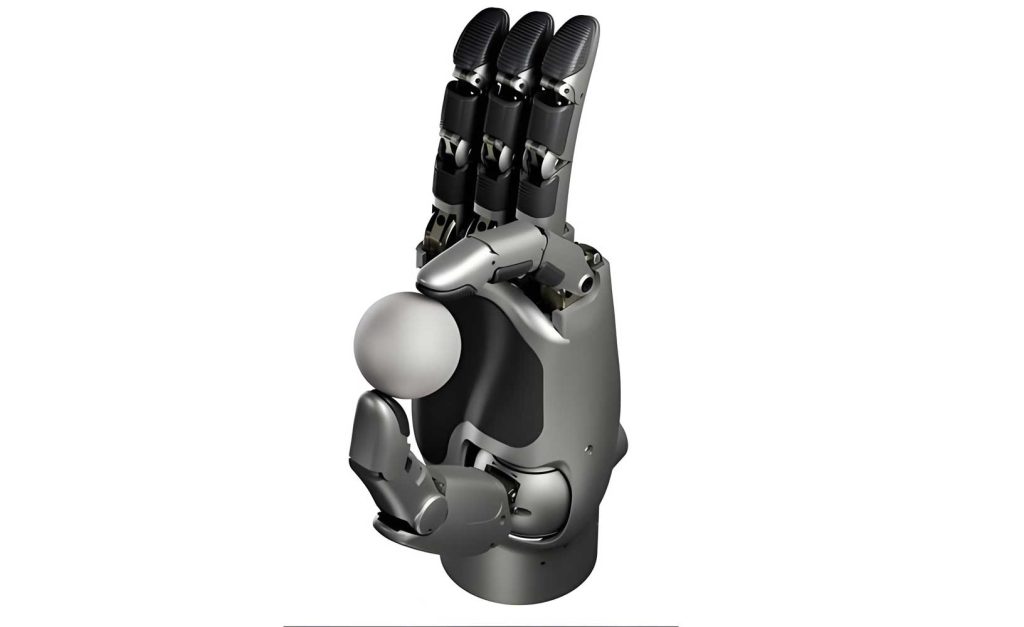
The core innovation of the TUST dexterous robotic hand lies in its synergistic combination of a novel positive-tendon transmission, electromagnetic locking joints, and a strategically integrated passive elastic element. This architecture enables a level of underactuation that drastically reduces the number of required actuators while maintaining the ability to perform stable, form-closure grasps and even simple in-hand manipulation. Unlike conventional tendon-driven hands where each tendon is a closed loop providing bidirectional pull, the TUST design employs a simplified, open-loop tendon path that is actively pulled and passively retracted. This approach, combined with per-joint braking, allows a single actuator to sequentially set the angles of multiple joints. This document will delve into the mechanical design of the finger modules, derive the mathematical models governing their motion and control, and explain the strategy for achieving flexible and stable grasping. The TUST dexterous robotic hand represents a significant departure from prior designs, exploring a new direction focused on extreme actuator reduction and intrinsic mechanical compliance.
Mechanical Design of the TUST Dexterous Robotic Hand Finger
The TUST hand is composed of five modular, identical fingers and a palm that provides an additional abduction/adduction degree of freedom for the thumb. Each finger is a self-contained unit with four degrees of freedom (three flexion/extension joints and one abduction/adduction joint at the base). The entire system is driven by steel tendons (cables), with sensory feedback provided by angle sensors (e.g., potentiometers or magnetic encoders) at each joint and a force sensor on the drive tendon. The pinnacle of the design is its ability to control all 21 DoFs with one motor, accomplished through a network of electromagnetic clutches that selectively engage and lock individual joints.
Novel Positive-Tendon Transmission for a Single Joint
The fundamental building block of the TUST dexterous robotic hand is its unique joint transmission mechanism. It diverges from traditional tendon-driven systems that rely on friction between the tendon and a pulley. As shown in the schematic below, the mechanism consists of a driving pulley fixed to the joint axis, a reset spring, and a tendon. The key differentiator is that the tendon is positively fixed to the pulley at an attachment point ‘a’.
When the tendon is pulled, point ‘a’ moves from an initial position A to a final position B, causing the pulley and the attached finger link to rotate by an angle $\theta$. This rotation is directly proportional to the amount of tendon displacement $L$. The relationship is given by:
$$L = \frac{a \cdot \theta \cdot \pi}{360}$$
where $a$ is the effective diameter of the pulley. This constitutes a direct, non-slip kinematic coupling. A torsional reset spring is pre-loaded against this motion. When the tendon tension is released, the stored energy in the spring rotates the joint back to its home position ($\theta = 0$).
The dynamic behavior during this reset phase can be modeled as a damped second-order system. The equation of motion is:
$$I\ddot{\theta} + b\dot{\theta} + k\theta = 0$$
where $I$ is the moment of inertia of the joint, $b$ is the damping coefficient, and $k$ is the torsional stiffness of the reset spring. Given an initial condition of $\theta = \theta_{initial}$ and $\dot{\theta} = 0$ at the moment of release, the system’s step response describes the return to zero. The reset time $t_{reset}$ is approximately proportional to the initial displacement $\theta_{initial}$ for a given system. A simplified linear approximation yields:
$$t_{reset} \approx K_{\tau} \cdot \theta_{initial}$$
where $K_{\tau}$ is a constant dependent on $I$, $b$, and $k$. This predictable reset behavior is crucial for the sequential control strategy.
| Feature | Traditional Friction-Based Tendon Drive | TUST Positive-Attachment Tendon Drive |
|---|---|---|
| Transmission Principle | Friction between tendon and pulley. | Positive pull via fixed attachment point. |
| Risk of Slippage | High, requires significant pretension. | None, inherently anti-slip. |
| Required Pretension | High to maintain grip. | Minimal, only to remove slack. |
| Maximum Continuous Rotation | Potentially unlimited. | Limited by attachment arc (e.g., ~90°). |
| Control Complexity | Requires dual tendons or complex routing for bidirectional control. | Simple; pull for active motion, spring for return. |
Integrated Finger Architecture and Highly Underactuated Tendon Routing
A full TUST finger integrates three of these single-joint mechanisms for flexion/extension. Embracing the principle of high underactuation, these three joints are driven in series by a single primary tendon. This routing is the cornerstone of the dexterous robotic hand’s actuator economy. The tendon passes through guides or low-friction sheaves, connecting sequentially to the pulleys of the Distal Interphalangeal (DIP), Proximal Interphalangeal (PIP), and Metacarpophalangeal (MCP) joints. A key design element is the integration of an electromagnetic brake (e.g., a solenoid-actuated pin or friction plate) at each joint axis. When energized, this brake locks the joint in its current position.
Additionally, a passive extension spring is connected in series with the drive tendon inside the finger. This spring serves two critical functions: 1) It provides mechanical compliance, allowing the finger to yield slightly upon unexpected impact, protecting both the object and the drive motor. 2) It acts as a force sensor; by measuring its deflection via a built-in encoder or other means, the tension in the tendon (and thus the approximate grasp force) can be inferred. A second, independent tendon is used to control the finger’s abduction/adduction motion at the base, following a similar positive-attachment principle.
The specification of a representative TUST finger module is summarized below:
| Parameter | Value / Description |
|---|---|
| Degrees of Freedom (DoF) | 4 (3 Flexion/Extension, 1 Abduction/Adduction) |
| Primary Actuation Tendons | 2 (1 for 3 flexion joints, 1 for abduction) |
| Joint Motion Range | 0° to 90° per flexion joint |
| Transmission Type | Positive-Attachment Tendon & Pulley | Joint Locking Mechanism | Electromagnetic Brake per joint |
| Compliance Element | Series Elastic Spring on Drive Tendon |
| Sensors | Angle Sensor per joint, Force sensing via spring deflection |
| Control Paradigm | Sequential, Highly Underactuated |
Mathematical Modeling and Sequential Control Strategy
The extreme underactuation of the TUST dexterous robotic hand necessitates an intelligent control strategy to coordinate the single motor, the electromagnetic brakes, and the tendon routing to achieve desired finger postures. The control logic is based on resolving the kinematic constraints imposed by the series tendon connection.
Problem Formulation and State Definition
Consider the three flexion joints of a finger, indexed $i = 1$ (MCP), $2$ (PIP), $3$ (DIP). Let their current angles be $\Theta_{current} = [\theta_1^c, \theta_2^c, \theta_3^c]$ and the desired target angles be $\Theta_{target} = [\theta_1^t, \theta_2^t, \theta_3^t]$. The required angular displacement for each joint is $\Delta\Theta = [\delta_1, \delta_2, \delta_3] = \Theta_{target} – \Theta_{current}$. By convention, positive $\delta$ signifies flexion (pulling the tendon), and negative $\delta$ signifies extension (releasing the tendon, allowing spring return).
Because a single tendon drives all three joints, the total tendon displacement $L_{total}$ is the sum of the individual joint displacements required for those joints that move in the flexion direction. However, a joint needing to extend cannot do so while the tendon is being pulled. This creates a sequencing problem.
Optimized Sequential Control Algorithm
The control algorithm’s goal is to transition from $\Theta_{current}$ to $\Theta_{target}$ in minimal time. Let $S^+ = \{\delta_i | \delta_i > 0\}$ be the set of positive (flexion) displacements and $S^- = \{\delta_i | \delta_i < 0\}$ be the set of negative (extension) displacements. Define $\delta_{max} = \max(S^+ \cup \{0\})$ and $\delta_{min} = \min(S^- \cup \{0\})$.
The total control time $T$ consists of the time to pull the tendon, the time to release it, and the joint reset time. If we pull first, the sequence is: Pull by $\delta_{max}$, then release by $|\delta_{min}|$. The time would be proportional to $|\delta_{max}| + |\delta_{min}|$. If we release first, the sequence is: Release by $|\delta_{min}|$, then pull by $\delta_{max}$. The time would be proportional to $|\delta_{min}| + |\delta_{max}|$. While the sum is identical, the *parallel reset* property is key. During the release phase, all joints in $S^-$ reset simultaneously. The optimal sequence is chosen to minimize the *sequential* motor action time, which is:
$$T_{motor} \propto \min(|\delta_{max}|, |\delta_{min}|) + ||\delta_{max}| – |\delta_{min}||$$
This simplifies to $T_{motor} \propto \max(|\delta_{max}|, |\delta_{min}|)$.
The control strategy is therefore:
- Calculate Displacements: Compute $\Delta\Theta$, $\delta_{max}$, and $\delta_{min}$.
- Decision: If $|\delta_{max}| \ge |\delta_{min}|$, execute the Pull-First Sequence. Otherwise, execute the Release-First Sequence.
- Pull-First Sequence Execution:
- a. Energize the motor to pull the tendon. Monitor all joint angles $\theta_i$.
- b. For any joint $j$ where $\theta_j^c + \delta_j$ is reached (i.e., $\theta_j = \theta_j^t$), immediately energize its electromagnetic brake to lock it.
- c. Continue pulling until the tendon has been displaced proportionally to $\delta_{max}$. At this point, all joints in $S^+$ should be locked at their target angles.
- d. Reverse the motor to release the tendon. The locked joints remain fixed. The joints in $S^-$ will begin to extend under spring force.
- e. Monitor the extending joints. When a joint $k$ in $S^-$ reaches its target $\theta_k^t$, energize its brake to lock it.
- f. Once all joints are locked, stop the motor. The finger is now in the target configuration.
- Release-First Sequence Execution: The reverse of the above: release first to handle extensions, then pull to achieve flexions.
The entire process forms a closed-loop control system using joint angle feedback. The state machine for this controller can be represented as follows:
Control State Machine:
$$ \text{START} \rightarrow \text{COMPUTE } \Delta\Theta \rightarrow \text{CHOOSE SEQUENCE} \rightarrow \text{ACTION PHASE 1 (Pull/Release)} \xrightarrow[\text{Joint Locking}]{\text{Continuous Feedback}} \text{ACTION PHASE 2 (Release/Pull)} \xrightarrow[\text{Joint Locking}]{\text{Continuous Feedback}} \text{ALL JOINTS LOCKED} \rightarrow \text{STOP}$$
Implementation of Flexible and Stable Grasping
A defining feature of a practical dexterous robotic hand is its ability to perform stable, yet compliant grasps. The TUST hand mimics the human grasp strategy, which often involves two phases: a shape conformation phase and a force application phase.
Grasp Phases and Force Control
- Shape Conformation Phase: The control strategy described above is used to bring the fingers into a wrapping posture around the object. The goal is to achieve multi-point contact and form closure, without applying significant force. During this phase, the series elastic spring is only lightly compressed.
- Force Application Phase: Once the finger links are in contact with the object and their angles can no longer change (geometrically blocked), the control system enters a force application mode. The motor continues to wind in the tendon. Since the joints cannot rotate further, this additional tendon displacement $\Delta L_{force}$ directly translates into compression of the series elastic spring according to Hooke’s Law:
$$F_{tendon} = k_{spring} \cdot \Delta L_{force}$$
where $k_{spring}$ is the stiffness of the series spring. This tendon force $F_{tendon}$ is translated into grasp forces $F_{grasp,i}$ at each contact point $i$, dependent on the finger’s geometry and static equilibrium. By controlling the amount of additional motor rotation (and thus $\Delta L_{force}$) after contact, the system can precisely regulate the pre-tension in the grasp. When the desired pre-tension is achieved, all joint brakes are fully engaged, locking the entire kinematic chain. The grasp is now maintained statically by the brakes, not by the motor, which can be powered down. This is crucial for achieving a stable, power-efficient grip.
Intrinsic Safety and Compliance
The series elastic spring is the key to the dexterous robotic hand’s flexible and safe operation. It provides several critical advantages:
- Impact Protection: If the finger strikes an object unexpectedly during fast motion, the spring compresses, slowing down the force transfer to the object and to the motor drive train. This protects both the object from damage and the motor from high impulsive loads.
- Force Sensing: As mentioned, spring deflection offers a direct, inexpensive measure of tendon tension, enabling implicit force control without dedicated force/torque sensors at each fingertip.
- Passive Compliance: During a locked grasp, if an external force attempts to dislodge the object, the spring provides a small amount of passive “give,” which can help maintain contact and stabilize the grasp against perturbations, much like the soft tissues in a human hand.
The relationship between motor position $\phi_m$, tendon displacement $L$, spring deflection $x_s$, and joint angles $\theta_i$ is summarized by the following constitutive equations:
$$L = r_m \cdot \phi_m$$
$$L = \sum_{i=1}^{3} \left( \frac{a_i \cdot \theta_i \cdot \pi}{360} \right) + x_s$$
$$F_{tendon} = k_s \cdot x_s$$
where $r_m$ is the motor winch radius, $a_i$ is the pulley radius for joint $i$, and $k_s$ is the spring constant. During free motion, $F_{tendon}$ is small and $x_s \approx 0$. During a force-closure grasp, $\theta_i$ are constant, so $\Delta L = \Delta x_s$, and $\Delta F_{tendon} = k_s \cdot \Delta L$.
System Integration and Performance Discussion
The TUST dexterous robotic hand integrates the finger modules, a palm structure, a single drive motor with an encoder, a set of electromagnetic brakes, and a microcontroller unit (MCU). The MCU runs the sequential control algorithm, reading all joint angle sensors and the spring deflection, and controlling the motor and the individual brake coils. The communication and power for the brakes and sensors are routed through the hand’s structure.
The primary advantages of this design are substantial:
- Extreme Underactuation: 21 DoFs controlled by 1 actuator represents a very high underactuation ratio, minimizing weight, cost, and control complexity.
- Non-Slip Transmission: The positive tendon attachment ensures reliable and repeatable joint positioning without complex tensioning systems.
- Stable, Power-Efficient Grasps: The ability to lock joints electrically allows the hand to maintain a powerful grasp without consuming motor power.
- Built-In Safety and Compliance: The series spring provides inherent force control and protection.
However, trade-offs exist and present avenues for future work:
- Speed vs. Complexity: The sequential control strategy is not time-optimal for all possible posture transitions, as joints must wait for their turn to be set. The reset time $t_{reset}$ can limit the speed of motions requiring large extensions.
- Brake Performance: The holding force of compact electromagnetic brakes is limited. Slippage under high load or impact can occur, which would compromise grasp stability. Future iterations could explore more robust locking mechanisms like shape memory alloy actuators or mechanical latches.
- Precision: Backlash in the tendon path, hysteresis in the spring, and resolution of the angle sensors all affect the final positioning accuracy of the fingertips.
Despite these challenges, the TUST dexterous robotic hand successfully demonstrates a novel and viable architectural paradigm. It proves that a highly underactuated hand, using a single motor, can achieve dexterous wrapping grasps through intelligent mechanical design and control sequencing. This approach opens a new direction for creating low-cost, lightweight, and robust robotic end-effectors for applications where the complexity and expense of fully actuated hands are prohibitive. The integration of passive compliance and electrical joint locking offers a compelling blend of flexibility and stability, moving us closer to the ideal of a versatile, adaptive, and safe dexterous robotic hand.