
In the field of robotics, dexterous robotic hands have emerged as critical tools for human-robot interaction, particularly in industrial and service robotics. Their high degrees of freedom and biomimetic capabilities make them ideal for complex manipulation tasks. However, existing dexterous robotic hands often face challenges such as low freedom, cumbersome assembly and disassembly processes, and complex control systems reliant on multiple sensors. To address these issues, I have designed and developed a modular, easily assemblable, direct-drive dexterous robotic hand with 11 degrees of freedom. This dexterous robotic hand utilizes permanent magnets for rapid joint assembly and disassembly, features a wide rotation range for each finger joint, and incorporates a specialized thumb design to enable seamless switching between left- and right-hand modes, as well as bilateral grasping. Through 3D printing, a prototype of this dexterous robotic hand was fabricated. To simplify the control system, a current feedback control algorithm was proposed, which establishes mathematical models linking motor drive current to joint rotation angles and fingertip forces via signal acquisition and post-processing. Grasping experiments demonstrate that this modular dexterous robotic hand possesses robust grasping capabilities, and the current feedback control algorithm effectively manages motion states and grasping forces, enabling stable object manipulation.
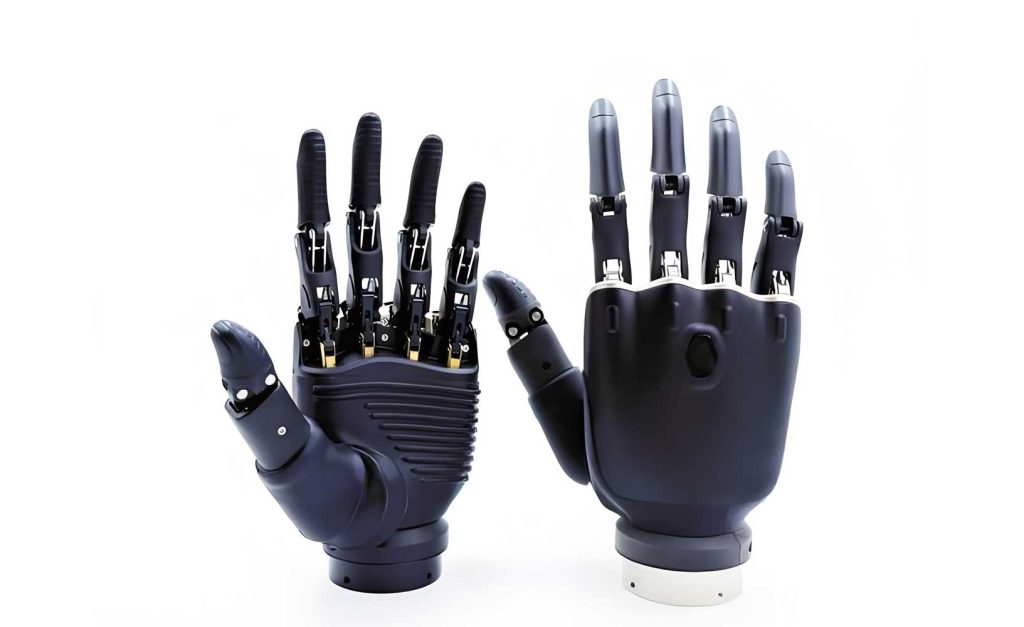
The development of dexterous robotic hands has been a focal point in robotics research, driven by their potential to replicate human-like manipulation. Traditional designs can be categorized into underactuated and fully actuated systems. Underactuated dexterous robotic hands, while simpler and easier to control, often lack the precision and flexibility required for intricate tasks. Fully actuated dexterous robotic hands, such as the Shadow Hand and Robonaut hand, offer higher dexterity but tend to be bulky, complex, and difficult to maintain. My work aims to bridge this gap by introducing a modular magnetic dexterous robotic hand that combines the benefits of both approaches—ease of assembly and high freedom—while leveraging current feedback for intuitive control. This dexterous robotic hand is designed to be biomimetic, with dimensions similar to a human hand, and employs 3D-printed components for cost-effectiveness and customization.
The structural design of the dexterous robotic hand revolves around modularity and magnetic adhesion. The hand consists of modular finger joints and a palm module, with each finger joint integrated with a miniature direct-drive motor. Permanent magnets are embedded in adjacent joints to facilitate quick assembly and disassembly, allowing for rotation ranges of at least ±90° per joint. The thumb is uniquely designed with three degrees of freedom, including a lateral swing joint that enables a rotation range of -125° to 125°, thereby supporting bilateral grasping and left/right-hand mode switching. The palm is symmetrically designed with anti-slip pads on both sides to accommodate dual-sided grasping. Key parameters of the dexterous robotic hand are summarized in Table 1.
| Component | Length (mm) | Width (mm) | Thickness (mm) | Rotation Range (°) |
|---|---|---|---|---|
| Palm | 95 | 86 | 24 | N/A |
| Composite Phalanx | 44 | 16 | 20 | -90 to 90 |
| Proximal Phalanx | 32 | 19 | 14 | -90 to 90 |
| Finger Base | 40 | 16 | 14 | N/A |
| Thumb Swing Joint | 33 | 12 | 14 | -125 to 125 |
Each modular finger in this dexterous robotic hand, except for the thumb swing joint, follows a uniform design. The finger joints are driven by miniature motors via a compound gear reduction system, providing high torque output. Magnetic rings with positioning pins ensure torque transmission between joints, while spring-loaded pins in the finger bases establish electrical connections with the palm through magnetic force. The fingers incorporate cross-elastic cords on one side to maintain posture in the absence of motor force, adding compliance for delicate grasping. The thumb’s structure, as shown in the design, allows for enhanced flexibility by enabling lateral movement and wide rotation, critical for adaptive grasping. The transmission mechanism of the dexterous robotic hand finger involves a dynamic system where motor torque drives joint rotation, influenced by inertial loads and external forces. The equation governing this system is derived from Newton’s second law for rotation:
$$ T = J_s \frac{d\omega_s}{dt} + R F_s $$
where \( T \) is the motor torque, \( J_s \) is the total inertia of the transmission components, \( \omega_s \) is the motor angular velocity, \( R \) is the distance from the joint axis to the fingertip, and \( F_s \) is the fingertip contact force. For the dexterous robotic hand, the direct-drive approach minimizes frictional losses, simplifying this model. The motor torque relates to the drive current through the motor’s electromechanical characteristics. Assuming a constant drive voltage in PWM control, the power \( P \) is proportional to current \( I \), leading to:
$$ I = \frac{2\pi n}{U} \left( J_s \frac{d\omega_s}{dt} + R F_s \right) $$
where \( n \) is the motor speed in revolutions per second, and \( U \) is the drive voltage. This equation forms the basis for the current feedback algorithm, linking current to both motion dynamics and grasping force in the dexterous robotic hand.
To implement the current feedback control for the dexterous robotic hand, mathematical models were developed to correlate current with fingertip force and joint rotation angle. An experimental setup was constructed using a single modular finger, a Hall-effect current sensor (WCS2801), a resistive pressure sensor (FSR400), a microcontroller, and a PC. Data acquisition involved driving the finger under varying loads and recording current and pressure values. The relationship between fingertip force \( F_s \) (in Newtons) and current sensor reading \( C_d \) (in milliamperes) was fitted to a polynomial equation based on 20 data points, resulting in:
$$ F_s = 4.455 \times 10^{-8} C_d^3 – 3.825 \times 10^{-5} C_d^2 + 0.015 C_d – 1.186 $$
This model, validated through curve fitting in Matlab, shows that for currents below 120 mA, the grasping force is zero (no contact), while between 121 mA and 182 mA, force increases gradually due to initial contact with the object, and above 431 mA, force rises sharply as the finger tightens, until motor stall. This allows the dexterous robotic hand to estimate contact force solely from current readings, eliminating the need for dedicated force sensors.
Similarly, the relationship between drive current and joint rotation angle was derived by measuring angular velocity under no-load conditions at different drive voltages. Table 2 summarizes the average current and corresponding angular velocity for voltages from 7 V to 12 V, with outliers removed to ensure accuracy.
| Drive Voltage (V) | Drive Current (mA) | Angular Velocity (°/s) |
|---|---|---|
| 7 | 154 | 29 |
| 8 | 186 | 38 |
| 9 | 242 | 57 |
| 10 | 356 | 86 |
| 11 | 473 | 96 |
| 12 | 584 | 103 |
Using Matlab’s fitting toolbox, the data were fitted to a quadratic equation, yielding the angular velocity \( \omega_s \) as a function of current \( C_d \):
$$ \omega_s = -4.47 \times 10^{-4} C_d^2 + 0.503 C_d – 38.27 $$
Given the drive time \( T_d \), the joint rotation angle \( \theta \) can be computed as \( \theta = \omega_s \cdot T_d \). This model enables the dexterous robotic hand to infer joint position from current signals before object contact, facilitating precise motion control.
The grasping experiments for the dexterous robotic hand were conducted using a test platform comprising the hand prototype, an Arduino Mega2560 controller, L9110S motor drivers, WCS2801 current sensors, and a power supply. The control algorithm integrates the current-feedback models: initially, the finger moves under no-load conditions, with current monitoring to detect contact via a sudden jump in current; upon contact, the current value is input into the force model to regulate grasping force, while the rotation angle is tracked using the angular velocity model. This closed-loop approach ensures stable and adaptive grasping. The flowchart of the grasping process involves continuous current sampling, comparison with thresholds, and force adjustment based on the derived models.
To evaluate the performance of this dexterous robotic hand, grasping tests were performed on objects with masses ranging from 3 g to 500 g and dimensions between 40 mm and 120 mm. The dexterous robotic hand successfully grasped various items, including cylindrical tools, spherical balls, and irregular shapes, demonstrating bilateral grasping capability where both sides of the hand could be used interchangeably. The current feedback algorithm proved effective in maintaining stable grips without slippage, as the force model allowed real-time force modulation. Table 3 provides a summary of sample objects grasped, highlighting the versatility of the dexterous robotic hand.
| Object Type | Mass (g) | Dimensions (mm) | Grasping Success Rate | Notes |
|---|---|---|---|---|
| Plastic Cylinder | 50 | Ø40 x 60 | 100% | Stable grip with force control |
| Rubber Ball | 100 | Ø60 | 95% | Compliant adaptation due to elastic cords |
| Metal Tool | 300 | 80 x 30 x 20 | 90% | Bilateral grasping demonstrated |
| Fragile Box | 200 | 100 x 50 x 30 | 98% | No damage, thanks to force feedback |
| Irregular Object | 500 | ~120 (max) | 85% | Adaptive finger conformations |
The results confirm that the modular magnetic dexterous robotic hand exhibits strong grasping abilities across a spectrum of objects. The current feedback control algorithm, by eliminating multiple sensors, reduces system complexity while providing accurate state estimation. This dexterous robotic hand can switch between left- and right-hand modes seamlessly, enabling bilateral operations that enhance manipulation efficiency in constrained environments. The use of 3D printing and magnetic assembly further underscores the design’s practicality for rapid prototyping and maintenance.
In summary, this work presents a novel approach to dexterous robotic hand design and control. The modular magnetic dexterous robotic hand addresses common issues of low freedom and cumbersome assembly through its innovative joint mechanism and biomimetic layout. The current feedback algorithm offers a simplified yet effective control strategy, deriving fingertip force and joint angle from motor current alone. Experimental validation underscores the hand’s capability for stable and versatile grasping. Future improvements could involve integrating machine learning for enhanced force prediction or expanding the modularity to include additional sensors for tactile feedback. Ultimately, this dexterous robotic hand contributes to advancing robotic manipulation by balancing complexity with functionality, paving the way for more accessible and adaptable robotic systems.
The mathematical models developed here are central to the dexterous robotic hand’s operation. For instance, the force-current relationship can be extended to account for dynamic effects by including acceleration terms. Consider the general equation for motor dynamics in the dexterous robotic hand:
$$ I = \frac{1}{K_t} \left( J_s \alpha + B \omega_s + \tau_f + R F_s \right) $$
where \( K_t \) is the motor torque constant, \( \alpha \) is angular acceleration, \( B \) is viscous friction coefficient, and \( \tau_f \) is static friction torque. For simplification in the current feedback approach, these parameters can be lumped into empirical constants derived from calibration. Another useful formula is the power dissipation in the dexterous robotic hand motors, which relates to efficiency:
$$ P_{loss} = I^2 R_m + K_e \omega_s I $$
where \( R_m \) is motor resistance and \( K_e \) is back-EMF constant. Monitoring \( P_{loss} \) via current can help in thermal management for prolonged use of the dexterous robotic hand.
Additionally, the modularity of the dexterous robotic hand allows for scalability. The magnetic adhesion force \( F_m \) between joints can be approximated by:
$$ F_m = \frac{B^2 A}{2\mu_0} $$
where \( B \) is magnetic flux density, \( A \) is contact area, and \( \mu_0 \) is permeability of free space. This ensures joint integrity during operation. For the grasping force control, a PID controller can be implemented using current feedback, with the error defined as:
$$ e(t) = F_{desired} – F_s(t) $$
and the control output adjusting the PWM duty cycle. This enhances the dexterous robotic hand’s responsiveness.
In terms of kinematics, the dexterous robotic hand’s finger can be modeled as a serial chain. For a two-joint finger, the fingertip position \( (x, y) \) relative to the base is given by:
$$ x = L_1 \cos(\theta_1) + L_2 \cos(\theta_1 + \theta_2) $$
$$ y = L_1 \sin(\theta_1) + L_2 \sin(\theta_1 + \theta_2) $$
where \( L_1 \) and \( L_2 \) are link lengths, and \( \theta_1 \), \( \theta_2 \) are joint angles derived from the current-angle model. This allows for position control in task space for the dexterous robotic hand.
To further illustrate the system’s performance, Table 4 compares key metrics of this dexterous robotic hand with other notable designs, emphasizing its advantages in modularity and control simplicity.
| Feature | Shadow Hand | Robonaut Hand | Proposed Dexterous Robotic Hand |
|---|---|---|---|
| Degrees of Freedom | 20 | 12 | 11 |
| Actuation Type | Tendon-driven | Pneumatic | Direct-drive with magnets |
| Modularity | Low | Medium | High |
| Control Sensors | Multiple | Multiple | Current feedback only |
| Bilateral Grasping | No | No | Yes |
| Assembly Ease | Complex | Moderate | Easy |
This comparison highlights how the dexterous robotic hand presented here offers a balanced solution for practical applications. The current feedback algorithm not only reduces sensor count but also enhances reliability by minimizing wiring and potential failure points. In industrial settings, such a dexterous robotic hand could be deployed for assembly tasks requiring delicate handling, while in service robotics, it could assist with everyday object manipulation.
Looking ahead, potential enhancements for this dexterous robotic hand include incorporating tactile sensing arrays on fingertips for richer feedback, or using adaptive control laws to handle uncertain environments. The mathematical models could be refined through real-time learning algorithms, allowing the dexterous robotic hand to improve its force estimation over time. Additionally, the modular design could be extended to include different joint types or actuators, making the dexterous robotic hand a platform for research and development.
In conclusion, the modular magnetic dexterous robotic hand represents a significant step forward in robotic manipulation technology. By leveraging magnetic adhesion for modularity and current feedback for control, it addresses longstanding challenges in dexterous robotic hand design. The experimental results validate its effectiveness, and the underlying models provide a foundation for future innovations. As robotics continues to evolve, such dexterous robotic hands will play a pivotal role in enabling more natural and capable human-robot interactions.