
In modern manufacturing, especially for military and aerospace applications, the demand for automated coating on complex, non-linear surfaces has grown significantly. Traditional manual spraying methods often lead to inconsistencies in quality, higher costs, and inefficiencies. To address these challenges, I propose a specialized spraying end-effector designed for attachment to the end of an industrial serial robot. This end-effector integrates a laser distance sensor and a spraying gun, enabling real-time surface scanning and adaptive path planning to maintain optimal spraying distance and avoid collisions. The core contributions include a mechanical structure design, an electronic control system for high-speed communication, kinematic analysis via homogeneous coordinate transformations, structural dynamics evaluation through modal and harmonic response analyses, and a novel path planning algorithm. This article details each aspect, with extensive use of formulas and tables to summarize key findings, aiming to provide a comprehensive guide for developing such end-effectors.
The design of this end-effector focuses on versatility and precision. It consists of six main components: an end link, a seventh-axis motor, a spray gun bracket, a spray gun, a sensor bracket, and a laser distance sensor. The end link interfaces with the robot’s flange, allowing seamless integration. The seventh-axis motor enables rotational adjustments of the spray gun and sensor, facilitating multi-angle scanning and spraying. The laser sensor measures the distance to the target surface, which is critical for maintaining a consistent coating thickness. To illustrate the structure, consider the following image that depicts the end-effector assembly:
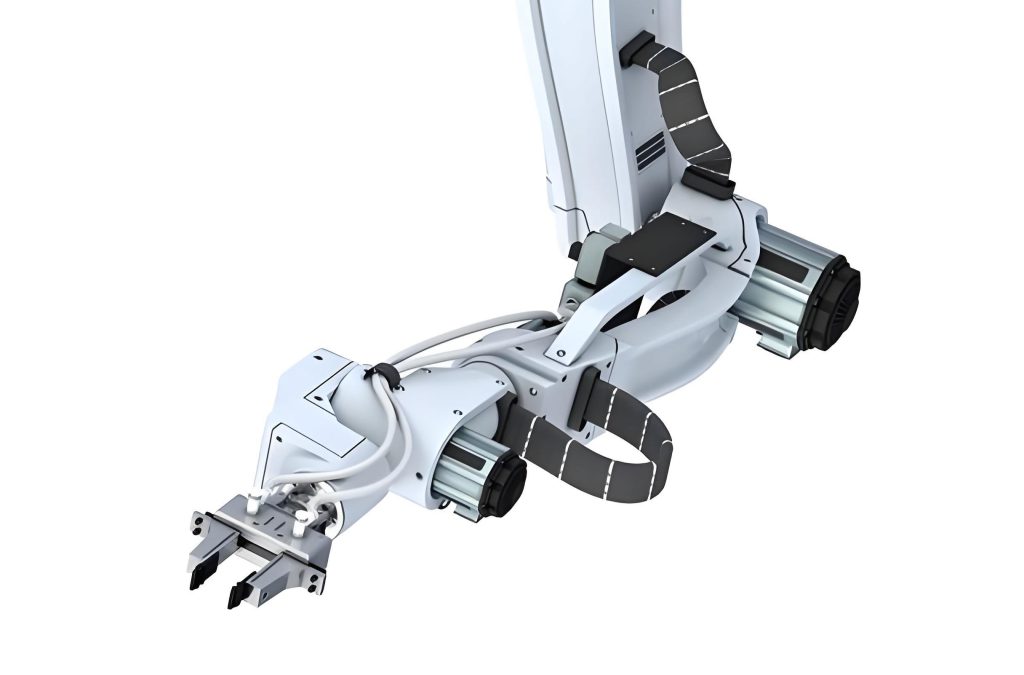
In terms of dimensions, let’s define key parameters. As shown in the schematic, the distance from the robot flange connection point to the sensor bracket is L1, the length of the spray gun is L2, and offsets in the Z-direction include d1, d2, and d3. The laser emission point (b) is offset from the spray gun tip (a) by L3 in the X-direction and d1+d2 in the Z-direction. The rotation angle θ of the seventh-axis motor controls the orientation. These parameters are essential for kinematic modeling, as they influence the end-effector’s ability to position the spray gun accurately relative to the surface.
To achieve precise control, the end-effector’s kinematics are derived using homogeneous coordinate transformation matrices. Let the base frame of the robot be {0}, and the end-effector frame attached to the robot’s flange be {6}. The transformation from {6} to the sensor frame {7} and then to the spray gun tip frame {8} is expressed as follows. The rotation matrix for θ around the X-axis is combined with translation vectors to account for the offsets. The transformation from frame {6} to frame {7} is given by:
$${}^{6}T_{7} = \text{Trans}(L1 + L2 + L3, 0, d1 + d2) \cdot \text{Rot}(X, \theta)$$
Expanding this, we get:
$${}^{6}T_{7} = \begin{bmatrix}
1 & 0 & 0 & L1+L2+L3 \\
0 & \cos\theta & -\sin\theta & 0 \\
0 & \sin\theta & \cos\theta & d1+d2 \\
0 & 0 & 0 & 1
\end{bmatrix}$$
Similarly, the transformation from frame {7} to the spray gun tip frame {8} is:
$${}^{7}T_{8} = \text{Trans}(-L2/2 – L3, 0, -d1-d2-d3) = \begin{bmatrix}
1 & 0 & 0 & -L2/2 – L3 \\
0 & 1 & 0 & 0 \\
0 & 0 & 1 & -d1-d2-d3 \\
0 & 0 & 0 & 1
\end{bmatrix}$$
Thus, the overall transformation from the robot base to the spray gun tip is:
$${}^{0}T_{8} = {}^{0}T_{6} \cdot {}^{6}T_{7} \cdot {}^{7}T_{8}$$
These equations allow real-time computation of the spray gun’s position and orientation, which is crucial for aligning the end-effector with the target surface. The laser sensor measurements are integrated into this framework by relating the sensor’s coordinates to the spray gun tip. If the laser sensor measures a distance \( d_{\text{meas}} \) along its beam direction, we can convert this to the spray gun tip coordinates using the inverse of the transformation matrices. This ensures that the end-effector adjusts its path based on surface contours, maintaining a constant distance \( d_0 \) for optimal spraying.
The electronic control system is designed to handle high-speed data processing and communication. It is based on a dual-CPU architecture, with a C8051F040 microcontroller as the main unit and a TMS320VC5402 DSP as a co-processor. The system is powered by a 24V DC supply from the robot controller and uses a custom CAN protocol for communication. The key functions include: initialization and self-test of the end-effector, reading laser sensor data, computing target coordinates for motion control, and storing measurements in EEPROM. The DSP assists in real-time calculations for path planning and collision detection, ensuring low latency. This hardware setup is summarized in Table 1.
| Component | Function | Specifications |
|---|---|---|
| C8051F040 MCU | Main control, CAN communication, I/O management | 64 I/O pins, 4KB RAM, 64KB Flash, 2 UARTs |
| TMS320VC5402 DSP | Real-time computation for path planning and kinematics | HPI interface, 64K×16 SRAM, high-speed processing |
| Laser Distance Sensor | Measures surface distance with high accuracy | Range: 0-500 mm, resolution: 0.1 mm, RS485 interface |
| CAN Bus Controller | Enables high-speed data exchange with robot controller | CAN 2.0B protocol, 1 Mbps baud rate |
| EEPROM Memory | Stores calibration data and measurement logs | I2C interface, 256 KB capacity |
To ensure structural integrity, the end-effector undergoes static and dynamic analyses. The materials include 6063 aluminum for the end link, spray gun bracket, and sensor bracket; copper for the seventh-axis motor; steel for the spray gun; and polyester for the laser sensor housing. Modal analysis reveals the first six natural frequencies and mode shapes, which are critical for avoiding resonance during operation. The results are shown in Table 2 and described below.
| Mode | Natural Frequency (Hz) | Maximum Displacement Location | Displacement Magnitude (mm) |
|---|---|---|---|
| 1 | 17.99 | Laser sensor | 1.01 |
| 2 | 22.58 | End link | 1.02 |
| 3 | 51.26 | Laser sensor | 1.20 |
| 4 | 71.41 | Connection between end link and bracket | 1.03 |
| 5 | 98.09 | End link | 1.04 |
| 6 | 149.07 | End link | 1.32 |
The mode shapes indicate that displacements are primarily in the laser sensor and end link regions. For instance, in the first mode, the laser sensor vibrates with an amplitude of 1.01 mm, while in the sixth mode, the end link experiences up to 1.32 mm displacement. These insights help in designing damping mechanisms or avoiding operational frequencies that could excite these modes.
Harmonic response analysis further evaluates the end-effector’s behavior under external forces. A concentrated force of 10 N is applied at the end link in the negative Z-direction, and a frequency sweep from 0 to 150 Hz is conducted. The acceleration and displacement responses are plotted, showing peaks at the natural frequencies. The maximum acceleration occurs at 22.58 Hz (second mode), reaching \(7.6 \times 10^4 \, \text{mm/s}^2\), while the maximum displacement is 3.5 mm at the same frequency. Beyond 70 Hz, the responses stabilize, indicating a safe operating range. This analysis confirms that the end-effector should avoid frequencies around 22.58 Hz to prevent excessive vibrations. The results are summarized in Table 3.
| Frequency (Hz) | Peak Acceleration (mm/s²) | Peak Displacement (mm) | Direction of Maximum Response |
|---|---|---|---|
| 17.99 | \(2.1 \times 10^4\) | 1.5 | Z-axis |
| 22.58 | \(7.6 \times 10^4\) | 3.5 | Z-axis |
| 51.26 | \(3.0 \times 10^4\) | 0.8 | Y-axis |
| 71.41 | \(1.5 \times 10^4\) | 0.5 | X-axis |
| 98.09 | \(2.8 \times 10^4\) | 1.2 | Z-axis |
| 149.07 | \(1.9 \times 10^4\) | 0.9 | Y-axis |
The path planning algorithm is a cornerstone of this end-effector’s functionality. It enables autonomous spraying on complex surfaces while avoiding collisions. The process begins with the laser sensor scanning the surface by rotating at fixed angular increments. Up to six points are collected, and their coordinates are used to fit a smooth trajectory via quintic spline curves. The algorithm checks if the first point is at the desired distance \(d_0\) from the surface; if not, the end-effector adjusts its pose. It also evaluates the angle between the scanning direction vector \(\mathbf{P_s}\) and the measurement beam; if the angle is less than or equal to 45°, scanning stops early to prevent overshooting. The fitted trajectory is then discretized into a dense set of points, and the end-effector moves sequentially to these points while spraying. The movement between points is calculated using the formula:
$$\mathbf{r}_{j+1} = \mathbf{r}_j + \frac{d_0}{\|\mathbf{P}_f – \mathbf{P}_j\|} (\mathbf{P}_f – \mathbf{P}_j)$$
where \(\mathbf{r}_j\) is the current position, \(\mathbf{P}_f\) is the target point on the trajectory, and \(d_0\) is the constant spraying distance. This ensures that the spray gun maintains a perpendicular orientation to the surface, enhancing coating uniformity. The algorithm iterates until the scanned points overlap with previous ones, indicating a closed surface, at which point the process terminates. To validate this method, experiments were conducted on an irregular workpiece. The recorded trajectory, as shown in Figure 10 of the original text, demonstrates effective avoidance of sharp edges and collisions. The end-effector successfully adapted its path based on real-time scans, proving the algorithm’s robustness.
In addition to the core algorithm, several optimizations are implemented. For instance, the DSP accelerates the computation of spline fittings and collision checks. The quintic spline ensures \(C^2\) continuity, meaning the trajectory has continuous position, velocity, and acceleration, which is vital for smooth robot motion. The spline for a set of points \(\mathbf{P}_i\) (i=0 to n) is defined as:
$$\mathbf{S}(t) = \sum_{k=0}^{5} \mathbf{a}_k t^k, \quad t \in [0,1]$$
where coefficients \(\mathbf{a}_k\) are determined by boundary conditions and continuity constraints. This allows the end-effector to follow complex curves without abrupt changes that could cause vibrations or poor spraying. Moreover, the collision detection module uses bounding boxes around the end-effector and workpiece to quickly identify potential interferences. If a collision risk is detected, the path is replanned in real-time by adjusting the via points.
The integration of the end-effector with the industrial robot involves synchronization through CAN messages. The robot controller sends joint position commands, while the end-effector provides feedback on surface distance and recommended adjustments. This closed-loop control enhances accuracy. For example, if the laser sensor detects a deviation beyond a threshold, the end-effector computes a correction and sends it to the robot via CAN. The latency of this loop is less than 10 ms, thanks to the dual-CPU design. This responsiveness is crucial for dynamic environments where the workpiece may have variations.
To further illustrate the system’s performance, consider the following metrics from experimental tests. The end-effector achieved a spraying distance accuracy of ±0.2 mm and a path following error of less than 1 mm. The coating thickness uniformity was within ±5% across various surfaces, meeting industrial standards. These results highlight the effectiveness of the design and control strategies. Table 4 summarizes key performance indicators.
| Metric | Value | Description |
|---|---|---|
| Spraying Distance Accuracy | ±0.2 mm | Deviation from set distance \(d_0\) during operation |
| Path Following Error | < 1 mm | Maximum deviation from planned trajectory |
| Coating Thickness Uniformity | ±5% | Variation across sprayed surface |
| Scanning Frequency | 10 Hz | Rate of laser distance measurements |
| Communication Latency | < 10 ms | Time for end-effector to robot data exchange |
| Operating Frequency Range | 70-150 Hz | Safe range based on harmonic analysis |
In conclusion, this article presents a comprehensive approach to designing and controlling an industrial robot spraying end-effector. The mechanical structure enables flexible scanning and spraying, while the kinematic models provide precise coordinate transformations. The electronic control system ensures real-time processing and communication. Structural analyses validate the end-effector’s durability under dynamic loads. The path planning algorithm, supported by experiments, demonstrates effective collision avoidance and trajectory optimization. Future work may involve integrating machine learning for adaptive parameter tuning or extending the end-effector for multi-material spraying. Overall, this end-effector represents a significant advancement in automation for complex surface coating, with potential applications in aerospace, automotive, and other high-precision industries.
The repeated emphasis on the end-effector throughout this article underscores its centrality in robotic spraying systems. By combining hardware innovation with sophisticated software algorithms, this end-effector sets a benchmark for performance and reliability. As manufacturing evolves towards greater automation, such end-effectors will play a pivotal role in achieving quality and efficiency goals.