
In recent decades, bionics has significantly propelled advancements in robotics, with research on dexterous robotic hands initially stemming from the aspiration to utilize motorized prosthetics for compensating limb loss. The flexibility of the human hand largely benefits from biomechanical features shaped through millions of years of evolution. The complex morphology of hand bones, diverse rotational degrees of freedom, and other biological characteristics collectively constitute a control system validated over millennia. Furthermore, dexterous robotic hands hold potential advantages in emerging fields such as neural prosthetics and limb regeneration. Successes in cultivating artificial muscles, inventions of biodegradable artificial ligaments, and printable biocompatible materials necessitate scaffolds suitable for cell growth. Given their high resemblance to the human hand, dexterous robotic hands may serve as future skeletal scaffolds for hand transplantation.
Based on the placement of actuators, dexterous robotic hands are categorized into internally actuated and externally actuated types. Internally actuated hands integrate controllers, actuators, and transmission mechanisms within the palm, such as the BH-985 hand developed by Beijing University of Aeronautics and Astronautics and the HIT/DLR Hand II from Harbin Institute of Technology. These hands exhibit high anthropomorphic appearance and modularity but suffer from increased finger size and weight due to integration, limiting flexibility. Externally actuated hands position transmission mechanisms and electrical modules in the forearm, employing rigid linkages or flexible tendons for remote actuation, like the Utah/MIT hand, the Stanford/JPL hand, and the Gifu hand. Compared to internally actuated ones, these reduce finger and palm weight and dimensions, while external motors enhance load capacity.
Underactuated dexterous robotic hands often utilize rigid linkages or flexible tendons for transmission. However, while simplifying mechanics, these introduce issues such as uncoordinated grasping motions and trajectories divergent from human hand movements. Therefore, we design a dexterous robotic hand that retains most biomechanical features of the human hand. To address low motion precision in underactuation, we propose a tendon-like bionic structure ensuring each finger accurately reaches desired positions, mitigating adverse effects of tendon drive hysteresis. Through static configuration analysis, we establish a basis for selecting tendon-like materials, and via kinematic analysis, we derive the workspace range of fingertip points. Finally, multi-finger dexterous grasping and teleoperation experiments validate the stability and reliability of our control system.
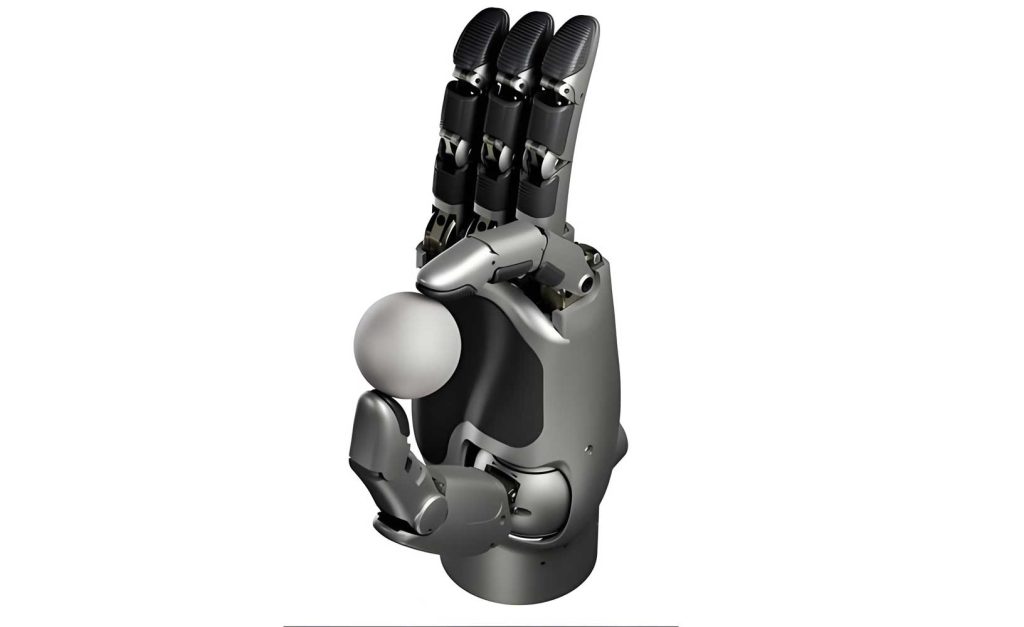
The skeletal design of our dexterous robotic hand is inspired by the physiological structure of the human hand. Finger joints and adjacent bone contact surfaces determine possible motion directions, with varying joint shapes leading to different degrees of freedom. During finger flexion, under the traction of flexor tendons, phalanges exhibit motion inclinations at the distal interphalangeal (DIP) and proximal interphalangeal (PIP) joints. Based on these characteristics, we simplify them into mechanical hinge structures. The thumb plays a crucial role in grasping; the unique shape of the trapezium bone at its base introduces additional degrees of freedom. Traditional dexterous robotic hands often neglect lateral displacement of the thumb, focusing solely on flexion. We initially considered using universal joints to mimic thumb motion but faced challenges in controlling rotation direction and passive flexion reliance. Thus, we decompose thumb motion into flexion and lateral displacement. Flexion employs mechanical hinges similar to other fingers, while a hinge at the carpometacarpal joint with a 60° angle to the palm plane mimics the trapezium’s function. Superimposing motions along two hinge axes enables arbitrary two-dimensional thumb movements.
Tendons play a vital role in adjusting muscle forces, a key biomechanical feature of the human hand. During finger motion, flexor tendons continuously modulate torques from muscle contraction, ensuring smooth movements. We employ laser-cut latex sheets to imitate the stabilizing mechanism of extensor tendons. This tendon-like structure compensates for resistance, directly influencing the motion characteristics and grasping stability of the dexterous robotic hand.
Static configuration analysis is conducted to determine the mathematical relationship between tendon tension and finger joint angles, providing theoretical basis for selecting latex tendon materials. Given the underactuation principle, finger static configuration is influenced by tendon tension and latex ligament elasticity. The driving torque at each joint is expressed as:
$$ \tau_1 = F r_1, \quad \tau_2 = F r_2 $$
where \( F \) is tendon tension, and \( r_1, r_2 \) are rotational radii of hinges at joints. During rotation of joint 1, if the driving torque at joint 2 exceeds the initial torque of the latex ligament, i.e., \( \tau_2 = F r_2 > k_2 \theta_{o2} \), joints 2 and 3 undergo coupled motion. The tendon tension distribution across joints is:
$$ M_1 = F r_1 – k_1 (\theta_1 + \theta_{01}) + k_2 (\theta_2 + \theta_{02}) + k_3 (\theta_3 + \theta_{03}) $$
$$ M_2 = F r_2 – k_2 (\theta_2 + \theta_{02}) + k_3 (\theta_3 + \theta_{03}) $$
Since the finger is in static equilibrium with zero moment at each joint (\( M_i = 0 \)), we derive:
$$ \theta_1 = \frac{F(r_1 + r_2 + r_3)}{k_1} – \theta_{01}, \quad \theta_2 = \frac{F(r_2 + r_3)}{k_2} – \theta_{02} $$
When joint 3’s driving torque exceeds the latex ligament’s initial torque, i.e., \( \tau_3 = F r_3 > k_3 \theta_{o3} \), joint 3 couples with joints 1 and 2, yielding:
$$ M_3 = F r_3 – k_3 (\theta_3 + \theta_{03}), \quad \theta_3 = \frac{F r_3}{k_3} – \theta_{03} $$
Thus, during finger flexion, tendon tension and joint angles maintain a linear relationship, guiding the selection of initial length and material for latex ligaments. This analysis ensures precise control of our dexterous robotic hand.
Kinematic analysis is performed to determine the maximum workspace of the dexterous robotic hand. We establish a forward kinematics model for one finger using the Denavit-Hartenberg (D-H) convention, which can be extended to other fingers. The D-H coordinate system is shown in a schematic, with parameters listed in the table below.
| Joint \( i \) | \( \theta_i \) | \( \alpha_i \) | \( l_i \) | \( d_i \) |
|---|---|---|---|---|
| 1 | \( \theta_1 \) | 0 | \( l_1 \) | 0 |
| 2 | \( \theta_2 \) | 0 | \( l_2 \) | 0 |
| 3 | \( \theta_3 \) | 0 | \( l_3 \) | 0 |
The transformation matrix between adjacent coordinate frames is:
$$ ^{i-1}T_i = \text{Rot}(z_{i-1}, \theta_i) \text{Trans}(z_{i-1}, d_i) \text{Trans}(x_i, l_i) \text{Rot}(x_i, \alpha_i) $$
Calculating yields:
$$ ^{0}T_1 = \begin{bmatrix} \cos \theta_1 & -\sin \theta_1 \cos 0 & \sin 0 \sin \theta_1 & l_1 \cos \theta_1 \\ \sin \theta_1 & \cos \theta_1 \cos 0 & -\sin 0 \cos \theta_1 & l_1 \sin \theta_1 \\ 0 & \sin 0 & \cos 0 & 0 \\ 0 & 0 & 0 & 1 \end{bmatrix} = \begin{bmatrix} C_1 & -S_1 & 0 & 0 \\ S_1 & C_1 & 0 & 0 \\ 0 & 0 & 1 & 0 \\ 0 & 0 & 0 & 1 \end{bmatrix} $$
$$ ^{1}T_2 = \begin{bmatrix} C_2 & -S_2 & 0 & 0 \\ S_2 & C_2 & 0 & l_1 \\ 0 & 0 & 1 & 0 \\ 0 & 0 & 0 & 1 \end{bmatrix}, \quad ^{2}T_3 = \begin{bmatrix} C_3 & -S_3 & 0 & 0 \\ S_3 & C_3 & 0 & l_2 \\ 0 & 0 & 1 & 0 \\ 0 & 0 & 0 & 1 \end{bmatrix} $$
where \( S_i = \sin \theta_i \), \( C_i = \cos \theta_i \). The overall transformation from base to fingertip is:
$$ ^{0}T_3 = ^{0}T_1 ^{1}T_2 ^{2}T_3 = \begin{bmatrix} C_{123} & S_{123} & 0 & l_1 S_1 + l_2 S_{12} \\ -S_{123} & C_{123} & 0 & l_1 C_1 + l_2 C_{12} \\ 0 & 0 & 1 & 0 \\ 0 & 0 & 0 & 1 \end{bmatrix} $$
with \( S_{ijk} = \sin(\theta_i + \theta_j + \theta_k) \), \( C_{ijk} = \cos(\theta_i + \theta_j + \theta_k) \). The position of the fingertip relative to the base frame is:
$$ \begin{bmatrix} x_i \\ y_i \end{bmatrix} = \begin{bmatrix} x_1 + l_1 S_1 + l_2 S_{12} + l_3 S_{123} \\ y_1 + l_1 C_1 + l_2 C_{12} + l_3 C_{123} \end{bmatrix} $$
For the middle finger, with lengths \( l_1 = 19.32 \, \text{mm} \), \( l_2 = 31.82 \, \text{mm} \), \( l_3 = 37.98 \, \text{mm} \), and joint angle ranges \( 0^\circ \leq \theta_1 \leq 65^\circ \), \( 0^\circ \leq \theta_2 \leq 90^\circ \), \( 0^\circ \leq \theta_3 \leq 90^\circ \), MATLAB simulation yields the fingertip workspace, demonstrating the dexterous robotic hand’s reachability.
To ensure synchronization in multi-finger control and real-time data transmission, we design dedicated data transmission and servo control modules. The system comprises an operator, a data glove equipped with flex sensors, and the dexterous robotic hand. The data glove captures all finger joint motion parameters, and a mapping algorithm establishes correspondence between human hand postures and robotic hand configurations, generating control commands. Filtering techniques are applied to enhance signal stability, as detailed in experiments.
We conduct two experiments to evaluate the performance of our dexterous robotic hand: a filter performance assessment and grasping tests. In the filter experiment, the operator wears the data glove with fingers kept at constant flexion. Static measurements show minimal variation, with ADC readings ranging between 1600 and 2600. Dynamic repeated flexion-extension tests reveal good repeatability, peak differences under 50, satisfying precision requirements for human-like gestures. For data processing, a five-point median filter effectively eliminates noise without significant delay, as shown in curves.
Grasping experiments test the dexterous robotic hand’s ability to handle daily objects through lifting, pinching, and gripping actions. The hand successfully lifts objects using finger-palm coordination, demonstrates real-time multi-finger coordination in pinching, and grips items naturally akin to human hands. These experiments validate the stability and reliability of our control system for the dexterous robotic hand.
The development of this underactuated dexterous robotic hand highlights the integration of bionic design and real-time control. By mimicking human hand biomechanics, we achieve a balance between simplicity and functionality. The tendon-like structure mitigates hysteresis, while kinematic analysis ensures accurate motion planning. Future work may focus on integrating tactile sensors, enhancing adaptability through machine learning, and exploring biomedical applications. Our dexterous robotic hand represents a step toward more natural and versatile robotic manipulation, with potential impacts on prosthetics and human-robot interaction.
In summary, we present a novel underactuated dexterous robotic hand with bionic features. The design retains key anatomical characteristics, supported by static and kinematic analyses. Experimental results confirm effective grasping and real-time control. This dexterous robotic hand advances robotic manipulation, offering insights for future research in adaptive and intelligent systems.