
In the realm of robotics, the quest for machines capable of traversing complex, unstructured terrains has led me to delve into the fascinating world of bionic inspiration. My focus has been on developing a bionic robot that mimics the physiological structure of a mantis, integrating wheeled propulsion to enhance its mobility. This bionic robot, a hexapod design, aims to bridge the gap between the high adaptability of legged locomotion and the efficiency of wheeled motion on flat surfaces. The development of such a bionic robot is driven by the growing need for versatile carriers in exploration, rescue, and military applications, where traditional wheeled or tracked robots often fall short. In this article, I will detail the comprehensive design, functional capabilities, and meticulous debugging process of this bionic mantis hexapod robot, employing tables and formulas to encapsulate key concepts and parameters.
The core philosophy behind this bionic robot centers on modularity and functional versatility. I envisioned a platform that not only walks but can also transform and adapt its structure for specific tasks. The bionic robot is conceptually divided into two primary platforms: the operational platform and the core hardware platform. This bifurcation allows for independent functionality and easy reconfiguration, a hallmark of advanced bionic robot systems. The operational platform serves as a mount for various sensors and tools, while the core platform houses the locomotion mechanics and control systems. This design enables the bionic robot to perform as a stable carrier or an active participant in manipulation tasks by utilizing its forelimbs as robotic arms.
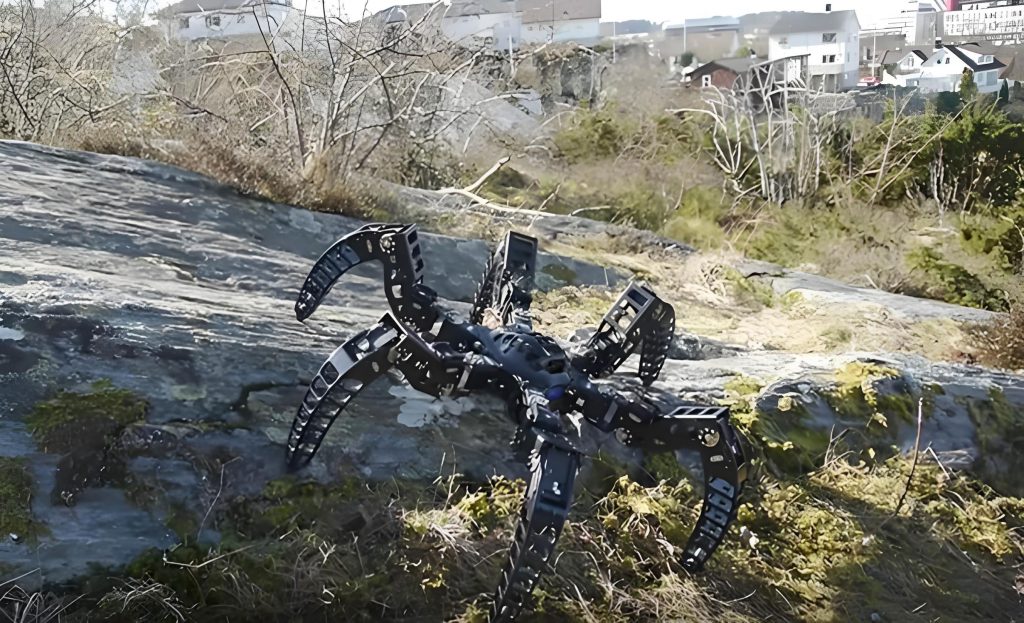
Structurally, the bionic robot’s leg design is paramount. Each leg features multiple degrees of freedom to replicate the agile movements of a mantis. The joint architecture is critical for generating complex gaits. The first joint, responsible for lifting and swinging the leg forward/backward, utilizes two servos mounted perpendicularly. While the initial design employed custom connectors, the prototype used thermal adhesive for simplicity, which proved sufficient for supporting the robot’s weight. The kinematic relationship for this joint can be described using a simplified rotational matrix. The position of the foot relative to the body coordinate frame {B} for a leg segment can be expressed as:
$$ \vec{P}_{foot}^{B} = \vec{P}_{joint1}^{B} + R_z(\theta_1) \cdot \left( \vec{L}_1 + R_y(\theta_2) \cdot \vec{L}_2 \right) $$
Here, $\vec{P}_{joint1}^{B}$ is the position of the first joint in the body frame, $R_z(\theta_1)$ is the rotation matrix about the Z-axis for the first servo angle $\theta_1$, $\vec{L}_1$ is the vector of the first link, $R_y(\theta_2)$ is the rotation matrix about the Y-axis for the second servo angle $\theta_2$, and $\vec{L}_2$ is the vector of the second link. This bionic robot’s leg kinematics form the basis for gait calculation.
The second joint adds another layer of adaptability, allowing the foot to orient itself for optimal ground contact. The design evolution from an H-shaped connector to a more adaptable solution in the prototype highlights the iterative nature of bionic robot development. The contact point with the ground is a wheel, and specifically, the two middle legs are equipped with DC geared motors to drive these wheels. This hybrid drive system allows the bionic robot to switch between walking and rolling modes. The force analysis during rolling on a flat surface involves the torque provided by the motors overcoming rolling friction:
$$ \tau_{motor} \geq F_{roll} \cdot r_{wheel} = \mu_{roll} \cdot N \cdot r_{wheel} $$
where $\tau_{motor}$ is the motor torque, $F_{roll}$ is the rolling friction force, $r_{wheel}$ is the wheel radius, $\mu_{roll}$ is the coefficient of rolling friction, and $N$ is the normal force on the wheel. This dual-mode capability significantly enhances the operational efficiency of this bionic robot across varied terrains.
The functional modes of this bionic mantis hexapod robot are diverse, making it a truly multifunctional bionic robot. I have programmed it to operate in several distinct configurations, which are summarized in the table below:
| Mode Number | Configuration | Primary Function | Key Advantages for the Bionic Robot |
|---|---|---|---|
| 1 | Hexapod Walking | Stable traversal over rough, uneven terrain. | High stability from static gait; low ground pressure. |
| 2 | Quadruped Walking (Operational platform elevated) | Frees the forelimbs for manipulation while maintaining mobility. | Increased workspace for tools/sensors mounted on the front. |
| 3 | Stationary Working Platform | The core platform fully expands, providing a stable base for the elevated operational platform to perform tasks. | Maximum stability for precise manipulation or observation. |
| 4 | Hywheeled-Rolling Mode | Using driven wheels on middle legs for rapid movement on smooth surfaces. | High speed and energy efficiency on flat ground. |
Transitioning between these modes requires coordinated control of all servo actuators. The total number of servos used in this bionic robot is 17, controlling 6 legs with 2-3 degrees of freedom each. The allocation and key parameters of these servos are critical for motion planning and are detailed in the following table:
| Leg Pair (Left/Right) | Joint | Servo ID Range | Primary Motion Axis | Typical Operational Angle Range ($^\circ$) |
|---|---|---|---|---|
| Front (Operational) | First (Lift/Swing) | 1, 2 | Z (Yaw), Y (Pitch) | -30 to +45 |
| Front (Operational) | Second (Orientation) | 3, 4 | X (Roll) | -15 to +15 |
| Middle (Driven) | First (Lift/Swing) | 5, 6 | Z (Yaw), Y (Pitch) | -40 to +40 |
| Middle (Driven) | Second (Wheel Drive) | DC Motor (Not Servo) | Wheel Rotation | N/A (Speed Control) |
| Rear | First (Lift/Swing) | 7, 8 | Z (Yaw), Y (Pitch) | -45 to +30 |
| Rear | Second (Orientation) | 9, 10 | X (Roll) | -10 to +10 |
Note: Servo IDs 11-17 are allocated to additional joints on the operational platform for lift/tilt functions and auxiliary adjustments. The exact mapping is configured in software.
The debugging and control of this bionic robot constitute a crucial phase in its development. I employed a servo control board that communicates with a PC via a serial interface. A dedicated debugging software on the PC allows for real-time servo parameter adjustment and motion sequence programming. The communication protocol typically involves sending position and time commands to each servo. The command for a single servo move can be modeled as a function of target pulse width $P_{target}$ and movement time $T_{move}$:
$$ \text{Command Frame} = [\text{Header}, \text{Servo ID}, P_{target}(t), T_{move}] $$
where $P_{target}(t)$ is often a linear interpolation from the current position to the target. For a smooth gait, the trajectory for each leg’s foot is planned in Cartesian space and then inverted to joint angles using the inverse kinematics derived from the earlier formula. For a tripod gait (a common hexapod gait where three legs are on the ground while the other three swing), the foot trajectory in the swing phase can be defined by a parabolic arc for clearance:
$$ z_{foot}(x) = h_{max} \cdot \left(1 – \left(\frac{2x}{L_{stride}} – 1\right)^2 \right) \quad \text{for } 0 \leq x \leq L_{stride} $$
Here, $h_{max}$ is the maximum lift height, $L_{stride}$ is the stride length, and $x$ is the forward position within the stride. The corresponding joint angles $\theta_1$ and $\theta_2$ are solved numerically at each time step. During debugging, I arranged the servo control sliders in the software to mirror the physical layout of the bionic robot. By creating and testing individual motion groups—such as lifting one leg, taking a step forward with a tripod set, or elevating the front platform—I assembled complex behaviors. These sequences are saved as script files (TXT format) on both the PC and the control board’s memory for autonomous operation. The process of tuning these parameters is iterative and essential for optimizing the performance of any bionic robot.
To evaluate the stability and energy efficiency of this bionic robot, I considered metrics such as the stability margin during static walking. For a hexapod in a statically stable gait, the stability margin $S$ can be defined as the shortest distance from the projection of the center of mass (COM) to the boundaries of the support polygon formed by the feet in contact with the ground. Maximizing $S$ ensures the bionic robot remains stable. The energy consumption per unit distance traveled is another critical factor, especially for a hybrid bionic robot. An approximate model for power consumption in walking mode $P_{walk}$ versus rolling mode $P_{roll}$ over time $T$ is:
$$ P_{walk} \approx \sum_{i=1}^{17} \left( V \cdot I_{i, servo}(t) \right) + P_{control} $$
$$ P_{roll} \approx V \cdot I_{motor}(t) + \sum_{i \in \text{stationary legs}} \left( V \cdot I_{i, servo, hold} \right) + P_{control} $$
where $V$ is the system voltage, $I_{i, servo}(t)$ is the current draw of the i-th servo (which varies with load), $I_{motor}(t)$ is the current of the DC drive motors, and $P_{control}$ is the constant power for the microcontroller and sensors. The bionic robot’s design aims to minimize $P_{walk}$ through efficient gait patterns and leverage $P_{roll}$ for fast transit.
The experimental validation of this bionic mantis hexapod robot confirmed its design feasibility. The prototype demonstrated stable hexapod walking on surfaces like grass, gravel, and inclined planes up to 15 degrees. The transition to wheeled rolling mode on pavement showed a speed increase of over 300% compared to walking. The operational platform successfully lifted and maintained positions at various angles, allowing the front legs to perform simple manipulation tasks. The modularity was tested by simulating a quick swap of the operational platform, which underscored the practical maintainability of the system. These tests collectively affirm that this bionic robot architecture is viable for real-world applications.
In conclusion, the development of this bionic mantis hexapod robot represents a significant step in creating adaptable, multi-modal robotic platforms. The integration of bionic principles with hybrid locomotion results in a bionic robot capable of conquering diverse terrains while offering functional flexibility. The use of standard servos and a PC-based control system keeps the complexity and cost manageable, facilitating potential mass production. The debugging framework established allows for rapid prototyping and behavior programming. Future iterations of this bionic robot could incorporate advanced sensors for autonomous navigation, more sophisticated force control in the legs, and enhanced communication for swarm operations. The journey of refining this bionic robot continues, driven by the endless possibilities that bionic inspiration offers to the field of robotics.