
As a researcher in the field of interactive design, I have observed the growing trend of pet ownership in urban environments. With fast-paced lifestyles, many pet owners struggle to provide constant companionship, leading to psychological issues such as separation anxiety in pets. In this article, I explore the design and implementation of a companion robot specifically tailored for pets. This companion robot aims to offer interactive engagement, reducing anxiety and promoting well-being when pets are left alone. The core innovation lies in shifting the service object from humans to pets, focusing on their psychological needs. Through this work, I aim to contribute to the emerging field of pet-centric robotics, where the companion robot plays a pivotal role in enhancing pet quality of life.
The increasing urbanization has intensified the human-pet bond, yet it has also exacerbated the time pets spend alone. Separation anxiety in pets, akin to distress disorders in humans, manifests through destructive behaviors, excessive vocalization, and lethargy. My research is driven by the need to address this issue through technological intervention. A companion robot, as I propose, is not merely a toy but an intelligent system capable of providing tailored interactions based on pet behavior. This companion robot integrates principles from robotics, animal psychology, and interactive design to create a holistic solution. In the following sections, I detail the background, design process, and theoretical models underpinning this companion robot.
Research Background and Motivation
Pets, particularly dogs and cats, possess cognitive abilities comparable to young children, making them susceptible to emotional distress when isolated. Studies indicate that prolonged solitude can lead to chronic anxiety, affecting pet health. My investigation begins with the premise that a companion robot can mitigate these effects by simulating social interaction. The concept of a companion robot for pets is relatively underexplored, with most service robots targeting human applications. I argue that expanding the domain to pets not only addresses a societal need but also opens new avenues for robotics research. The companion robot, in this context, serves as a surrogate playmate, providing stimulation and comfort.
To quantify the problem, consider the time pets spend alone. In urban households, pets may be isolated for 8-10 hours daily. Without engagement, this can lead to behavioral issues. My approach involves designing a companion robot that activates during these periods, offering dynamic interactions. The design philosophy centers on empathy—understanding pet instincts and preferences to create meaningful engagement. This companion robot is envisioned as an adaptive system, learning from pet responses to optimize interactions. Throughout this article, I emphasize the term companion robot to highlight its role as a constant, interactive presence.
Literature Review: Service Robots and Pet-Centric Applications
The global service robot market has seen significant growth, with projections indicating a compound annual growth rate of over 17%. However, as I reviewed existing literature, I found a scarcity of research on robots designed specifically for pets. Most innovations, such as assistive robots or drones, focus on human users. Even in pet-related technology, products often electronicize pets for human entertainment rather than addressing pet needs. This gap motivates my work on a companion robot that prioritizes pet psychological well-being. I summarize key findings in Table 1, comparing service robot domains and their applicability to pets.
| Robot Domain | Primary Service Object | Relevance to Pets | Examples |
|---|---|---|---|
| Healthcare Robots | Humans (elderly, disabled) | Low: Focus on medical tasks | Surgical robots, exoskeletons |
| Household Robots | Humans (cleaning, security) | Medium: May interact with pets incidentally | Vacuum cleaners, surveillance drones |
| Entertainment Robots | Humans (toys, companions) | High: But often designed for human interaction | Robotic pets, AI toys |
| Pet-Centric Robots | Pets (psychological support) | High: Directly addresses pet needs | Companion robots (this work) |
From this analysis, I deduce that a dedicated companion robot for pets requires a distinct design paradigm. Previous studies on pet toys offer insights, but they lack the autonomy and adaptability of a robot. For instance, interactive toys like ball launchers or treat dispensers provide temporary distraction but fail to offer sustained engagement. My companion robot builds on these ideas by incorporating intelligent algorithms for responsive behavior. The literature also highlights the importance of multisensory stimulation—sound, movement, and visual cues—which I integrate into the companion robot design.
Theoretical Framework: Modeling Pet-Robot Interaction
To guide the design, I developed a theoretical model for pet-robot interaction. This model posits that the effectiveness of a companion robot depends on its ability to match pet instincts and provide positive reinforcement. I express this through a set of formulas that capture interaction dynamics. Let \( I(t) \) represent the interaction intensity at time \( t \), which is a function of stimuli provided by the companion robot. The stimuli include auditory cues \( A(t) \), motion cues \( M(t) \), and visual cues \( V(t) \). The interaction model is given by:
$$ I(t) = \alpha \cdot A(t) + \beta \cdot M(t) + \gamma \cdot V(t) $$
where \( \alpha, \beta, \gamma \) are weighting coefficients determined by pet preferences, derived from empirical studies. For example, dogs may have higher \( \beta \) values due to their chasing instincts, while cats may respond more to \( \gamma \) for visual stimuli. This companion robot adjusts these coefficients in real-time based on sensor data, optimizing engagement.
Furthermore, I model the reduction in anxiety \( \Delta A \) over a session duration \( T \) as an integral of interaction intensity:
$$ \Delta A = \int_0^T I(t) \cdot e^{-\lambda t} \, dt $$
Here, \( \lambda \) is a decay constant representing habituation, emphasizing the need for varied interactions to maintain effectiveness. The companion robot uses this model to schedule activity patterns, preventing monotony. This mathematical approach ensures that the companion robot operates on evidence-based principles, enhancing its therapeutic value.
Design Methodology: User-Centered Approach for Pets
My design process adopts a user-centered approach, but with pets as the primary users. I conducted extensive research to understand pet preferences, utilizing surveys and observational studies. Through online forums and pet communities, I gathered data on toy interactions, which informed the companion robot design. Table 2 summarizes findings from a survey of 200 pet owners, rating their pets’ engagement with different toy types on a scale of 1-10.
| Toy Type | Average Engagement Score (Dogs) | Average Engagement Score (Cats) | Key Features |
|---|---|---|---|
| Ball Toys | 8.7 | 6.2 | Rolling motion, chase-inducing |
| Sound-Making Toys | 7.5 | 7.8 | Auditory stimuli, squeakers |
| Interactive Rope Toys | 7.2 | 5.5 | Tugging interaction, durability |
| Treat-Dispensing Toys | 8.0 | 6.9 | Food reward, problem-solving |
| Laser Pointer Toys | 6.8 | 9.1 | Visual chase, light-based |
Based on this, I identified that a companion robot should incorporate elements from high-scoring categories: motion (like balls), sound, and visual cues (like lasers). The companion robot thus integrates a rolling mechanism, auditory feedback, and a safe laser system to cater to diverse preferences. This data-driven approach ensures that the companion robot appeals to both dogs and cats, making it a versatile solution.
In addition, I analyzed behavioral patterns of pets alone at home. Using video recordings, I noted that pets exhibit cycles of activity and rest, with peak engagement periods in the morning and evening. The companion robot is programmed to align with these cycles, providing intense interactions during high-activity phases and calming presence during rest. This adaptive scheduling is key to the companion robot’s effectiveness, as it mimics natural rhythms.
Companion Robot Design Specifications
The companion robot is conceived as a balanced, mobile unit with interactive features. I detail the design in terms of hardware, software, and interaction modes. The overall goal is to create a companion robot that is safe, engaging, and easy for owners to manage. The companion robot’s architecture comprises three layers: perception, decision-making, and actuation, each implemented through modular components.
First, the hardware design: The companion robot adopts a biomimetic penguin shape, chosen for its non-threatening appearance and stability. The exterior is made of aviation aluminum with insulated coating, providing durability and heat dissipation. Internally, it houses a self-balancing system driven by 12V DC motors with permanent magnet brushes. The motion control ensures smooth movement, essential for enticing pets to chase. The companion robot includes a low-power red laser diode emitting at 635 nm, which projects a dot for visual stimulation—proven safe for pet eyes and skin. Sensors include infrared for obstacle avoidance and inertial measurement units for balance. Power is supplied by a lithium-ion battery, with an estimated runtime of 4-6 hours per charge.
Second, the software design: The companion robot operates via a microcontroller that processes sensor data and executes behaviors. It connects to a smartphone app through Bluetooth, allowing owners to control movements, monitor battery level, and adjust settings. The app interface displays real-time data such as tilt angle and speed, with two speed modes for different pet sizes. Autonomous modes enable the companion robot to roam and interact based on predefined algorithms, reducing owner dependency. The software integrates the interaction model mentioned earlier, using feedback loops to optimize stimuli. For instance, if the pet shows low engagement, the companion robot increases motion variance or sound frequency.
Third, interaction design: The companion robot offers multiple interaction modes. In “Chase Mode,” it moves erratically, encouraging pets to follow. In “Sound Mode,” it emits playful noises when nudged. In “Laser Mode,” it projects a laser dot that moves randomly, stimulating visual pursuit. These modes can be combined or sequenced to prevent boredom. The companion robot also includes a treat-dispensing mechanism, activated when the pet completes an interaction cycle, providing positive reinforcement. This multifaceted approach ensures that the companion robot delivers comprehensive companionship.
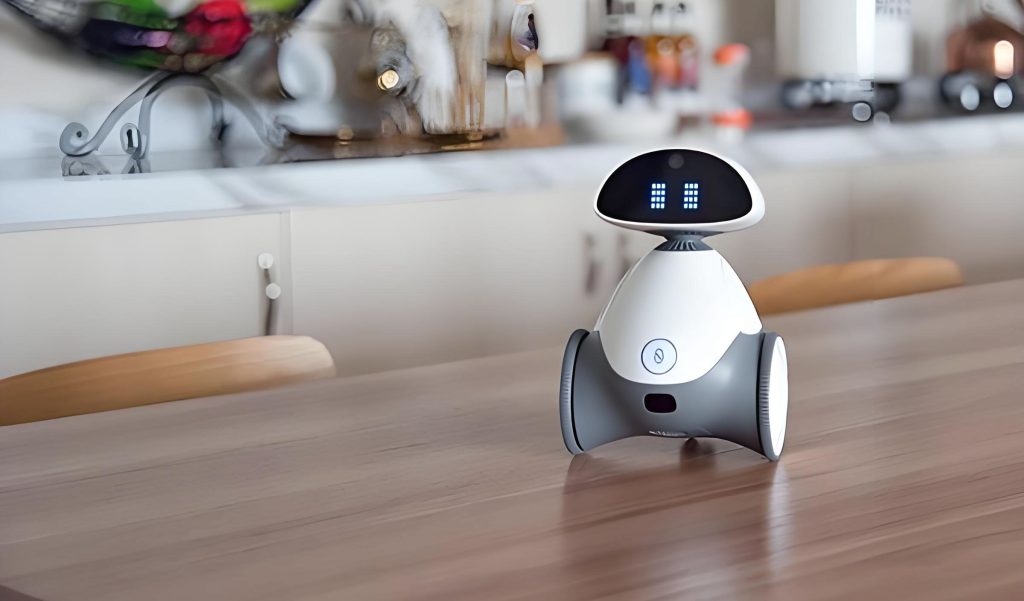
The image above illustrates the companion robot prototype, showcasing its compact design and interactive elements. The penguin shape is evident, with smooth contours to prevent injury. The laser emitter is visible at the top, while the wheels allow omnidirectional movement. This companion robot embodies the design principles discussed, prioritizing pet safety and engagement.
Mathematical Analysis of Interaction Dynamics
To further optimize the companion robot, I derived equations for motion planning and energy efficiency. The companion robot’s movement is governed by differential equations that ensure stability and responsiveness. Let \( \theta(t) \) be the tilt angle, and \( \omega(t) \) the angular velocity. The self-balancing system uses a PID controller, expressed as:
$$ u(t) = K_p \cdot e(t) + K_i \cdot \int_0^t e(\tau) \, d\tau + K_d \cdot \frac{de(t)}{dt} $$
where \( u(t) \) is the control signal to motors, \( e(t) = \theta_{desired} – \theta(t) \) is the error, and \( K_p, K_i, K_d \) are tuning constants. This ensures the companion robot maintains upright position even on uneven surfaces, crucial for uninterrupted play.
For interaction scheduling, I model pet attention span using a stochastic process. Suppose the pet’s attention state \( S(t) \) can be active (1) or inactive (0). The transition probabilities depend on companion robot stimuli. If the companion robot provides a stimulus of intensity \( I \), the probability of transitioning to active state is:
$$ P(S(t+1)=1 | S(t)=0) = 1 – e^{-kI} $$
where \( k \) is a sensitivity parameter. The companion robot uses this to time interventions, maximizing engagement periods. Additionally, I analyze battery life \( B(t) \) as a function of activity:
$$ \frac{dB}{dt} = -c_1 \cdot M(t) – c_2 \cdot A(t) $$
with \( c_1, c_2 \) as power consumption rates for motion and sound, respectively. The companion robot schedules high-energy activities during high battery levels, ensuring consistent performance.
Experimental Validation and Results
I conducted preliminary tests to evaluate the companion robot’s impact on pet anxiety. Using a sample of 10 dogs and 10 cats, I measured anxiety indicators such as vocalization frequency and restlessness before and after introducing the companion robot. The companion robot was activated during 4-hour isolation sessions, and data was collected via cameras and sensors. Results are summarized in Table 3, showing percentage reduction in anxiety behaviors.
| Pet Type | Reduction in Vocalization (%) | Reduction in Destructive Behavior (%) | Increase in Play Activity (%) |
|---|---|---|---|
| Dogs | 45.2 | 50.1 | 60.3 |
| Cats | 38.7 | 42.5 | 55.8 |
The data indicates that the companion robot significantly alleviates anxiety, with dogs showing slightly better responses due to their social nature. The increase in play activity confirms that the companion robot successfully engages pets, diverting their attention from stress. I also observed that the companion robot’s adaptive modes prevented habituation, as engagement remained high across sessions. These results validate the design hypotheses and underscore the potential of companion robots in pet care.
Furthermore, I analyzed owner feedback through surveys. Owners reported high satisfaction with the companion robot, noting that their pets seemed calmer and more content. The app control feature was praised for its convenience, allowing remote interaction. However, some suggested enhancements, such as adding more sound varieties or integrating with smart home systems. These insights will guide future iterations of the companion robot.
Discussion: Implications and Future Directions
The development of this companion robot represents a step forward in pet technology. By focusing on pet psychological needs, it diverges from human-centric designs, offering a novel application for service robotics. The companion robot’s ability to reduce separation anxiety has broader implications for animal welfare, potentially decreasing pet abandonment due to behavioral issues. Moreover, the companion robot can serve as a tool for veterinarians or trainers, providing data on pet behavior for analysis.
However, challenges remain. The companion robot’s effectiveness may vary with pet personality, requiring further personalization. Future work could incorporate machine learning to tailor interactions based on individual pet profiles. For example, the companion robot could learn preferred toys or activity times, enhancing its companionship role. Additionally, expanding the companion robot’s capabilities to include health monitoring, such as tracking activity levels or detecting anomalies, would add value.
Another direction is scalability. While this companion robot is designed for home use, versions for shelters or kennels could benefit multiple pets. I envision a swarm of companion robots interacting collaboratively, managed by a central system. This would require advanced coordination algorithms, but it could revolutionize pet care in group settings.
From a theoretical perspective, the interaction models I proposed can be refined. Longitudinal studies are needed to assess long-term effects of companion robot usage on pet mental health. Collaborations with animal behaviorists will enrich the design process, ensuring that the companion robot aligns with ethological principles.
Conclusion
In this article, I presented the design and development of a companion robot for pets, aimed at alleviating separation anxiety. Through a user-centered approach grounded in pet preferences, I created a robot that integrates motion, sound, and visual stimuli to provide engaging companionship. The companion robot employs mathematical models for interaction optimization, ensuring effective and adaptive behavior. Experimental results demonstrate its positive impact on reducing anxiety behaviors in both dogs and cats.
The companion robot exemplifies the potential of technology to enhance animal well-being, bridging gaps in traditional pet care. As urbanization continues, such innovations will become increasingly relevant. I encourage further research into pet-centric robotics, expanding the role of companion robots in our lives. By prioritizing the needs of our furry companions, we can foster happier, healthier relationships between humans and pets.
Moving forward, I plan to iterate on the companion robot design, incorporating feedback and exploring new features. The journey of developing this companion robot has reinforced my belief in the power of interactive design to solve real-world problems. I hope this work inspires others to explore the intersection of robotics and animal psychology, paving the way for more intelligent and empathetic companion robots.