
The global agricultural sector faces increasing pressure to enhance productivity and efficiency while addressing labor shortages and rising operational costs. Fruit harvesting, a labor-intensive and repetitive task, is a prime candidate for automation. Papaya (Carica papaya L.), a fruit of significant nutritional and economic value, presents a particular challenge due to its delicate skin, relatively large size, and growth pattern on tall, often slender trees. Manual harvesting is strenuous, costly, and inefficient, limiting the scalability of papaya cultivation. Robotic harvesting systems offer a promising solution, with the end effector—the device that interacts directly with the fruit—being a critical component of such systems. This article details the comprehensive research, design, and development of a novel, underactuated mechanical end effector specifically engineered for the robotic harvesting of papaya fruit.
The primary objective of this design was to create an end effector that replicates the human picking action of grasping and twisting the fruit to detach it from the stem. The design goals were multifaceted:
| Design Goal | Description |
|---|---|
| Functional Efficacy | Reliably grasp papayas of varying diameters (approx. 30-120 mm) and apply sufficient torque to twist and sever the peduncle. |
| Ergonomics & Integration | Be lightweight, compact, and possess a simple kinematic structure for easy integration onto a robotic manipulator arm. |
| Adaptability | Accommodate natural variations in fruit size and orientation without complex sensing or control algorithms. |
| Cost-Effectiveness | Utilize a minimal number of actuators and commercially available components to keep costs low. |
To achieve these goals, the principle of underactuation was adopted. In a fully actuated system, each degree of freedom (DOF) requires a dedicated actuator. For an end effector performing a grasp and a twist, this would typically necessitate at least two motors. Underactuation employs fewer actuators than DOFs, using passive mechanical elements (like springs, linkages, or tendons) and the principle of “minimum resistance” to sequence motions. This approach significantly reduces weight, complexity, and cost.
The core operational sequence of the underactuated end effector is as follows: First, the fingers close to grasp the fruit. Only after a secure grip is established does the entire grasping mechanism rotate to twist the fruit off its stem. This sequential motion (grasp-then-twist) is achieved with a single motor. The mechanical intelligence lies in the system’s force distribution. Initially, the resistance to close the fingers is designed to be lower than the frictional resistance preventing rotation. Once the fruit is gripped, the force required to further close the fingers surpasses the rotational friction, causing the subsequent rotation to occur. This can be conceptually modeled by comparing torques:
$$
\tau_{\text{motor}} = \tau_{\text{grasp}} + \tau_{\text{friction}}
$$
Where $\tau_{\text{grasp}}$ is the torque needed to close the fingers, and $\tau_{\text{friction}}$ is the torque due to static friction resisting rotation. The sequence is governed by:
$$ \text{If } \tau_{\text{motor}} < \tau_{\text{friction}}, \text{ then grasping occurs.}$$
$$ \text{If } \tau_{\text{motor}} > \tau_{\text{friction}}, \text{ and grasping is complete, then rotation occurs.}$$
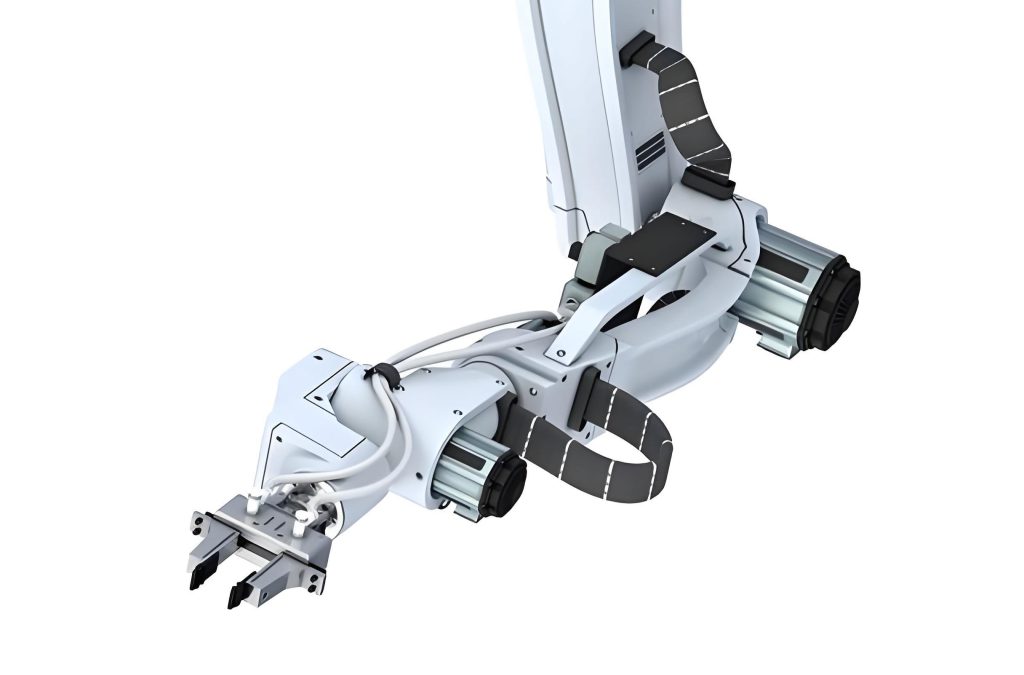
The mechanical design of the end effector was meticulously executed using SolidWorks 3D CAD software. The assembly comprises several key subsystems that work in harmony to achieve the underactuated grasping and twisting functions.
1. End Effector Structural Components
The main body of the end effector consists of the finger assemblies, the palm assembly, the drive unit, and the support housing.
- Finger Assemblies (Three): Each finger features a parallel closure mechanism, meaning the contact surface moves in a straight line towards the fruit’s center. This is superior to a revolute closure for fruit picking, as it minimizes positional error and ensures more uniform pressure distribution on the fruit’s surface, reducing the risk of bruising. The fingertip is equipped with a compliant pad and a swivel joint, allowing it to self-align to the contour of the papaya for a secure, adaptive grip.
- Palm Assembly: This component houses the three linear guide slots for the fingers. It also integrates pulleys that guide the drive tendons (steel cables). The palm is the rotating part of the end effector; it carries the fingers and the grasped fruit during the twisting motion.
- Drive Unit: The heart of the actuation system is a Maxon DC brushed gearmotor. Its selection was based on the torque and speed requirements derived from papaya peduncle biomechanical tests, which indicated a required twisting torque of 1.2–3.0 N·m. The motor is coupled to a custom-designed spool.
- Support Housing: This static component mounts to the robotic arm. It holds the motor and provides the bearing surface against which the palm rotates. A specially designed friction interface between the housing and the palm regulates the transition from the grasping phase to the twisting phase.
2. Tendon-Driven Underactuated Mechanism
The single motor drives the entire end effector through a tendon (steel cable) system. Two independent cable loops per finger are wound around the central spool in opposite directions. When the motor turns in one direction, one set of cables is wound onto the spool, pulling the fingers closed in a parallel motion. Simultaneously, the opposing cable loops are released from the spool. This elegant design allows for both closing and opening of the end effector with just one motor reversing its direction, eliminating the need for separate return springs which add load to the motor. The kinematics of the finger closure can be related to the spool rotation by:
$$
\Delta L = n \cdot \pi \cdot D_{\text{spool}}
$$
where $\Delta L$ is the total cable length wound, $n$ is the number of motor revolutions (after gearing), and $D_{\text{spool}}$ is the effective diameter of the cable spool. This $\Delta L$ directly translates to the linear travel distance of each finger.
3. Material Selection
The end effector components are designed for manufacture via 3D printing or CNC machining using engineering plastics. Key material properties required include:
| Property | Importance for the End Effector | Selected Material (e.g., PTFE/Nylon Blend) |
|---|---|---|
| Low Density | Minimizes weight and inertial load on the robot arm. | Excellent |
| Chemical Resistance | Withstands corrosive latex sap exuded from papaya stems. | Excellent (PTFE) |
| Wear Resistance & Low Friction | Ensures longevity of sliding/rotating parts and consistent friction interface. | Good |
| Mechanical Strength | Withstands gripping and twisting forces without failure. | Sufficient for applied loads |
The control system for this underactuated end effector is deliberately kept simple and robust to align with the overall design philosophy of low cost and reliability. It is an open-loop system that manages the motor’s direction and speed.
1. Hardware Components
The control hardware is centered around a custom-designed printed circuit board (PCB) that interfaces between a power source, user inputs, and the DC motor.
| Component | Function | Specification/Role |
|---|---|---|
| Microcontroller/Logic Circuit | Processes input signals and generates control signals for the motor driver. | Coordinates the sequence based on switch position. |
| Motor Driver (H-Bridge) | Controls the direction and enables speed control (PWM) of the DC motor. | Key component for executing forward (grasp/twist) and reverse (release) motions. |
| Potentiometer | Provides a user-adjustable voltage input. | Acts as a speed controller for the motor, allowing adjustment of grasping and twisting speed. |
| DPDT (Double-Pole, Double-Throw) Switch | Manual control for selecting operating mode. | One position commands “Harvest” (motor forward), the other commands “Release” (motor reverse). |
| Voltage Regulator | Provides stable DC voltage to sensitive components. | Ensures consistent logic circuit operation. |
2. System Operation Workflow
- Power On: A 24V DC power supply is connected to the control board.
- Speed Setting: The potentiometer knob is adjusted to set the desired motor operating speed. A lower speed allows for gentler, more controlled grasping.
- Harvest Cycle: The operator or a higher-level robot controller flips the DPDT switch to the “Harvest” position. The motor runs forward, winding the grasp-tendons. The fingers close. Upon securing the fruit, increased tension overcomes the preset friction in the housing, causing the entire palm and finger assembly to rotate, twisting the papaya free.
- Release Cycle: The switch is flipped to “Release.” The motor reverses, winding the release-tendons, which actively open the fingers to drop the fruit into a collection bin.
The performance of the end effector prototype was evaluated against the initial design goals. Laboratory tests using artificial and real papaya fruits were conducted to measure key parameters.
1. Grasping and Force Analysis
The parallel finger mechanism successfully accommodated the target diameter range. The relationship between motor current (proportional to torque) and finger position confirms the two-phase operation. The grasping force $F_g$ on the fruit can be estimated from motor torque and the mechanism’s geometry:
$$
F_g \approx \frac{\tau_{\text{motor}} \cdot \eta}{r_{\text{pulley}} \cdot n_{\text{fingers}}}
$$
where $\eta$ is the mechanism efficiency, $r_{\text{pulley}}$ is the effective pulley radius, and the force is divided among the three fingers. Testing showed that the end effector could generate a clamping force well above the minimum required 3.5-5.0 N to hold the fruit securely during twisting.
2. Twisting Action and Success Rate
The critical test was the successful severing of the peduncle via torsion. The underactuation sequence proved effective: rotation consistently began only after the fruit was firmly held. The adjustable friction interface was crucial; too little friction caused premature rotation and poor grip, while too much friction prevented rotation entirely. After calibration, the end effector achieved a peduncle separation success rate exceeding 90% in controlled tests, with failures primarily due to extreme peduncle angles or obstructions not accounted for in the simple mechanical design.
3. Advantages and Limitations
| Advantages | Limitations & Future Work |
|---|---|
|
|
This article has presented the complete design study of a novel underactuated end effector for robotic papaya harvesting. By leveraging the principle of underactuation and a clever tendon-driven mechanism, the design successfully consolidates the complex sequence of grasping and twisting into a single-motor operation. This end effector embodies key desirable traits for agricultural robotics: simplicity, robustness, low cost, and adaptive mechanical intelligence. The detailed mechanical design, material selection, and control system provide a viable blueprint for a functional harvesting tool. While further refinement and field integration are necessary, this end effector represents a significant step towards automating the harvest of delicate, high-value fruits like papaya, with the potential to alleviate labor pressures and improve harvesting efficiency. The core underactuated methodology is also highly transferable, suggesting promise for the development of similar end effectors for other fruits and agricultural manipulation tasks.