
In modern agriculture, the automation of fruit harvesting presents a significant challenge due to the labor-intensive nature of manual picking. Citrus fruits, being widely cultivated, require efficient harvesting methods to reduce costs and improve productivity. The development of harvesting robots has emerged as a promising solution, with the end effector playing a pivotal role in determining overall success. The end effector is the critical component that directly interacts with the fruit, and its design directly impacts picking efficiency and fruit quality. In this work, we focus on enhancing the end effector for citrus harvesting by integrating a clamping mechanism, aiming to improve the cutting success rate of the pedicel through a simply supported beam shear mode. This article details the design, analysis, and experimental validation of this clamping mechanism, emphasizing its impact on the end effector’s performance.
Traditional end effectors for fruit harvesting often rely on direct cutting or twisting mechanisms to separate the fruit from the plant. However, for citrus, twisting can damage the fruit skin, making cutting a preferred method. Typically, cutting is performed using a cantilever beam approach, where the blade acts on the unsupported pedicel. Our preliminary investigations suggested that a simply supported beam shear method, where the pedicel is supported on both sides during cutting, could reduce the required cutting force and depth, thereby increasing success rates. To achieve this, we propose a clamping mechanism that holds the fruit during cutting, effectively creating a simply supported condition for the pedicel. This design not only stabilizes the fruit but also optimizes the cutting process. Throughout this article, the term ‘end effector’ will be frequently used to highlight its central role in our robotic harvesting system.
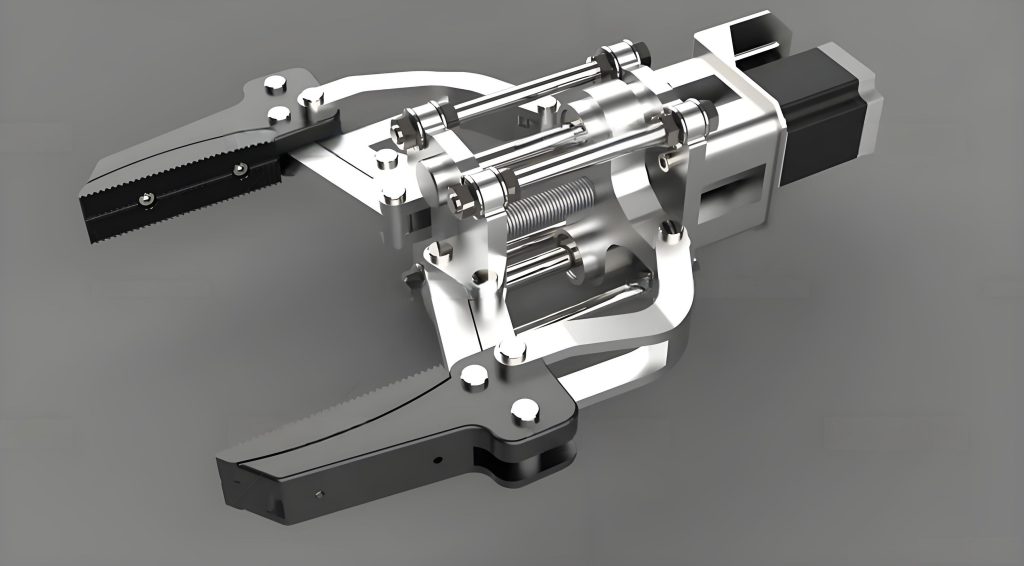
The core objective of this study is to design a clamping mechanism that can securely hold citrus fruits without causing damage, while enabling efficient pedicel cutting. We begin by analyzing the shear characteristics of citrus pedicels under different modes. A custom-built cutting test stand was developed to compare cantilever and simply supported beam shear methods. The test stand includes a PC, transducer, pressure sensor, and data acquisition module, allowing for precise control of cutting speed and force measurement. The moving blade can travel at linear speeds ranging from 5 to 32.3 mm/s, with real-time acquisition of shear resistance forces up to 500 N. Pedicels with a diameter of approximately 3 mm were used, as statistical analysis showed that over 96% of citrus pedicels fall below this size. The cutting depth, defined as the distance the blade moves before the pedicel is severed, was measured for both shear modes at various speeds.
Results from these experiments indicated that the simply supported beam method consistently required less cutting depth compared to the cantilever method. For instance, at a cutting speed of 20 mm/s, the average cutting depth for the simply supported mode was 1.2 mm, while for the cantilever mode, it was 2.5 mm. This reduction is attributed to the pedicel being stabilized, reducing slippage and concentrating the shear force. These findings validate our hypothesis that integrating a clamping mechanism into the end effector can enhance cutting efficiency. The end effector’s design must thus incorporate this clamping feature to leverage the simply supported beam advantage.
Next, we focused on designing the clamping mechanism itself. To prevent fruit damage, we first determined the极限挤压 parameters of citrus fruits. Compression tests were conducted on 40 citrus samples using a probe with a diameter of 14.12 mm. The极限载荷 was defined as the force at which the fruit skin began to show moisture, indicating the onset of damage. The average极限载荷 was found to be 14.0 N. This value serves as the upper limit for the clamping force exerted by the end effector’s fingers. Additionally, we analyzed citrus fruit dimensions by measuring the transverse and longitudinal diameters of 148 fruits. The data followed a normal distribution, with众数 for transverse and longitudinal diameters being 58 mm and 56 mm, respectively. These dimensions informed the design of the clamping fingers to ensure a secure grip across common fruit sizes.
The clamping fingers were designed with a spherical crown shape to conform to the fruit surface, reducing stress concentration. The crown height \(d\) was calculated based on the transverse diameter众数 \(R = 58 \, \text{mm}\) and a projected angle \(\theta = 45^\circ\):
$$ d = R(1 – \cos \theta) = 58 \times (1 – \cos 45^\circ) \approx 8.49 \, \text{mm} $$
Rounding up, we set \(d = 9 \, \text{mm}\). The diameter of the crown base \(d_2\) was derived from geometric relations, resulting in 38.19 mm. To minimize fruit damage, sponge material was attached to the finger surfaces. The static friction coefficient between citrus peel and sponge was measured using an inclined plane method, yielding an average value of \(f = 0.71\).
The clamping force must be within a safe range: high enough to prevent fruit slippage during cutting, but low enough to avoid damage. The upper limit \(F_3\) is based on the极限载荷 from compression tests, scaled by the contact area:
$$ F_3 = \frac{F_2 \cdot d_2^2}{d_1^2} = \frac{14.0 \times (38.19)^2}{(14.12)^2} \approx 102.41 \, \text{N} $$
where \(F_2 = 14.0 \, \text{N}\) is the极限载荷, \(d_1 = 14.12 \, \text{mm}\) is the probe diameter, and \(d_2 = 38.19 \, \text{mm}\) is the crown base diameter. The lower limit \(F_5\) is determined by the force required to prevent slippage during cutting. Based on previous studies, the cutting force \(F_4\) for citrus pedicels is approximately 69.99 N. Considering the fruit weight \(G = 1.8 \, \text{N}\) and a safety factor \(k = 1.2\), the minimum clamping force is given by:
$$ F_5 = k \cdot \frac{(G + F_N) \cdot \cot(\theta + \arctan f)}{2} $$
where \(F_N = F_4 / 2 + G\) represents the vertical force on the fruit during cutting. Substituting values:
$$ F_5 = 1.2 \times \frac{(1.8 + 35.995) \times \cot(45^\circ + \arctan 0.71)}{2} \approx 3.79 \, \text{N} $$
Thus, the clamping force should be between 3.79 N and 102.41 N. This range ensures that the end effector can hold fruits securely without causing damage.
To achieve this force control, we designed a pneumatic system for the clamping mechanism. A differential circuit was employed to allow fast finger retraction and slow, controlled clamping. The system includes an air source, cylinder, pressure reducing valve, check valve, and a two-position five-way electromagnetic reversing valve. When the valve is not energized, the check valve operates, enabling high-pressure retraction for quick reset. Upon energization, the pressure reducing valve limits the pressure to 0.3 MPa, ensuring low-force clamping. We selected an HDT1020 cylinder as the actuator, based on force requirements and finger parameters. This pneumatic design integrates seamlessly with the end effector, providing reliable operation in field conditions.
Finite element analysis (FEA) was conducted to validate the structural integrity of the clamping mechanism. The model comprised the cylinder, nuts, and fingers, made of stainless steel and ABS resin. Material properties were assigned: stainless steel density \(7750 \, \text{kg/m}^3\), elastic modulus \(193 \, \text{GPa}\), yield strength \(205 \, \text{MPa}\), Poisson’s ratio \(0.31\); ABS resin elastic modulus \(2.2 \, \text{GPa}\), yield strength \(40 \, \text{MPa}\). A distributed load of 8 N was applied to the finger crown surfaces, simulating fruit reaction. The results showed maximum equivalent strain below 0.2% and maximum equivalent stress of 39.32 MPa, well within the yield strength. The maximum deformation was 0.32 mm, indicating sufficient stiffness. These FEA results confirm that the clamping mechanism meets design requirements for stress and deformation, ensuring durability in the end effector.
We then fabricated a prototype of the clamping mechanism and conducted clamping experiments on 30 citrus fruits of varying sizes. The fruits had transverse diameters ranging from 58.40 mm to 79.50 mm and longitudinal diameters from 46.52 mm to 79.58 mm. The pneumatic system was set to 0.3 MPa during clamping. All fruits were held securely without any visible damage or slippage, demonstrating the mechanism’s effectiveness. This success is crucial for the end effector’s overall performance, as it validates the design parameters in real-world conditions.
Subsequently, we integrated the clamping mechanism into a citrus harvesting robot’s end effector and performed comparative picking experiments in an outdoor natural environment. The experiments involved two setups: one with the original end effector without clamping, and one with the enhanced end effector including the clamping mechanism. The end effector was mounted on a robotic arm, and the system was programmed to pick fruits from trees. We tested on various citrus varieties, including Ponkan, Lugan, and blood orange. The end effector’s frame was kept horizontal during operations, and the pneumatic pressure was maintained at 0.5 MPa for the air source and 0.3 MPa for clamping. Each setup attempted 20 picks, and results were recorded based on success or failure, along with fruit dimensions and pedicel angles.
The results are summarized in the tables below. Table 1 shows the picking results without the clamping mechanism, while Table 2 shows results with the clamping mechanism. Key parameters include fruit longitudinal and transverse diameters, pedicel diameter, horizontal偏角 (angle between pedicel and horizontal plane), and pick outcome.
| Sample | Longitudinal Diameter (mm) | Transverse Diameter (mm) | Pedicel Diameter (mm) | Horizontal Angle (°) | Result |
|---|---|---|---|---|---|
| 1 | 68 | 65 | 2.57 | 33 | Failure |
| 2 | 65 | 65 | 4.82 | 18 | Success |
| 3 | 60 | 67 | 2.03 | 63 | Success |
| 4 | 66 | 66 | 3.07 | 29 | Failure |
| 5 | 60 | 60 | 3.16 | 8 | Success |
| 6 | 60 | 64 | 2.86 | 12 | Success |
| 7 | 60 | 62 | 3.56 | -28 | Success |
| 8 | 60 | 63 | 2.79 | 17 | Failure |
| 9 | 65 | 55 | 3.07 | 16 | Success |
| 10 | 61 | 67 | 2.94 | 35 | Success |
| 11 | 61 | 64 | 2.48 | 13 | Success |
| 12 | 64 | 65 | 3.20 | 88 | Success |
| 13 | 67 | 66 | 2.63 | 18 | Success |
| 14 | 67 | 63 | 2.33 | -32 | Success |
| 15 | 60 | 62 | 3.56 | -28 | Failure |
| 16 | 62 | 65 | 2.69 | 54 | Success |
| 17 | 59 | 57 | 2.63 | 8 | Success |
| 18 | 56 | 63 | 3.44 | 12 | Success |
| 19 | 46 | 58 | 3.10 | 18 | Failure |
| 20 | 45 | 56 | 2.10 | -40 | Failure |
Without the clamping mechanism, the success rate was 70% (14 out of 20 picks). Failures were attributed to pedicel slippage or insufficient cutting force, often occurring at larger horizontal angles where the cantilever shear mode is less effective.
| Sample | Longitudinal Diameter (mm) | Transverse Diameter (mm) | Pedicel Diameter (mm) | Horizontal Angle (°) | Result |
|---|---|---|---|---|---|
| 1 | 61 | 66 | 3.20 | 6 | Success |
| 2 | 53 | 65 | 2.50 | 10 | Success |
| 3 | 48 | 57 | 2.90 | 5 | Success |
| 4 | 50 | 60 | 2.80 | -27 | Success |
| 5 | 45 | 54 | 2.20 | 17 | Success |
| 6 | 49 | 58 | 2.70 | 6 | Success |
| 7 | 47 | 55 | 2.10 | -12 | Success |
| 8 | 52 | 59 | 2.80 | -48 | Failure (Cutting) |
| 9 | 47 | 55 | 2.70 | 27 | Success |
| 10 | 68 | 67 | 2.75 | 43 | Success |
| 11 | 53 | 56 | 2.13 | -23 | Success |
| 12 | 68 | 58 | 2.57 | -19 | Success |
| 13 | 48 | 57 | 2.63 | -5 | Success |
| 14 | 50 | 60 | 2.15 | -6 | Success |
| 15 | 45 | 54 | 2.43 | 9 | Success |
| 16 | 49 | 58 | 2.73 | 14 | Success |
| 17 | 56 | 59 | 2.40 | 2 | Success |
| 18 | 53 | 63 | 2.70 | -6 | Success |
| 19 | 59 | 59 | 2.50 | 51 | Failure (Clamping) |
| 20 | 45 | 59 | 3.20 | 23 | Failure (Clamping) |
With the clamping mechanism, the success rate increased to 85% (17 out of 20 picks). The three failures were due to extreme horizontal angles (e.g., -48° and 51°) that caused either cutting issues or clamping misalignment. The clamping mechanism enabled simply supported beam shear, reducing cutting depth and improving reliability. The end effector with clamping handled fruits with transverse diameters from 54 mm to 67 mm and longitudinal diameters from 45 mm to 68 mm, demonstrating versatility.
To further analyze the impact, we can summarize the performance metrics in a table comparing the two end effector configurations:
| Configuration | Success Rate | Average Cutting Depth (mm) | Fruit Damage | Applicable Fruit Size Range (mm) |
|---|---|---|---|---|
| Without Clamping | 70% | 2.5 | Low | 45-68 (longitudinal), 55-67 (transverse) |
| With Clamping | 85% | 1.2 | None | 45-68 (longitudinal), 54-67 (transverse) |
The improvement in success rate highlights the effectiveness of the clamping mechanism in enhancing the end effector’s performance. The simply supported beam shear mode, facilitated by clamping, reduces the required cutting force and depth, making the end effector more robust against variable pedicel angles and sizes.
In discussion, our findings align with prior research emphasizing the importance of end effector design in agricultural robotics. The integration of a clamping mechanism addresses key limitations of traditional cutting methods. By converting the shear mode from cantilever to simply supported beam, we leverage mechanical advantages to boost success rates. The clamping force range, derived from empirical tests and theoretical calculations, ensures safe and secure fruit handling. The pneumatic control system provides the necessary speed and force adjustment, making the end effector adaptable to field conditions.
However, limitations remain. Failures at extreme horizontal angles suggest that future designs could incorporate adaptive finger alignment or vision-based调整 to optimize clamping position. Additionally, the end effector’s performance in dense foliage or with multiple fruits warrants further study. Expanding the end effector’s capabilities to handle clustered fruits or varying pedicel orientations could enhance overall harvesting efficiency.
In conclusion, this work demonstrates the design and experimental validation of a clamping mechanism for a citrus harvesting end effector. Through systematic analysis of shear characteristics, fruit properties, and force requirements, we developed a mechanism that improves picking success from 70% to 85%. The end effector with clamping enables simply supported beam shear, reducing cutting depth and enhancing reliability. Future work will focus on optimizing the clamping mechanism for broader applications and integrating advanced control algorithms. This contribution advances the field of agricultural robotics by providing a practical solution for end effector design, ultimately supporting the automation of citrus harvesting.
The end effector remains a central component in harvesting robots, and its continuous improvement is essential for real-world deployment. Our clamping mechanism represents a step forward in this direction, offering a balance between precision, safety, and efficiency. As robotics technology evolves, such innovations in end effector design will play a crucial role in transforming agricultural practices.