
In modern agricultural practices, the automation of transplanting processes is crucial for improving efficiency and reducing labor costs. Particularly in the cultivation of ornamental plants like cacti, which are often grown in plug trays, the need for a reliable and flexible automatic transplanter is evident. Existing equipment for sparse planting and transplanting of cacti faces several challenges, including poor flexibility in plant spacing adjustment, low automation levels, and suboptimal transplanting success rates. To address these issues, we embarked on designing a novel end effector for an automatic cactus transplanter. This end effector is capable of dynamically adjusting plant spacing to accommodate different plug tray configurations, thereby enhancing the overall transplanting performance. In this article, I will detail the design process, analytical calculations, simulation studies, and experimental validations of this end effector, emphasizing its key components and operational principles.
The core objective of our work was to develop an end effector that can efficiently pick and place cactus seedlings from dense plug trays (e.g., 105-cell trays) to sparse ones (e.g., 50-cell or 32-cell trays). The end effector must handle the physical characteristics of cacti, such as their root ball structure and sensitivity to damage, while ensuring high survival rates post-transplant. Based on the transplanting工艺 requirements, we focused on creating a needle-type end effector with adjustable spacing mechanisms. The design incorporates a cam-driven system for dynamic plant spacing adjustment and pneumatic actuators for needle insertion and retraction. Throughout this project, we utilized engineering software like UG and Adams for modeling and simulation, and conducted orthogonal experiments to optimize key parameters. The results demonstrate that our end effector achieves high seedling integrity and survival rates, making it suitable for automated cactus transplanting in controlled environments.
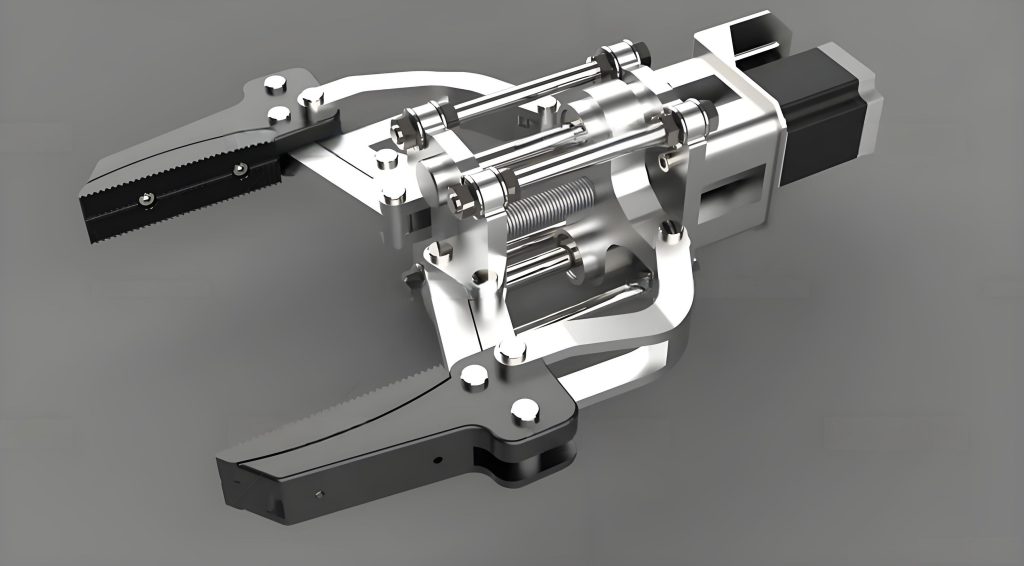
The overall structure of the end effector consists of several key components: the seedling needles, needle plates, finger cylinders, sliders, cam shafts, couplings, and stepper motors. The stepper motor provides the driving force, and through programmable logic controller (PLC) coordination, it enables precise angular position control. The cam shaft, sliders, and guides form a spiral transmission pair, where the rotation of the cam shaft drives the sliders along the guides. These sliders are connected to the seedling fingers, allowing for dynamic adjustment of the spacing between five seedling fingers. The central cam groove is circular, while the other four cam grooves are symmetrically distributed. Each seedling finger comprises a pen-shaped cylinder, a seedling needle, and a needle plate. The pen-shaped cylinder’s piston extends or retracts to move the seedling needle up and down, facilitating the picking and placing of seedlings. This design ensures that the end effector can adapt to various plug tray specifications, such as 32-cell, 50-cell, and 105-cell trays, with plant spacing ranging from 41 mm to 67 mm.
To understand the operational workflow, let’s delve into the working principle of the end effector. Initially, the end effector is positioned above the source plug tray. The stepper motor activates, adjusting the spacing of the seedling fingers until they align with the cells of the source tray, as detected by limit switches. The end effector then descends to the picking position, and the pen-shaped cylinders extend the seedling needles into the seedling plugs. Upon lifting, the seedlings are extracted from the tray. The end effector is transported to the target tray, where the stepper motor readjusts the finger spacing to match the target cell positions. After descending, the seedlings are placed into the target cells, and the needles retract, completing the transplanting cycle. This process minimizes human intervention and maximizes efficiency, with the end effector ensuring precise and gentle handling of the cactus seedlings.
In designing the end effector, we carefully selected the driving components. Various driving methods were considered, including electromagnetic, hydraulic, pneumatic, and electric drives. Based on stability, applicability, compactness, responsiveness, design difficulty, and cost-effectiveness, we opted for an electric drive using a stepper motor. Specifically, we chose an 86 stepper motor set (model: 86 BYG250H) with a driver (model: MA860H) for its precise control and reliability in agricultural settings. The stepper motor allows for accurate angular displacement control, which is essential for the dynamic spacing adjustment via the cam mechanism. This choice aligns with the need for a robust and cost-effective solution in facility agriculture.
The transmission mechanism is a critical aspect of the end effector, enabling the dynamic plant spacing adjustment. We evaluated several mechanisms, such as cam drives, pulley调节 systems, linkage调节 systems, and塔轮调节 systems. After analysis, we selected a cam-driven mechanism due to its simplicity, smooth operation, flexibility in adjusting spacing, and low manufacturing cost. The cam mechanism consists of a cylindrical cam shaft with five封闭 cam grooves that guide the sliders. The cam grooves are designed with harmonic motion curves to ensure平稳 movement and minimize冲击. The equations for the cam curves are derived based on the required displacement ranges. For the inner symmetrical cam grooves, the curve is defined by: $$ x(t) = 20 \times \sin(\theta – 90^\circ) + 50 $$ where \( x(t) \) is the axial displacement in mm, and \( \theta \) is the cam shaft rotation angle in degrees (\( 0^\circ \leq \theta \leq 360^\circ \)). For the outer symmetrical cam grooves, the curve is: $$ x(t) = 40 \times \sin(\theta – 90^\circ) + 100 $$ These equations ensure that the sliders move smoothly between the minimum and maximum spacing positions, corresponding to the plug tray dimensions.
To determine the structural parameters of the cam mechanism, we conducted a force analysis. During operation, the cam shaft rotates, and the sliders interact with the cam grooves, producing axial motion. The forces involved include the cam torque \( T \), the normal force \( F_2 \) at the contact surface between the slider and cam groove, the axial thrust \( F_1 \), and the friction force \( F_3 \). The angle between \( F_2 \) and the vertical is denoted as \( \theta \). The equilibrium equations are: $$ \begin{cases} F_3 – \mu F_2 = 0 \\ F_1 + \mu F_2 – F_2 \sin \theta = 0 \\ F_2 \sin \theta + F_3 \cos \theta – \frac{T}{r} = 0 \end{cases} $$ where \( \mu \) is the coefficient of friction, and \( r \) is the cam shaft radius. Using these equations, we calculated the required torque and dimensions to ensure reliable operation without excessive wear. The cam shaft is made of 45 steel with a diameter of 50 mm, and the cam grooves have a depth of 4 mm and a width of 8 mm. This design withstands the operational stresses while maintaining精度.
The seedling fingers are the direct interface with the seedling plugs, and their design is paramount for successful transplanting. We chose a直插式 (direct-insertion) needle-type design over a夹持式 (clamping) design because it minimizes damage to the root ball. Each seedling finger consists of four symmetrically arranged needles made of aluminum alloy for lightweight and corrosion resistance. The key parameters of the needles include the inclination angle \( \varphi \), length \( L_1 \), upper diameter \( D_3 \), and lower diameter \( D_4 \). Based on the plug tray specifications, we derived the following constraints. The inclination angle must be greater than the tray cell angle to prevent piercing the cell wall: $$ \varphi \geq \arctan\left(\frac{D_1 – D_2}{2H_1}\right) = \beta $$ where \( D_1 \) is the upper cell diameter, \( D_2 \) is the lower cell diameter, \( H_1 \) is the cell height, and \( \beta \) is the cell棱线 angle. From measurements, for 32-cell, 50-cell, and 105-cell trays, \( \beta \) values are approximately 16.70°, 15.52°, and 14.03°, respectively. We set \( \varphi = 18^\circ \) to ensure safety. The needle length must not刺破 the tray bottom: $$ \frac{L_1}{\cos \varphi} \leq H_1 $$ Given the minimum cell height of 40 mm (for 105-cell trays), we selected \( L_1 = 36 \) mm. The needle diameters must fit within the cells: \( D_4 < D_2 \) and \( D_3 < D_1 \). Using typical values, we chose \( D_4 = 13 \) mm and \( D_3 = 33 \) mm. These parameters ensure that the end effector can handle various tray sizes without causing damage.
To validate the design, we performed motion simulations using UG and Adams software. We created a composite model of the seedling plug and end effector, applying constraints such as fixed joints, contact pairs, and rotational joints. The cam shaft was driven at a speed of 5°/s, and the simulation steps were set to 600. We analyzed the displacement and velocity curves for different transplanting scenarios, such as from 105-cell to 50-cell trays and from 105-cell to 32-cell trays. The simulation results showed that the end effector operates smoothly, with minimal vibration. However, slight velocity fluctuations and abrupt changes were observed during spacing adjustments, leading to冲击. We calculated the maximum contact stress using the simulation data and compared it with the allowable stress of the materials (200 MPa for 45 steel and 150 MPa for aluminum alloy). The results are summarized in the table below.
| Transplanting Scenario | Spacing Adjustment (mm) | Maximum Acceleration (m/s²) | Maximum Contact Stress (MPa) |
|---|---|---|---|
| 105-cell to 50-cell | 25 | 2.18 | 30.45 |
| 105-cell to 32-cell | 47 | 2.35 | 32.82 |
The contact stresses are well within the allowable limits, confirming the structural integrity of the end effector. The simulations also helped us optimize the cam profiles to reduce冲击, ensuring reliable performance during high-speed transplanting operations.
Following the design and simulation phases, we proceeded to experimental validation. We constructed a test platform for the automatic cactus transplanter, integrating the end effector. The experiments aimed to evaluate the performance based on seedling integrity rate \( P \) and transplant survival rate \( \eta \). The integrity rate is defined as: $$ P = \frac{m_1 – m_2}{m_1} \times 100\% $$ where \( m_1 \) is the total mass of seedling plugs before transplanting, and \( m_2 \) is the mass lost during transplanting. The survival rate is: $$ \eta = \frac{W_1 – W_2}{W_1} \times 100\% $$ where \( W_1 \) is the total number of seedlings transplanted, and \( W_2 \) is the number that died after 7 days. We used an orthogonal experimental design with four factors at three levels each, as shown in the table below.
| Level | Needle Inclination Angle (°) | Needle Length (mm) | Needle Insertion Speed (m/s) | Needle Lower Diameter (mm) |
|---|---|---|---|---|
| 1 | 19 | 32 | 0.4 | 11 |
| 2 | 19.5 | 32.5 | 0.5 | 12 |
| 3 | 20 | 33 | 0.6 | 13 |
We employed an L9(3^4) orthogonal array, conducting nine trials with multiple repetitions each. The results for seedling integrity and survival rates are presented in the following table.
| Trial | Factor A (Angle) | Factor B (Length) | Factor C (Speed) | Factor D (Diameter) | Integrity Rate (%) | Survival Rate (%) |
|---|---|---|---|---|---|---|
| 1 | 1 | 1 | 1 | 1 | 96.3 | 93.2 |
| 2 | 1 | 2 | 2 | 2 | 93.2 | 92.5 |
| 3 | 1 | 3 | 3 | 3 | 91.5 | 91.8 |
| 4 | 2 | 1 | 2 | 3 | 92.3 | 91.2 |
| 5 | 2 | 2 | 3 | 1 | 89.7 | 89.7 |
| 6 | 2 | 3 | 1 | 2 | 93.7 | 95.8 |
| 7 | 3 | 1 | 3 | 2 | 90.2 | 87.3 |
| 8 | 3 | 2 | 1 | 3 | 92.6 | 91.5 |
| 9 | 3 | 3 | 2 | 1 | 88.6 | 90.3 |
We performed range analysis to determine the optimal parameter combination and the influence of each factor. For the integrity rate, the average values for each factor level are calculated as follows. Let \( E_{ij} \) denote the average integrity rate for factor \( i \) at level \( j \), and \( F_i \) be the range for factor \( i \). The results are:
| Factor | E1 (%) | E2 (%) | E3 (%) | F |
|---|---|---|---|---|
| A (Angle) | 92.50 | 92.23 | 89.70 | 3.82 |
| B (Length) | 90.57 | 91.23 | 92.63 | 3.05 |
| C (Speed) | 93.50 | 91.33 | 89.60 | 3.90 |
| D (Diameter) | 91.06 | 91.87 | 91.50 | 0.81 |
For the survival rate, the average values are:
| Factor | E1 (%) | E2 (%) | E3 (%) | F |
|---|---|---|---|---|
| A (Angle) | 93.67 | 91.90 | 90.47 | 3.20 |
| B (Length) | 92.93 | 91.83 | 91.27 | 1.65 |
| C (Speed) | 94.20 | 91.37 | 90.47 | 3.73 |
| D (Diameter) | 91.53 | 92.37 | 92.13 | 0.60 |
The range analysis indicates that for integrity rate, the optimal combination is A1, B1, C1, D2, with factor C (insertion speed) having the greatest influence. For survival rate, the optimal combination is A1, B3, C1, D2, with factor C again being most significant. Considering that longer needles provide better stability without piercing the tray bottom, we selected B3 (33 mm). Thus, the overall optimal parameters are: needle inclination angle of 19°, needle length of 33 mm, needle insertion speed of 0.4 m/s, and needle lower diameter of 12 mm. This end effector configuration ensures both high integrity and survival rates.
To verify these findings, we conducted additional validation experiments using 10 trays of 105-cell cactus seedlings. The end effector was set to the optimal parameters, and transplanting was performed to both 50-cell and 32-cell trays. The results showed an average seedling integrity rate of 93.67% and a survival rate after 7 days of 91.83% for transplanting to 32-cell trays, with similar results for 50-cell trays. These outcomes confirm that the end effector operates effectively under the optimized conditions, meeting the requirements for automated cactus transplanting.
In conclusion, our design of an adjustable end effector for cactus automatic transplanting addresses key limitations in existing equipment. The end effector features a cam-driven mechanism for dynamic plant spacing adjustment, pneumatic needle actuators for gentle handling, and optimized parameters based on rigorous analysis and experimentation. The simulations demonstrated smooth operation with acceptable stress levels, while the orthogonal experiments identified optimal settings that maximize seedling integrity and survival. This end effector not only enhances transplanting efficiency but also reduces labor dependency, making it a valuable tool for modern agriculture. Future work could focus on scaling the design for other crops or integrating advanced sensors for real-time monitoring. Overall, the end effector represents a significant step forward in the automation of horticultural processes, particularly for delicate plants like cacti.
Throughout this project, we emphasized the importance of the end effector as a core component of the transplanter. By repeatedly refining the design and testing various configurations, we ensured that the end effector meets practical demands. The use of engineering software for simulation and statistical methods for optimization proved invaluable in achieving high performance. We believe that this end effector can be adapted to similar transplanting tasks, contributing to broader advancements in agricultural robotics. The successful integration of mechanical design, control systems, and experimental validation underscores the potential for automated solutions in facility-based farming. As we continue to develop this technology, the end effector will remain a focal point for innovation, driving improvements in precision, speed, and reliability for plant transplanting operations worldwide.