
In recent years, the development of dexterous robotic hands has garnered significant attention due to their potential applications in industrial automation, healthcare, and service robotics. Traditional multi-finger dexterous robotic hands often suffer from high complexity, numerous actuators, and excessive weight, which limit their practical deployment. Moreover, during grasping tasks, the actuators typically operate in a stalled state, leading to overheating and reduced lifespan. Additionally, the inability to accurately perceive object pose and apply appropriate grasping forces remains a challenge. To address these issues, we propose a novel underactuated finger structure with self-locking capabilities, alongside tendon transmission mechanisms with varying load capacities. This article presents the design, sensor integration, and experimental validation of a series of dexterous robotic hands, including two-finger, three-finger, and five-finger configurations. We focus on enhancing the adaptability, reliability, and cost-effectiveness of dexterous robotic hands through innovative mechanical design and sensor development.
The core innovation lies in the underactuated finger design, which reduces the number of actuators while enabling adaptive grasping of objects with irregular shapes. Our dexterous robotic hand incorporates high-sensitivity, low-cost force and tactile sensors to facilitate precise force control and slip detection. In this work, we detail the structural design, kinematic analysis, and experimental results, demonstrating the effectiveness of our approach. The dexterous robotic hand showcases improved performance in terms of weight reduction, grasping stability, and energy efficiency, making it a promising solution for real-world applications.
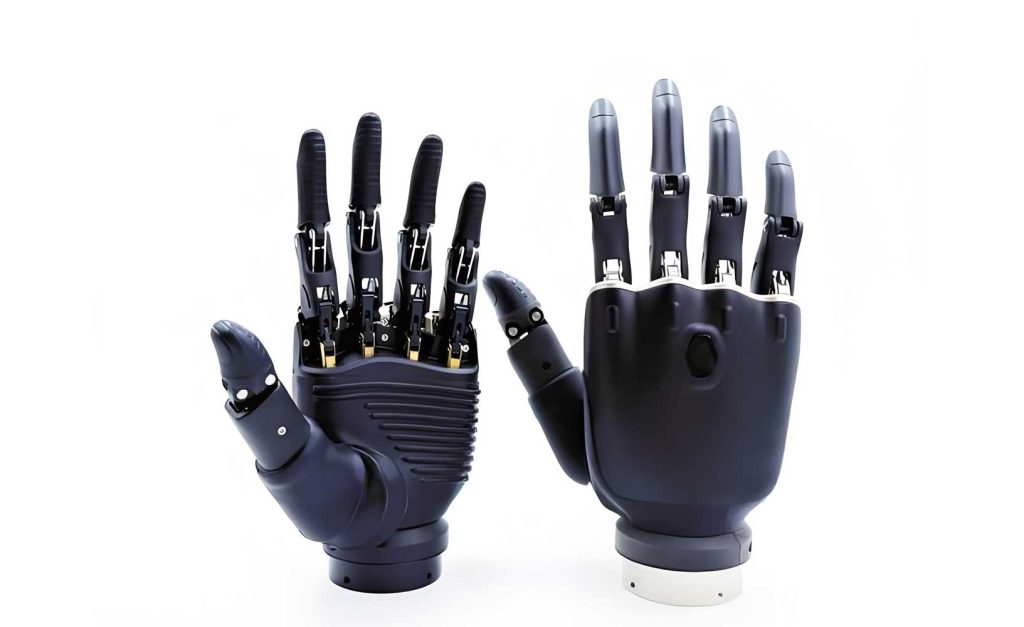
Our dexterous robotic hand finger structure is based on an underactuated mechanism that utilizes a worm-gear system for self-locking and high reduction ratios. This design ensures that during grasping, the actuators can be disengaged, reducing energy consumption and heat generation. The finger consists of two joints: a proximal joint and a distal joint, coupled through a tendon-driven system. The actuation is provided by a brushed servo motor, which drives a gear train connected to worm-gear sets. The kinematic relationship between the joints is derived as follows: let $\omega_0$ be the angular velocity of the motor output gear, $i_1$ the gear ratio between gears G1 and G2, $i_2$ the ratio between G2 and G3, $i_3$ the ratio between G2 and G4, $i_4$ the worm-gear ratio, and $i_5$ the tendon transmission ratio. The angular velocity of the proximal joint $\omega_1$ and distal joint $\omega_2$ are given by:
$$\omega_1 = \omega_0 i_1 i_2 i_4$$
$$\omega_2 = \omega_0 i_1 i_3 i_4 i_5$$
Thus, the coupling ratio is:
$$\frac{\omega_1}{\omega_2} = \frac{i_2}{i_3 i_5}$$
For our design, $i_2 = 0.52$, $i_3 = 0.62$, and $i_5 = 1.11$, resulting in $\omega_1 / \omega_2 = 1/1.326$. This allows the proximal joint to rotate from $0^\circ$ to $140^\circ$ and the distal joint from $0^\circ$ to $45^\circ$, enabling a wide range of grasping postures for the dexterous robotic hand.
The underactuation is achieved through a disengagement mechanism involving a disc spring. When the finger contacts an object, the torque increases until it exceeds a pre-set threshold, causing the gear to slip relative to the shaft. This allows the distal joint to continue moving independently, adapting to object geometry. The tendon transmission uses a steel cable (7×7 specification, 0.5 mm diameter) for compactness and high stiffness. For higher load capacities, we developed enhanced tendon transmission structures with robust clamping mechanisms. The efficiency of the finger drive system is critical for performance. The overall efficiency $\eta$ is calculated as the product of gear transmission efficiency $\eta_1$, tendon efficiency $\eta_2$, and worm-gear efficiency $\eta_3$:
$$\eta = \eta_1 \eta_2 \eta_3$$
where $\eta_1 = 0.9025$ (for two-stage gear transmission), $\eta_2 = 0.96$, and $\eta_3 = 0.34$ (based on friction coefficients and lead angles). Thus, $\eta \approx 0.295$. The total reduction ratio $i$ is:
$$i = i_1 i_2 i_3 i_4 = 157.7$$
Hence, the output torque $T$ at the fingertip is related to the motor torque $T_1$ by:
$$T = T_1 i \eta$$
This design ensures that the dexterous robotic hand finger can deliver sufficient force while maintaining compact dimensions.
We extended the finger design to various configurations of dexterous robotic hands. The two-finger dexterous robotic hand comprises two opposed modular fingers with independent drives, offering four joints (two active and two passive). This configuration is suitable for precision grasping tasks. The three-finger dexterous robotic hand features one fixed finger and two rotational fingers that can synchronously rotate up to $180^\circ$, providing four degrees of freedom. This design enhances versatility for handling objects of different shapes. The five-finger dexterous robotic hand mimics human hand anatomy, with three-joint fingers and a palm structure. Each finger uses a cross-linkage mechanism for joint coupling, and the thumb includes a worm-gear for abduction. The joint ranges are summarized in the table below:
| Finger Name | Distal Joint (°) | Middle Joint (°) | Proximal Joint (°) |
|---|---|---|---|
| Index | 65 | 52 | 78 |
| Middle | 65 | 52 | 78 |
| Ring | 65 | 52 | 78 |
| Little | 65 | 52 | 78 |
| Thumb | 90 | 52 | 37 |
These configurations allow the dexterous robotic hand to perform a variety of grasping modes, such as parallel, pinch, and enveloping grasps.
Sensor integration is crucial for the dexterous robotic hand to perceive interaction forces and detect slip. We developed a one-dimensional bidirectional force sensor based on strain gauges mounted on a cantilever beam within the tendon tensioning mechanism. The output voltage $e$ of the Wheatstone bridge circuit is:
$$e = \frac{1}{2} K E \epsilon$$
where $K$ is the gauge factor, $E$ is the excitation voltage, and $\epsilon$ is the strain. The strain is related to the fingertip torque $T$ and tendon support distance $D$ through geometric analysis. For a given $D$, the output $e$ is linear with $T$:
$$e = \rho T D$$
where $\rho$ is a constant. This sensor enables real-time monitoring of grasping forces in the dexterous robotic hand.
Additionally, we designed a tactile sensor with three elastic arms and foil strain gauges to detect object slip. When an object slips, the strain signals become inconsistent, triggering force adjustment. The sensor’s sensitivity was validated through finite element analysis, showing that under loads from 20 N to 50 N, the strain varies linearly with force. For slip detection, non-uniform strain patterns indicate instability, allowing the dexterous robotic hand to react promptly.
To evaluate the performance of our dexterous robotic hand, we conducted a series of experiments using a three-finger prototype. First, we tested the tendon transmission stability under static and dynamic loads. Five tendon mechanisms were subjected to a 2.5 kg load for 17 hours, and the cable displacement was measured. The results showed minimal movement (≤0.5 mm in only 2 out of 40 tests), confirming reliability. Dynamic load testing with cyclic loads from 25 N to 36 N over 100 cycles revealed no slippage or wear, demonstrating robustness for the dexterous robotic hand.
Next, we calibrated the one-dimensional force sensor by applying loads from 1 N to 30 N at different support distances $D$ (1 mm, 1.5 mm, 2 mm). The output voltage versus load curves are linear, as shown in the table below for average values over five trials:
| Load (N) | Output at D=1mm (V) | Output at D=1.5mm (V) | Output at D=2mm (V) |
|---|---|---|---|
| 1 | 0.12 | 0.18 | 0.24 |
| 5 | 0.60 | 0.90 | 1.20 |
| 10 | 1.20 | 1.80 | 2.40 |
| 15 | 1.80 | 2.70 | 3.60 |
| 20 | 2.40 | 3.60 | 4.80 |
| 25 | 3.00 | 4.50 | 6.00 |
| 30 | 3.60 | 5.40 | 7.20 |
The linearity confirms the sensor’s accuracy for force feedback in the dexterous robotic hand.
We also measured the drive system efficiency by applying input torques from 0.01 N·m to 0.03 N·m and recording output torques. The average efficiency was approximately 32.63%, close to the theoretical value of 29.5%. The results are summarized below:
| Input Torque (N·m) | Average Output Torque (N·m) | Efficiency (%) |
|---|---|---|
| 0.01 | 0.461 | 29.3 |
| 0.015 | 0.803 | 34.0 |
| 0.02 | 1.060 | 33.5 |
| 0.025 | 1.292 | 32.8 |
| 0.03 | 1.573 | 33.2 |
This validates the design calculations for the dexterous robotic hand transmission.
Motion precision was assessed by analyzing the repeatability of finger positioning. Using encoders with 4096 lines on the joint and 2048 lines on the motor, we controlled the finger to move at various speeds. The relationship between motor speed $x$ (in rpm) and joint overshoot angle $F(x)$ (in degrees) after stopping was fitted to:
$$F(x) = -1.2215 \times 10^{-10} x^3 + 1.4712 \times 10^{-6} x^2 – 1.6015 \times 10^{-3} x + 0.4841$$
To achieve a control precision of ±0.1°, we implemented a motion planning profile with acceleration, constant velocity, deceleration, low-speed, and stop phases. Experiments on three finger prototypes showed an average positional deviation of ±0.13 mm at the fingertip, equivalent to ±0.06° at the proximal joint, meeting the precision requirement for the dexterous robotic hand.
Finally, we conducted grasping stability tests with objects of different shapes: a rectangular block, a sphere, and an irregular cylinder. Each object was grasped 10 times. The dexterous robotic hand successfully performed parallel grasps on the block, pinch grasps on the sphere, and enveloping grasps on the cylinder, with only two failures due to the lightweight irregular cylinder tipping over. After adding water to increase weight, all grasps were stable. This demonstrates the adaptability and reliability of our dexterous robotic hand in real-world scenarios.
In conclusion, our underactuated dexterous robotic hand design effectively reduces actuator count and weight while enabling adaptive grasping. The tendon transmission mechanisms offer scalable load capacity, and the integrated sensors provide accurate force perception at low cost. Experimental results confirm high stability, precision, and grasping performance. Future work will focus on enhancing the dexterous robotic hand with advanced control algorithms and broader application testing. This research contributes to the development of practical, efficient, and cost-effective dexterous robotic hands for diverse robotic systems.
The dexterous robotic hand represents a significant step forward in robotic manipulation, combining mechanical innovation with sensor technology. By leveraging underactuation and self-locking principles, we have created a dexterous robotic hand that balances complexity and functionality. The modular design allows for customization into two-finger, three-finger, and five-finger configurations, catering to various tasks. The use of strain-based sensors ensures responsive feedback without prohibitive costs. Overall, this dexterous robotic hand platform holds promise for advancing robotics in fields such as manufacturing, healthcare, and autonomous services. Continued refinement of the dexterous robotic hand will further unlock its potential, making it an indispensable tool for future robotic applications.
Throughout this study, the dexterous robotic hand has been the central focus, driving innovations in structure, sensing, and control. The integration of underactuated fingers with high-efficiency transmissions enables the dexterous robotic hand to perform delicate tasks with minimal energy consumption. The sensor suite empowers the dexterous robotic hand with tactile intelligence, allowing for safe interaction with objects and environments. As robotics evolves, the dexterous robotic hand will play a crucial role in bridging the gap between human-like dexterity and machine reliability. We believe that our contributions to the dexterous robotic hand field will inspire further research and development, ultimately leading to more capable and accessible robotic systems worldwide.